
Amazon FBA inspection red flags are the product, packaging, barcode, labeling, prep, and quality issues that can cause receiving problems, stranded inventory, customer returns, or marketplace damage after the shipment reaches Amazon. Sellers should catch these issues before shipment because FBA is a fulfillment channel, not a substitute for supplier quality control.
For Amazon sellers, a product can fail in more than one way. It can fail Amazon receiving because the barcode is wrong. It can fail prep expectations because the unit is loose, unprotected, or not marked as a set. It can pass receiving but still fail commercially because customers return it, complain, or leave poor reviews. A pre-shipment inspection should cover both Amazon-handling requirements and customer-facing quality.
The key is to inspect before the product leaves the factory or prep point. Once inventory is in the FBA flow, correction becomes slower and more expensive. Sellers may face relabeling, removal orders, stranded inventory, delayed launch, return spikes, or listing health issues. The best FBA inspection checklist prevents those problems before cartons move.
- Amazon receiving risk: wrong barcode, exposed old barcode, wrong carton or set handling.
- Prep risk: loose, fragile, sharp, bagged, bundled, or case-packed goods not prepared correctly.
- Quality risk: defects that customers see after FBA fulfills the order.
- 2026 reminder: do not rely on Amazon to fix prep or labeling gaps for US FBA shipments.
The Direct Answer
Amazon sellers should inspect FBA shipments for barcode accuracy, packaging security, set labeling, SKU consistency, prep readiness, compliance labels, and customer-visible defects before releasing the shipment.
Amazon Seller Central public guidance explains that FBA units need barcodes and discusses manufacturer barcodes, Amazon barcodes, and Transparency codes. See Amazon's barcode discussion here: FBA barcode types and requirements.
Amazon Seller Central packaging guidance also emphasizes secure packaging, set labeling, and covering outside barcodes that should not be scanned. See the public Amazon discussion here: preparing inventory for Amazon FBA.
A 2026 operational point matters for US sellers: a public Seller Central discussion states that Amazon will no longer offer prep and item labeling services for US FBA shipments starting January 1, 2026. Sellers should confirm current account-specific terms in Seller Central, but the practical inspection takeaway is clear: factory-side and seller-side prep evidence matters more. Source: FBA prep services discussion.
8 Amazon FBA Inspection Red Flags
The red flags below should be checked before final payment, shipment release, or FBA delivery planning.
#1 Wrong or missing barcode
Every FBA unit needs the correct scannable identifier. Wrong FNSKU, UPC confusion, missing label, or unscannable placement can create receiving problems.
#2 Old scannable barcode still exposed
Existing outside barcodes should be removed, covered, or made unscannable so the wrong code is not scanned during receiving.
#3 Set not marked as a set
Products sold as one unit should be packaged together and marked clearly so fulfillment teams do not separate components.
#4 Loose or unsecured unit
Units should be contained in a secure package. Loose sleeves, pouches, parts, or accessories can create damage and receiving issues.
#5 Fragile, sharp, or glass item underprepared
Products that can break, cut, leak, or damage other goods need suitable packaging before they reach FBA.
#6 Mixed SKU or case-pack inconsistency
Cartons with mismatched SKU, condition, or quantity can fail receiving logic and create inventory errors.
#7 Label or product claim mismatch
Product title, label, warning, material claim, model number, or country-of-origin mark should match the listing and compliance file.
#8 Visible quality defect likely to drive returns
FBA can receive a product and still leave the seller with returns, bad reviews, or account risk if customers reject the item.
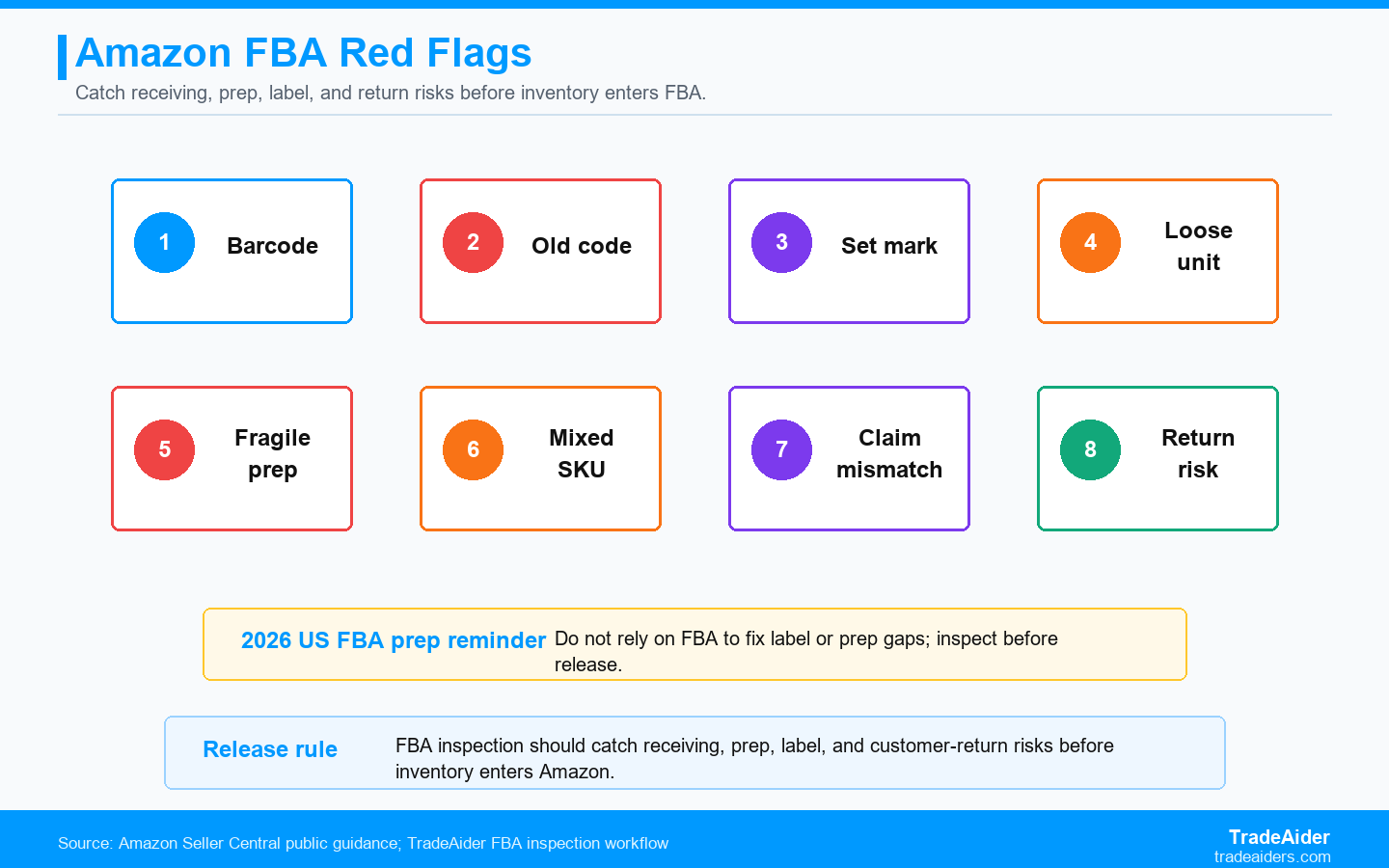
FBA inspection should catch receiving, prep, label, and customer-return risks before inventory enters Amazon.
FBA Red Flag Decision Table
Not every red flag requires the same response; severity depends on receiving impact and customer impact.
| Red Flag | Amazon-Side Risk | Customer-Side Risk | Pre-Shipment Action |
|---|---|---|---|
| Barcode wrong or missing | Receiving scan problem or inventory mismatch | Wrong seller attribution or delayed availability | Relabel and rescan before shipment |
| Exposed old barcode | Wrong code may be scanned | Inventory confusion | Cover or remove incorrect barcode |
| Set not marked | Components may be separated | Customer receives incomplete unit | Package together and mark as set |
| Loose or unsecured unit | Prep or damage issue | Broken or missing parts | Secure, bag, band, or protect |
| Mixed SKU carton | Receiving quantity or SKU error | Wrong item shipped to buyer | Sort cartons and verify packing list |
| Visible defect pattern | May be received but becomes return risk | Returns and reviews | Rework, sort, reinspect, or hold |
This table shows why FBA inspection is not just a barcode check. A barcode problem can block receiving, but a quality problem can pass receiving and still damage the seller's account economics. The inspection should cover both operational acceptance and customer acceptance.
Where TradeAider Fits In FBA Inspection
TradeAider fits before the shipment enters the FBA flow, when the seller can still correct issues at source.
TradeAider's e-commerce quality solutions are relevant when sellers need to verify FBA-ready packaging, SKU match, label placement, accessory completeness, carton marks, and visible product quality before release.
For finished goods, Pre-Shipment Inspection can check the lot before final payment and shipment. If the supplier is still producing and the seller has seen repeat defects, During Production Inspection can catch packaging or assembly drift earlier.
The business fit is simple: TradeAider helps Amazon sellers catch FBA receiving and customer-return risks while the factory can still relabel, repack, sort, replace, or rework. That is cheaper than discovering the problem after inventory is already in a fulfillment network.
What To Put In An FBA Inspection Checklist
The checklist should match both Amazon handling rules and the seller's product promise.
The first checklist layer is identity: SKU, ASIN reference, FNSKU or manufacturer barcode decision, barcode placement, scannability, label text, carton marks, and packing list. The inspector should photograph the unit label, carton label, retail package, and any barcode that should be covered.
The second layer is prep: unit packaging, set labeling, poly bag or secure closure where needed, protection for fragile or sharp goods, accessory containment, suffocation warning where applicable, and carton packing method. The seller should provide the exact prep rules from Seller Central and any account-specific shipment plan requirements.
The third layer is customer quality: function, appearance, completeness, instruction insert, warning text, model number, size, color, material claim, and sample match. A product can satisfy receiving but still fail the business if customers reject it. This is where FBA inspection must behave like a quality-control process, not only a warehouse-prep check.
How To Inspect FBA Readiness At The Factory
The inspector should verify the unit, the carton, the shipment plan, and the customer-facing product together.
Start at the unit level. The inspector should photograph the sellable unit from multiple sides, check that the barcode is present and scannable, confirm that irrelevant barcodes are covered, verify that accessories are contained, and compare label text to the seller's files. If the item is a set, the sellable unit should be physically packaged as a set before it is counted as ready.
Then check the carton level. Carton marks, SKU, quantity, condition, weight, and shipment references should match the packing list and shipment plan. Case-packed goods should not mix SKUs, conditions, or quantities unless the shipment plan specifically allows that structure. Mixed cartons are one of the easiest factory mistakes to miss and one of the most frustrating receiving problems to solve later.
Next, check handling risk. Fragile, sharp, glass, liquid, heavy, bundled, or accessory-heavy products should be packaged so they can survive transit and fulfillment handling. The inspector should not merely ask whether the supplier packed carefully. The report should show photos of the packaging method, closure, cushioning, warning label, and sample product condition after handling checks when relevant.
| Inspection Layer | What To Verify | Photo Evidence | Release Risk |
|---|---|---|---|
| Unit identity | FNSKU, UPC/EAN decision, label text, scannability | Close-up barcode and retail pack | Receiving mismatch |
| Unit prep | Set label, bagging, closure, accessory containment | Full sellable unit photo | Prep failure or missing parts |
| Carton control | SKU, quantity, carton mark, old barcode covered | Carton sides and labels | Warehouse receiving error |
| Customer quality | Function, finish, completeness, insert, warning | Defect and sample-match photos | Returns and reviews |
The buyer should also tell the inspector what Amazon will not know from the label alone. If the product has a known return driver, such as missing screws, weak adhesive, color mismatch, or poor assembly, that must be in the inspection checklist. FBA readiness is operational and commercial at the same time.
SPAR Scenario: The Shipment Would Have Reached FBA Wrong
The issue was small at the factory and expensive after receiving.
Situation: A private-label seller prepares 4,000 kitchen organizers for US FBA. The supplier says the retail units are packed and asks for final balance.
Problem: TradeAider PSI finds that one color uses the old FNSKU label, several cartons expose a supplier logistics barcode, and the accessory bag is loose inside part of the sampled units. The product itself looks good, but the FBA risk is real.
Action: The seller holds release, requires relabeling, covers the outside logistics barcode, secures the accessory bag, and asks for reinspection photos before shipment.
Result: The shipment is delayed two days but avoids FBA receiving confusion and customer complaints about missing accessories. The seller updates the next PO with barcode and accessory-pack checkpoints.
Action Card: FBA Inspection Before Shipment
Treat FBA readiness as a release condition, not as warehouse cleanup.
- Provide the inspector with the shipment plan, SKU list, FNSKU or barcode rules, carton marks, and prep requirements.
- Check that old or irrelevant outside barcodes are covered or made unscannable.
- Verify that sets are packaged together and marked clearly as one sellable unit.
- Inspect fragile, sharp, loose, bundled, or accessory-heavy products for secure prep.
- Do not release goods with visible defects that are likely to create returns, even if Amazon could receive them.
After each FBA inspection, sellers should update the supplier checklist. If a barcode was wrong once, require pre-production label proof and final scan photos next time. If accessories were loose, add accessory containment to the packing instruction. The goal is to make the next shipment easier to pass before it reaches FBA.
Sellers should also archive the inspection report with the shipment plan and receiving records. If inventory later becomes stranded or returns spike, that file helps separate factory quality problems from fulfillment, listing, or customer-use problems.
If you are preparing an Amazon FBA shipment, send TradeAider the SKU list, FNSKU/barcode files, shipment plan notes, packaging photos, prep rules, defect history, and final payment date. The next step is to ask TradeAider to inspect the FBA shipment before it enters Amazon's fulfillment flow.
Frequently Asked Questions
Can Amazon fix my FBA labels or prep problems?
Sellers should not rely on that. Public Seller Central discussions indicate US FBA prep and item labeling services are being discontinued from January 1, 2026, and sellers should confirm current account-specific rules in Seller Central.
Is barcode checking enough for FBA inspection?
No. Barcode checking is essential, but FBA inspection should also cover set labeling, secure packaging, SKU consistency, carton marks, prep readiness, and customer-visible quality.
Should I inspect products before sending to a prep center?
Yes, when supplier quality risk is meaningful. A prep center may handle labels or packaging, but it may not solve product defects, wrong components, or factory workmanship problems.
Can TradeAider inspect Amazon FBA products in China?
Yes. TradeAider can inspect finished goods, packaging, labels, cartons, accessories, and visible quality before shipment when those checks are included in the FBA inspection checklist.
Related Articles

Grow your business with TradeAider Service
Click the button below to directly enter the TradeAider Service System. The simple steps from booking and payment to receiving reports are easy to operate.

