
- About Us

- Our Services
- Your Industry
- Resources
- News & Blog
Apparel quality control testing combines laboratory tests on materials with on-site checks of the finished garment, and both are measured against a written specification before a garment ships. A complete program covers what each test category answers, which standards set the method, how to build a test plan from the garment's risks, how sampling and acceptance decisions work, and which records support a release. A buyer can follow that path to build a matched test plan instead of a copied list.
What Apparel Quality Control Testing Is and Why It Matters
Apparel quality control testing is the combined use of laboratory tests on materials and on-site checks of the finished garment to verify a product against a written specification before it ships. The two halves answer different questions, and a complete program treats them as one evidence path rather than two separate services. Testing matters because a garment carries promises: a care label, a fiber content, a performance claim and a safety requirement, and each one has to be supported before the order is released.
When a claim is not supported, the cost lands after the goods leave the factory. A dye that bleeds in the wash becomes returns and negative reviews; a care instruction that damages the garment becomes a care-label complaint; an unsupported fiber content or a missed substance limit can trigger a recall or a market rejection. None of those outcomes is visible in a unit that looks correct on the table, which is why testing is a document and decision exercise as much as a physical one.
Because a buyer cannot run every test in house, the records matter as much as the units. When a brand shares a specification, a material list and existing reports with an outside provider, the engagement should make clear who performs which test and who keeps the evidence. For information about the organization handling a proposed test scope, review TradeAider's company background.
Inspection Checks and Laboratory Tests Are Different Evidence
An on-site inspection compares goods with an agreed checklist, while a laboratory test measures a material against a named method, so the two produce different evidence and should not be merged into one result. An inspector can confirm that a seam matches the approved sample, that the label is attached and legible, and that the packing count is correct; a laboratory measures how the fabric behaves under a defined condition.
Keeping the two separate keeps each result interpretable. A checklist item such as a seam that looks intact is a judgment against an agreed standard, while a seam-strength figure is a measurement against a method, and combining them into a single pass or fail hides which one failed. The rest of the program keeps the two apart, so a test result and an inspection finding can each be traced to the question they answer.
The Main Types of Apparel Quality Control Testing
The main apparel test categories each reproduce a different stress, so the category a buyer needs follows from the risk rather than from the product category. Physical and mechanical tests apply a load; colorfastness and dimensional-change tests apply water, heat, light or friction; and flammability and substance tests apply a safety rule to the product and its parts.
| Category | Risk it answers | Method or rule that sets it | Evidence it produces |
|---|---|---|---|
| Physical and mechanical | A seam or fabric that splits, tears or pills under load | ASTM D5034 breaking strength, ASTM D1424 tear strength, seam and abrasion tests | A measured strength or surface result against a limit |
| Colorfastness and dimensional change | A dye that bleeds or a fabric that shrinks after washing | A wash, rub, light or sweat method that names the cycle | A color-change or shrinkage result for a stated cycle |
| Flammability | A fabric that burns too fast for its surface type | 16 CFR 1610 for clothing textiles; sleepwear standards for children | A burn-time or char-length class against the rule |
| Restricted substances | A part that carries a limited substance | 15 U.S.C. 1278a lead limit for children's products; REACH for the EU | A substance result for the tested parts |
| Label and care | An unsupported claim printed on the label | FTC fiber and origin rules; the FTC Care Labeling Rule | Label and care evidence tied to the garment |
Read the table as a map, not a menu. Each row answers a different question, and a plan that covers the risks in the second column can stay short while still covering the garment. The sections below explain what each category measures, which rule sets the method, and how the results feed a release decision.
Physical and Mechanical Tests
Physical and mechanical tests apply a load to the fabric or the seam, so the method has to match the fabric structure and the stress the garment will meet. Breaking strength, tear strength, seam strength, abrasion and pilling are separate properties, and a single general strength test does not cover them.
Breaking strength is measured to a named method. ASTM D5034 covers the grab and modified grab procedures for the breaking strength and elongation of most textile fabrics, and the standard notes that it is not recommended for knitted and other high-stretch fabrics, which it defines as more than 11% stretch. Ordering that method for a stretch knit would produce a result that does not describe how the garment behaves.
Tear resistance is a different property. ASTM D1424 covers the tearing strength of fabrics by a falling-pendulum apparatus, which answers how a fabric resists a tear once it starts rather than how much force it takes to break. Read the method name against the risk before you order the test, and record the fabric version the result describes.
Colorfastness and Dimensional Change
Colorfastness is how well a dyed or printed material keeps its color under washing, rubbing, light or sweat, and dimensional change is how much a fabric shrinks or grows under a stated wash and dry cycle. Both reproduce a condition, so the method must name the cycle or the exposure it applies.
That condition is what makes two reports comparable. A shrinkage figure without a stated procedure cannot be compared with another report, even when both numbers look precise, and a color-change grade without the wash cycle or the light exposure cannot support a care claim. Record the exact fabric version and the cycle with the result, so a later mill or dye lot is not treated as covered by an earlier number.
Flammability and Restricted-Substance Tests
Flammability and restricted-substance limits attach to the product and its parts, so they are a separate mandatory evidence line and a passing performance test does not establish substance compliance. A colorfastness report says nothing about lead, and a lead result says nothing about whether a dye bleeds.
16 CFR 1610 provides methods of testing the flammability of textiles intended for apparel and establishes three classes of flammability. The method holds a specimen at a 45-degree angle, applies a flame for one second, and records the time the flame takes to travel 127 mm, and plain-surface and raised-surface fabrics are not judged by the same criteria.
Substance limits apply to what the garment contains. Under 15 U.S.C. 1278a, a children's product that contains more lead than the limit is treated as a banned hazardous substance, and the limit covers accessible component parts such as trims, prints and fasteners. Keep the two lines on separate reports, and check that the sample and the components match the claim before you rely on an older result.
The Standards and Rules Behind Each Test
Standards and regulations fix the method and the acceptance criterion, so the test plan has to name the standard it relies on and keep the acceptance criteria separate from the method that measures them. An acceptance criterion is the measurable limit that decides whether a tested characteristic passes or fails. Keep the two apart; the inspection-standard guidance explains the criteria side, so the method and the criterion do not get merged into one ambiguous result.
Name the standard by its designation and year, and state the criterion the buyer will apply. A report that says only that strength passed cannot be checked against a purchase order, and a criterion that is never written down leaves the pass or fail decision open. The next two sections separate the rules that apply in the United States from the rules a destination market adds.
United States Rules That Apply to Apparel
Federal labeling requirements require most textile products to carry a label listing the fiber content, country of origin and the identity of the manufacturer or another responsible business, so the label is a claim the test plan should be able to support.
Care instructions are a second claim. The Care Labeling Rule requires manufacturers and importers to attach care instructions and to have a reasonable basis, such as reliable evidence, for every instruction and warning. A dryclean-only instruction warns that washing will harm the garment, so it needs evidence rather than habit.
Children's sleepwear adds a separate sampling rule. 16 CFR 1615 defines a fabric production unit as up to 5,000 linear yards for normal sampling and a garment production unit as up to 500 dozen finished garments, so one passing test does not cover an unlimited order and a new unit needs its own evidence.
International and Destination-Market Rules
Destination markets set their own substance and labeling rules, so the same garment can need different evidence for different destinations. In the European Union, REACH is the regulation adopted to improve the protection of human health and the environment from the risks posed by chemicals, and it restricts hazardous substances in products placed on the EU market.
Treat a destination-market substance limit as a separate line from a performance test, and confirm the current substance list and the product scope before you rely on an older report. Keep the destination attached to each report, so a later order does not inherit evidence that belongs to another market.
Build the Test Plan From the Garment's Risks
A test plan is built by listing the risks the garment creates, then attaching a method, a sample and an acceptance criterion to each one, so the plan stays short and every line changes a decision. Start with the fiber and finish, the construction and trims, the wearer and how the item is used, and the destination market, then write down the risk each input creates.
The order of the work matters. Write the specification and the acceptance criterion first, then name the method, then agree the sample. While the sampling inputs are still open, the AQL calculator can help set the sample size and the acceptance number before the goods are presented, so the plan and the sampling decision are fixed before a result arrives. A short plan that covers every open risk is more useful than a long list that leaves the highest risk untested.
Illustrative Example: A Sleepwear Order With Three Test Lines
A children's sleepwear brand sources a cotton-blend pajama set from a factory in China and places a first bulk order of 8,000 garments across three colors. The buyer has a generic test list from a previous supplier that covers colorfastness and pilling, and the bulk fabric is made at a different mill than the pre-production sample. The buyer plans to reuse the generic list and the previous report because the garment type looks the same, and does not connect the sleepwear rules or the new mill to the order.
The previous report covers colorfastness and pilling but does not cover sleepwear flammability or lead in the printed snap fasteners. The bulk fabric is a different mill and dye lot than the pre-production sample, so the earlier fabric result does not describe the goods.
The generic list measured fabric appearance, not the mandatory sleepwear and children's-product requirements, so a passing report would not support the release decision, and the changed mill means the earlier result does not cover the goods being shipped. Hold the release, rebuild the request as three matched lines covering flammability on the production unit, lead and trim screening, and laundering behavior, and state the material version and acceptance criteria before the laboratory reports.
The factory supplies fabric from the tested mill or the buyer orders the mandatory tests on the new production unit, and the printed fasteners are screened as accessible parts. Re-check that each report names the same material version and production unit as the goods, and confirm the mandatory lines pass before release. An illustrative apparel testing example, not measured client defect data, a supplier rating, or a compliance result.
Sampling, Samples, and Acceptance Decisions
Sampling and acceptance decisions bound what a result proves, so the buyer agrees the sample source, the sample count and the acceptance criterion before the test runs. A sampled result is a decision about the production unit, not proof about every unit, and the sample has to represent the goods it is meant to cover.
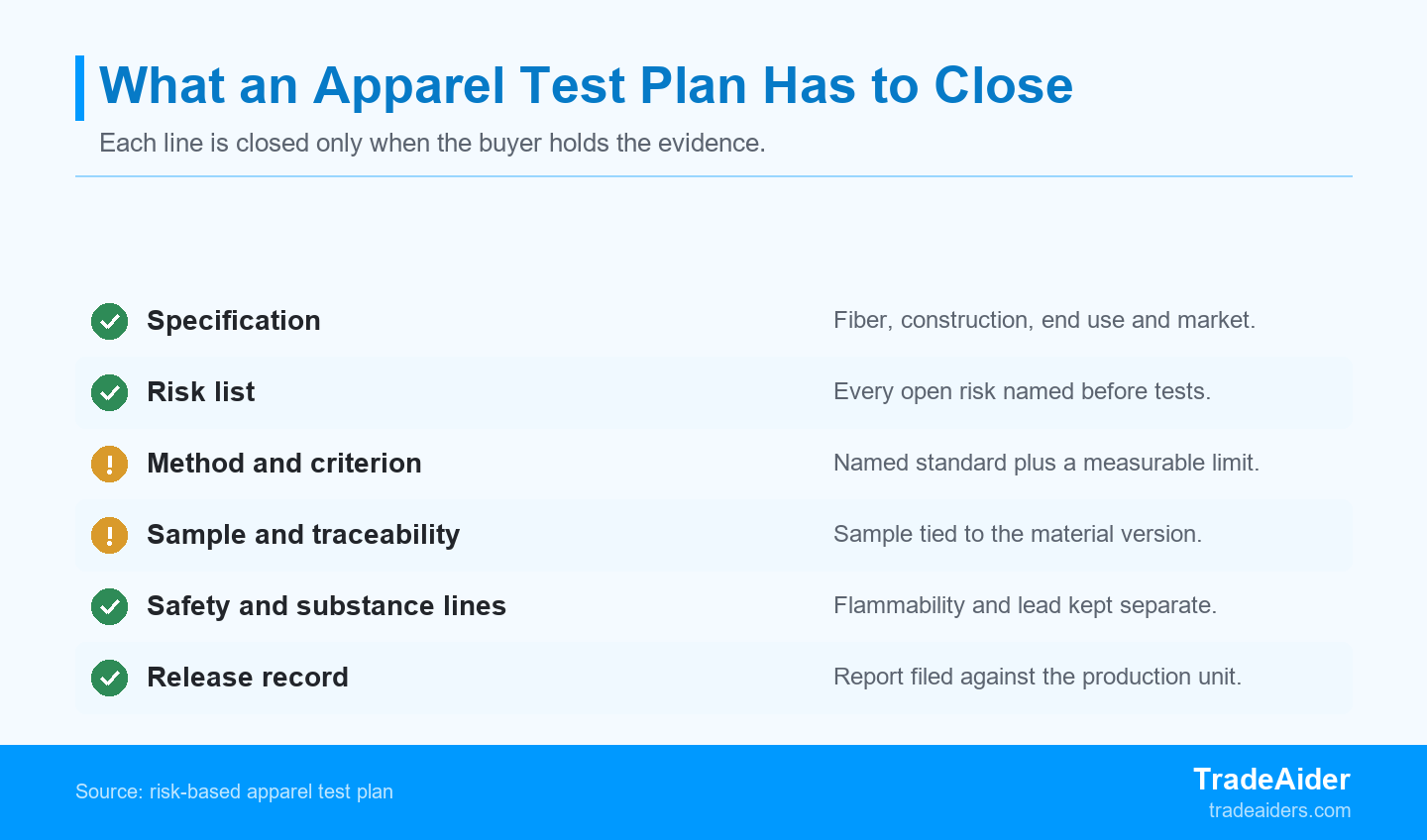
Each control is closed only when the buyer holds the evidence, so the specification, the method and the sample plan come before the result.
Decide who draws the sample and how it is identified, because a sample chosen by the supplier may not represent the production run. Agree whether it comes from bulk production or a pre-production run, how many units are drawn, and who records the identifiers, then keep the sample linked to the material version and the production unit. When an order needs a matched test set and a traceable sample handoff, review TradeAider's softline product testing process, which covers needs alignment, sample identification and traceability, testing, result determination, report issuance and filing.
Record, Report, and Improve
Records keep each result tied to the material version and the production unit, so a later question can be answered and a repeated finding can drive a correction rather than another sort. File the report with the sample identity, the method and its year, the acceptance criterion and the unit it covers.
The same record is what lets a buyer compare runs. When the same finding returns across a shift, a run or a mill change, the pattern points to the process, and the buyer can escalate from sorting units to a corrective action and then re-check the same characteristic to confirm the fix held. Keep the specification, the test reports, the inspection findings and the approved samples in one order file, and review the findings on a regular cadence so a repeated issue becomes a process change.
What to Do First
Send the specification, the end use, the destination market and the acceptance criteria with the request so the test set and the inspection scope can be reviewed together.
- Write the specification and the acceptance criteria before comparing quotes or ordering tests.
- Map each risk to a method and a criterion, and name the risk no line covers.
- Agree the sample source, the sample count and the acceptance criterion in writing.
- Keep the safety and substance lines on their own reports.
- File each report against the material version and the production unit it covers.
A scoped review needs the garment type and size range, the fiber, finish, construction and trims, the wearer and how the item is used, the destination markets and any existing reports, and the acceptance criteria you intend to apply. TradeAider can review those inputs, agree which tests and which on-site checks apply, and return a scoped proposal with an agreed test list, a sample plan and a reporting deliverable. To scope that work, contact TradeAider about your apparel test scope.
Frequently Asked Questions
How many tests does one garment need?
There is no fixed number, because the count follows the number of open risks created by the fiber, the construction, the end use and the destination market. Start with the risks and add a test only when its result would change a decision. A plain cotton T-shirt for a low-risk market may need two or three lines, while a children's sleepwear set may need flammability, substance and laundering evidence before it can ship.
Can I reuse a previous test report for a new order?
You can reuse a report only when the material version, the construction and the end use are unchanged, because a report covers the exact item and production unit that were tested. A new mill, a different dye lot, an added trim or a new color can change the result. Check that the report names the same method and the same material version as the goods you are shipping, and order a new test for any component the report does not cover.
What happens if a test result fails?
A failing line identifies a risk the garment does not yet meet, so hold the release and decide whether to change the material, the construction or the claimed use. Read the result against the acceptance criterion and the method, then confirm which production unit the sample represents. A failure can also point to a wrong sample rather than a wrong product, so check the material version and the test conditions before you reject a whole order.
Who should select the samples sent to the lab?
Agree on the sampling party and the sampling method in advance, because a sample chosen by the supplier may not represent the production run. Decide whether the sample comes from bulk production or from a pre-production run, how many units are drawn, and who records the identifiers. Keep the sample linked to the material version and the production unit, so the report can be traced back to the goods it is meant to cover.

Related Articles


Grow your business with TradeAider Service
Click the button below to directly enter the TradeAider Service System. The simple steps from booking and payment to receiving reports are easy to operate.

