
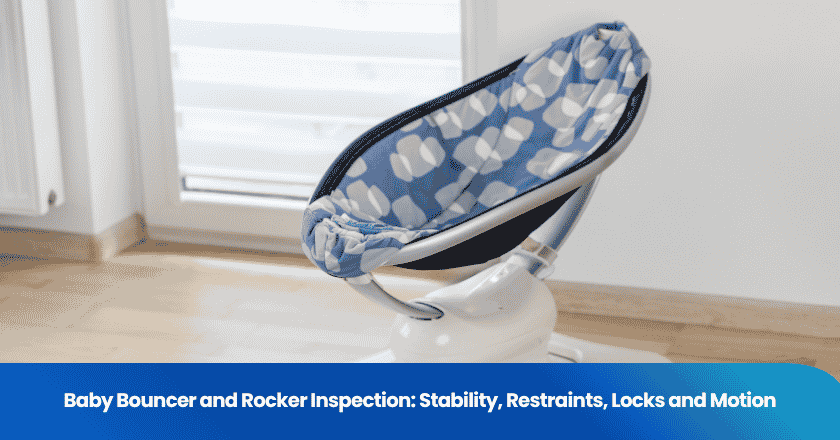
A baby bouncer and rocker inspection should check stability, restraint attachment, folding locks and the full range of movement on finished production units. Start with the checklist below, then use the model's applicable standard and instructions to set the test configuration and acceptance limits. A smooth rocking demonstration will help you spot interference, but it cannot replace a specified stability or restraint test.
Baby Bouncer and Rocker Inspection Checklist
Select units across the order's models, frame versions and production batches. Record the model, carton number, operating mode, recline setting and maximum recommended occupant weight. For each row, enter the measured result or mark the test not performed; do not leave an unchecked item looking like a pass.
| Area | What to do | What to compare | Result to fill in |
|---|---|---|---|
| Stability | Check assembly and feet; perform the applicable forward, sideward and rearward stability methods. | Specified surface, fixture, load and recline position; permitted movement and tipping criteria. | Mode: ___; method: ___; load: ___; outcome: ___ |
| Restraints | Inspect the required straps, buckle, stitching and attachments; test retention using the specified method. | Approved restraint layout and anchorage limits, including the load and hold time. | Attachment: ___; force/time: ___; separation or movement: ___ |
| Locks and frame | Set up, fold and reopen the unit; check locking and seat mounting hardware before and after the applicable tests. | Full engagement, correct hardware and continued operation; no prohibited disassembly or collapse. | Position: ___; sequence: ___; lock condition: ___ |
| Motion | Move through every intended setting; examine moving joints, covers, springs and attachments. | Applicable opening, pinch and shear requirements; slip resistance assessed separately from tipping. | Setting: ___; location: ___; finding: ___ |
| Labels and instructions | Compare the unit, retail packaging and instructions with the approved market-specific artwork. | Required warnings, use limits, model identification and production information. | Artwork: ___; identifiers: ___; mismatch: ___ |
Agree the sample allocation and acceptance rules before the visit. The acceptance quality limit (AQL) sampling calculator helps document an attribute-sampling plan for workmanship. Specify the functional and safety checks separately, including what happens if a sample fails. A workmanship acceptance result cannot override an unresolved stability or restraint failure.
Schedule the pre-shipment inspection when production is 100% complete and at least 80% packed for export. The 80% is a packing threshold, not permission to inspect an unfinished order. Packed cartons let the team check the delivered parts and instructions as well as the assembled unit.
Confirm the Product Type and Test Standard
In US guidance, an infant bouncer seat supports a reclined infant and facilitates bouncing. A typical bouncer's seat moves while its supporting base remains stationary. A rocker moves as a whole over its curved base; a swing has a different movement and classification. Check the actual construction and intended use rather than relying on a supplier's product name.
The US bouncer rule is 16 CFR part 1229. CPSC lists ASTM F2167-22 for bouncers manufactured after December 19, 2022. For rockers, ASTM lists F3084-25 as the active voluntary edition. The federal rocker rulemaking record describes work on a final-rule briefing package; that status is not an effective mandatory standard. Confirm the regulatory position and the edition specified for the order before testing.
A multi-mode product may need more than one applicable assessment. Identify every advertised mode, its occupant limits and its own test configuration. A swing attachment does not make the bouncer requirements disappear, and a rocker setting should not simply be tested to whichever standard seems stricter.
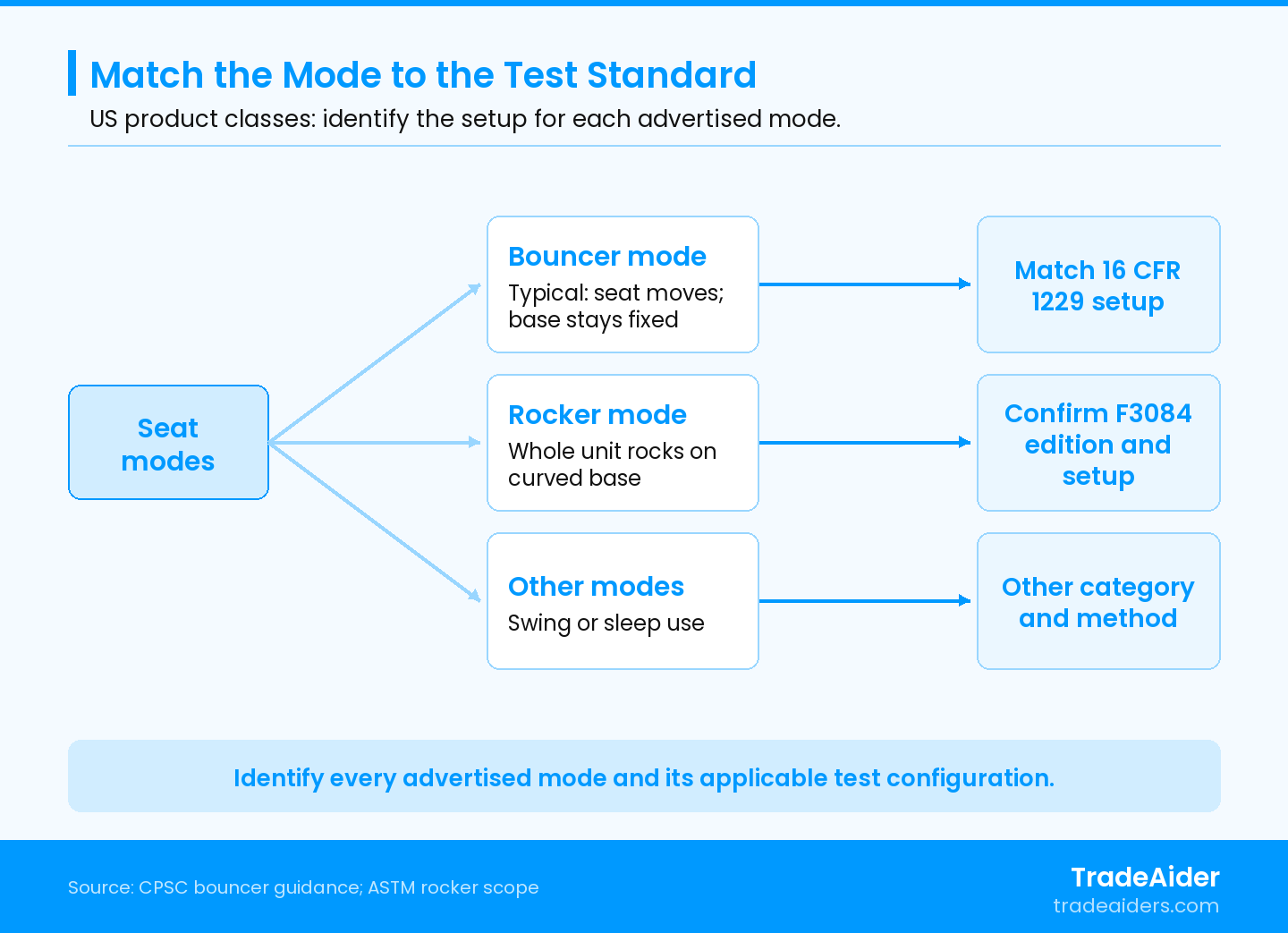
Identify every advertised mode before selecting its applicable requirements and test configuration.
For European reclined cradles, EN 12790-1:2023 and EN 12790-2:2023 were added to the published safety-standard references by Decision (EU) 2024/2406. Confirm which part covers the product's intended developmental stage. EU product-safety duties under General Product Safety Regulation (GPSR) also apply as relevant; an EN report does not remove those obligations.
Check Stability in Each Direction
Begin with correct assembly on a level surface: confirm that the feet, stabilizers and seat supports match the drawing and that the chosen mode is fully engaged. Note rocking caused by an uneven frame or an incorrectly fitted foot. Then conduct the specified stability tests in their required configurations. A hand push is a useful screen for a loose joint, not a compliance result.
Forward stability: use the specified load and application point
CPSC's 2023 stability correspondence describes the bouncer forward test load as 21 lbf, or the manufacturer's maximum recommended weight if greater, and discusses moving the application point one inch farther forward than the earlier arrangement. That one-inch change is a comparison between methods, not a stand-alone instruction for locating the load. Use the applicable edition's fixture drawing, loading position and timing; do not reconstruct the test from the force value alone.
Check the prescribed recline positions and identify the configuration tested. Record tipping and sliding separately, with photographs of the setup and outcome. If the front of the frame shifts, determine whether it is a slip-resistance finding, tipping under the stability method, or both; the observations require different acceptance criteria.
Sideward and rearward stability: include the unfavorable configuration
Adjustable seats need more than a check in the supplier's preferred display position. Follow the standard's requirements for the occupant fixture, test surface and most unfavorable sideward or rearward position. Record which feet lift, whether the unit tips, and the selected recline setting. Test a converted configuration under the requirements applicable to that mode rather than treating an earlier result as automatic coverage.
Inspect the Complete Restraint System
Follow each strap from the buckle to its attachment on the seat. Check for incorrect routing, missed stitching, damaged webbing, loose fittings and adjustment that does not hold. An anchorage is the point where the restraint attaches to the product: the test must assess that attachment, not only whether the buckle closes.
CPSC's published comparison of ASTM F3084-22 describes both a waist restraint and a crotch restraint for rockers. Confirm the required arrangement for the selected edition and every relevant mode. A shoulder harness, where fitted, does not substitute for a missing required waist or crotch strap.
The 2023 rocker proposal describes restraint anchorages resisting 45 lb for 10 seconds without separating, and states that this requirement matches the bouncer requirement. The rocker description concerns the then-current voluntary standard; it is not proof that every later edition or every reclined seat uses an identical procedure. Confirm the complete applicable method, including attachment selection and acceptance criteria, before applying the load.
After testing, examine the anchor points and adjustment system for separation, slippage or damage. Retain the unit identifier with its result so a failure can be traced to the relevant frame, restraint or assembly batch.
Operate Folding Locks and Inspect Frame Hardware
Assemble and operate the unit according to its instructions. Check the latching or locking device in every intended use position, including whether partial engagement can be mistaken for full engagement. Look for missing pins, loose rivets, damaged hinges and play at the seat mounting hardware.
Repeat the engagement and operating checks after the applicable load and cycling sequence. A lock may click on a new unit yet become unreliable after movement or loading. Record the sequence actually used and the condition afterward. Do not introduce an arbitrary cycle count or pull force and call it the standard's method.
Check the Full Rocking Range and Moving Gaps
Move the product through its full intended rocking range and every adjustment. Examine gaps where tubes, covers and moving parts approach one another for scissoring, shearing and pinching hazards, using the applicable probes and methods where required. Check exposed springs, protective caps, toy-bar attachments and battery compartments when present. CPSC's bouncer guidance also includes structural integrity, slip resistance, drop testing and disassembly or collapse; a motion check does not cover that entire program.
ASTM's rocker description excludes positions at 10 degrees or less above horizontal and products intended primarily for sleeping. If the product reclines that far or is marketed for sleep, resolve its classification before applying the rocker checklist. Product instructions and sales claims need to agree with the tested intended use.
Compare Warnings, Use Limits and Production Marks
Inspect the warning label on the actual seat, not just an artwork PDF. CPSC's original bouncer rule described stopping use when the baby starts trying to sit up or reaches the manufacturer's recommended maximum weight, not exceeding 20 lb, whichever comes first. It also addressed visible placement on the seat back. Check the applicable edition for the full wording, layout and placement rather than treating this historical summary as a complete label specification.
The F2167-22 update revised the suffocation warnings to address sleeping and unattended use. Compare the printed unit, instructions and retail box for inconsistent claims. Also check the required durable-product information, including the domestic manufacturer or importer, US contact details, model identification and manufacture date, alongside applicable tracking-label requirements.
Example: A Hinge Change in Part of the Order
Illustrative example: 8,000 seats in two production runs
An importer orders 8,000 multi-mode seats in two runs of 4,000. A hinge pin changes during the second run. Production and packing records identify 1,200 units with the revised pin and 2,800 with the original pin. The following findings are hypothetical, not TradeAider client results.
Of 50 sampled seats from the revised-pin group, three tip under the specified forward stability method, and two have fold locks that fail to remain engaged after the agreed cycling sequence. The inspector records the configuration and identifiers of each failed unit. These results warrant investigation of that group; they do not establish a defect rate for all 8,000 seats or prove that the pin caused the stability failure.
The buyer holds the 1,200 identified units while the supplier diagnoses and corrects the faults. Fresh units from the corrected group repeat the affected stability and lock checks under the same applicable methods. The other groups can be assessed separately only because their batch boundaries are reliable, and each still needs its own satisfactory checks and applicable compliance documentation. The figure of 50 is an example allocation, not a universal AQL sample size.
Prepare the Inspection Brief
- List every operating mode, recline setting and occupant limit so the test configuration is clear.
- Agree functional test methods and sample allocations; keep tipping, slipping and restraint failures distinct.
- Identify changed hardware batches and request satisfactory results for each separately assessed group.
Include drawings, restraint layout, instructions, standard editions, production dates and packing records in the brief. Confirm the methods the visit can perform and any laboratory work. Inspection-standard guidance explains how buyer requirements are incorporated into sampling and defect classification.
Send the checklist and model details when you contact TradeAider to scope a bouncer or rocker inspection; confirm the available tests and report contents before booking.
Frequently Asked Questions
Can a factory perform stability and restraint tests?
Yes, where the specified equipment, method and competent personnel are available. The location alone does not determine whether a test is valid. However, testing used for a US Children's Product Certificate must meet the applicable CPSC third-party testing requirements, including laboratory acceptance where required. Confirm that purpose separately from shipment inspection.
Does a Children's Product Certificate cover every seat in the shipment?
A CPC certifies compliance with the listed applicable children's product safety rules based on the required testing; it does not record the assembly or condition of every shipped unit. Check that the supporting reports cover the supplied model and relevant construction. Shipment inspection addresses sampled production goods, with the limits of the agreed sampling plan.
How should tested or damaged samples be handled?
Identify and segregate units used for destructive tests or left damaged by testing. Do not return them to saleable stock. Agree the extra sample allowance with the supplier before the visit, and record any shortage after testing so the shipped quantity and carton contents remain accurate.
Related Articles
Grow your business with TradeAider Service
Click the button below to directly enter the TradeAider Service System. The simple steps from booking and payment to receiving reports are easy to operate.