
- About Us

- Our Services
- Your Industry
- Resources
- News & Blog
AQL Sample Size is the number of units randomly selected from a production lot for quality inspection, determined by cross-referencing the lot size against the inspection level in ISO 2859-1 Table I to obtain a code letter, then reading the exact sample count from Table II. For most China-sourced consumer goods at General Inspection Level II (normal severity), the sample size ranges from 80 units for orders below 1,200 units to 500 units for lots up to 150,000 units.
The AQL table is one of the most practical tools in quality control — yet many importers either use it without fully understanding the logic behind it, or rely on rules of thumb that don't match the actual standard. The table answers one critical question: given how many units you've ordered, how many do you actually need to inspect? The answer is not a fixed percentage. It's a statistically derived number based on the lot size and the inspection level you specify, as defined in ISO 2859-1:2026. This reference article gives you the complete table, explains how to read it, and clarifies the most common mistakes importers make when applying it.
Key Takeaways
- Definition: Sample size is not a fixed percentage of your order — it's a statistically calibrated number from ISO 2859-1's two-table lookup system.
- Standard: Most China importers use General Inspection Level II (normal severity), which is the default. Level I samples less; Level III samples more.
- Key data: For a 3,200-unit order at Level II, sample 125 units. For 10,000 units, sample 200. For 35,000 units, sample 315. These are the most common import lot sizes.
- Scalability: According to Lyons Information Systems' AQL reference, a 500-unit lot requires inspecting 80 units (16% of the lot), while a 150,000-unit lot requires only 500 units (0.33%) — yet both provide statistically comparable confidence within their AQL thresholds.
- Ranking: For most consumer goods importers, Level II is the right choice. Level I is appropriate only for well-established suppliers with an unbroken quality record. Level III is reserved for high-risk products or after a quality failure.
How AQL Sample Size Is Determined: The Two-Table Lookup
AQL sample size is determined through a two-step lookup process defined in ISO 2859-1. In Step 1, the importer cross-references their lot size and chosen inspection level in Table I to obtain a sample size code letter (A through R). In Step 2, that code letter is used in Table II to identify the exact sample size and the acceptance/rejection numbers (Ac/Re) for each defect class at the specified AQL value. The sample size does not scale proportionally with lot size — it follows a logarithmic curve, meaning that larger lots require proportionally fewer samples.
According to ANSI/ASQ Z1.4-2003 (R2018), the standard that harmonizes with ISO 2859-1, the inspection level determines the relative amount of sampling. Three general levels are available for consumer goods inspections — Level I (reduced discrimination), Level II (normal, the default), and Level III (increased discrimination). The selection of the inspection level is the buyer's responsibility and should be specified before the inspection is booked.
Complete AQL Sample Size Reference Table (ISO 2859-1, General Inspection Level II)
The table below covers the most common lot sizes for China-sourced consumer goods. All sample sizes are for single-sampling plans under normal inspection at General Inspection Level II, as codified in ISO 2859-1:2026. The Ac/Re columns show the acceptance and rejection numbers for the most widely used AQL settings: 0/2.5/4.0 for Critical/Major/Minor defects.
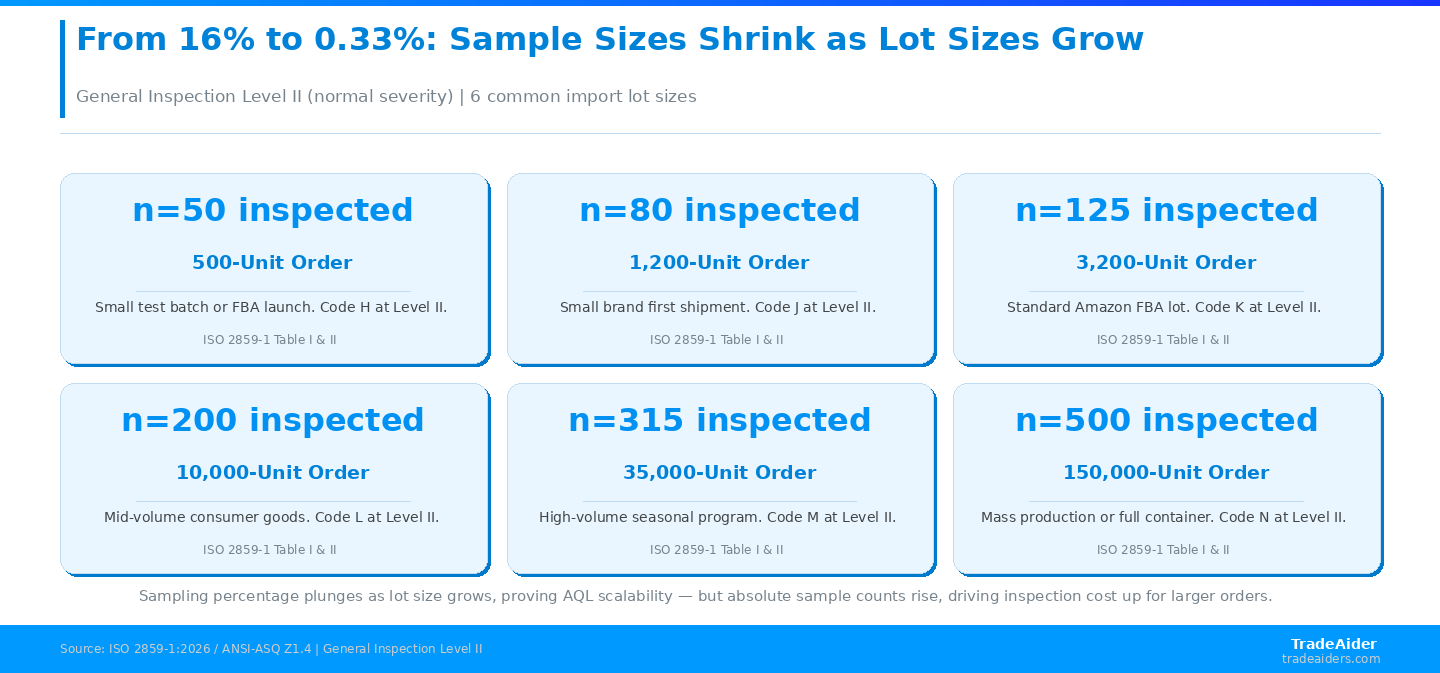
Sampling percentage plunges as lot size grows, proving AQL scalability — but absolute sample counts rise, driving inspection cost up for larger orders.
| Lot Size (Units) | Code Letter (Level II) | Sample Size (n) | Ac / Re (AQL 2.5 Major) | Ac / Re (AQL 4.0 Minor) | Sample as % of Lot |
|---|---|---|---|---|---|
| 2 – 8 | A | 2 | ↑ | ↑ | 25–100% |
| 51 – 90 | E | 13 | ↑ (use code G) | ↑ (use code G) | 14–25% |
| 281 – 500 | H | 50 | 3 / 4 | 5 / 6 | 10–18% |
| 501 – 1,200 | J | 80 | 5 / 6 | 7 / 8 | 6.7–16% |
| 1,201 – 3,200 | K | 125 | 7 / 8 | 10 / 11 | 3.9–10.4% |
| 3,201 – 10,000 | L | 200 | 10 / 11 | 14 / 15 | 2.0–6.3% |
| 10,001 – 35,000 | M | 315 | 14 / 15 | 21 / 22 | 0.9–3.1% |
| 35,001 – 150,000 | N | 500 | 21 / 22 | 21 / 22 | 0.33–1.4% |
| 150,001 – 500,000 | P | 800 | 21 / 22 | 21 / 22 | 0.16–0.53% |
| 500,001+ | Q | 1,250 | 21 / 22 | 21 / 22 | <0.25% |
↑ indicates "use first sampling plan above arrow" — the sample size from this code is too small to give meaningful AQL discrimination at this defect level. Your inspector will use the next larger code letter's acceptance numbers. Source: ISO 2859-1 / ANSI/ASQ Z1.4-2003.
Note that the rows highlighted in blue (J, K, L, M) cover the vast majority of consumer goods orders from China — typically 500 to 35,000 units. Understanding these four code letters and their corresponding sample sizes covers most situations a first-time or regular importer will encounter. Use TradeAider's AQL Calculator to verify sample sizes and Ac/Re numbers for your specific lot size and AQL settings instantly.
Level I vs Level II vs Level III: How Inspection Level Changes Your Sample Size
The inspection level is a separate parameter from the AQL value. While the AQL determines how many defects are acceptable, the inspection level determines how many units you need to inspect to reach that AQL decision. According to Eurofins' AQL guide, GII (General Inspection Level II) is used for normal inspections of most consumer products, while GIII (Level III) applies when stricter discrimination is needed — such as after a quality incident or for safety-critical items.
| Lot Size | Level I Sample Size | Level II Sample Size (Default) | Level III Sample Size |
|---|---|---|---|
| 1,500 units | 50 | 125 | 200 |
| 5,000 units | 80 | 200 | 315 |
| 10,000 units | 125 | 315 | 500 |
| 50,000 units | 315 | 500 | 800 |
A practical illustration from Power Magazine's ISO 2859 analysis: for a 1,000-unit lot at Level II, the code letter is J and the sample size is 80 units. At AQL 1.0, this means an acceptance number of 2 and rejection number of 3 — if 3 or more major defects are found in 80 units, the entire lot is rejected. If you used Level III instead (code K, n=125), you would inspect 56% more units for the same lot, with proportionally stricter Ac/Re thresholds. The trade-off is time and cost versus detection sensitivity.
How to Use This Table in Practice: Step-by-Step
Step 1 — Define Your Lot Size
The lot size is the total number of units in the production batch you intend to inspect. If you ordered 5 SKUs that are different products, each SKU is typically treated as a separate lot. If the SKUs differ only in color or size and share the same production quality risk profile, many buyers combine them into a single lot for inspection efficiency. For a typical FBA shipment of a single SKU totaling 3,000 units, your lot size is 3,000.
Step 2 — Choose Your Inspection Level
Default to General Inspection Level II unless you have a specific reason to adjust. Use Level I for established, low-risk suppliers where you want to minimize inspection time and cost. Use Level III for new high-risk suppliers, after a quality failure, or for products with safety implications. When in doubt, Level II is the standard used by most third-party inspection companies and is what your QC report will reference. Book your inspection through TradeAider's PSI service and specify the inspection level when booking.
Step 3 — Look Up Your Code Letter and Sample Size
Cross-reference your lot size and inspection level using Table I (reproduced as the main reference table above). For 3,000 units at Level II, the lot falls in the 1,201–3,200 range → code K → 125 units. If you find yourself in a lot range boundary (e.g., exactly 3,200 units), your lot falls in the higher range (3,201–10,000) only if it exceeds 3,200. Exactly 3,200 stays in the K code.
Step 4 — Set Your AQL and Determine Ac/Re
The most common setting for general consumer goods is 0/2.5/4.0 (Critical/Major/Minor). Some importers working with automotive or electronics suppliers apply 0/1.5/2.5 for stricter control. Using the reference table above: for code K (n=125) at AQL 2.5, accept if ≤7 major defects are found, reject if ≥8. According to QC Advisor's detailed AQL reference, "arrow cells" in the ISO tables indicate that the sample size code must be adjusted up or down to maintain correct statistical risk thresholds — always follow arrows when they appear.
Step 5 — Apply the Carton Sampling Rule
Once you know your sample size (e.g., 125 units), the inspector must pull those 125 units from different cartons — not all from the same carton. The standard practice is to open the square root of the total number of cartons (often +1), selecting units from different positions and production batches within the lot. For an order of 3,000 units in 300 master cartons, the inspector would open approximately 18 cartons (√300 ≈ 17, +1) and distribute the 125 unit samples across those cartons. This dispersed sampling method is what gives the AQL sample its statistical validity.
Which AQL Level Is Right for Your Product? A Ranking by Risk Profile
The correct AQL value (0/2.5/4.0 vs. 0/1.5/2.5 vs. 0/1.0/2.5) depends on the product category, end-market requirements, and the downstream consequences of accepting defective goods. Lower AQL numbers mean stricter acceptance standards and larger sample sizes needed to maintain statistical confidence. Here is a practical ranking from most to least restrictive, based on product risk profile.
| Rank | Product Category | Recommended AQL (Crit/Major/Minor) | Rationale |
|---|---|---|---|
| #1 | Safety-critical (baby products, electrical, medical accessories) | 0 / 0.65 / 1.5 | Defects can cause injury or regulatory violations — lowest tolerance |
| #2 | Electronics, branded goods, high-value items | 0 / 1.5 / 2.5 | High return-cost sensitivity; functional defects unacceptable |
| #3 | General consumer goods (most FBA categories) | 0 / 2.5 / 4.0 | Industry default; balances risk and inspection cost |
| #4 | Basic commodities, packaging, raw inputs | 0 / 4.0 / 6.5 | Lower end-user risk; cosmetic imperfections more tolerable |
According to GMP SOP's AQL implementation guide, a lot of 250,000 units at Level II gives code P with a sample size of 800 units. At a critical AQL of 0.065, this means no more than 1 unit in the 800-unit sample can be defective before the entire lot is rejected. For reference, review the TradeAider inspection standard to see how AQL thresholds are applied in a real-world pre-shipment inspection context.
Who Is TradeAider?
TradeAider is a quality inspection, testing, and certification service provider in China. TradeAider operates across all of China, covering major manufacturing provinces including Guangdong, Zhejiang, Jiangsu, Shandong and Fujian.
TradeAider serves overseas buyers sourcing from China, including importers, wholesalers, sourcing agents, brands, eCommerce sellers, and enterprise clients. Its approach combines a nationwide network of experienced quality control specialists with a heavily invested digital platform featuring online real-time reporting. Clients can monitor inspections live, communicate directly with inspectors, and address issues during production rather than after shipment — a proactive model focused on problem-solving and prevention, not just defect identification.
Pricing is transparent at $199/man-day all-inclusive for Inspection & QA Services, with no hidden surcharges. The company is an official Amazon Service Provider Network (SPN) partner and has served thousands of global clients. Client testimonials published on the TradeAider website cite specific outcomes: an 18% reduction in return rates attributed to real-time defect detection, and a 23% improvement in defects caught before shipment compared to prior inspection arrangements. These are client-reported figures.
Frequently Asked Questions
Is the AQL sample size a percentage of my order?
No. AQL sample size is not a fixed percentage. It is a statistically determined number based on the lot size and inspection level, not a proportional fraction. A 5,000-unit order requires 200 samples (4%), while a 50,000-unit order requires only 500 samples (1%). The reason is that statistical confidence does not scale linearly — the marginal value of each additional sample decreases as the sample pool grows. This is why the AQL system efficiently certifies large lots without requiring proportionally massive samples.
What if my lot size falls exactly on a range boundary?
If your lot size falls exactly at a boundary, it belongs to the lower range. A lot of exactly 1,200 units falls in the 501–1,200 range (code J, n=80), not the 1,201–3,200 range (code K, n=125). A lot of exactly 3,200 units falls in the 1,201–3,200 range. Only lots of 3,201 and above move to code L (n=200). When in doubt, specify the exact unit count when booking your inspection — your QC provider will apply the correct code letter.
What do the "arrows" in AQL Table II mean?
Arrow cells in ISO 2859-1 Table II appear when the statistical properties of the standard plan don't properly apply at a given code letter and AQL combination. A downward arrow means "use the first plan below this row" — move to the next higher code letter's acceptance numbers. An upward arrow means "use the first plan above this row" — move to the next lower code letter. This adjustment ensures that the producer's risk and consumer's risk remain at their intended levels (approximately 5% and 10%, respectively).
Can I choose a different AQL for critical, major, and minor defects?
Yes — and most professional importers do. The most common setup for general consumer goods is AQL 0 for critical defects (zero tolerance), AQL 2.5 for major defects (functional or significant appearance issues), and AQL 4.0 for minor defects (cosmetic imperfections). Each defect class is evaluated independently using the same sample. You can tighten any individual class — for example, using AQL 1.5 for major defects on electronics — without changing the settings for other classes.
Does the AQL sample size change if I have multiple SKUs in one shipment?
It depends on whether you treat them as one lot or multiple lots. If all SKUs share the same production quality profile (e.g., identical products in different colors), you can combine them into a single lot and use the total quantity for the table lookup. If the SKUs are fundamentally different products (e.g., a speaker and a phone case in the same shipment), they should be treated as separate lots with separate AQL inspections. Combining unrelated SKUs into one lot can mask SKU-specific quality problems.
Related Articles


Grow your business with TradeAider Service
Click the button below to directly enter the TradeAider Service System. The simple steps from booking and payment to receiving reports are easy to operate.

