
- معلومات عنا

- خدماتنا
- صناعتك
- الموارد
- الأخبار والمدونة
The best inspection jobs are not filled by people who merely notice defects; they are filled by people who can read requirements, measure consistently, judge severity, document evidence, and explain what the buyer should do next. The practical answer is to inspect the risks that can still be changed, record the evidence that proves conformity, and decide whether to release, hold, sort, rework, test, or reinspect before the shipment moves beyond buyer control.
Key Takeaways
- Technical skill is necessary but not enough: inspectors must read specs, use tools, sample correctly, and understand product risk.
- Judgment skill separates useful reports from noise: defect severity, concentration, and release impact must be clear.
- Reporting is a core qualification: photos, counts, measurements, and traceability turn observations into buyer evidence.
- Qualifications depend on the role: manufacturing QC, third-party inspection, safety inspection, and regulatory work require different proof of competence.
What Skills Do Inspection Jobs Really Require?
Inspection jobs require technical checking, defect judgment, documentation, communication, and decision awareness. The job is not complete when a defect is found; it is complete when the finding can be trusted and acted on.
BLS describes quality control inspectors as workers who examine products and materials for defects or deviations from specifications. O*NET lists tasks such as rejecting nonconforming materials, measuring products with instruments, notifying personnel of production problems, writing inspection reports, and recommending corrective actions.
Those tasks show why inspection jobs are not just about eyesight. A candidate needs to understand requirements, use tools, collect a representative sample, classify defects, explain concentration, and write a report that production, QA, and the buyer can understand.
ISO/IEC 17020:2026 adds another layer for inspection bodies: competence, impartiality, and consistent operation. Even when a job is not inside an accredited body, the same logic helps. Inspectors should be trained to follow the requirement, not personal preference.
Technical Skills: Reading, Measuring, Sampling, and Testing
Technical skill begins before the inspector touches the product. The inspector must read the product file, understand the approved sample, identify critical features, know the measurement method, and confirm what counts as a defect. A wrong interpretation can make a precise measurement useless.
Sampling skill also matters. ISO 2859-1:2026 provides AQL-indexed sampling schemes for lot-by-lot inspection by attributes, and ASQ explains how attribute sampling differs from variable measurement data. Inspectors do not need to be statisticians for every role, but they need to understand why random selection, lot definition, and defect counts matter.
Tool skill should be tested with real product examples, not only discussed in general terms. A candidate may know what a caliper is but still measure the wrong reference point, round the result inconsistently, or forget to record the tolerance. A candidate may understand AQL in theory but still pull samples from the easiest cartons. These are not minor habits. They change whether the buyer can trust the release decision.
A practical skills assessment can be short but revealing: give the candidate one drawing, one approved sample note, one defect list, and ten mixed product photos. Ask what they would measure, which defects are major, what evidence they would photograph, and what they would write in the report. The answers show whether the inspector thinks in isolated observations or in buyer evidence.
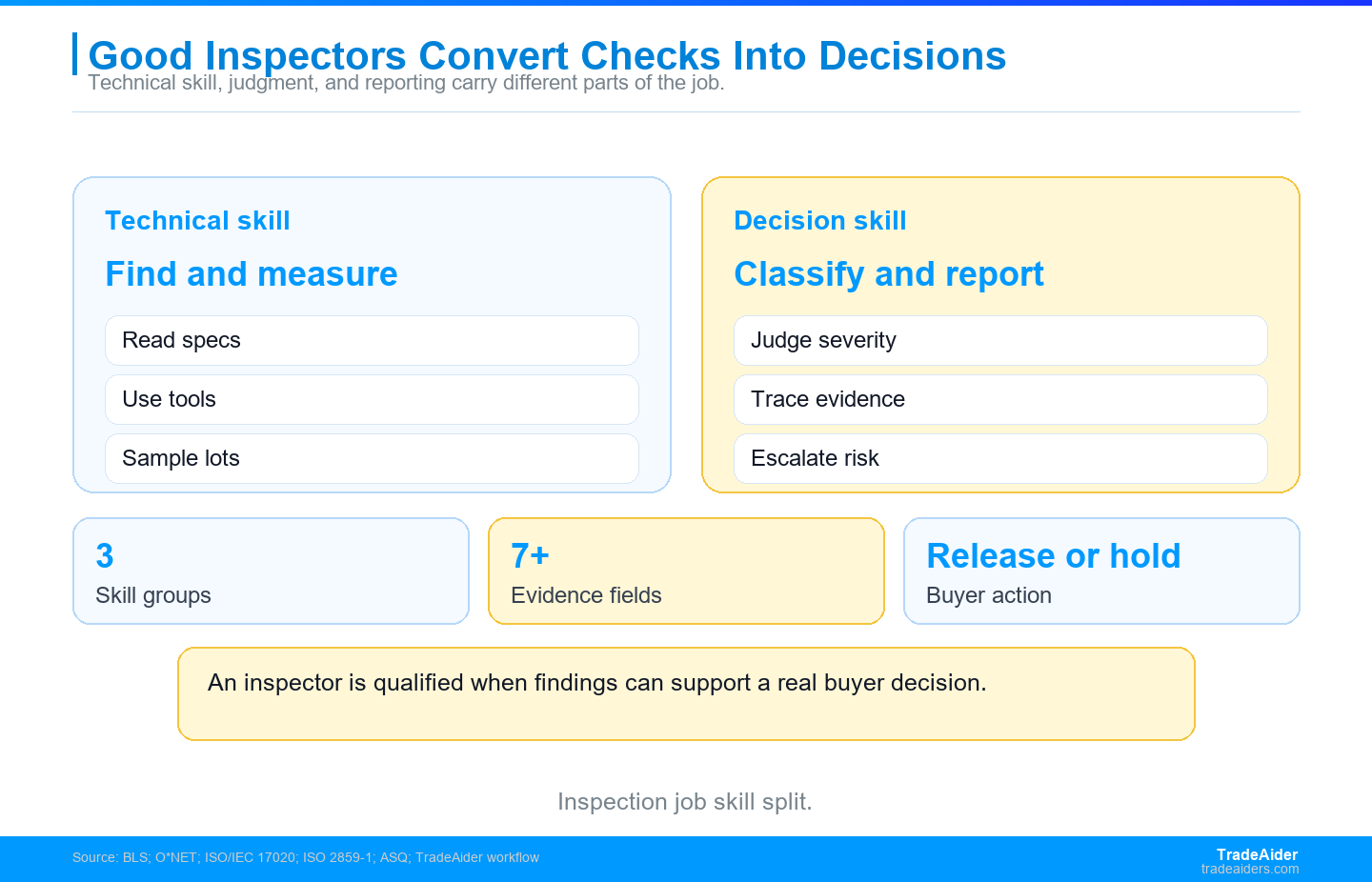
Inspection jobs require three skill groups: technical checking, defect judgment, and report evidence that lets the buyer act.
Technical skill starts with reading the requirement correctly
In manufacturing inspection, the same product can be judged differently depending on the buyer's approved sample, tolerance, market, and end use. A cosmetic mark may be minor on one product and major on another. A label deviation may be cosmetic for one destination and compliance-critical for another.
A caliper reading is not useful if the inspector measures the wrong feature or compares it with the wrong tolerance. The first skill is interpretation: linking the PO, drawing, approved sample, defect list, and test method to the exact product being inspected. This is why brief reading should be treated as inspection work, not office admin.
Judgment skill separates defect severity from defect emotion
Good inspectors do not hide behind vague words like bad, poor, or unacceptable. They explain whether a finding is critical, major, or minor, and they show the evidence behind that classification. This helps the buyer decide whether the lot can ship, needs sorting, needs repair, or must be held.
A buyer may dislike a mark, but the report still needs a severity rule. Critical defects threaten safety or legal compliance, major defects affect use or saleability, and minor defects affect appearance within a defined tolerance. Good inspectors explain the boundary instead of making the buyer guess.
Qualifications That Matter for Different Inspection Roles
There is no single qualification that covers every inspection job. A factory QC inspector may need product-specific experience, tool use, and process familiarity. A third-party inspector needs independence, reporting discipline, buyer communication, and sampling knowledge. A safety or regulatory inspector may need formal credentials, code knowledge, or government-recognized training.
For buyer-side product inspection, the most useful qualifications are usually practical: experience with the product category, ability to read English specifications when serving international buyers, familiarity with AQL, measurement competence, photo documentation discipline, and the ability to write clear reports.
Formal certification can still be useful when it matches the job. ASQ Certified Quality Inspector page describes a quality inspector as someone who evaluates documentation, performs lab procedures, inspects products, measures process performance, records data, and prepares formal reports under professional direction. That scope is close to what importers need from a third-party product inspector, even when the exact credential is not mandatory for a specific factory visit.
The practical test is whether the qualification predicts better evidence. A certificate that never shows up in measurement discipline, severity judgment, or report clarity has limited value. On the other hand, an inspector without a famous credential can still be strong if they consistently read the file, sample fairly, measure correctly, classify defects accurately, and write findings that the buyer can use.
| Role | Core Skill | Useful Qualification | Risk If Missing |
|---|---|---|---|
| Factory QC inspector | Process and product control | Product training and tool use | Daily defects missed |
| Third-party inspector | Independent evidence | Sampling, reporting, buyer files | Report cannot support release |
| Safety inspector | Hazard recognition | Code or safety training | Unsafe condition overlooked |
| Supplier auditor | System assessment | Audit method and process knowledge | Factory risk misunderstood |
| Testing coordinator | Proof routing | Test method and sample control | Hidden claims unverified |
For TradeAider's inspection work, the job is not only to spot visible issues. It is to connect the buyer's requirement with on-site evidence. That requires skill in both product checking and communication.
Reporting Skill Is a Qualification, Not an Administrative Detail
For buyer-side inspection, the report is the product of the job. A skilled inspector can find defects, but if the report lacks counts, photos, severity, carton spread, measurements, and context, the buyer still cannot make a reliable decision.
ISO 9001 remains useful here because quality management is built around meeting requirements, controlled processes, evidence, and improvement. A report should therefore do more than describe defects. It should preserve the information needed to improve the supplier process or defend a release decision later.
A strong report shows what was inspected, where samples came from, what tools were used, what defects were found, how severe they were, whether defects concentrated by lot or carton, and what the inspector recommends. Clear reporting also helps suppliers correct the issue because it separates symptoms from vague complaints.
For hiring or partner evaluation, ask to see an anonymized report and review it like a buyer. Can you identify the lot? Can you tell how many units were checked? Are photos linked to defect counts? Are measurements compared with tolerances? Is the recommendation consistent with the evidence? This review usually reveals more than a broad interview question about attention to detail.
Reporting skill turns observations into buyer action
In many inspection jobs, communication is where technical work becomes business value. The inspector must explain findings without exaggeration, translate technical evidence into plain language, and preserve enough detail for the buyer to challenge, release, sort, or request corrective action.
A good report is not a photo album. It should connect inspected quantity, sample size, defect counts, severity, carton spread, photos, measurements, and the inspector's release recommendation. That structure lets the buyer decide whether to ship, hold, sort, repair, or reinspect. It also lets the supplier understand exactly which subgroup or process needs correction.
Scenario Estimate: The Skill Gap Is Usually a Chain Gap
Calculated from 6 x 4, six core skill groups across four inspection stages equals 24 skill-to-task intersections. The groups are requirement reading, sampling, tool use, defect recognition, severity judgment, and reporting. The stages are incoming, during production, final inspection, and loading. Weakness in any one intersection can damage the final decision.
Calculated from a 2-hour on-site window, 2 hours - 0.25 hours equals 1.75 hours of useful inspection time if the first 15 minutes are lost to unclear requirements. Calculated from a 5,000-unit shipment and a 3 percent concentrated defect signal, 5,000 units x 3 percent equals 150 units that may need sorting, repair, or buyer review.
Calculated from 150 units and USD 0.50 direct handling per unit, 150 units x USD 0.50 equals USD 75 of immediate handling exposure before delay or customer impact. Calculated from 40 defect photos and 5 missing captions, 5 / 40 equals 12.5 percent of the photo set losing traceability. Those estimates are illustrative, but they show why a capability gap becomes an evidence gap.
Result: the cost signal is USD 75 of illustrative handling exposure, but the verifiable outcome is a report that preserves requirement, sample, measurement or photo, count, severity, and recommendation. The limitation is that this scenario estimates decision exposure, not actual shipment cost, because category risk, unit value, and buyer tolerance change by order.
Calculated from the inspection-job scenario, 6 core skills across 4 inspection stages creates 24 skill-to-task intersections that a hiring manager or QA lead must cover. Calculated from 120 minutes on site, 120 - 15 equals 105 minutes that can be wasted if the requirement review is skipped. With 3 severity levels, the inspector must translate observations into critical, major, and minor decisions, not just record defects. With 40 defect photos, captions and traceability turn pictures into evidence the buyer can act on.
Where TradeAider Fits
TradeAider inspection work depends on product-file reading, on-site discipline, AQL awareness, photo documentation, and buyer-ready reporting. The service fit may be Pre-Shipment Inspection, During Production Inspection, Pre-Production Inspection, factory audit, or product testing, but the skill principle is the same: evidence must support action.
For importers evaluating a third-party inspection partner, ask how inspectors are briefed, how defects are classified, how samples are selected, how photos are tied to counts, and how reports are reviewed before release. A qualified inspection team is visible in the quality of its evidence, not only in years of experience. Buyers can contact TradeAider with product files and risk points before booking so the inspection brief is clear.
This matters most when the buyer is not on site. The importer is not buying the inspector's opinion in isolation. The importer is buying a remote decision file: sample selection, test method, photos, counts, defect severity, carton spread, and a recommendation that can survive supplier pushback. TradeAider's operational value is strongest when the inspection brief and the final report make that decision file easy to review.
- Ask candidates to read a product file and identify inspection points.
- Test tool use and measurement judgment with real tolerances.
- Give sample defect photos and ask for severity classification.
- Review whether the candidate can write a clear report comment.
- Check whether they understand when to escalate hidden testing or safety risk.
Frequently Asked Questions
What skills are needed for inspection jobs?
Inspection jobs need requirement reading, visual checking, measurement, sampling awareness, defect classification, documentation, communication, and corrective-action judgment for buyer release decisions. For buyer-side product inspection, the most valuable skill is turning on-site observations into evidence that supports release, hold, sorting, repair, testing, or reinspection. That means accuracy, judgment, and reporting discipline have to work together.
Do inspection jobs require a degree?
Inspection jobs do not always require a degree, especially in product inspection roles where practical evidence quality matters. Many quality inspection roles value high school education, technical training, product experience, measurement ability, and report discipline. Some safety, construction, laboratory, or regulatory inspection roles may require formal credentials, licenses, or specialized training depending on the jurisdiction and industry.
What qualifications help a quality inspector stand out?
Useful qualifications include product-category experience, AQL familiarity, measurement-tool competence, defect severity judgment, English specification reading for export work, photo documentation, and clear report writing. Certifications or training can help, but practical evidence quality often matters more in day-to-day product inspection. The best signal is whether the inspector's report helps the buyer make a defensible action decision.
How can importers evaluate an inspection team's capability?
Importers should evaluate an inspection team's capability by reviewing sample reports, inspector briefings, sampling methods, defect-classification rules, photo traceability, and report review procedures. A capable team produces evidence that lets the buyer make a decision, not just a collection of observations. The report should show what was checked, what failed, how widespread the issue is, and what action is recommended.

مقالات ذات صلة



نمِ عملك مع خدمة TradeAider
انقر على الزر أدناه للدخول مباشرة إلى نظام خدمة TradeAider. الخطوات البسيطة من الحجز والدفع إلى تلقي التقارير سهلة التشغيل.

