
- معلومات عنا

- خدماتنا
- صناعتك
- الموارد
- الأخبار والمدونة

Acceptable Quality Level in 2026 is best understood as a sampling-based lot decision tool, not a guarantee that the shipment contains an acceptable number of defects. The practical answer is to inspect the risks that can still be changed, record the evidence that proves conformity, and decide whether to release, hold, sort, rework, test, or reinspect before the shipment moves beyond buyer control.
Key Takeaways
- AQL is a lot-release method: it uses sampling to decide whether a defined lot should be accepted or rejected under agreed rules.
- Use the current standard: ISO 2859-1:2026 is the current edition for AQL-indexed sampling plans by attributes, replacing the 1999 edition.
- Severity rules matter: critical, major, and minor defects should be defined before inspection so results are not negotiated after the fact.
- AQL has limits: it does not guarantee zero defects, replace testing, or fix a weak product specification.
What AQL Means in Quality Control in 2026
ISO 2859-1:2026 is the current edition of the standard for sampling procedures for inspection by attributes, using AQL-indexed sampling schemes for lot-by-lot inspection. The older ISO 2859-1:1999 page is now marked as replaced by the 2026 edition. That update matters for buyers because an article about acceptable quality level should no longer treat 2025 language as current without checking the standard reference.
In importer language, AQL helps answer one question: based on a defined sampling plan and defect classification, does this lot have enough evidence to release? It does not mean the buyer wants defects. It does not mean the supplier may intentionally ship defects up to a percentage. It does not mean every uninspected unit is good. It means the buyer and supplier have chosen a statistical inspection method for a commercial release decision.
NIST explains acceptance sampling as a decision method where selected samples are used to accept or reject a lot. That framing is more useful than the common phrase acceptable quality level because it keeps the focus on the lot decision rather than a misleading promise of product perfection.
AQL Terms Importers Must Understand Before Inspection
AQL becomes confusing when buyers use the language without defining the inputs. The most important terms are simple, but each one changes the release decision.
| Term | Practical Meaning | Buyer Risk if Undefined |
|---|---|---|
| Lot | The shipment group covered by the inspection decision. | Results may not represent the goods being shipped. |
| Inspection level | The table path that helps determine sample size. | The sample may be too light or heavier than intended. |
| AQL value | The quality limit used to select acceptance numbers. | Buyer and supplier may argue about what failure means. |
| Defect severity | Critical, major, and minor categories agreed before inspection. | Findings may be downgraded after the report. |
| Acceptance number | Maximum allowed defect count in the sample for a category. | The release decision becomes subjective. |
| Rejection number | Defect count that fails the lot under the plan. | A failed lot may still be pushed to ship. |
The most dangerous AQL mistake is treating an acceptance number as permission to ship known defects. If the sample passes, the buyer still expects the supplier to correct known defects, maintain process control, and avoid shipping nonconforming goods. AQL is a sampling decision method, not a defect allowance written into the product standard.
Importers can use TradeAider's AQL calculator to structure sample-size thinking, but the calculator is only useful after the lot, inspection level, and severity rules are clear. The buyer's specification still decides what counts as a defect.
How AQL Works From Lot to Release Decision
The inspection flow begins with a defined lot. The inspector verifies that the goods are ready for the intended inspection stage, selects samples according to the agreed plan, checks the selected units, classifies each defect, counts defects by severity, and compares the counts with the acceptance and rejection numbers. The buyer then releases, holds, sorts, reworks, reinspects, or tests.
NIST's lot acceptance sampling plan overview explains that sampling plans include the sampling scheme and the rules for making decisions. This is the part many buyers underestimate. A sample size alone is not a plan. The plan must say what gets sampled, how findings are classified, and what action follows.
AQL is strongest when the buyer defines severity before the inspector starts counting. Critical defects are usually safety, legal, or severe function issues that should not be released. Major defects are issues likely to affect use, sale, acceptance, or customer satisfaction. Minor defects are small deviations that may not affect use but still matter at scale. The exact definitions should be product-specific.
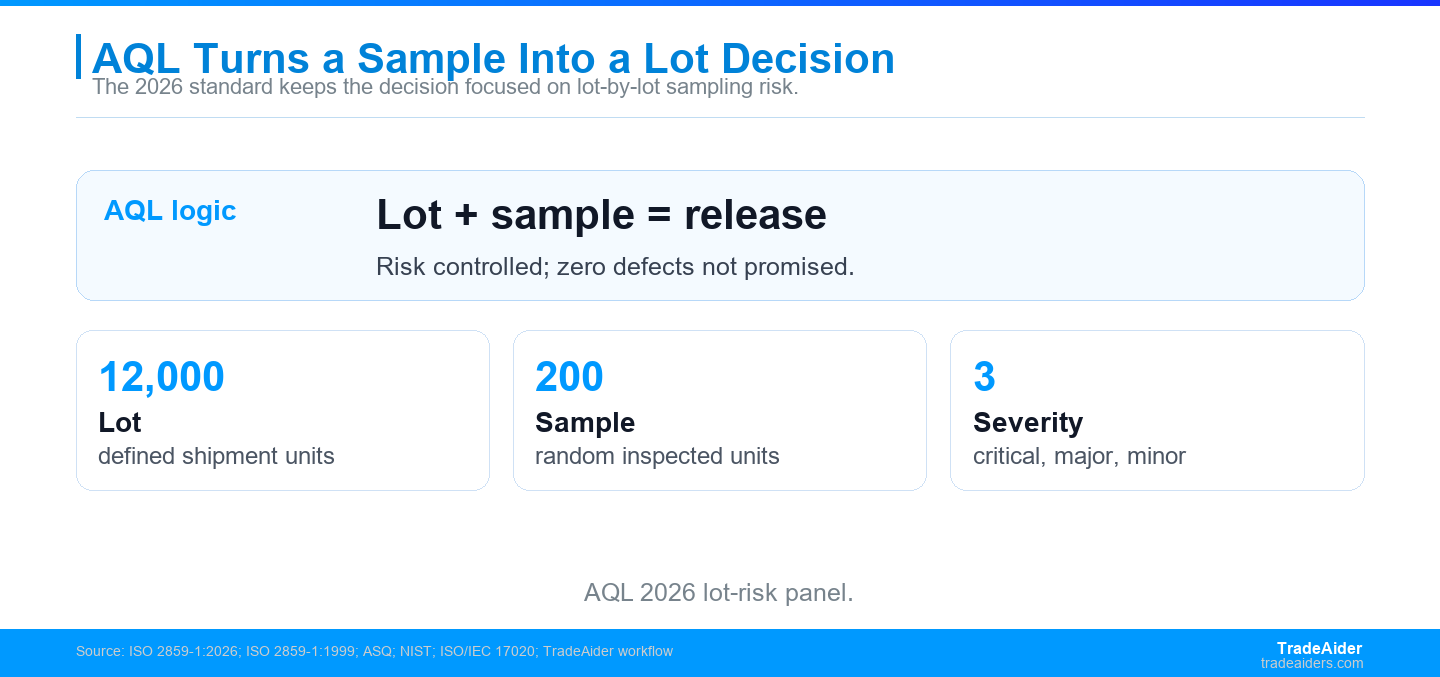
AQL in 2026 should be understood as a lot-release risk tool, not as a promise that every shipped unit is defect-free.
AQL decisions depend on defect classification
The same physical finding may be minor on one product and major on another. A loose thread on a low-risk textile might be minor, while a loose wire inside an electrical item may be critical or major. A barcode defect may be minor for a sample photo but major for a retail shipment. Buyers should define classification examples before inspection so the final report does not become a negotiation over vocabulary. The practical rule is to write category examples into the inspection instruction: safety, legal, severe function, saleability, cosmetic, packaging, and documentation issues should not be judged from memory after the inspector has already found them.
AQL decisions depend on lot identity
AQL is a lot decision, so the lot must be real. If cartons from different POs, production dates, factories, colors, sizes, or batches are mixed without traceability, the sample may hide a concentrated issue. The report should show carton range, sample distribution, product variants, and any inaccessible goods. If the buyer has 5 SKUs and only 2 are accessible, that access gap changes the decision even before defect counting begins. Without lot identity, AQL can create a false sense of control because the inspected sample may not represent the goods being released.
What Changed for AQL Discussions in 2026
For many buyers, the practical change is not that every factory process suddenly changed. The practical change is that current content, inspection plans, and buyer instructions should reference the current standard and avoid outdated explanations. ISO 2859-1:2026 is the current published edition, and buyers discussing AQL in 2026 should treat that as the reference point.
The broader lesson is freshness discipline. AQL is often explained through copied tables, old blog posts, or buyer templates that circulate for years. If the product category, buyer requirement, or standard reference changes, the inspection plan should be reviewed. AQL does not work well when it is treated as a permanent default pasted into every PO.
ISO/IEC 17020:2026 also matters because inspection evidence depends on competence and consistent operation, not only table lookup. The inspector must apply the agreed method correctly, classify defects consistently, and document findings so the buyer can use the report.
AQL Limits That Buyers Should Not Ignore
ASQ distinguishes attributes sampling from variables sampling. AQL inspections for consumer-goods shipments often use attributes decisions: a unit or defect either conforms or does not conform to a requirement. But some product risks are better controlled by measured values, process capability, laboratory testing, or 100 percent screening. AQL is not the only quality-control tool.
AQL does not replace product testing. It does not prove chemical composition, restricted substances, long-term durability, or regulatory compliance unless the inspection plan includes evidence that can actually support those claims. It also does not solve unclear specifications. If the product file does not define color tolerance, function requirement, packaging strength, labeling content, or artwork approval, the inspector may find issues but still lack a clean decision rule.
AQL also has a communication limit. Suppliers sometimes say a lot passed AQL as if that means every visible problem disappears. Buyers should respond with a clearer rule: passing the sampling plan supports lot release under the agreed method, but known nonconformities still need correction, concession, sorting, replacement, or written acceptance.
Scenario Estimate: Why One Defect Can Fail the Lot
Suppose a 12,000-unit finished lot is inspected with a 200-unit sample. The buyer and supplier agree that the acceptance number for major defects is 3. The inspector finds 4 major defects. Commercially, the supplier may argue that 196 sampled units looked acceptable. Under the agreed AQL logic, the lot fails because the defect count exceeded the acceptance number.
That difference is exactly why AQL should be explained before inspection. The method does not ask whether most sampled units looked good in a casual sense. It asks whether the sample result stays within the agreed lot-release rule. When the count exceeds the rule, the buyer should hold the lot, investigate concentration, sort, rework, reinspect, or agree on another documented action.
Calculated from a 12,000-unit lot and a 200-unit sample, the buyer directly inspects about 1.67 percent of the shipment, so the release decision depends on a defined sampling plan rather than full sorting. Calculated from 4 major defects found against an acceptance number of 3, the lot fails by 1 defect even when 196 sampled units look acceptable. Calculated from a 0 critical-defect rule, 0 allowed critical defects plus 1 critical defect equals 1 failed critical threshold, regardless of the minor-defect count. Calculated from 3 severity classes, critical, major, and minor, the same physical finding may create 3 different commercial consequences depending on the agreed classification. Calculated from a 2-day reinspection window, 2 days equals 48 hours of delay that preserves the buyer's right to decide before shipment. Calculated from 3 severity buckets and 2 SKUs, 3 x 2 equals 6 classification combinations that should be defined before sampling starts. Calculated from a 12,000-unit lot minus a 200-unit sample, 11,800 units remain uninspected, which is why AQL must be treated as sampling risk rather than full sorting.
Where TradeAider Fits
TradeAider uses AQL as part of an inspection decision, not as a standalone slogan. In pre-shipment inspection, the lot should be 100 percent completed and at least 80 percent packed for export so the sample reflects the shipment being released. In during-production inspection, AQL-style sampling can help identify defect spread while correction is still possible. In pre-production inspection, the buyer can align product files, severity examples, and sampling expectations before output starts.
Buyers should combine AQL with a clear inspection standard, product-specific defect classifications, photo evidence, and action rules. If the risk is hidden or regulatory, normal sampling should be paired with product testing or document verification. AQL works best when it is the release method for visible and inspectable requirements, not a substitute for all quality control.
AQL Checklist for 2026 Buyer Instructions
Before the inspection is booked, confirm that the instructions say which standard and edition are being used, which lot is covered, which inspection level applies, which AQL values apply by severity, how defects are classified, how mixed SKUs are sampled, and what happens when the lot fails.
- Reference the current AQL standard or the buyer's approved sampling procedure.
- Define the lot, SKU coverage, carton access, and shipment readiness.
- Agree critical, major, and minor defect examples before inspection starts.
- Separate AQL inspection from laboratory testing and document compliance.
- State the release, hold, sort, rework, reinspection, or concession rule.
For orders where AQL results will decide payment or shipment release, buyers can contact TradeAider to align lot readiness, defect severity, and report evidence before inspection day.
Frequently Asked Questions
What does Acceptable Quality Level mean in quality control?
Acceptable Quality Level is a sampling-based quality limit used to decide whether a defined lot can be accepted under an agreed inspection plan. It does not mean the buyer accepts known defects as normal. In practical importing, AQL helps translate sample results, defect severity, and acceptance numbers into a release or hold decision.
Is ISO 2859-1:2026 the current AQL standard?
ISO 2859-1:2026 is the current published edition for sampling procedures for inspection by attributes using AQL-indexed schemes for lot-by-lot inspection. The older 1999 edition has been replaced. Buyers should make sure their inspection instructions, templates, supplier agreements, and report expectations reference the current or explicitly agreed procedure before the lot is inspected.
Does passing AQL guarantee zero defects?
Passing AQL does not guarantee zero defects because only a sample is inspected, not every unit in the lot. It supports a release decision under the agreed sampling plan. Buyers still need clear specifications, supplier process control, correction of known nonconformities, documented concessions where relevant, and testing where hidden or regulatory risks cannot be verified by normal inspection.
Should importers use AQL for every product?
Importers can use AQL for many visible and inspectable product requirements, but it is not enough for every risk. Safety claims, chemical composition, long-term durability, legal compliance, and supplier process capability may need testing, certification review, or process validation. AQL should sit inside a broader quality plan, with clear defect definitions and release actions, not replace it.

مقالات ذات صلة


نمِ عملك مع خدمة TradeAider
انقر على الزر أدناه للدخول مباشرة إلى نظام خدمة TradeAider. الخطوات البسيطة من الحجز والدفع إلى تلقي التقارير سهلة التشغيل.

