
- معلومات عنا

- خدماتنا
- صناعتك
- الموارد
- الأخبار والمدونة
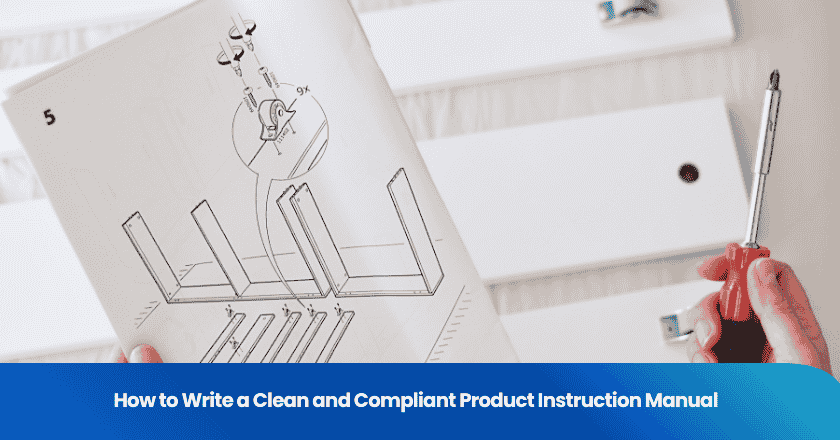
A product instruction manual is the last line of defense between your product and a customer who doesn't know how to use it safely. For importers sourcing goods from Chinese factories, the instruction manual is also one of the most frequently cited reasons for customs holds, product recalls, and retailer rejection. It's rarely the top priority when managing a production order — but it should be.
This guide explains exactly what makes a product instruction manual compliant, which regulations govern different product categories in the US market, and how to structure a manual that protects both your customers and your business.
Key Takeaways
- Product instruction requirements in the US are product-specific: toys, electronics, children's products, and PPE are all governed by different regulations and standards.
- The CPSC's official guidance document (Manufacturer's Guide to Developing Consumer Product Instructions) is the most practical starting point for general consumer products.
- Safety warnings must appear before instructions — not at the back of the manual — and must follow ANSI Z535.6 formatting conventions.
- Language requirements are primarily English for the US market, but Spanish is required for products sold in Puerto Rico and recommended for bilingual markets.
Why Instruction Manuals Are a Compliance Risk
Non-Compliant Manuals Trigger Recalls and Retailer Rejection
A non-compliant instruction manual can make an otherwise safe product legally non-compliant. The US Consumer Product Safety Commission (CPSC) requires certain consumer products to include specific safety warnings, assembly instructions, and age-grading information directly in the manual — not just on the label. Products that arrive without the required instructional content can be rejected at the port of entry, pulled from retailer shelves, or recalled at the importer's expense.
The CPSC's Manufacturer's Guide to Developing Consumer Product Instructions — published specifically to help manufacturers and importers create effective instructional materials — notes that well-designed instructions reduce injury rates, reduce product liability exposure, and increase customer satisfaction. The absence of mandatory instruction content is a reportable defect under Section 15(b) of the Consumer Product Safety Act.
The Connection Between Instructions and Product Liability
In US product liability law, a product can be considered defective not because of a flaw in the physical product itself, but because its instructions failed to adequately warn users of foreseeable risks. This "failure to warn" theory of liability holds importers, distributors, and retailers jointly responsible along with manufacturers. For an Amazon FBA seller importing consumer electronics or a Shopify brand importing nursery products, an inadequate instruction manual is a direct legal exposure that no amount of factory-supplied quality certificates eliminates.
Which Regulations Govern Product Instructions in the US?
The requirements depend entirely on the product category. There is no single federal law that covers all product instruction manuals — instead, instructions are regulated through a patchwork of product-specific rules. The table below summarizes the key frameworks.
| Product Category | Governing Rule | Key Instruction Requirement |
|---|---|---|
| Toys (children under 12) | CPSIA / ASTM F963 / 16 CFR Part 1250 | Age grading, safety warnings, assembly instructions per ASTM F963 Section 6 |
| Electronics / RF devices | 47 CFR Part 15 (FCC) | FCC modification warning; shielded cable and grounding instructions |
| Bicycles | 16 CFR Part 1512 | Instruction manual with assembly, maintenance, and operation/safety content |
| Children's bunk beds | 16 CFR Part 1513 | Verbatim safety warnings; mattress size and foundation specifications |
| Medical devices | 21 CFR Subchapter H (FDA) | Setup, operation, storage, disposal, and risk/benefit explanation |
| General consumer products | CPSC guidance | CPSC Manufacturer's Guide best practices; mandatory where CPSC rules apply |
| Wearing apparel | 16 CFR Part 423 / ASTM D5489 | Care labels with washing or dry cleaning instructions; standardized care symbols |
For a comprehensive overview of which specific US regulations require user instructions by product category, the guide published at ComplianceGate — Product User Instructions Requirements in the United States provides a useful cross-reference of applicable CFR sections.
The Structure of a Compliant Instruction Manual
While regulatory requirements specify mandatory content, they rarely prescribe the exact structure. The ANSI Z535.6 standard — Product Safety Information in Product Manuals, Instructions and Other Collateral Materials — establishes the industry-accepted framework for structuring safety information within manuals. Following ANSI Z535.6 is not legally mandatory for most consumer products, but it is widely referenced in product liability cases as evidence of industry best practice.
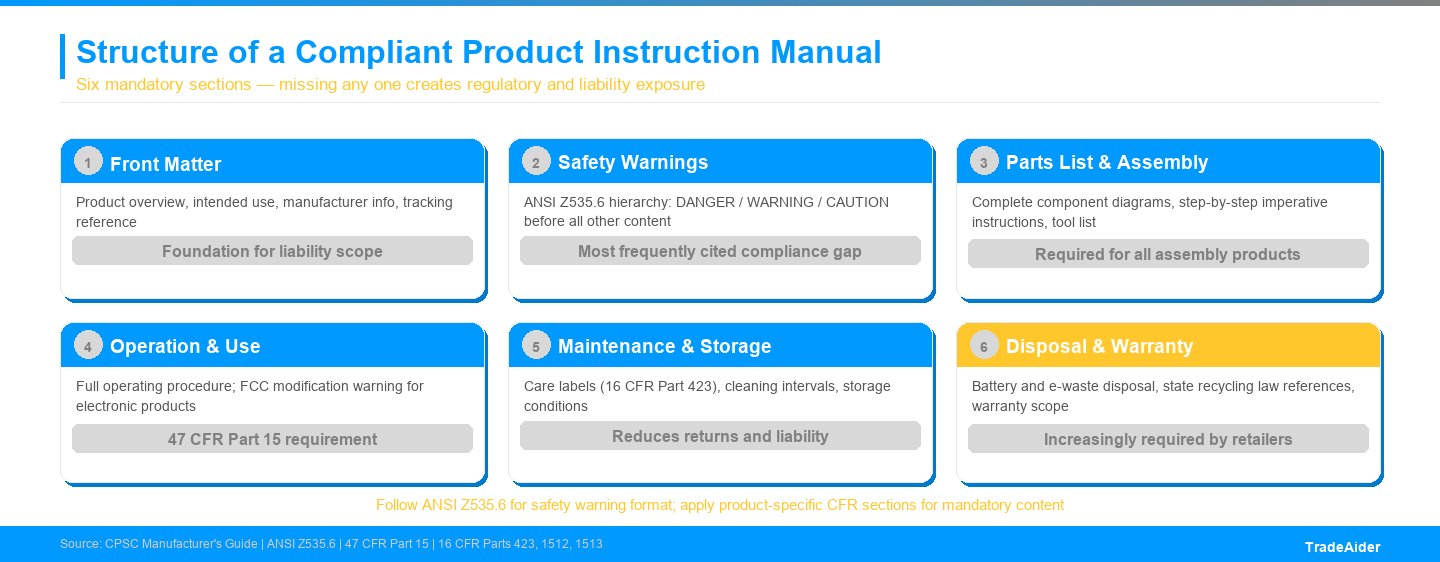
1. Front Matter: Product Overview and Intended Use
The manual should open with a brief product description — what the product is, what it does, and who it is intended for. Intended use is legally significant: it defines the scope of your product's foreseeable use, and anything a user does outside that scope shifts liability toward the user. Clearly stated intended use also allows retailers and regulators to confirm that the product is correctly classified and that the correct standards have been applied.
Include the product name, model number, manufacturer or importer name and address (required under ASTM F963 Section 7 for toys), and a tracking label reference if applicable. For children's products subject to CPSIA tracking label requirements, the lot number, date of manufacture, and manufacturing location must appear on the product and packaging — but referencing this information in the manual as well is good practice.
2. Safety Warnings and Hazard Communication
Safety warnings are the most regulated element of any instruction manual. Under ANSI Z535.6, safety messages must use a three-level hierarchy: DANGER (immediate hazard likely to cause death or serious injury), WARNING (hazard that could cause death or serious injury), and CAUTION (hazard that could cause minor or moderate injury). Each signal word must be formatted consistently, with the signal word in a header panel followed by the nature of the hazard and the instructions to avoid it.
Safety warnings for consumer products regulated by the CPSC must appear prominently and early in the manual. For some product categories, specific warning language is mandated verbatim in the Code of Federal Regulations — bunk beds (16 CFR Part 1513) and baby products are examples. Using different language, even if the meaning is equivalent, creates compliance risk.
A practical rule: if the product can injure a user who misuses it in a foreseeable way, that misuse scenario needs a warning. Courts routinely find against importers who argued a hazard was "obvious" — if the risk is not explicitly warned against in the manual, the importer bears the burden of proving it should have been obvious.
3. Parts List and Assembly Instructions
Any product that requires assembly must include a complete parts list with diagrams, identifying each component by name and number. The parts list should reference the quantities included — so the user can immediately verify that nothing is missing from the box. Missing parts are among the leading causes of assembly-related injuries, and a clear parts list creates a documented baseline for what the user received.
Assembly instructions must be step-by-step, using active imperative sentences ("Insert bolt A into slot B" rather than "Bolt A should be inserted"). Each step should cover only one action. Diagrams must correspond precisely to the text — a diagram that contradicts the written instruction is worse than no diagram at all. For complex assemblies, a torque specification for fasteners, a tool list, and a warning about incorrect assembly consequences should all be included.
4. Operation and Use Instructions
Operation instructions describe normal use of the product. This section must be complete enough that a user who has never seen the product before can operate it correctly after reading the instructions. Assume no prior knowledge — do not rely on users to read other documentation, follow implied steps, or use common sense for product-specific tasks.
For electronically operated products regulated by the FCC under 47 CFR Part 15, the operation instructions must include the standard FCC modification warning: that unauthorized changes or modifications could void the user's authority to operate the equipment. This text is mandatory and must appear in the manual.
5. Maintenance, Cleaning, and Storage
This section reduces product liability exposure by making explicit what users should and should not do to maintain the product. For products with consumable components (filters, batteries, blades), specify replacement intervals and approved replacement part specifications. For products that degrade with improper storage — outdoor furniture, certain textiles, battery-powered products — specify storage conditions explicitly.
Wearing apparel sold in the US is required under 16 CFR Part 423 to have care labels stating washing or dry cleaning instructions. The care symbols used should follow ASTM D5489, which standardizes the symbols used across the industry.
6. Troubleshooting, Warranty, and Disposal
A troubleshooting section reduces post-sale support costs and reduces the likelihood that a user will attempt a dangerous improvised repair. List common problems, their probable causes, and the recommended action — which, for safety-critical components, should often be "contact the manufacturer" rather than a DIY repair sequence.
Disposal instructions are increasingly important for products containing batteries, electronics, or hazardous materials. Several US states have mandatory e-waste disposal laws, and many retailers require disposal language in product documentation. For battery-powered products, reference local battery disposal programs and include the appropriate recycling symbol.
Common Instruction Manual Failures That Cause Import Problems
Missing Mandatory Warning Language
The most common failure is omitting mandatory verbatim warning language required by specific CFR sections. For example, bunk bed instructions must include specific safety warnings listed in 16 CFR Part 1513.6 exactly as written — substituting paraphrased equivalents is not compliant. Factories producing products for multiple export markets often provide generic manuals that satisfy Chinese or European standards but miss US-specific CFR language entirely.
Instructions Not in English
Products intended for the US market must have instructions in English. Manuals provided only in Chinese, or primarily in Chinese with minimal English content, will be flagged by US Customs during entry examination and by retailers during product review. For products sold in Puerto Rico, Spanish-language instructions satisfy the language requirement where English would otherwise apply, per 21 CFR 801.15.
Age Grading and Choking Hazard Warnings Absent or Incorrect
For toys and children's products, age grading information and small-parts/choking hazard warnings are mandatory under both ASTM F963 and CPSIA. A product intended for children under 3 that does not prominently carry "Not suitable for children under 3 years" and the required choking hazard warning will be non-compliant. These must appear on the product, packaging, and in any instructional literature included with the product.
Instructions Provided Only Digitally When Paper Is Required
Some regulations permit instructions to be delivered digitally (47 CFR Part 15 explicitly allows online manuals for FCC-regulated products). However, many CPSC-regulated product categories still require physical instructions to be included with the product at point of sale. Providing only a QR code that links to an online manual, without paper instructions, does not satisfy requirements for most consumer products.
Quality Checking Your Instruction Manual Before Shipment
Instruction manuals should be treated as a regulated component of the product — reviewed and approved before production begins, not corrected after goods arrive at the warehouse. A pre-shipment inspection should explicitly include a documentation check: verifying that the correct manual is included with every unit, that mandatory language is present, and that the manual corresponds to the actual product shipped (not a previous revision or a different market version).
For importers bringing new products to market, commissioning a compliance review of the instruction manual before production — not after — is the only cost-effective approach. Reprinting 10,000 manuals after goods arrive at a US warehouse is an expensive, time-pressured correction. Reviewing a draft manual before the print run costs a fraction of that, and catches the most common compliance failures at the point where they're easiest to fix. TradeAider's product testing service covers documentation and labeling compliance review as part of a complete product compliance assessment.
Frequently Asked Questions
Does every product sold in the US need an instruction manual?
Not every product requires a formal instruction manual, but many do — and for products with any meaningful safety or operational complexity, providing one is strongly advisable regardless of whether it's strictly required. The CPSC recommends that all consumer products include instructional materials that cover safe use, assembly, maintenance, and disposal. For specific regulated categories (toys, children's furniture, electronics, bicycles, PPE), instructions are mandatory. When in doubt, a written checklist of the CFR sections applicable to your product category is the safest starting point.
What standard governs how safety warnings should be formatted in product manuals?
ANSI Z535.6 — Product Safety Information in Product Manuals, Instructions and Other Collateral Materials — is the primary standard governing safety message format in product documentation. It specifies the three-level signal word hierarchy (DANGER, WARNING, CAUTION), the use of safety alert symbols, and the placement and visual formatting of hazard messages. While ANSI Z535.6 is a voluntary standard, it is widely referenced in US product liability litigation as the industry benchmark for adequate safety communication in manuals.
Can a factory-supplied instruction manual be used as-is for the US market?
Rarely without modification. Factory-supplied manuals are typically written for the domestic Chinese market, or for European standards, and miss US-specific regulatory requirements in almost every case. Common gaps include absent FCC warning language for electronics, missing CPSC-required verbatim warnings for regulated product categories, incorrect or absent age-grading information for children's products, and instructions not written in English. The importer — not the factory — is legally responsible for the compliance of the product and its documentation on the US market, so treating the factory manual as a starting draft rather than a final document is the correct approach.
How should instruction manuals be handled during a pre-shipment inspection?
During a pre-shipment inspection, the inspector should verify that the correct instruction manual version is packed with every unit in the shipment, that mandatory safety warnings and language requirements are visibly present, that the manual language matches the destination market, and that assembly/parts diagrams correspond accurately to the actual product being shipped. Any discrepancy between the manual version and the physical product — even a minor revision change — should be flagged as a non-conformity requiring resolution before the shipment is released. Instruction manual errors are among the fastest defects to correct before shipment and among the most expensive to address after goods enter the distribution chain.
مقالات ذات صلة
نمِ عملك مع خدمة TradeAider
انقر على الزر أدناه للدخول مباشرة إلى نظام خدمة TradeAider. الخطوات البسيطة من الحجز والدفع إلى تلقي التقارير سهلة التشغيل.

