
- معلومات عنا

- خدماتنا
- صناعتك
- الموارد
- الأخبار والمدونة
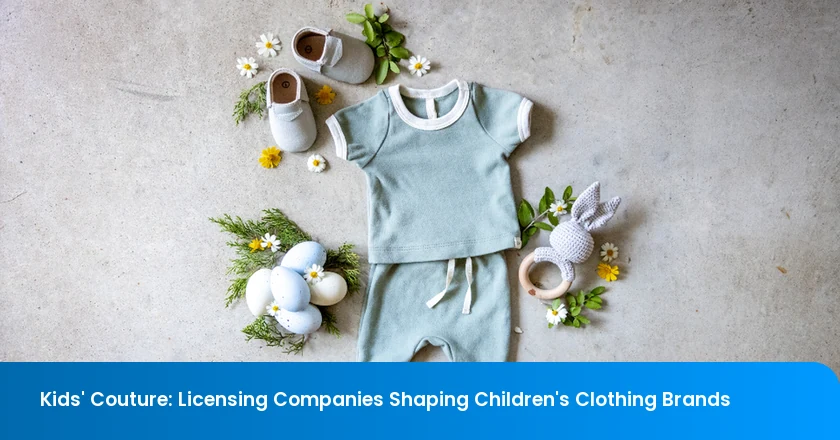
Clothing licensing companies sit between a brand owner and the factory that makes the clothes. A license is an agreement in which a licensor, the owner or representative of a property, grants a licensee the right to use that property on products in return for payment, and licensing companies and their agents run the deal, the approvals and the retail relationships around it. That is how a children's clothing brand adds a character, a celebrity or another label without building a new factory, and why the same license ties the brand to the owner's style guide and production checks. The sections below cover the roles, the reach and design benefits, the collaborations, and the approval-to-production path.
What Clothing Licensing Companies Do in Children's Clothing
Clothing licensing companies run the relationship between a brand owner and a manufacturer, so a children's clothing brand can extend its range without building its own factory. A license is an agreement in which a licensee leases the rights to a legally protected piece of intellectual property from a licensor for use with a product or service. In children's clothing, that usually means a character, a designer name or a corporate brand appears on garments that a separate factory makes, sells and ships.
The roles are worth separating. The licensor owns or represents the property and grants the license; the licensee takes the license and makes the product; and a licensing agent or consultant manages the program for one side or the other. Licensing International defines a license as an agreement through which a licensee leases the rights to a legally protected piece of intellectual property from a licensor for use with a product or service. The property is not transferred: WIPO explains that a registered trademark can be used by its owner or licensed to another party for use in return for payment. The owner keeps the exclusive right, and with it the final say over how the brand appears.
For a children's clothing brand, licensing is brand extension without the cost of a new production line. The brand gains a licensed property and a manufacturer that already knows how to make the garment, and the licensor gains a new product category. Because the owner keeps control, the deal also carries obligations: submissions for approval, agreed quality, and a style guide that says how the brand may be shown. Clear ownership of each decision, who approves the design and who owns the production run, is what makes the rest of the plan work. For information about the organization handling the inspection side, review TradeAider's company background.
Expanding Reach and Building Credibility
Licensing expands a brand's reach because it connects the property to a wider retail and distribution network and to established manufacturers. A licensing company already has relationships with retailers, online sellers and factories, so a children's clothing brand can appear on more shelves, in more regions and in more product categories than it could reach alone.
Reach is not limited to one country. Licensing International's Global Licensing Survey reports that global sales revenue from licensed merchandise and services grew to $389.8 billion in 2025, a 5.45% increase over 2024, so a license is rarely confined to a single market. That scale is also why credibility matters: the same network that puts the product in front of shoppers also decides whether the product is made well enough to keep them.
Credibility comes from the manufacturer as much as from the name. When a licensing company pairs a brand with a manufacturer that meets agreed standards, the licensed garment carries the brand's promise rather than undermining it. The buyer's practical check is to ask who the licensee is, which factory will run the order, and what evidence will show that the finished garments match the approved design.
Enhancing Design and Innovation
Licensing enhances design and innovation because the licensor brings market insight and a written style guide while keeping the brand coherent. Trends in children's fashion move quickly, and a licensor that tracks a character's or a label's audience can point a clothing brand toward themes that will actually sell.
The style guide is the mechanism that lets a brand innovate without drifting. Licensing International describes how the licensor gives guidance, often as a printed or digital style guide, about how the brand, character or logo may be portrayed on the product, on packaging and in advertising. The licensor also runs an approval process, so new artwork, a new colorway or a new print placement is reviewed before it reaches production. Keep the approved design separate from the method used to check it, because a clear requirement can still be measured in more than one way; the inspection-standard guidance explains how the two are kept apart.
Creating Iconic Collaborations
Licensing companies create iconic collaborations by negotiating the agreements that pair a children's clothing brand with a character, celebrity or franchise, and they run the product approval that follows. A collaboration is not only a marketing event; it is a contract with an approval calendar, and that calendar has to fit the production schedule.
Collaborations are the centre of gravity of the business. The same Global Licensing Survey records that character and entertainment licensing is the largest property type at a 41.5% share, which is why a children's clothing range so often leans on a well-known character: the audience, and the retail interest, already exist.
The agent's role is easy to miss. Brand owners often retain a licensing agent to manage the program, negotiate contracts and run the product approval, and the agent earns a share of the royalties. For the clothing brand, that means the approval request goes through the agent, and the production team should know the approval window before it books fabric or print slots. A collaboration also has a defined term and a territory, so the same character may be licensed to different manufacturers in different regions. Confirm which territory and which product categories the license covers before the design work starts, because a print approved for one market may not be approved for another, and the approved sample for one territory may not be the reference for the next.
From Approved Artwork to Production Quality Checks
The license obliges the licensee to submit products for approval and to make them to agreed standards, so the approved design has to be carried into production quality checks. The approved artwork and the approved sample then become the benchmark every later unit is measured against. That is the part of a licensed program that a factory self-check cannot cover on its own.
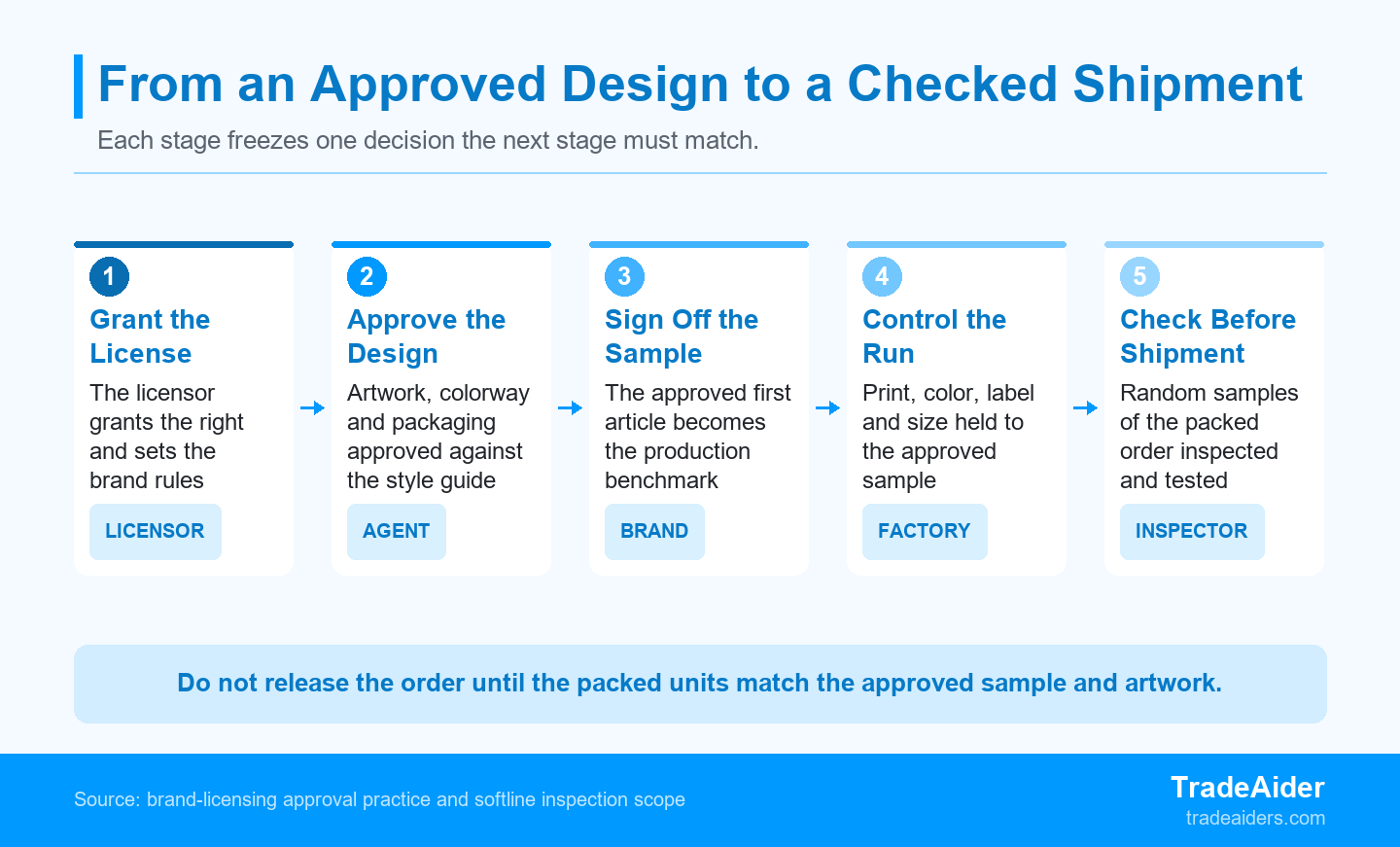
Each stage freezes one decision, and the approved artwork and sample become the reference the production check measures against.
Independent verification is where that benchmark gets tested. TradeAider's Product Testing Services cover product testing in accredited laboratories in China, and the process runs from needs alignment and sample management to testing, result determination and report issuance. A print or color question goes to a print and color check against the approved sample, a material question goes to the laboratory, and the packed order goes to a pre-shipment inspection.
Illustrative Example: An Approved Print That Drifts in Production
An illustrative case shows how an approved design can still ship off-brand. A children's clothing brand holds a license for a popular animated character and places an order of 24,000 toddler t-shirts, across two runs of 12,000, with a factory in Asia for the US and EU markets. The factory prints the character graphic and, after the approved sample was signed off, switches to a cheaper ink and a slightly larger print size. The first run passed the buyer's visual check, so the buyer assumes the second run will match and does not ask about the ink or the print size.
The second run passes a quick look, but the print color is duller than the approved sample and the character is about 8% larger. The factory cannot show an ink record or a first-article print check for the change. The care label and the hangtag still carry the approved artwork reference, so the paperwork and the product disagree.
A visual pass hid a print and color drift because the run was judged by memory rather than measured against the approved sample, so the approved reference and the shipped product diverged while the label claimed they matched. The buyer holds the second run, escalates from sorting to a reprint against the approved artwork, and requires an ink record and a first-article print check before the run continues.
The factory restores the approved ink and print size or submits the change for written approval, then reprints the 3,000 affected units and updates the label reference. The buyer re-checks the corrected first article and the next production sample against the approved sample under the same lighting, and keeps both runs' print records in one file. This is an illustrative licensing and quality example, not measured client defect data, a supplier rating, or a compliance result.
Design and Artwork Approval: What the License Requires
Design and artwork approval fixes the character, colorway, placement and packaging before production, so the approval record is the reference a later production check measures against. The licensor or its agent reviews the concept, the artwork file, the color match and the print placement, and may require the packaging and the hangtag to be approved as well.
The approval is a version, not a conversation. Keep the approved file, its date and its version in the order file, and state which version the factory is authorised to run. The approved first article, sometimes called the pre-production sample, is what the run is measured against. When a material or print method has to change, the change goes back through the same approval rather than being decided on the line. That single rule prevents most of the drift that a later inspection would otherwise find.
Production Quality Checks a Licensed Line Needs
A licensed children's clothing order needs a first-article and approved-sample check, in-line checks on print, color, label and size, and a pre-shipment check of the packed order. The children's clothing safety points, such as cord and drawstring safety and edge and tip inspection, belong in the testing scope, alongside color fastness, heavy-metal testing and fiber-content label verification. Each check answers a different question, and none of them replaces the approved sample as the reference.
| Stage | What it fixes | Owner | Evidence to keep |
|---|---|---|---|
| License and style guide | The rights and the brand rules | Licensor and brand | Signed license and style guide |
| Artwork approval | Character, colorway, placement and packaging | Licensor or agent | Approved artwork file and version |
| Approved sample | The production benchmark | Brand and factory | Signed-off sample and first-article report |
| Production control | Print, color, label and size on the run | Factory | In-line check records and material records |
| Pre-shipment check | The packed order before release | Third party | Inspection report with photos |
Read the table as a decision tool: each row names who owns the record and what the check can still change. A first-article check catches a print or material drift before the run, a pre-shipment inspection confirms the packed order when 100% of the order is complete and at least 80% is packed, and neither replaces the approved sample as the reference. The checks are ordered from the first article to the packed order so a drift can be caught before the shipment rather than after it.
Licensing Challenges That Put Quality at Risk
Licensing faces two recurring quality risks: approvals that arrive late or unclear and compress production, and unapproved changes to materials, print or packing after the sample is signed off. Both are managed rather than solved, and each one has a clear owner once it is named.
An approval that lands after the fabric is cut forces a choice between a rush run and a late shipment. A change that is agreed in a chat message but never recorded leaves the factory and the brand with different ideas of the approved product. Assign an owner who tracks the approval calendar and an owner who controls changes, and keep the approved artwork, the approved sample and the change log in one controlled file. The cost of a recorded change is small next to the cost of reprinting a licensed run that no longer matches the approved design.
How to Keep a Licensed Children's Clothing Line on Brand
To keep a licensed children's clothing line on brand, a brand pairs internal control, built on the approved sample and written procedures, with independent testing and a pre-shipment check. Start from the audit-standard guidance to see how a factory's quality system is scoped, and require the records that show it is followed. The internal system is what holds quality between orders: written procedures, a controlled approved sample and regular audits turn the brand's requirements into routine work rather than a one-off test. A factory that can show its standard operating procedures and its audit trail is far easier to trust on the next run.
Independent verification closes the loop at the shipment. A pre-shipment inspection is normally conducted when 100% of the order is complete and at least 80% is packed, and it inspects randomly selected samples against the buyer's specification. It confirms the packed order rather than the design, so it works best after the artwork, the approved sample and the material tests are already set. Match each risk to a check, keep the resulting records with the order file, and the licensor can see that the brand kept its side of the agreement.
Turn a License Into a Production and Inspection Plan
Send the license, the approved sample and the production schedule with the request so the softline inspection and testing scope can be reviewed together. A first licensed-apparel brief is short, and it states the decisions that drive every later check.
- Name the licensed property and confirm who approves the artwork.
- Keep the approved artwork, the approved sample and the change log in one file.
- Map each off-brand risk to a first-article, in-line or pre-shipment check.
- Add the children's clothing safety and material tests the destination requires.
A review needs four inputs: the licensed brand or character and the license terms, the garment, size range and target market, the approved artwork, colorway and approved sample, and the production schedule and shipment date. TradeAider can review those inputs, agree which softline checks and tests apply, and return a scoped softline inspection and testing proposal with an agreed check list, test list and reporting deliverable. Keep the request short but complete, because a clear brief lets the provider confirm the approved reference and the checks before quoting. If several runs or markets are involved, list them all so the scope can be planned together rather than run by run. To scope that work, contact TradeAider about your licensed apparel inspection plan.
Frequently Asked Questions
Do licensing companies make the clothing, or only handle the brand deal?
They usually handle the brand deal, not the manufacturing, because a license grants a licensee the right to make and sell the product while the licensor keeps control of how the brand appears. A licensing company or agent negotiates the agreement, manages the approvals and connects the brand to manufacturers and retailers, while the licensee, often an established garment maker, owns the production run. Some brand owners license even their core categories and others keep production in house, so confirm which side makes the garments before you plan the order.
Who approves licensed artwork before a children's clothing order runs?
The licensor, or the licensing agent acting for it, approves the artwork against the style guide before production, because the license ties the use of the brand to the owner's approval. Approval usually covers the artwork file, the colorway, the print placement and the packaging, and it is tied to a version. If a material or print method changes later, send it back through the same approval rather than letting the factory decide, because an unrecorded change is what turns an approved design into an off-brand shipment.
How do you keep a licensed children's clothing line on brand after the first order?
Hold every run to the approved sample and artwork, because a visual pass on one run does not prove the next run matches once the ink, the print size or the material changes. Keep the approved sample and the approved artwork version with the order file, require a first-article check on any change, and re-check the production sample against the approved reference under the same conditions. A short change log that records who approved what, and when, is what makes the second and third runs as safe as the first.
What should you inspect on a licensed children's clothing shipment?
Check the packed order against the approved sample for print, color, label, size and packing, and add the children's clothing safety and material tests the destination requires. The pre-shipment stage normally runs when the order is 100% complete and at least 80% packed, and the inspector draws random samples from the shipment to check against your specification. Because it confirms the packed order rather than the design, it works best after the artwork, the approved sample and the material tests are already set.
مقالات ذات صلة
نمِ عملك مع خدمة TradeAider
انقر على الزر أدناه للدخول مباشرة إلى نظام خدمة TradeAider. الخطوات البسيطة من الحجز والدفع إلى تلقي التقارير سهلة التشغيل.

