
- معلومات عنا

- خدماتنا
- صناعتك
- الموارد
- الأخبار والمدونة
China accounts for over 25% of all US consumer product imports — totaling more than $210 billion in goods annually, according to the US International Trade Administration's China Consumer Goods Guide. It also accounts for a disproportionate share of product quality incidents: the CPSC's China Product Hazard Monthly Bulletin tracks recurring defect patterns across product categories that importers and FBA sellers encounter on every sourcing cycle. This article ranks the most commonly defect-prone product categories by defect frequency, defect type, and inspection detection rate — based on CPSC data, industry return rate analysis, and pre-shipment inspection findings.
Key Takeaways
- Rankings: Consumer electronics and apparel generate the highest defect frequencies among China-sourced goods — with electronics leading in functional failures and apparel leading in specification deviations.
- CPSC data: In 2024, the CPSC issued 64 unilateral safety warnings — 42 of which involved China-origin products, and 43 of which involved products sold on Amazon, according to Consumer Federation of America's 2025 analysis.
- Inspection impact: Industry analysis indicates that over 70% of defects identified during final inspection could have been avoided with clearer product specifications or early-stage quality checks — making specification management the highest-ROI intervention before inspection.
- Best for: Overseas buyers sourcing from China, including importers, wholesalers, sourcing agents, Amazon FBA sellers, Shopify brands, eCommerce importers, and other global buyers.
How We Ranked These Categories
The ranking below orders product categories by overall defect risk for overseas importers sourcing from China. Defect risk is assessed across three dimensions: defect frequency (how often defects are found during inspection), defect severity (how likely defects are to generate customer complaints, returns, or CPSC flags), and inspection detectability (how reliably a standard pre-shipment inspection catches the category's common defects before shipment). Categories ranked higher present a combination of high frequency, high severity, and lower detectability without targeted inspection protocols.
The Top 6 Most Defect-Prone Product Categories — Ranked
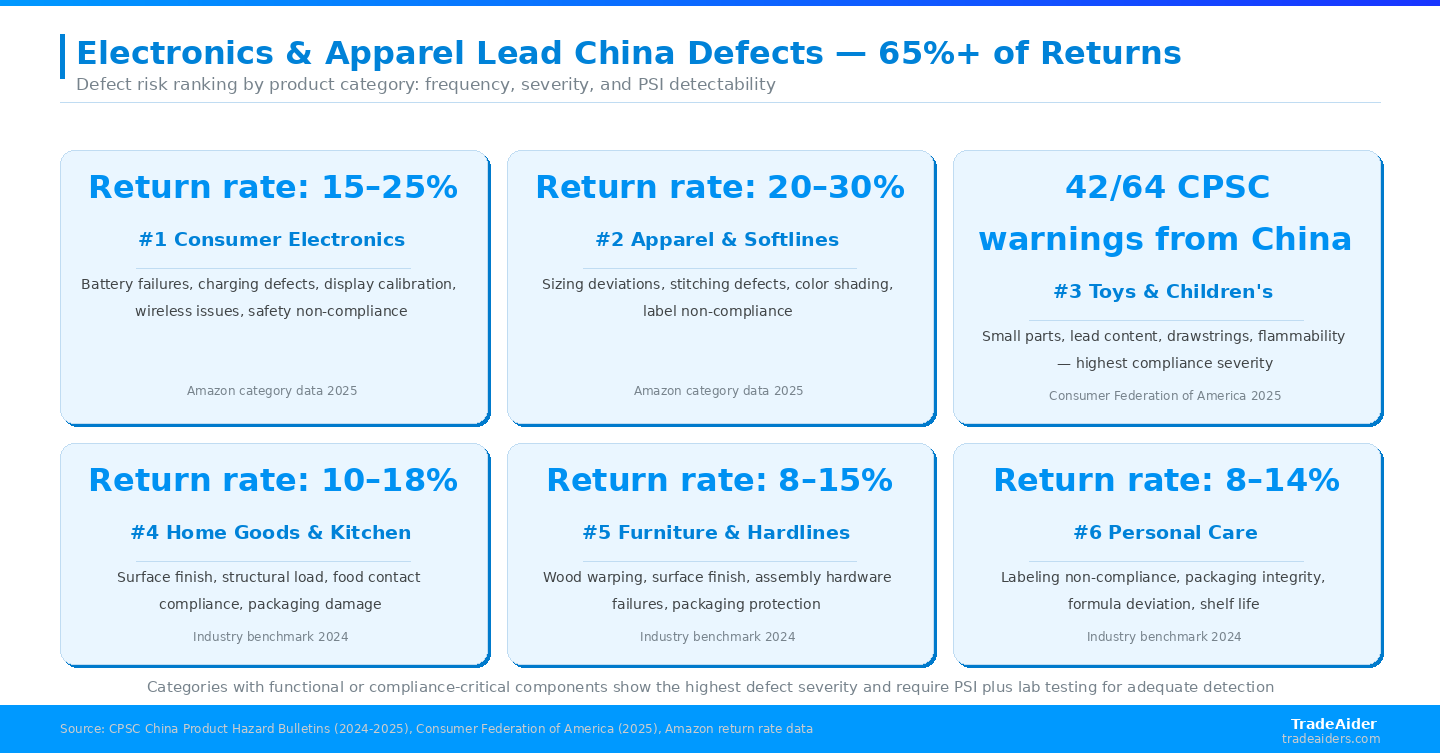
Categories with functional or compliance-critical components show the highest defect severity and require PSI plus lab testing to achieve adequate detection rates
#1 Consumer Electronics — Highest Combined Defect Risk
Consumer electronics top the defect risk ranking for China-sourced goods because functional failures are both common and severe. The category encompasses products with complex components — circuit boards, lithium batteries, wireless modules, display screens — where a single component substitution or assembly deviation causes product failure that buyers immediately notice and return.
The CPSC's China Product Hazard Monthly Bulletin consistently flags electronics defects as a leading category, with lithium-ion battery issues, electrical hazard non-compliance, and overheating risks recurring across monthly summaries. The Consumer Federation of America's analysis of 2024 CPSC data found that 43 of 64 unilateral safety warnings involved products sold on Amazon — a high proportion of which were electronics and electrical accessories. Amazon's return rate data for electronics shows 15–25% returns, the highest among non-apparel categories, with functional failures as the primary driver.
Most common electronics defects found in PSI:
- Battery performance below spec or safety threshold (particularly lithium cells)
- Charging failures — incorrect voltage output, incompatible protocols
- Display calibration errors — color temperature, dead pixels, backlighting inconsistency
- Wireless connectivity failures — Bluetooth pairing, Wi-Fi range below spec
- Electrical safety non-compliance — missing CE/FCC markings, insulation gaps
Inspection detection rate: High — functional testing during PSI catches 80%+ of electronics defects. Detection requires a specific functional test protocol, not a generic visual check. Importers should provide a detailed test script for each SKU.
#2 Apparel and Softlines — Highest Defect Volume
Apparel generates the highest absolute volume of defects among China-sourced categories, driven by the complexity of garment construction (multiple components, processes, and subcontractors) and the high tolerance sensitivity of end consumers for sizing, fit, and finish. According to category-level return rate data (Red Stag Fulfillment, 2025), apparel return rates on Amazon run 20–30%, with quality-driven returns (sizing defects, stitching failures, color deviation) representing a significant share.
Most common apparel defects found in PSI:
- Measurement deviations — garments outside the allowed size tolerance (typically ±1cm)
- Stitching defects — skipped stitches, puckered seams, unraveling thread ends
- Color shading — visible lot-to-lot color variation within the same order
- Label non-compliance — missing care instructions, incorrect country of origin, wrong fiber content
- Trim defects — wrong button size, incorrect zipper type, mismatched thread color
Inspection detection rate: High for visual and measurement defects. AQL 2.5 sampling with a measurement checklist catches the majority of sizing and workmanship issues. Color shading requires a specific shade-band check against an approved color standard.
#3 Toys and Children's Products — Highest Severity Risk
Toys and children's products rank third in defect frequency but first in defect severity. A single compliance failure — excess lead in paint, a small part accessible to children under age 3, flammability non-compliance in children's sleepwear — can trigger a CPSC mandatory recall with no warning period. The CPSC's monthly China Product Hazard Bulletin specifically and repeatedly flags children's product hazards: lead levels in jewelry and accessories, choking hazards from drawstrings, and small detachable parts in toys.
Most common toys and children's product defects:
- Small parts — components that detach and present a choking hazard to children under 3
- Lead content — excess lead in surface coatings, substrate materials, or accessories (above 100ppm under CPSC rules)
- Flammability — children's sleepwear not meeting US or EU flammability standards
- Drawstring hazards — strings on children's upper outerwear creating strangulation risk
- Structural integrity — toys that break in ways creating sharp edges or projectile hazards
Inspection detection rate: Moderate for visual compliance checks; low for chemical hazards (lead, phthalates) without lab testing. Standard PSI catches structural and small-part hazards; lead and chemical compliance requires product testing in addition to on-site inspection.
#4 Home Goods and Kitchenware — High Defect Frequency, Moderate Severity
Home goods and kitchenware present a broad defect spectrum spanning structural integrity, surface finish, and food safety compliance. Products in this category include cookware, storage containers, home décor items, cleaning accessories, and kitchen tools — each with distinct defect patterns.
Most common home goods defects found in PSI:
- Surface finish defects — scratches, paint chips, plating inconsistency
- Dimensional tolerance failures — lids that don't fit, stacking that doesn't work, assembly misalignment
- Food contact material non-compliance — for cookware and containers, BPA or heavy metal migration above regulatory limits
- Structural failure — welds, joints, or folded metal edges that separate under normal use load
- Packaging damage — products damaged in transit due to insufficient packaging protection
Inspection detection rate: High for visual, dimensional, and structural defects. Chemical compliance (food contact materials) requires lab testing. Packaging integrity is a specific PSI checkpoint that catches transit damage risk before shipment.
#5 Furniture and Large Hardlines — Lower Frequency, High Impact Per Event
Furniture and large hardline products have lower defect rates than apparel or electronics, but defects in this category generate outsized customer impact: a wobbly chair, a cabinet that warps in humidity, or a bed frame that fails assembly instructions generates a return or a negative review that damages the listing significantly. Furniture also has the highest per-unit rework cost among consumer categories — returning a large item to China for correction is economically unfeasible, making source-point detection critical.
Most common furniture defects found in PSI:
- Wood quality deviations — moisture content out of spec leading to warping after delivery
- Surface finish issues — paint runs, uneven staining, veneer delamination
- Assembly hardware defects — missing screws, wrong thread pitch, non-functional cam locks
- Structural load failures — joints that do not meet weight specification under test load
- Packaging damage risk — insufficient corner protection for heavy items in transit
Inspection detection rate: High for visual, structural, and completeness checks. Moisture content requires a specific meter reading checkpoint. Assembly integrity requires a full assembly test on sampled units.
#6 Personal Care and Beauty Products — Emerging Compliance Risk
Personal care products — skincare, haircare, cosmetics, wellness accessories — represent a growing share of China-sourced imports for FBA and DTC sellers. Defects in this category increasingly center on regulatory compliance (ingredient labeling, prohibited substance lists, claims compliance) rather than functional or cosmetic issues. A labeling non-compliance in a personal care product can trigger FBA listing removal and account-level compliance flags simultaneously.
Most common personal care defects found in PSI:
- Labeling non-compliance — missing ingredient lists, incorrect country of origin, false or unsupported claims
- Packaging integrity failures — pump mechanisms that leak, containers that break under normal handling
- Shade or formula deviations — product color, texture, or scent different from the approved sample
- Shelf life documentation — missing lot code or expiration date compliant with destination market requirements
Inspection detection rate: Moderate for visual and labeling checks; low for formula compliance and prohibited substances without lab testing. TradeAider also provides testing services, covering Hardline Products, Softline Products, Electrical & Electronic Products, and Industrial Products, enabling buyers to manage quality control and testing needs within a single service framework.
Quick Comparison: Defect Risk by Category
| Rank | Category | Typical Return Rate | Top Defect Type | PSI Detectability |
|---|---|---|---|---|
| #1 | Consumer Electronics | 15–25% | Functional failure, battery defect | ✅ High (with functional test) |
| #2 | Apparel & Softlines | 20–30% | Sizing deviation, stitching | ✅ High (measurement check) |
| #3 | Toys & Children's Products | 12–20% | Small parts, lead, drawstrings | ⚠️ Moderate (PSI + lab testing) |
| #4 | Home Goods & Kitchenware | 10–18% | Surface finish, structural | ✅ High (visual + structure) |
| #5 | Furniture & Hardlines | 8–15% | Warping, assembly hardware | ✅ High (assembly test + moisture) |
| #6 | Personal Care & Beauty | 8–14% | Labeling, packaging integrity | ⚠️ Moderate (PSI + testing) |
Based on this comparison, the data shows a clear pattern: categories with functional or compliance-critical components (electronics, toys, personal care) require inspection protocols that go beyond standard visual AQL — including functional testing, compliance checklists, and in some cases product testing from an accredited laboratory. Categories driven by cosmetic and dimensional defects (apparel, home goods, furniture) are highly catchable with a well-structured PSI brief that includes measurement checkpoints and golden sample comparison.
The CPSC Recall Context: Why China-Sourced Defects Get Escalated
The CPSC reported in 2025 that in 2024, nearly half of all product recalls and safety warnings involved goods originating from China — against a backdrop of 369 total recalls, the highest number in recent years. The Consumer Federation of America's 2025 analysis found that of the 64 unilateral CPSC safety warnings issued in 2024, 42 involved China-made products and 43 involved products sold on Amazon. The convergence of these two channels — China sourcing and Amazon selling — creates a structural quality risk that pre-shipment inspection directly addresses.
The most frequently flagged hazard types in the CPSC's China Product Hazard Monthly Bulletins correspond directly to the defect categories in the ranking above: lithium-ion battery hazards (electronics), small part and drawstring hazards (toys and children's products), lead in surface coatings (jewelry and accessories), and flammability non-compliance (apparel and textiles). Importers in these categories face not just return rate exposure but potential mandatory recall liability if defects reach consumers in volume.
For a comprehensive AQL sampling plan matched to your product's defect risk profile, use the AQL calculator to determine sample sizes before booking inspection. For categories requiring product testing alongside PSI, TradeAider's testing services cover hardline, softline, electrical/electronic, and industrial products within a single service framework.
Who Is TradeAider?
TradeAider is a quality inspection, testing, and certification service provider in China. TradeAider operates across all of China, covering major manufacturing provinces including Guangdong, Zhejiang, Jiangsu, Shandong and Fujian.
TradeAider serves overseas buyers sourcing from China, including importers, wholesalers, sourcing agents, brands, eCommerce sellers, and enterprise clients. Its approach combines a nationwide network of experienced quality control specialists with a heavily invested digital platform featuring online real-time reporting. Clients can monitor inspections live, communicate directly with inspectors, and address issues during production rather than after shipment — a proactive model focused on problem-solving and prevention, not just defect identification.
Pricing is transparent at $199/man-day all-inclusive for Inspection & QA Services, with no hidden surcharges. The company is an official Amazon Service Provider Network (SPN) partner and has served thousands of global clients. Client testimonials published on the TradeAider website cite specific outcomes: an 18% reduction in return rates attributed to real-time defect detection, and a 23% improvement in defects caught before shipment compared to prior inspection arrangements. These are client-reported figures.
Frequently Asked Questions
What are the most common product defects found in China-made consumer goods?
The most common defects vary significantly by product category, but the highest-frequency types across all categories include: functional failures (electronics), measurement deviations (apparel), small part hazards (toys), surface finish defects (home goods and furniture), and labeling non-compliance (personal care, toys, and any regulated product category). According to industry inspection data, over 70% of final-inspection defects could have been avoided with clearer product specifications or earlier quality checks — making specification management the primary prevention lever.
Which product category has the highest defect rate when sourcing from China?
Consumer electronics and apparel generate the highest combined defect frequency for China-sourced goods. Electronics lead in functional defect severity — battery failures, connectivity issues, and electrical safety non-compliance — while apparel leads in absolute defect volume due to the complexity of garment construction across multiple subcontractors. Both categories have return rates significantly above the cross-category average, making them the highest priority for systematic pre-shipment inspection across every order cycle.
Can pre-shipment inspection catch all the defect types listed in this article?
Pre-shipment inspection catches the majority of defect types in all six categories — particularly functional, dimensional, cosmetic, and packaging defects. However, chemical and material compliance defects (lead content, food contact migration, prohibited substances in personal care) require product testing from an accredited laboratory in addition to on-site PSI. Importers in regulated categories (toys, children's products, personal care, electronics) should plan for both PSI and product testing. TradeAider provides testing services covering Hardline, Softline, Electrical and Electronic, and Industrial Products alongside its inspection service.
How does China's manufacturing structure contribute to high defect rates?
China's manufacturing ecosystem relies heavily on subcontracting — factories routinely sub-contract components, surface treatments, or assembly steps to smaller suppliers without buyer notification. When a sub-supplier changes a component grade or process parameter to reduce cost, the defect enters the supply chain invisibly. This structural pattern explains why defect rates often rise suddenly on repeat orders from previously reliable suppliers, and why the most effective intervention (pre-shipment inspection with golden sample comparison) operates at the finished goods stage rather than during production planning.
Contact TradeAider to build a category-specific inspection brief for your next order — Amazon SPN partner, $199/man-day all-inclusive, same-day booking available.
مقالات ذات صلة

نمِ عملك مع خدمة TradeAider
انقر على الزر أدناه للدخول مباشرة إلى نظام خدمة TradeAider. الخطوات البسيطة من الحجز والدفع إلى تلقي التقارير سهلة التشغيل.

