
- معلومات عنا

- خدماتنا
- صناعتك
- الموارد
- الأخبار والمدونة

Moisture content is the single most important quality metric for wooden furniture — and the one most often overlooked during inspection. Wood that is too wet warps, molds, and fails at joints. Wood that is too dry cracks and splits. For importers buying wooden furniture from Chinese manufacturers, moisture content checks during product inspection are the difference between furniture that lasts for years and furniture that falls apart in the first season.
This guide covers how moisture content affects wooden furniture quality, what target ranges you should specify, how inspectors test for moisture on the factory floor, and the standards that define acceptable levels for different markets.
Key Takeaways
- Target moisture content for indoor wooden furniture is 6-12%, depending on wood species, product type, and destination climate
- Moisture above 20% triggers mold and fungal growth, while levels below 5% cause cracking and structural weakness
- Pin-type moisture meters are the standard inspection tool — accurate to within plus or minus 1-2% when used correctly
- Kiln-dried wood for export should be stabilized at 8-12% MC to match climate conditions in most destination markets
- China's GB/T 3324 standard requires wood moisture content to match the equilibrium moisture content of the destination region plus 1%
Why Moisture Content Determines Furniture Quality
What Happens When Moisture Is Too High
Wood is hygroscopic — it absorbs moisture from humid air and releases it in dry conditions. When furniture leaves a Chinese factory with moisture content above the equilibrium level for its destination market, the wood continues to dry during transit and storage. That drying process causes shrinkage, and shrinkage creates stress.
The results are predictable and expensive:
- Warping and bowing — tabletops and panels curve as one face dries faster than the other
- Joint separation — mortise-and-tenon, dovetail, and dowel joints loosen as wood shrinks away from glue lines
- Finish failure — lacquer, varnish, and paint crack and peel as the substrate moves beneath them
- Mold and mildew — moisture content above 20% creates conditions for fungal growth during container shipping, particularly in sealed ocean freight containers where humidity builds
What Happens When Moisture Is Too Low
Over-dried wood is just as problematic. When moisture content drops below the equilibrium level for the destination, the wood absorbs moisture from the air and swells. Drawers stick, doors bind, and panels buckle. In extreme cases, rapid moisture absorption causes checking — fine cracks that spread along the grain.
The goal is never to get wood "as dry as possible." The goal is to get wood to the moisture content that matches the environment where the furniture will live. That target varies by destination market.
Target Moisture Content by Destination Market
The correct moisture content for wooden furniture depends on the equilibrium moisture content (EMC) of the destination region — the level at which wood neither gains nor loses moisture in that specific climate. The table below shows target ranges based on climate data and industry standards.
| Destination Market | Climate Zone | Target MC Range | Common Wood Species |
|---|---|---|---|
| United States (most regions) | Temperate / Continental | 6-9% | Oak, walnut, maple, birch |
| US Southeast / Gulf Coast | Humid subtropical | 9-12% | Oak, pine, ash |
| United Kingdom / Western Europe | Maritime temperate | 10-12% | Oak, beech, ash, pine |
| Australia (coastal) | Temperate / subtropical | 10-13% | Oak, pine, rubberwood |
| Middle East | Arid / desert | 5-7% | Teak, oak, walnut |
| Scandinavia / Northern Europe | Cold continental | 7-9% | Birch, pine, oak |
Industry guidance from moisture measurement specialists indicates that furniture-grade hardwoods in North America typically require 6-9% MC, while the same species destined for more humid markets like the UK or Southeast Asia should be at 10-13% to minimize post-delivery movement. Export-focused furniture manufacturers in Vietnam and China generally target 8-12% as a safe range for most international destinations.
How Inspectors Test Moisture Content
Pin-Type Moisture Meters (Primary Inspection Tool)
Pin-type meters are the standard tool for on-site moisture content inspection at Chinese furniture factories. They work by driving two pins into the wood surface and measuring electrical resistance between them — since wood's resistance changes predictably with moisture content, the meter converts that resistance into a percentage reading.
The inspection protocol for pin meters includes:
- Insert pins to a depth of 6 mm minimum — surface readings are unreliable because the outer layer dries faster than the core
- Take readings at multiple points on each component — at least three measurements per major piece (tabletop, chair leg, cabinet side panel)
- Test both face grain and end grain — end grain absorbs and releases moisture faster, showing the extremes of the moisture gradient
- Record the wood species setting — different species have different calibration curves; using the wrong setting introduces error
When calibrated and used correctly, pin-type meters are accurate to within plus or minus 1-2 percentage points, which is sufficient for field inspection purposes. The Chinese standard for wooden furniture inspection specifies that the moisture meter error must not exceed plus or minus 2%.
Pinless Moisture Meters
Pinless meters use electromagnetic scanning to measure moisture without penetrating the surface. They are faster and leave no marks — important for inspecting finished pieces where pin holes would be unacceptable. However, pinless meters measure an average over their entire scanning area (typically 19-25 mm deep) and cannot detect moisture gradients within the wood thickness.
Experienced inspectors often use both types: pinless meters for rapid scanning to identify problem areas, then pin meters for precise spot measurements where elevated readings are found.
Oven-Dry Method (Laboratory Reference)
When there is a dispute about moisture readings, the oven-dry method provides the definitive measurement. A sample is weighed, dried in an oven at 103 degrees Celsius until all moisture is removed, then weighed again. The moisture content is calculated as the weight loss divided by the dry weight. This method is accurate but destructive and time-consuming, making it impractical for routine inspection but essential for calibration verification and dispute resolution.
Setting Up a Moisture Content Inspection Protocol
When to Measure
Timing matters because moisture content changes as furniture moves through production stages:
- Raw material receiving — verify kiln-dried lumber arrives at the correct MC before production begins. This is where a pre-production inspection adds the most value
- After assembly, before finishing — joinery, gluing, and sanding can introduce moisture. Check before lacquer or paint is applied
- Final inspection before shipment — verify finished goods are within the target range. This is your last chance to catch problems before the furniture enters a shipping container
How Many Points to Test
For an AQL-based inspection using standard sampling, the number of units tested for moisture follows the same sample size calculation as visual defect checks. Within each sampled unit, measure moisture at:
- Flat surfaces (tabletops, shelves): 3 points — center and two edges
- Legs and vertical components: 2 points — top and bottom
- Joined assemblies: 1 reading at each major joint
- Plywood and engineered wood: 2 points per panel — face and edge
Any reading outside the specified tolerance range counts as a defect. Consistently high readings across multiple units indicate a systemic kiln-drying or storage problem at the factory, not random variation.
Applicable Standards for Wood Moisture in Furniture
| Standard | Scope | Key MC Requirement |
|---|---|---|
| GB/T 3324-2017 | Chinese national standard for wooden furniture | MC must match regional annual average EMC + 1% |
| QB/T 1951.1 | China industry standard for wood furniture quality | Moisture content within product use region's EMC range |
| ASTM D4442 | Direct moisture content measurement of wood | Oven-dry reference method for calibration |
| ASTM D4444 | Calibration of hand-held moisture meters | Meter accuracy within plus or minus 2% |
| EN 14749 | European domestic storage furniture safety | Strength and durability requirements (implies MC control) |
| ISO 13061-1 | Physical and mechanical properties of wood | Determination of moisture content for testing |
When writing your inspection requirements, reference GB/T 3324-2017 for products manufactured in China and ASTM D4444 for meter calibration standards. Using both standards in your specification gives the inspector clear, measurable criteria and gives you an objective basis for accept-or-reject decisions. Detailed inspection standard guidelines can help you structure these requirements.
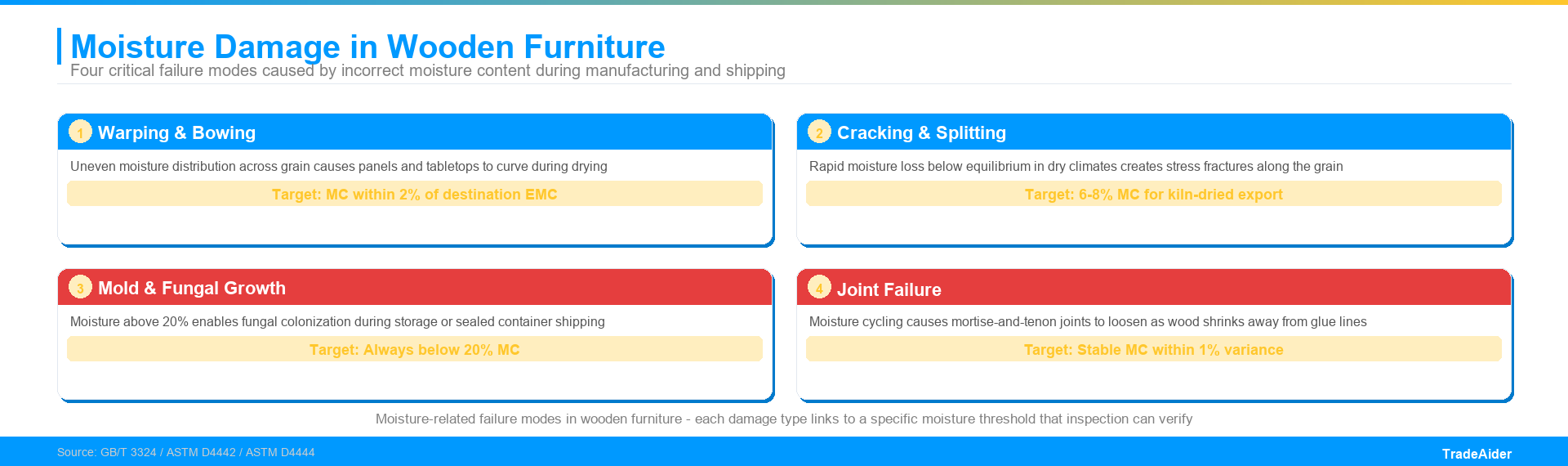
Moisture-related failure modes in wooden furniture — each damage type links to a specific moisture threshold that inspection can verify
Common Questions
What is the acceptable moisture content for wooden furniture?
For indoor furniture destined for temperate markets like the US and Europe, the generally accepted range is 6-12% MC. Furniture-grade hardwoods in North America typically target 6-9%, while products for more humid markets like the UK or Southeast Asia should be 10-13%. The key principle is matching the wood's moisture content to the equilibrium moisture content of the destination environment.
How accurate are pin-type moisture meters?
Properly calibrated pin-type moisture meters are accurate to within plus or minus 1-2 percentage points. The Chinese wooden furniture inspection standard requires meter error not to exceed plus or minus 2%. Accuracy depends on correct species calibration, proper pin insertion depth (minimum 6 mm), and regular meter calibration against oven-dry reference samples.
Is 17% moisture content acceptable in wood furniture?
No. At 17% MC, wooden furniture is at significant risk of mold growth, warping, and joint failure. While some sources consider up to 17% acceptable for rough lumber in outdoor storage, finished furniture for indoor use should always be below 12%. Moisture above 20% creates active conditions for fungal growth and is a clear rejection criterion during inspection.
When should moisture content be checked during production?
Moisture should be checked at three critical points: when raw lumber arrives at the factory (to verify kiln-drying), after assembly but before finishing (to catch moisture introduced during production), and during final pre-shipment inspection (to confirm finished goods are within specification before they enter the shipping container).
Protect Your Wooden Furniture Shipments
Moisture content is not a "nice to have" check — it is the fundamental quality metric that determines whether wooden furniture will perform as expected in your customer's home. High moisture causes warping and mold. Low moisture causes cracking. Both trigger returns, reviews, and reputation damage.
The good news is that moisture content inspection is straightforward: a calibrated pin-type moisture meter, a trained inspector, and clear tolerance specifications are all you need to catch problems before they leave the factory. TradeAider provides on-site inspection in China at $199 per man-day, with real-time reporting that lets you see moisture readings and make decisions as the inspection happens.
Schedule your wooden furniture inspection to verify moisture content on your next shipment.
مقالات ذات صلة



نمِ عملك مع خدمة TradeAider
انقر على الزر أدناه للدخول مباشرة إلى نظام خدمة TradeAider. الخطوات البسيطة من الحجز والدفع إلى تلقي التقارير سهلة التشغيل.

