
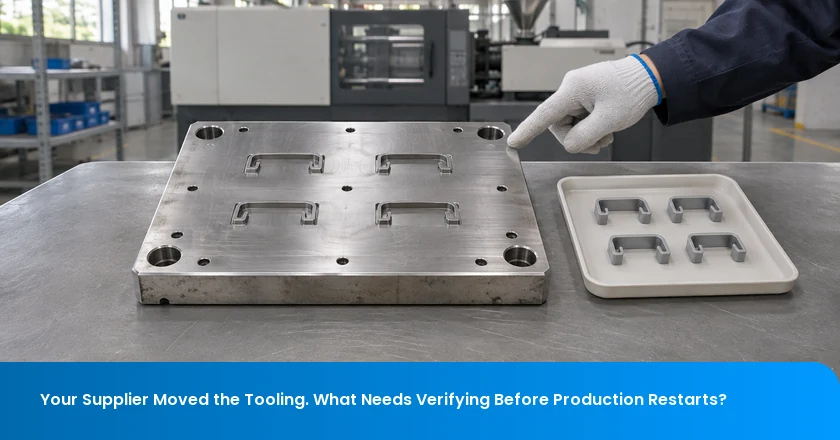
Confirm that the tool arrived in its approved configuration and that the receiving factory can run it under an agreed setup. Authorize a controlled trial, compare first articles made at the new site against the approved requirements, then review pilot evidence before releasing routine production. Keep trial output segregated while approvals are open. Use the order’s change-control rules to identify any site approval, audit or formal resubmission that also needs to be completed.
Confirm what moved and what changed
Identify the transferred tool and the conditions at the new site before authorizing a controlled trial. Ask for the tool ID, revision, active cavities, matching inserts and maintenance or repair history. A cavity is a space in the mold that forms a part. Compare the dispatch and receiving records for the same tool and attached components. Record transport damage, corrosion, missing items or disputed identity before the new site changes the condition or starts a trial.
- Confirm the tool, manufacturing address and equipment that will be used.
- Agree which changed conditions need first-article or pilot evidence.
- Record who can authorize the trial, accept the first articles and release routine production.
Ask for a side-by-side record of the previous and planned setup. Include the mold and press, material grade and source, part handling and any secondary operation, such as trimming. Compare the measuring equipment and fixtures, trained roles and site dependencies relevant to the product, such as cooling and material conditioning. Name each change that could affect a drawing feature or function so the technical owner can choose a targeted check.
In its own supplier release procedure, Bosch Rexroth includes relocation among the reasons to review production processes. Check the actual change-notification and approval terms for your order. If the new site or a subcontracted operation is outside the original approval, confirm whether the buyer requires a supplier audit, a focused technical review or a formal submission before releasing that scope.
TradeAider describes pre-production inspection as checking readiness after raw materials arrive and before manufacturing begins. Agree which conditions an inspection can document at the receiving site. Have the supplier’s qualified staff complete the installation and commissioning checks, then obtain any required buyer signoff for the controlled trial.
Compare first articles from the new setup
Use first articles made on the identified new setup to check product conformity. A first article is an early production sample made under the setup being evaluated. Before the run, agree the samples, drawing revision, features to check, measurements, fit checks and acceptance criteria. If the tool produces several parts or includes several cavities, agree how the sampling will cover each relevant output.
Choose the approved comparison and method
Compare the early output against the controlling drawing and recorded methods, with the old approved sample as a reference where applicable. The old sample can help show an approved finish or fit. Use the current drawing or agreed limit to judge a toleranced dimension. Confirm how the feature is located and measured, including any specified fixture, part conditioning and timing after molding.
NIST’s guidance on gauge studies describes how to characterize sources of measurement error in production instruments. If the new site uses a different fixture, instrument or method, ask the technical owner to verify that it can make the required decision. A measurable difference can come from the part, the method or both. Resolve a disputed comparison before approving the affected feature.
Keep samples tied to the tool and process
Identify which cavity, material and equipment produced each sampled part. Mark each part or its container with the cavity, tool and machine references, material lot and time in the run. Record the applicable setup or recipe revision so the samples can be linked to the conditions you intend to repeat. Separate adjusted trial pieces from pieces made from the intended setup.
Use TradeAider’s inspection standard as a starting point for the inspection brief. Include the comparison method and current specifications for your part. If the supplier changed the intended setup after obtaining samples, ask which characteristics need to be rechecked and preserve the earlier record as evidence of that earlier setup.
Review the pilot before authorizing routine production
Use representative pilot data and the agreed acceptance criteria to justify routine production. A pilot is a limited run used to collect evidence from the proposed production setup. Agree its duration or quantity and check intervals with the technical owner. Plan coverage for conditions that could change output, such as warming up, the relevant cavities or material lots, and the handoff between operators if it matters. Identify how the factory will mark and hold the pilot output.
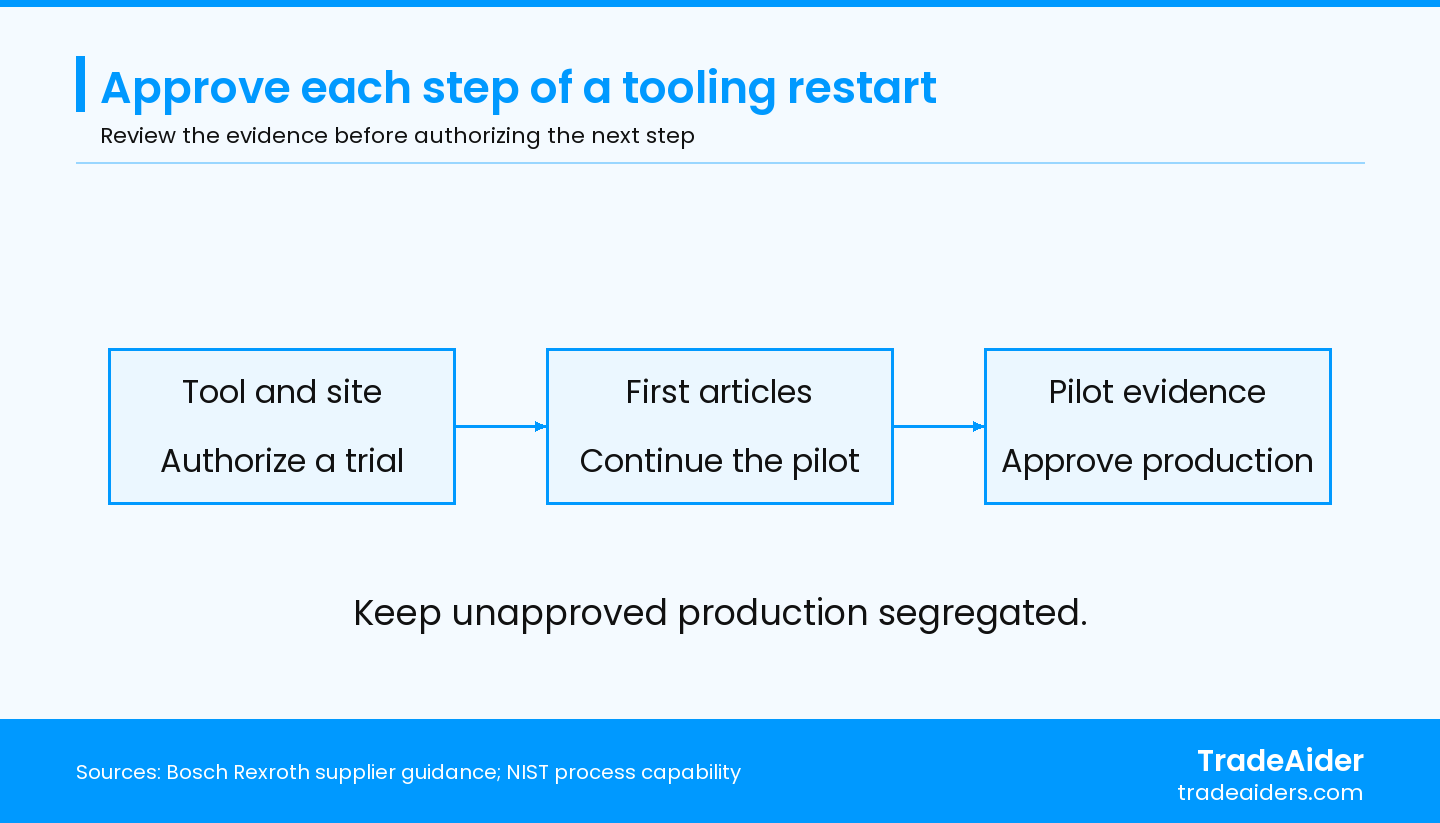
Review the tool and site before trial, approve the initial parts against the specified criteria, and use representative pilot evidence to decide on routine production.
DecisionEvidence to reviewScope the decision can authorizeReady for a controlled trialTool identity, condition, receiving setup and required site approvalsAgreed trial with identifiable and segregated outputFirst articles conformTraceable new-site samples, drawing and verified methodsAcceptance of the samples and continuation within the approved pilot scopeReady for routine productionRepresentative pilot results, required capability evidence and control planProduction on the specifically approved setup and conditionsEvidence incomplete or a check failsAffected time, cavity and output, plus unresolved approvalHold affected goods, close the gap and verify again as applicable
NIST’s process capability guidance compares the variation of a stable process with its specification limits. One conforming reading per cavity provides evidence about those parts. To support a claim about repeatability, review results in time order, at the cavity or other appropriate grouping, under the conditions that will apply in production. If the order requires a capability study, agree the data plan, applicable method and acceptance criterion before committing to production.
Review any change in spread, trend or out-of-limit observation before relying on a pooled summary. If the pilot changed equipment, settings or materials that matter, identify what those results can establish and whether a new run on the final configuration is needed. Have the supplier identify the affected stock and the owner responsible for corrective work and verification.
The same mold passes first articles but fails a pilot check
Illustrative scenario. A supplier moves a four-cavity mold for plastic storage-bin clips to a different factory and mounts it on another press. The buyer’s drawing gives the mating width as 20.00 ± 0.10 mm, an acceptable range of 19.90 to 20.10 mm. The tool ID, cavity configuration, material grade and receiving record match the approved transfer. The documented new press and cooling setup are allowed for a controlled trial. The new site uses a verified measuring method under the specified conditioning.
Conforming first articles can coexist with a later pilot failure on the same tool. The first clip from each cavity checks at 19.98, 20.01, 20.03 and 20.02 mm respectively. Assume the other specified first-article checks also meet the buyer’s criteria. The buyer accepts the first-article evidence and continues the agreed pilot with the output held.
Later in the pilot, a clip from cavity four measures 20.12 mm after the same conditioning. The buyer keeps routine production on hold and asks the supplier to check the measurement and the relevant process records. If confirmed, the reading is above the upper limit. It does not diagnose the cause. Keep the pilot segregated and identify which cavity and time range may share the issue. If those parts cannot be separated reliably, retain the wider potentially affected group. Confirm any correction with a new documented run and the required approvals before routine production.
Record exactly what the approval permits
The written release should identify the approved site and setup, the evidence behind it and which production is authorized. Include the site, tool and machine IDs, product revision, approved cavities, material specification and any restrictions. Reference the approved first-article results, pilot record and current checks the supplier will use once volume begins. Assign an owner and a due date for unresolved actions.
Specify whether the approval covers a further pilot, a limited run or routine production. Write a separate disposition for trial stock and keep it identifiable until the buyer accepts the stated scope. Ask the supplier to flag subsequent changes that invalidate the record. If shipment has a separate release rule, carry the new-site approval into the shipment file and complete the order’s required checks.
To discuss verification at the receiving factory, contact TradeAider with the previous and new site, tool and press IDs, product drawing, and the proposed trial or first-article plan. Identify which conditions need observation and which approvals are still open.
FAQ
Can the supplier use the old site’s capability data?
Use the old site’s data to select characteristics and understand earlier performance. Compare its equipment, settings, material, measurement method and data grouping with the proposed operation. Assess the current process with the new-site data required under the buyer’s plan or explicit technical decision.
What if the original molding press moved with the tool?
Confirm the new site’s installation and dependencies even if both the mold and press are unchanged. The receiving team may use different support equipment, material handling, utilities or gauges. Agree whether existing approvals still apply and verify the dependencies that could alter the parts or the measurement.
Does every tool transfer need a formal PPAP submission?
Use the production part approval process (PPAP) only when the applicable customer, program or quality agreement requires it. Check the agreed notification and submission rules before restarting. The customer’s authorized contact should confirm the evidence needed for this change, including any written decision to limit the resubmission scope.
مقالات ذات صلة

نمِ عملك مع خدمة TradeAider
انقر على الزر أدناه للدخول مباشرة إلى نظام خدمة TradeAider. الخطوات البسيطة من الحجز والدفع إلى تلقي التقارير سهلة التشغيل.