
- معلومات عنا

- خدماتنا
- صناعتك
- الموارد
- الأخبار والمدونة
Quality control checks are the specific inspections, measurements, tests, counts, and evidence steps used to confirm whether a product or shipment matches defined requirements. They work only when the buyer knows what should be checked, how samples are selected, how defects are classified, and what result triggers release or correction.
ISO 9001 makes the core point: quality depends on meeting requirements consistently. For importers, a quality control check is useful only when it is tied to a requirement in the PO, approved sample, drawing, label file, packing rule, or destination-market obligation.
ASQ quality terminology distinguishes quality assurance and quality control concepts, which helps buyers avoid a common mistake: a supplier system may be audited, but the actual shipment still needs product-level checks.
When checks are sampled, ISO 2859-1:2026 provides a lot-by-lot attribute sampling framework many buyers use for AQL inspection. The standard supports sampling discipline; the buyer must still define the product requirements and severity rules.
- A check needs a requirement: otherwise the inspector is judging from habit, not buyer evidence.
- Sampling needs lot structure: SKU, color, size, carton, date, and factory groups must be represented.
- Defect classification turns findings into action: critical, major, and minor rules should be set before inspection.
- The output should be a decision: release, hold, sort, rework, retest, or reinspect.
How Do Quality Control Checks Work?
Quality control checks work by comparing selected products, components, packaging, labels, or documents against defined requirements, recording defects or measurements, classifying severity, and using the result to decide whether the lot should be released, held, sorted, reworked, tested, or reinspected.
A check can be simple, such as confirming that each carton has the right barcode. It can also be technical, such as measuring a critical dimension, testing basic function, checking adhesive bonding, verifying accessories, or comparing labels against a destination-market file. The principle is the same: requirement, sample, check, evidence, action.
For process-related checks, NIST process-control guidance is useful because it shows why repeated signals matter. If the same defect appears by line, shift, material batch, or production date, the buyer should treat the finding as a pattern rather than a random observation.
Inspection consistency also matters. ISO/IEC 17020 frames inspection around competence and consistency. A buyer can apply the same idea by giving inspectors clear scope, tools, product context, and reporting rules before the visit.
Quality Control Check Types and Outputs
Each check should produce evidence the buyer can use.
| Check Type | What It Verifies | Evidence Produced | Decision It Supports |
|---|---|---|---|
| Visual check | Workmanship, finish, color, label presence | Photos and defect counts | Sort or rework |
| Measurement check | Dimension, weight, thickness, tolerance | Measurement table | Hold affected subgroup |
| Function check | Basic use, power, fit, assembly, movement | Pass/fail count and video/photo proof | Release or rework |
| Packing check | Carton, retail box, accessories, marks, quantity | Carton photos and count evidence | Correct before loading |
| Document check | Report, certificate, manual, label artwork | File match or gap list | Escalate before shipment |
| Sampling check | Lot-level acceptance by sample plan | AQL result and defect severity | Release, hold, reinspect |
A good checklist uses several check types together. A toy, shoe, electronic device, garment, furniture item, or accessory may need visual, measurement, function, label, packing, and document checks in the same inspection.
The check type should follow the risk. If the risk is a hidden chemical claim, visual checks are not enough. If the risk is a wrong carton mark, laboratory testing will not solve it. Matching check type to risk is the heart of inspection planning.
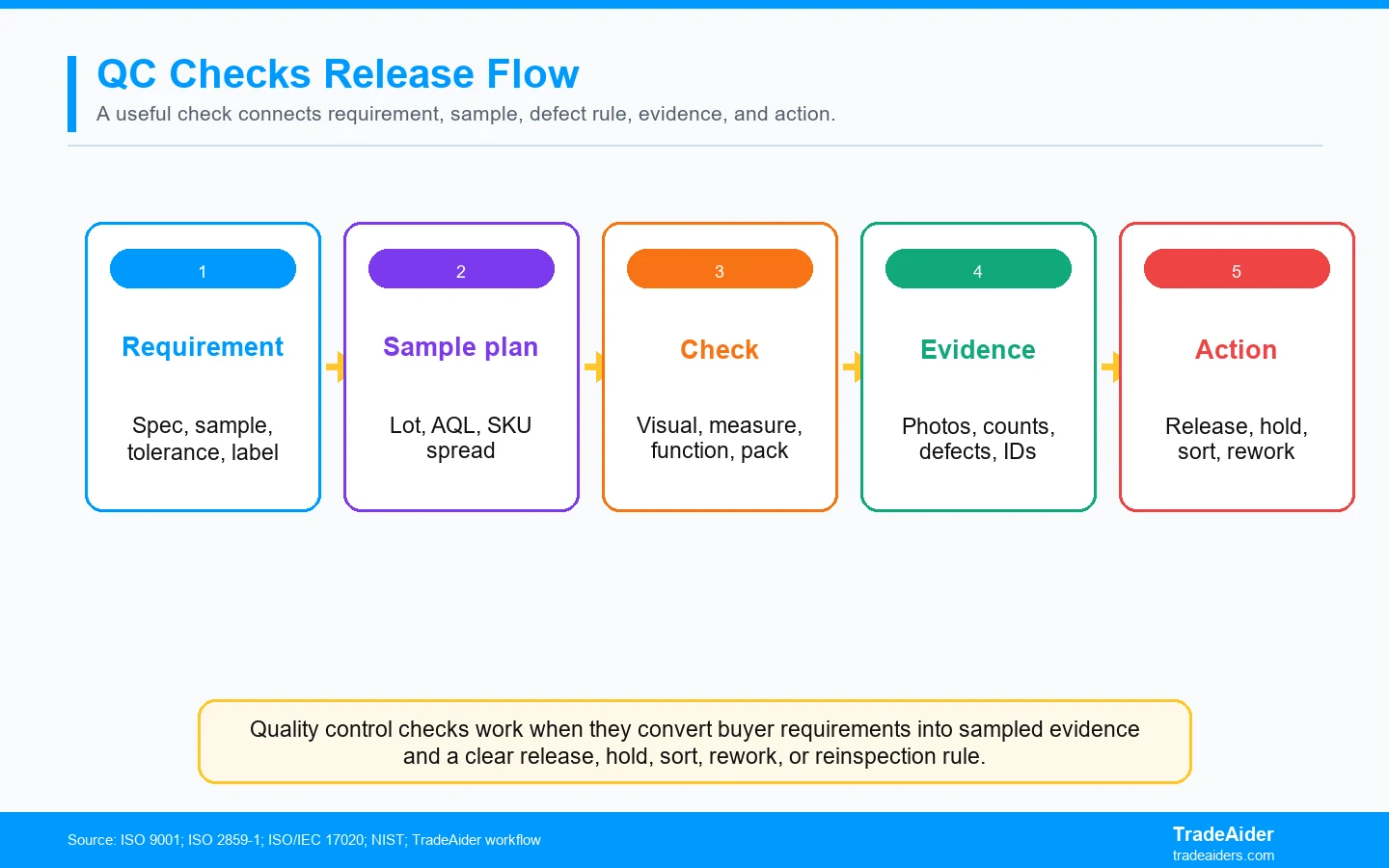
Quality control checks work when they convert buyer requirements into sampled evidence and a clear release, hold, sort, rework, or reinspection rule.
Quality Control Checks Work as a Release System
A check is not useful because it exists; it is useful because it changes a shipment decision.
Start with the buyer requirement
Before inspection, the buyer should define what counts as acceptable: specification, approved sample, drawing, tolerance, color reference, label artwork, barcode, packing method, test report, safety file, and defect class. If a check cannot be linked to one of these requirements, it may be decorative.
This is why generic checklists often fail. They include many common items but miss the critical-to-quality points that make a specific shipment acceptable or risky. A battery product, cabinet, T-shirt, plush toy, and metal bracket should not share the same core checks.
Then define the sample and severity
Sampling should reflect the real lot. If the order includes multiple SKUs, colors, sizes, carton groups, production dates, or factories, the inspector should sample across those groups. Otherwise the cleanest subgroup can hide the risky subgroup.
Defect severity should be agreed before the visit. A scratch, missing label, failed function, wrong warning, loose part, or missing accessory can be critical, major, or minor depending on product use and buyer promise. The inspection result depends on that classification.
The Report Should Explain What Was Checked and What It Means
Inspection evidence should be traceable enough for the buyer to act without guessing.
A useful report records sample size, carton selection, SKU spread, production status, checked points, defect photos, counts, measurements, severity, and whether the result meets the defined acceptance rule. It should not only say that the product was checked.
The best reports also show concentration. If all defects appear in one SKU, one color, one carton range, one production date, or one line, the buyer may release clean subgroups and hold the affected subgroup. If defects are scattered across the lot, the buyer may need broader reinspection or supplier correction.
Evidence is strongest when it is tied to identity. Photos should show product, label, carton, SKU, barcode, date code, or other traceability clues where relevant. Otherwise the buyer may know a defect exists but not which goods are affected.
Scenario Estimate: A 1% Defect Rate Can Mean Very Different Actions
The meaning of a defect count changes when the buyer sees concentration and severity.
Assume a 10,000-unit shipment has a 1% visible defect rate, or about 100 affected units. If those defects are minor scratches scattered randomly, sorting may solve the issue. If the same 100 defects are failed function concentrated in one 1,000-unit SKU, the buyer should hold that subgroup.
This scenario does not replace AQL or contract rules. It shows why a quality control check should record severity, location, and concentration, not just a total defect count.
A buyer who sees only the percentage may make the wrong decision. A buyer who sees the pattern can choose release, sort, rework, reinspection, or supplier corrective action with less guesswork.
Common Reasons Quality Control Checks Fail
A check usually fails because the buyer did not connect it to a requirement, a sample, or an action.
The check is too generic for the product
A generic checklist may ask whether workmanship is acceptable, but it may not ask whether a toy has the right warning, a garment has the right care label, an electronic device has the right adapter, or a cabinet includes all hardware. The check sounds complete while missing the buyer's real risk.
The fix is to write the checklist from the product file outward. Start with the PO, approved sample, customer promise, known failure modes, destination market, and sales channel. Then decide which visual, measurement, function, packing, and document checks belong in the inspection.
The report records findings without a threshold
Another common failure is a report that lists defects but never says whether the lot meets the buyer's rule. If the buyer receives photos of scratches, failed functions, and carton issues without critical/major/minor classification, the report becomes a discussion document rather than a release decision.
The buyer should set thresholds before the visit: zero critical defects, AQL limits for major and minor defects, hold rules for repeated failures, and reinspection requirements after rework. The inspector then knows what evidence the buyer needs, and the factory knows what result will stop release.
Use Check Results to Improve the Next Purchase Order
A quality control check should not disappear after one shipment decision.
After the order is released, held, sorted, or reinspected, the buyer should update the product file with the inspection findings. Repeated defects can become new checklist items, photos can become defect examples, and unclear tolerances can become measurable requirements on the next PO.
This habit is important for growing importers because each inspection becomes a small quality database. If three reports show label placement drift, the next order should include earlier label approval and carton-level label checks. If function failures cluster around one component, the next order may need incoming material review, production-line checks, or added functional sampling.
The goal is not to make every future inspection longer. The goal is to make the inspection sharper. Remove checks that never affect release, strengthen checks that repeatedly protect the buyer, and make the supplier understand which evidence will decide payment and shipment. That is how repeated QC checks become practical supplier control.
Where TradeAider Fits in Quality Control Checks
TradeAider helps importers turn product requirements into measurable checks, sampled evidence, defect classification, and release decisions before goods leave China.
For finished goods, Pre-Shipment Inspection can apply AQL sampling, visual checks, measurements, function checks, label review, packing verification, and photo evidence.
For process drift, During Production Inspection can check early output before the same defect spreads across the lot. For setup risk, Pre-Production Inspection can verify samples, materials, labels, and readiness before production starts.
TradeAider can also help buyers define defect classes with inspection standard guidance and choose sample logic with the AQL calculator before the factory visit.
SPAR Scenario: The Check Was Fine, but the Release Rule Was Missing
The buyer changed the report from observations into a decision.
Situation: A buyer received a report showing 38 defects across a 9,000-unit order.
Problem: The report did not classify severity or show whether defects were concentrated by SKU.
Action: The buyer asked TradeAider to remap defects by carton range, SKU, severity, and sample location.
Result: The buyer released three clean SKUs, held one SKU for rework, and reinspected only the affected subgroup instead of delaying the whole shipment.
Quality Control Check Planning Checklist
Use this checklist before inspection starts.
- Define the product requirement each check supports.
- Choose sample spread by SKU, color, size, carton, or production date.
- Classify critical, major, and minor defects with examples.
- Name tools, measurements, function tests, and photo evidence needed.
- Set release, hold, sort, rework, retest, or reinspection rules.
- Confirm the report will show identity, severity, counts, and concentration.
A short checklist with clear decisions is better than a long checklist with no release rule. If a finding will not change what the buyer does, it probably does not belong in the main inspection scope.
The buyer should update the checklist after every serious defect, return, or supplier dispute so the next inspection becomes more precise.
If your team has a product spec but no clear inspection checklist, send TradeAider the PO, spec sheet, approved sample, defect concerns, lot structure, and shipping deadline. The next step is to turn your product requirements into QC checks before the factory visit.
Frequently Asked Questions
What is a quality control check?
A quality control check is a specific inspection, measurement, test, count, or document review used to confirm whether a product or shipment meets defined requirements.
How do QC checks differ from QA?
Quality assurance focuses on the system that should prevent defects, while quality control checks verify actual products, lots, labels, packing, or documents against requirements.
What should be included in QC checks?
Include visual workmanship, dimensions, function, labels, packing, quantity, documents, accessories, and product-specific risks tied to the approved sample and purchase order.
Can every product use the same QC checklist?
No. Generic checklists miss critical-to-quality points. Each checklist should reflect the product category, buyer promise, destination market, and known defect risks.
What should happen after a QC check fails?
The buyer should decide whether to release, hold, sort, rework, retest, or reinspect based on defect severity, concentration, and contract requirements.
مقالات ذات صلة

نمِ عملك مع خدمة TradeAider
انقر على الزر أدناه للدخول مباشرة إلى نظام خدمة TradeAider. الخطوات البسيطة من الحجز والدفع إلى تلقي التقارير سهلة التشغيل.

