
- معلومات عنا

- خدماتنا
- صناعتك
- الموارد
- الأخبار والمدونة
You've placed an order with a factory you've never visited. The price is right, the samples look good — but do you actually know how those products are made? Who assembled them? Whether the working conditions meet basic ethical standards? For importers sourcing from China and other manufacturing hubs, these questions have moved from "nice to think about" to "legally required." Supply chain due diligence is the process that answers them — and the stakes have never been higher.
Key Takeaways
- Supply chain due diligence is a structured process to identify, assess, and address ethical and legal risks in your supplier network — covering labor practices, environmental standards, and product safety.
- New legislation — including the EU's Corporate Sustainability Due Diligence Directive (CSDDD) and the U.S. Uyghur Forced Labor Prevention Act (UFLPA) — now makes due diligence a legal obligation for many importers, not just a best practice.
- Third-party factory audits and pre-shipment inspections are the most reliable on-the-ground tools for verifying supplier compliance, providing documented proof that your supply chain meets required standards.
What Is Supply Chain Due Diligence?
Supply chain due diligence is a systematic, ongoing process through which a company identifies, prevents, mitigates, and accounts for actual and potential adverse impacts within its supply chain. According to the Accountability Framework initiative, due diligence is not a one-time checkbox exercise — it's a risk management discipline that must be embedded into how a company sources, contracts, and monitors its suppliers.
In practical terms, due diligence for an importer sourcing from China means going beyond a supplier's word or a polished product catalog. It means verifying that the factory you're working with:
- Employs workers under legal and ethical conditions (no forced labor, fair wages, safe environment)
- Operates in compliance with environmental regulations
- Produces goods that meet your destination market's safety and quality standards
- Has a documented quality management system that prevents defects from leaving the factory floor
The scope of due diligence has expanded significantly over the past decade. Where once it focused primarily on financial risk (can this supplier actually deliver?), it now encompasses human rights, environmental responsibility, and regulatory compliance across the entire supply chain — including sub-suppliers and raw material sources.
Why Supply Chain Due Diligence Has Become Non-Negotiable
The Legal Landscape Is Changing Fast
The single most important driver of due diligence urgency for importers is legislative pressure. Two major frameworks now define what's legally expected.
In Europe, the EU's Corporate Sustainability Due Diligence Directive (CSDDD), which entered into force on July 25, 2024, requires companies operating in the EU to conduct due diligence on their own operations and their supply chains for human rights and environmental impacts. The full text of Directive (EU) 2024/1760 outlines obligations that extend beyond direct suppliers to upstream value chain partners. Companies that fail to comply face substantial fines and civil liability.
In the United States, the Uyghur Forced Labor Prevention Act (UFLPA) operates under a rebuttable presumption: goods with any connection to the Xinjiang Uyghur Autonomous Region are presumed to have been produced with forced labor and are banned from import unless the importer can provide clear and convincing evidence to the contrary. According to a 2025 UFLPA Strategy update analysis by Troutman Pepper, enforcement has broadened to include new high-risk industries and additional entities on the UFLPA entity list, requiring importers to trace supply chains with far greater granularity than before.
The Business Case Is Just as Compelling
Legislation aside, the business case for due diligence is straightforward. A single high-profile supply chain scandal — a factory fire with unsafe conditions, a forced labor allegation, a product recall tied to a non-compliant supplier — can cause brand damage that takes years to repair. For e-commerce sellers in particular, where customer reviews and platform ratings are existential, the reputational risk of a compromised supply chain is immediate and visible.
There's also a direct financial argument. Importers who conduct proper due diligence before placing orders catch compliance issues, quality problems, and capacity limitations early — when they're still fixable. Those who skip this step discover them at the port, in the warehouse, or in customer returns. The difference in cost between finding a problem at the factory and finding it after shipment can be an order of magnitude.
The 5 Steps of Supply Chain Due Diligence
Effective due diligence isn't a single inspection — it's a repeating cycle. The Ethisphere Institute's practical guide to supply chain due diligence emphasizes that companies need both a systematic process and the right verification tools at each stage. Here's how that cycle works for importers sourcing from Asia.
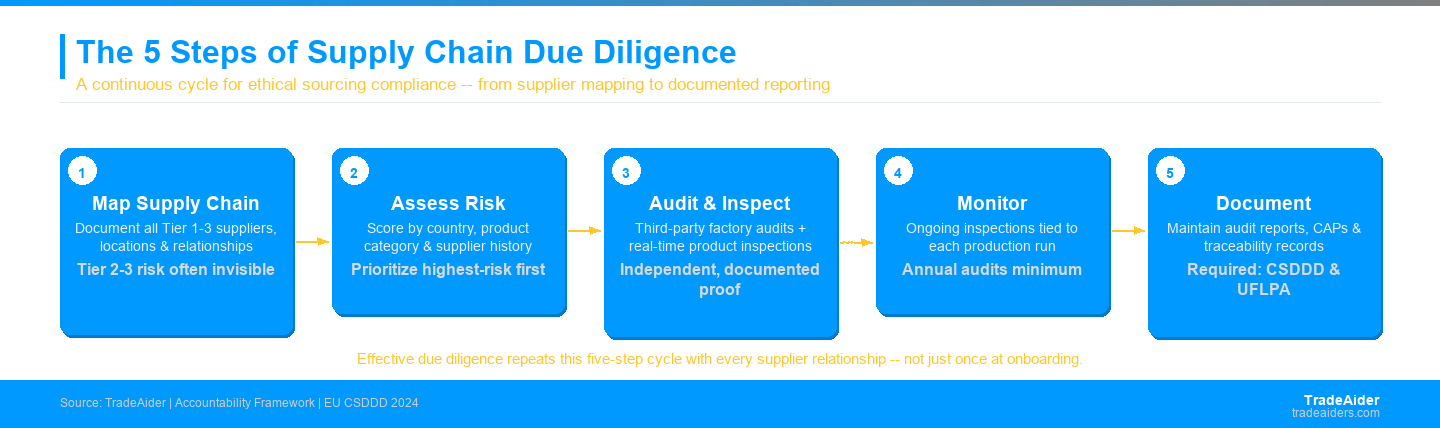 Supply chain due diligence is a five-step continuous cycle — not a one-time checkbox. Each step builds evidence and informs the next.
Step 1: Map Your Supply Chain
You can't manage what you can't see. The first step is building a clear map of your supplier network — not just your Tier 1 factory contacts, but the sub-suppliers who provide raw materials, components, and packaging. For many importers, this reveals significant blind spots: a garment manufacturer who subcontracts embroidery to an unvetted workshop, or an electronics assembler whose PCB supplier operates in a restricted region.
Mapping tools range from simple spreadsheets for small importers to dedicated supply chain visibility platforms for larger operations. At minimum, every supplier relationship should be documented with: legal entity name, physical address, key contacts, products/services supplied, and any applicable certifications.
Step 2: Assess Risk by Supplier and Category
Not all suppliers carry the same risk. A factory producing metal brackets for furniture carries different risk profiles than one producing children's toys or food-contact products. Risk assessment should consider:
- Country and region risk — certain geographies carry elevated human rights, environmental, or geopolitical risk
- Product category risk — products in regulated categories (food, cosmetics, electronics, children's goods) face stricter compliance requirements
- Supplier relationship depth — new suppliers warrant more intensive scrutiny than long-term verified partners
- Certification gaps — suppliers without relevant certifications (ISO 9001, SA8000, BSCI, etc.) represent higher baseline risk
This risk segmentation allows importers to allocate their verification resources proportionally — conducting deeper audits where the risk is highest, and relying on lighter touch monitoring where suppliers have a strong track record.
Step 3: Verify Through Audits and Inspections
This is where due diligence moves from desk research to ground truth. Third-party factory audits and product inspections are the primary tools for verification — and the only way to get independent, documented evidence of what's actually happening on the factory floor.
A thorough factory audit covers:
- Management systems — quality control procedures, documentation, corrective action processes
- Labor practices — employment contracts, working hours, wages, freedom of association, health and safety
- Environmental compliance — waste management, emissions, chemical handling
- Physical conditions — fire safety, structural integrity, emergency procedures
- Sub-contracting practices — whether the factory uses unapproved sub-suppliers
Product inspections — whether conducted before production (PPI), during production (DPI/DUPRO), or before shipment (PSI/FRI) — provide a parallel verification layer focused on quality and specification compliance. Real-time inspection platforms now allow importers to observe the inspection process remotely and review findings as they happen, rather than waiting for a static PDF report days later. This real-time visibility fundamentally changes the dynamic: instead of finding out what went wrong after the fact, buyers can make decisions during the inspection and direct corrective actions before product leaves the factory. To understand what these stages cover, see pre-shipment inspection services and during-production inspection options.
Step 4: Monitor Continuously
Conditions in a factory change. A supplier who passed an audit two years ago may have taken on too much new business, outsourced production, changed management, or cut corners to meet pricing pressure. Due diligence is not a one-time event — it requires ongoing monitoring.
Continuous monitoring can take several forms: regular re-audits (annually or semi-annually for high-risk suppliers), periodic product inspections tied to order cycles, real-time platform monitoring during production runs, and supplier self-assessments with spot-check verification. The cadence should be calibrated to the risk profile established in Step 2.
Step 5: Document and Report
The documentation component of due diligence has become critical under new legislation. Under the CSDDD, companies must maintain records of their due diligence processes and findings. Under UFLPA, importers facing CBP scrutiny must be able to produce supply chain traceability documentation on demand.
Beyond legal compliance, good documentation serves a practical purpose: it builds an institutional record of supplier performance over time, creates accountability for corrective actions, and provides the evidence base for supplier development programs or sourcing decisions.
Common Pitfalls in Supply Chain Due Diligence
Treating Audits as a One-Time Pass/Fail
Many importers commission a factory audit when onboarding a new supplier, receive a passing score, and consider the job done. This misunderstands what audits can and cannot do. An audit captures a snapshot — what was observable and documentable on a specific day. A factory can prepare for an audit, temporarily improve conditions for the visit, and revert afterward. The antidote is a combination of: unannounced or short-notice audits, regular re-inspection, and monitoring beyond the audit visit itself, such as real-time inspection during production runs.
Focusing Only on Tier 1 Suppliers
The most significant compliance risks often sit in Tier 2 and Tier 3 — the raw material suppliers and component manufacturers that your direct factory uses. This is precisely where the UFLPA has caught many importers off guard: a product assembled in an otherwise compliant Tier 1 factory can still be blocked at the U.S. border if a cotton or polysilicon component traces back to a restricted source. Extending due diligence beyond direct suppliers is operationally challenging but increasingly mandatory.
Relying Solely on Supplier Self-Declarations
Supplier-provided certificates and self-assessment questionnaires have a role in due diligence — they establish a documented baseline and create contractual accountability. But they are not verification. Independent third-party audits and inspections exist precisely because self-declarations are insufficient evidence. For any supplier relationship carrying meaningful risk, independent verification is non-negotiable.
How TradeAider Supports Your Due Diligence Process
For importers sourcing from China who need practical, on-the-ground due diligence support, the combination of factory audits and product inspections forms the core of a defensible compliance program. TradeAider's factory audit service goes beyond a static report: buyers can participate in the audit interactively through the real-time platform, asking questions and directing the inspector's attention to specific concerns as the audit unfolds. This means a buyer in the UK can have the same situational awareness as someone physically present on the factory floor in Guangdong.
For ongoing monitoring, linking audit findings to a regular inspection schedule — pre-production, during production, and pre-shipment — creates a continuous verification loop that satisfies both operational quality needs and regulatory documentation requirements. If you're building or reviewing your supply chain due diligence program, contact our team to discuss how independent inspection and audit services can fit into your compliance framework.
Frequently Asked Questions
What is the difference between supply chain due diligence and a factory audit?
Supply chain due diligence is the overarching process — the systematic framework for identifying, assessing, and addressing risks across your supplier network. A factory audit is one tool within that process. Due diligence also encompasses supplier mapping, risk assessment, document review, ongoing monitoring, and reporting. A factory audit without a broader due diligence framework provides only a point-in-time snapshot without the context of continuous improvement and risk management.
Is supply chain due diligence legally required for importers?
It depends on where you sell. The EU's CSDDD, which entered into force in July 2024, creates binding due diligence obligations for companies operating in the EU above certain thresholds. In the U.S., the UFLPA effectively requires importers of goods with any connection to specific regions to conduct and document detailed supply chain traceability. Additional country-specific legislation — including Germany's Supply Chain Act (LkSG) and France's Duty of Vigilance Law — applies to companies of certain sizes operating in those markets. The trend is clearly toward mandatory due diligence globally, even for mid-sized importers.
How often should I audit my suppliers?
High-risk suppliers — new relationships, suppliers in high-risk regions, or those producing regulated product categories — should be audited at least annually, with unannounced spot checks in between. Established suppliers with a strong track record can move to an 18-month or 2-year cycle, supplemented by ongoing product inspections. For very high-risk categories, some importers conduct a factory audit before every major production run. The right cadence depends on your risk assessment and the regulatory requirements of your target markets.
Can I conduct supply chain due diligence remotely?
Remote due diligence — document review, supplier questionnaires, virtual meetings — can supplement but not replace on-site verification for high-stakes supplier relationships. However, real-time inspection technology has significantly expanded what remote oversight can achieve during production and inspection. Buyers can now observe inspections as they happen, receive live photos and videos from the factory floor, and make real-time decisions without being physically present. This is particularly valuable for importers who can't travel frequently to China. For a deeper look at how remote inspection platforms work, see how TradeAider's platform works.
What documentation do I need to prove supply chain due diligence?
The documentation required depends on the regulatory framework you're operating under, but a solid due diligence record typically includes: supplier mapping documents (entity names, locations, roles), risk assessment records for each supplier, factory audit reports from independent third parties, product inspection reports tied to specific order numbers, corrective action records (what issues were found and how they were resolved), supplier certifications (ISO, SA8000, etc.), and import compliance records (country of origin declarations, UFLPA traceability documentation where applicable). The key principle under most frameworks is that documentation must be contemporaneous, specific, and independently verifiable — not prepared after the fact.
مقالات ذات صلة
نمِ عملك مع خدمة TradeAider
انقر على الزر أدناه للدخول مباشرة إلى نظام خدمة TradeAider. الخطوات البسيطة من الحجز والدفع إلى تلقي التقارير سهلة التشغيل.

