
- About Us

- Our Services
- Your Industry
- Resources
- News & Blog
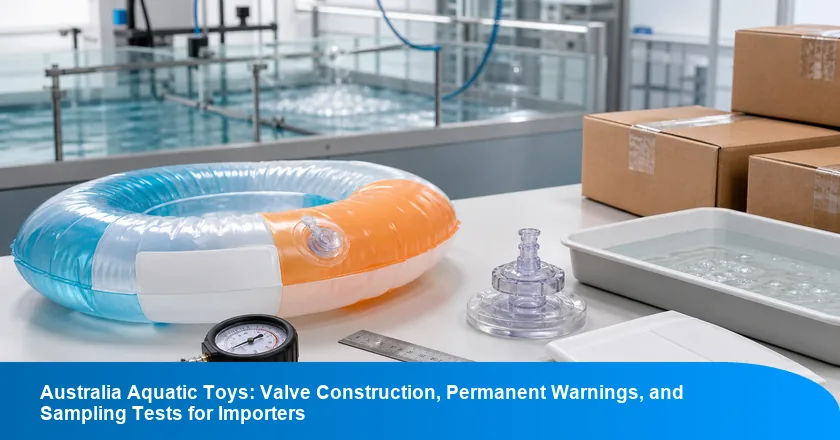
An Australian aquatic toy is a toy designed to bear the mass of a child under 14 for play in shallow water, whether it is inflatable or not. The 2026 safety standard defines that boundary. For importers, the practical release question is whether that category, the current valve-and-warning version, and the cartons actually sampled still describe the same product.
Why an aquatic-toy release begins with product scope
Product form can mislead a sourcing team. A ring, novelty float, shallow-water toy boat, or wearable item may look close to a swimming aid, yet the Australian rules treat aquatic toys and swimming or flotation aids as separate categories. ACCC Product Safety explains that these toys are not safety devices. That distinction matters before an order is sampled, because the applicable standard determines the construction, marking, and evidence question that follows.
Start with the Australian category and the 2026 transition
The current Australian aquatic-toy standard was updated on 26 June 2026 and has a transition period through 25 June 2028. During that period, the compliance route must be recorded deliberately rather than assumed from an old report: the current mandatory-standard guidance lists the available 2020 and 2026 options and the relevant AS/NZS ISO 8124.1 or ISO 8124-1 versions. Put the chosen route, product description, model code, and evidence reference in one controlled file before the factory visit.
Scope comes first because some familiar water products are excluded or covered elsewhere. Beach balls, bodyboards, kickboards, surfboards, inflatable air beds, and deep-water inflatable boats are not within this aquatic-toy standard. If the item is worn, attached to the body, or promoted as helping a child swim, ask the Australian responsible party to confirm the category; an inspector can compare the physical product with the agreed classification, but should not make the legal classification decision alone.
What valve construction must be checked
For an inflatable aquatic toy, the air inlet must use a non-return valve with a stopper permanently attached to the toy. When the toy is inflated, the stopper must be capable of being pushed in and must not stand out more than 5 mm from the toy surface, as set out in the ACCC Product Safety construction guidance. This is not a generic “inflates / does not inflate” check: it is a check of the controlled valve assembly on the current production version.
Put a valve reference in the product file: a drawing or approved photo, the supplier part code, the valve location, and the model or artwork revision it belongs to. During an inflation observation, record whether the stopper is attached, whether it can be pushed in, and whether the sampled unit matches that reference. If the factory substitutes a valve supplier, changes the stopper geometry, or performs rework, treat the change as a new version question. A check version changes during production is most useful before those units are mixed into final export cartons.
How to verify permanent warnings without treating artwork as proof
The warning carried by an aquatic toy must be in English, clearly legible, clearly visible, and indelible. Section 14 of the Consumer Goods (Aquatic Toys) Safety Standard 2026 sets that requirement. Current Product Safety guidance also states that the warning must tell users that the toy is not a life-saving device and is for shallow water under adult supervision. The approved artwork is therefore an input to inspection, not the result of inspection.
Ask the factory for the approved warning file before sampling. The inspection brief should name the language, location on the toy, print or moulding method, artwork revision, and a photo requirement for each sampled version. Compare the wording and placement on the unit itself, not just on the retail box. A carton may carry correct graphics while an individual toy has a faint, incomplete, removable, or wrong-version warning. Escalate that mismatch to the responsible supplier or compliance owner; an inspection report should describe what was observed and which units or cartons it covered.
A safe aquatic-toy release rests on three records
One category record, one current product-version record, and one named lot record form a practical buyer-side release file. This is not an extra statutory test; it is a way to stop a valid observation from being attached to the wrong product or cartons.
- Category: state why the item is being handled as an aquatic toy and which current compliance path the file follows.
- Version: tie the valve construction, warning artwork, and model or supplier codes to the units being made.
- Lot: identify the carton, pallet, or other physical population that the sample result can honestly describe.
The Aquatic Toy Version-to-Lot Check
The Aquatic Toy Version-to-Lot Check is a buyer framework: release only the cartons for which the product category, current version, sample purpose, and carton range still agree.
Start with the category record. It should identify the intended shallow-water use and the current standard path, while making clear that the toy is not being presented as a flotation aid. Next, match the physical version: the product code, valve assembly, warning artwork, and pack-out reference must point to the same approved configuration. Finally, name the population. “Order sampled” is too vague when a late valve replacement, a warning reprint, or a mixed rework process could affect only part of the order.
The framework changes the release question from “Did the sample look acceptable?” to “Which cartons does this observation actually describe?” For a version-specific factory observation, TradeAider can work from the named configuration and carton range rather than a generic order reference. That question is especially useful for aquatic toys because a passing inflation observation cannot repair a missing warning or identify a valve change hidden inside mixed cartons. It is a buyer control, not a legal classification, certification, or substitute for the supplier's compliance obligations.
Use three different samples for three different questions
A product test, a pre-shipment check, and an ongoing compliance check are distinct activities in supplier guidance. ACCC Product Safety explains the distinction. The same separation should govern samples. An engineering check can reveal an observed condition; an AQL sample can estimate agreed lot-quality findings; a laboratory sample can be tested to the applicable method. None should be renamed as another after the result arrives.
| Sample purpose | What it can answer | What it cannot establish alone |
|---|---|---|
| Engineering check | Whether the agreed sampled valve and warning features are observed on named units. | Compliance with every applicable standard requirement or the state of unsampled cartons. |
| AQL inspection sample | The agreed defect classification and sample outcome for a defined production lot. | A standard-specific laboratory result or an unidentified rework population. |
| Laboratory test sample | Whether a specimen was tested against the applicable method and scope. | That every shipped unit matches the tested specimen without version and lot control. |
The comparison means the purchase order should name the sample purpose before selection. If the open question is standard conformity, coordinate product-testing support for the applicable standard rather than asking an inspector to convert an AQL result into a compliance certificate. If the open question is whether cartons match a known version, define the carton population and the observable points in the inspection brief.
Worked scenario: valve rework without a reliable carton boundary
An untraceable valve-rework claim can justify a full-lot hold even when a focused engineering screen records no immediate issue in the units examined. The following illustration is a procurement decision example, not a laboratory result or legal compliance determination.
Why the result is a hold, not a wider sample
More sampled units cannot create a carton-level rework boundary that the packing records do not identify. The numerical result below is deliberately bounded: it describes a screening activity, not a prescribed acceptance rule.
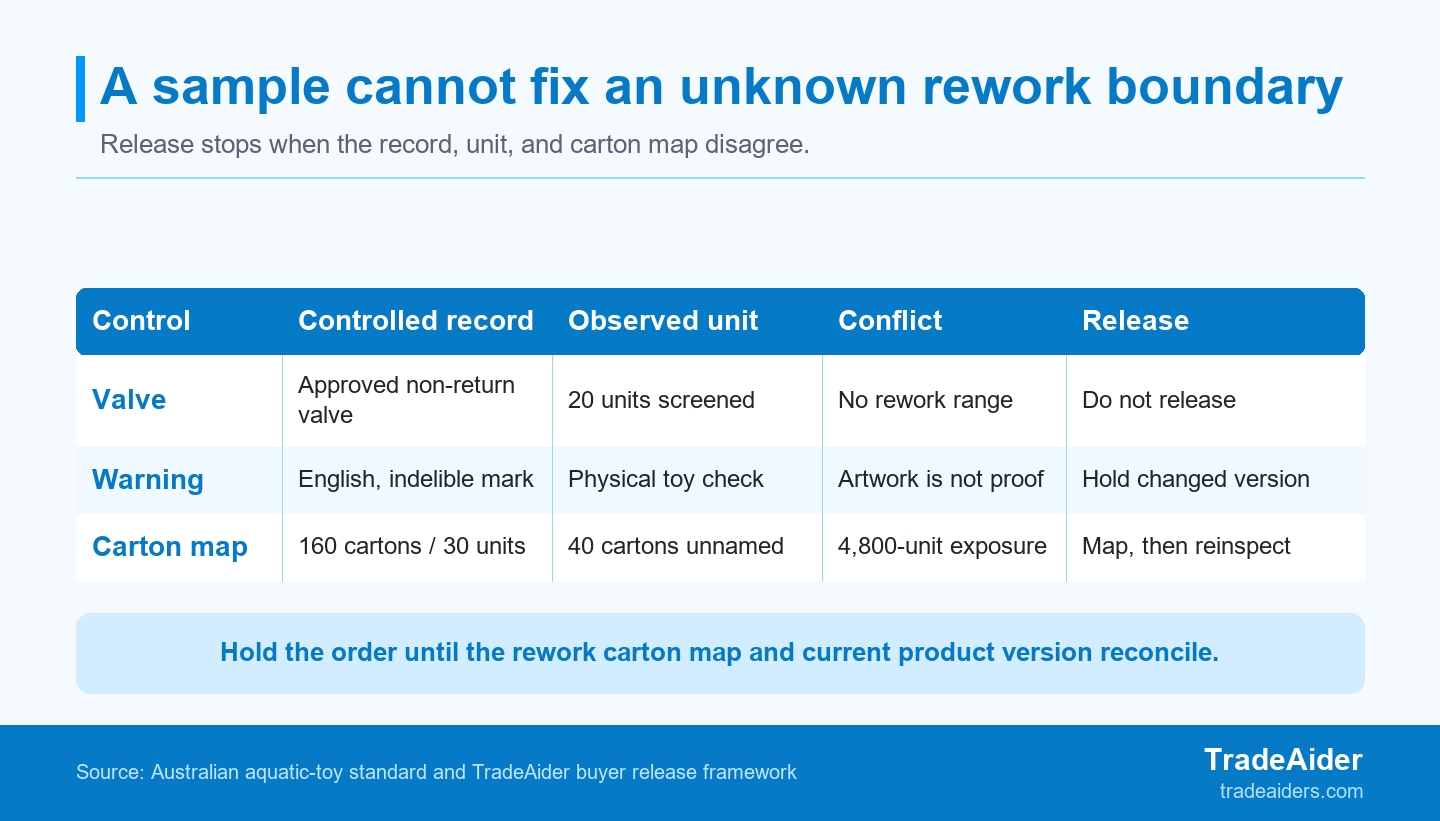
A sample result can describe observed units, but it cannot define a reworked carton population that factory records cannot identify.
Situation: An importer is preparing inflatable ring-style aquatic toys for supply in Australia.
The order contains 4,800 units in 160 export cartons, with 30 units per carton and one planned shipment.
The buyer has approved warning artwork and a valve specification, but the factory reports valve rework after a production issue.
Problem: The factory says 40 cartons may contain units with replacement valves, yet its carton labels do not identify those cartons.
A 20-unit engineering screen across 10 available cartons uses three inflation-and-observation cycles per unit: 60 observations, not a standard-compliance verdict.
The screen can record the sampled units' condition, but it cannot establish the scope of rework or transfer that result to the entire order when the carton boundary is unknown.
Action: Hold the 4,800-unit lot until the factory creates a reliable rework boundary or returns every affected unit to a controlled verification process.
Segregate and identify reworked cartons, reconcile the replacement valve to the controlled specification, then perform the agreed repeat checks on the defined population.
No release follows until the rework population, valve version, permanent warning, and carton identifiers are reconciled and the agreed verification is complete.
Result: The buyer loses time while the carton map is rebuilt, but avoids making an order-wide statement from a sample that cannot identify the reworked population. This example shows a procurement hold rule; the applicable standard, laboratory work, and supplier responsibilities remain separate decisions.
What an inspection can support—and what it cannot
Importers are suppliers, and products subject to a mandatory standard must meet relevant requirements before supply in Australia. ACCC Product Safety's compliance guidance makes that supply-side boundary clear, and ACCC guidance on product-safety responsibilities calls for businesses to review design and production, maintain quality procedures, and test to relevant mandatory standards where applicable. A pre-shipment inspection can document agreed physical observations—such as sampled valve construction, warning presence, model identity, carton markings, and packing quantities—but it cannot certify the product or take over the responsible supplier's legal role.
The distinction is practical, not semantic. A PSI can be scheduled when 100% of the order quantity is completed and at least 80% is packed for export, which makes it useful to inspect the packed lot before shipment. Its report should state the selected population, the observations, the evidence supplied, and every point outside the agreed scope.
Build a version-specific inspection brief
A version-specific inspection brief should name the category decision, approved warning, controlled valve, sample purpose, carton range, and hold escalation. That turns “check aquatic-toy safety” into an observable scope and gives the factory time to surface a version change before the visit.
- Name the product model, intended use, current standard path, and the person responsible for the compliance decision.
- Attach the approved warning artwork and valve reference, including the revision number and the location to photograph.
- State whether each activity is an engineering screen, an AQL inspection sample, or a laboratory handoff, and what each result may not conclude.
- List the carton or pallet identifiers that define the release population, plus the hold rule for missing records, rework, or mixed versions.
Send the packet before the inspection date, not after a discrepancy appears. When the model, sample purpose, and carton range are ready, buyers can request an observation scope limited to the physical and documentary checks they actually need: request a version-specific inspection scope.
Who Is TradeAider?
TradeAider is a quality inspection, testing, and certification service provider in China. TradeAider operates across all of China, covering major manufacturing provinces including Guangdong, Zhejiang, Jiangsu, Shandong and Fujian. Buyers deciding whether a China-based observation scope fits their sourcing footprint can read about TradeAider's inspection coverage.
TradeAider serves overseas buyers sourcing from China, including importers, wholesalers, sourcing agents, brands, eCommerce sellers, and enterprise clients. Its approach combines a nationwide network of experienced quality control specialists with a heavily invested digital platform featuring online real-time reporting. Clients can monitor inspections live, communicate directly with inspectors, and address issues during production rather than after shipment—a proactive model focused on problem-solving and prevention, not just defect identification.
Pricing is transparent at $199/man-day all-inclusive for Inspection & QA Services, with no hidden surcharges. The company is an official Amazon Service Provider Network partner and has served thousands of global clients. Client testimonials published on the TradeAider website cite an 18% reduction in return rates attributed to real-time defect detection and a 23% improvement in defects caught before shipment compared with prior inspection arrangements; these are client-reported figures.
Frequently Asked Questions
Which products count as aquatic toys in Australia?
Australian aquatic-toy rules cover toys designed to bear the mass of a child under 14 for play in shallow water, whether inflatable or not. The category can include novelty shapes, shallow-water toy boats, and unattached rings. Do not decide by appearance alone: beach balls, bodyboards, kickboards, surfboards, inflatable air beds, and deep-water inflatable boats are outside this standard, while swimming and flotation aids follow a separate mandatory-standard path.
Can an AQL inspection sample prove an aquatic toy complies?
No, an AQL sample can describe agreed inspection findings in a defined lot, but it does not replace the standard-specific evidence or testing required for compliance. It can be useful for visible warning, valve, workmanship, or packing observations when the buyer states the defect rules and lot boundary in advance. It cannot establish that an unsampled, changed, or untraceable population matches the tested configuration.
What should be checked on an inflatable aquatic-toy valve?
For an inflatable aquatic toy, check the approved valve assembly against the current product version, including the non-return valve, permanently attached stopper, and its position when pushed in. Record the model code, valve reference, and sampled carton identifiers with the observation. If the factory reports a replacement valve, rework, or a new supplier, do not assume an earlier sample or report covers the changed configuration.
Does a warning on the carton replace the warning on the toy?
No, packaging artwork does not by itself establish that the toy carries the permanent warning required by the applicable aquatic-toy standard. Compare the approved wording and location with the physical product, then record the result against the relevant model and carton population. If the warning is missing, unreadable, removable, or from a different artwork revision, hold that version for the responsible supplier or compliance owner to review.
Related Articles
Grow your business with TradeAider Service
Click the button below to directly enter the TradeAider Service System. The simple steps from booking and payment to receiving reports are easy to operate.

