
- About Us

- Our Services
- Your Industry
- Resources
- News & Blog

A projectile toy is a toy intended for a child under 14 that can launch a projectile. For Australian import release, the useful evidence chain is the current product build, the relevant test or requirement record, and the specific export cartons the record is being used to support.
A passing document is useful only for the build and population it actually covers. For projectile toys, that distinction matters because a warning condition, a protective feature, and a laboratory result may all be tied to a particular configuration rather than to a purchase order in the abstract. Before a buyer asks for a final inspection, the product file should make it possible to answer three practical questions: Which build is packed? Which evidence applies to that build? Which cartons are inside the release statement?
What must align before a projectile-toy lot is released
Australia projectile toys kinetic energy protective tips factory inspection work is easiest to manage when it starts with alignment, not sampling size. The supplier can provide artwork, a test report, a model code, and a carton list, yet those records are not automatically about the same product version. A controlled version is the documented product build used for comparison: its launcher, projectile, tip, warning artwork, packaging, and any other feature that could affect the applicable evidence. If one of those records changes, the buyer should first establish the population affected and then decide whether observation, reconciliation, or laboratory work is needed.
Start with the Australian projectile-toy rules
The standard applies to new projectile toys clearly intended for children under 14. The Australian Product Safety page describes a projectile toy as a toy that launches a projectile and identifies recognised compliance pathways for design and construction requirements, including relevant toy-safety standards. A buyer should therefore first confirm that the product, claimed age range, projectile and intended market all sit inside the scope being assessed. Read the ACCC Product Safety mandatory-standard guidance and the Federal Register instrument before turning a supplier specification into an inspection checklist.
The warning conditions include more than 300 mm range and more than 0.08 J kinetic energy when all statutory conditions apply. Kinetic energy here means the energy carried by a moving projectile; it is not a visual judgement about whether a dart or projectile seems soft. The legislative instrument says the packaging or instructions must carry the English warning “WARNING: Do not aim at eyes or face” when the toy can reasonably be aimed at eyes or face and satisfies the listed range and energy conditions. The instrument also directs how range and energy are determined under the standard route the supplier intends to use. Check the legislative text for the full conditions and wording; product classification may need product-specific advice.
That distinction changes the factory conversation. The inspection brief can ask the factory to show the version being packed, the artwork used, the projectile type and the lot identifiers. It should not ask an inspector to infer a kinetic-energy conclusion from a launch demonstration. If the buyer’s question is whether a stated method and threshold are met, the question belongs with the relevant test evidence and method.
Protective tips are a construction-control question
The ACCC mandatory-standard page identifies protective measures against skin-puncture hazards as a requirement area. The ACCC page identifies protective measures against skin-puncture hazards as a requirement area. This does not license a buyer to approve a tip because it looks rounded in a photograph; it means the exact projectile and its protective feature should be controlled as part of the build. A practical product file can name the projectile SKU, tip material, drawing revision, cavity or mould identifier where available, approved colour, and the source of any test evidence. Those identifiers make a later factory comparison meaningful rather than cosmetic.
The consumer safety guidance gives the reason for this discipline: toys that shoot objects or launch projectiles can create eye-injury, choking, cut, or laceration risks. The ACCC projectile-toy safety guide also covers familiar forms such as toy guns, slingshots, bow sets and dart blasters. At the factory, use the approved sample and drawing to compare observable features, record any substitution, and preserve photographs of the checked unit and packaging. Where the aim is to catch a controlled component change before final pack-out, buyers can monitor controlled components during production against an agreed version file.
Do not turn this into an invented “tip pass” test. An inspector can observe the agreed appearance, assembly, markings and consistency of sampled units. Whether a component satisfies the applicable technical method is a separate question that must remain tied to the relevant standard and evidence route.
Keep three evidence jobs separate
Supplier guidance differentiates testing stages and calls for ongoing quality assurance. The ACCC advises suppliers to test at appropriate stages, to use reliable testing, and to reassess evidence after design, material, or production changes. It also distinguishes product testing from pre-shipment checks and ongoing quality checks. ACCC guidance on sourcing and testing products is especially useful here because it makes clear why pre-production evidence alone is not the whole quality system.
For an importer, the most useful separation is not “pass versus fail.” It is the question that each activity can honestly answer.
| Evidence job | Question it can support | What it must not be called |
|---|---|---|
| Laboratory evidence | Whether the identified build was assessed by the applicable method | Proof for a different, later build |
| Factory comparison | Whether sampled units visibly match agreed components, labels and packaging | A substitute laboratory result |
| Lot inspection | What was observed in a declared finished-goods population before shipment | A conclusion about cartons outside the declared population |
The first job asks a method question. The second checks whether the current build appears to remain the build described in the product file. The third connects observations to the named finished lot. If a kinetic-energy or construction question needs a test method, the buyer can coordinate product-testing support for the applicable method; the resulting report should then be reviewed against the actual production version rather than stored as a generic supplier credential. For buyers working with TradeAider, this separation helps define whether the booking concerns testing coordination, production observation, or finished-lot inspection.
The Projectile Evidence Handoff
Release only the cartons for which the build, evidence route and population agree. The Projectile Evidence Handoff is a buyer-side framework, not a product certificate. It asks for four short records that can be reconciled before a shipment decision: the controlled version, the evidence question, the evidence record, and the carton population. When all four point to the same configuration, a factory inspection can document the agreed observable checks on a bounded lot. When one record does not match, the decision is not to create a broader claim from a smaller sample; it is to hold, trace, or escalate the gap.
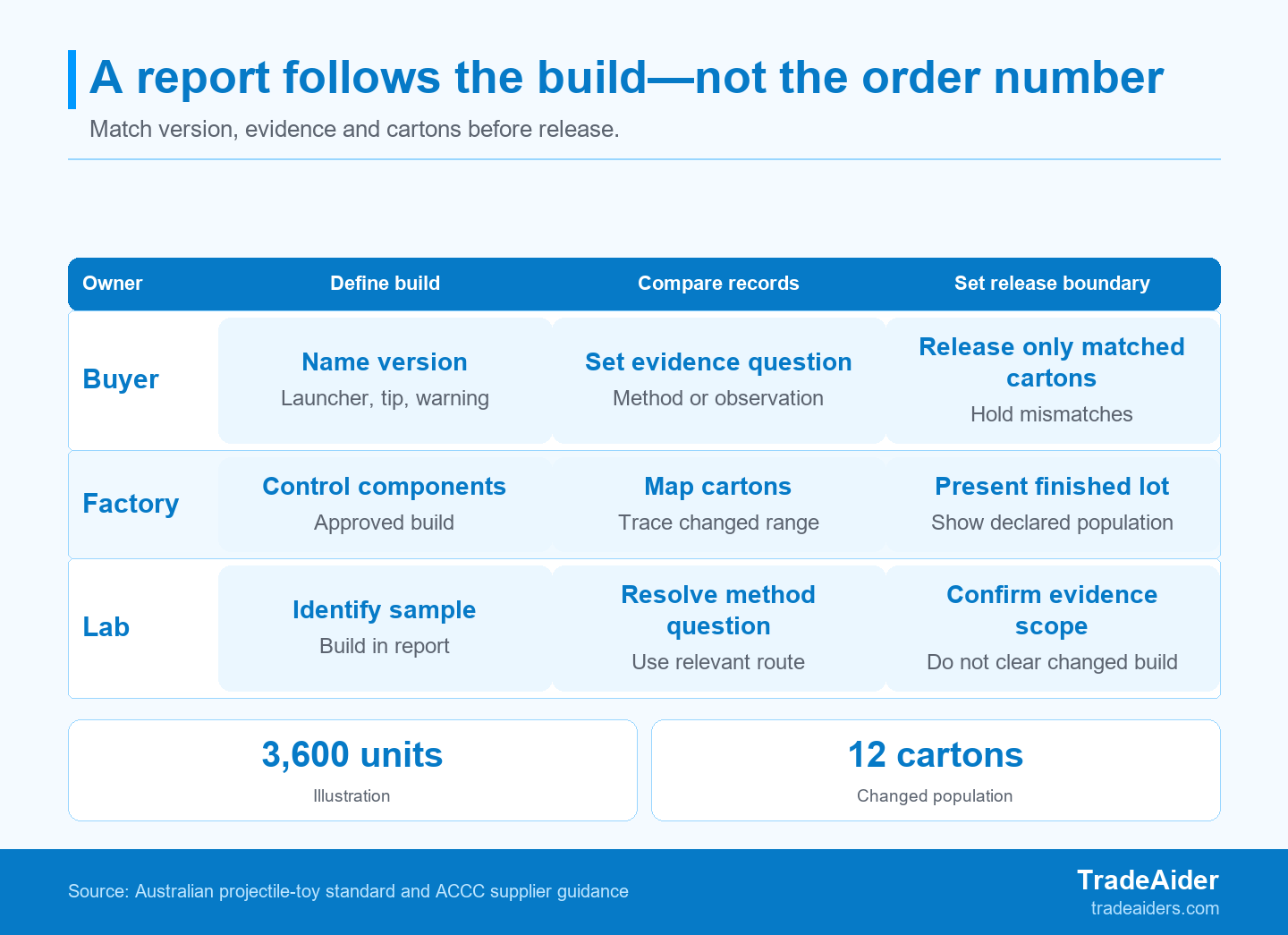
A factory inspection can record observable agreement with the current build; it does not turn a historic report into evidence for a changed configuration.
- Name the build: use a model code plus the projectile, launcher, tip, warning artwork and packaging revision that matter to the evidence question.
- Name the evidence question: state whether the need is a laboratory method, a physical comparison, a warning check, or a combination of these.
- Name the evidence record: retain the report number, sample description, date, standard route and any scope limits that identify what was actually assessed.
- Name the release population: specify production dates, carton marks, order quantity, carton sequence and any segregated rework or changed-build range.
There is no value in making this file ornate. Its value is that it gives a reviewer a direct route from a sample or report to the product in cartons. It also gives the factory a clear escalation rule: if the launcher, projectile, tip, artwork, material, or other controlled feature changes, stop treating the old evidence as automatically transferable.
Three release records a buyer should reconcile
- Product record: the controlled build, including the launcher, projectile, protective tip and warning version.
- Evidence record: the applicable method or report and the exact sample it describes.
- Population record: the identifiable export cartons that may be released, held or escalated.
Worked scenario: a changed launcher after the report
Twelve changed cartons are held in the article’s illustration. Consider an Australian importer buying a foam-dart blaster set: 3,600 units are packed in 120 export cartons. The buyer has a report for the approved pre-production build. At final inspection, the factory’s packing records show that 12 cartons were packed after a launcher-spring adjustment. The report’s sample description identifies the earlier build but does not state the adjusted spring.
Why packing date alone is not the answer
A date does not prove which controlled build is inside a carton. A later date becomes decision-useful only if it is connected to a manufacturing record, component revision and carton range that can be audited. If the spring change was used intermittently, if cartons were mixed during packing, or if rework was returned to the line without a distinct mark, a date cannot create the boundary the records failed to preserve.
An Australian importer is buying a foam-dart blaster set for the Australian consumer market.
The order contains 3,600 units across 120 export cartons; supplier records show 12 cartons packed after a launcher-spring adjustment.
A report exists for the approved pre-production build, but its sample description does not identify the adjusted spring in the later cartons.
- Twelve cartons carry a later packing date than the report sample, creating a traceable changed population.
- The launcher spring specification changed after the report sample, so the report and production build do not yet reconcile.
- Physical labels and dart tips match the approved artwork, which is useful for comparison but not a kinetic-energy result.
The label, tip and carton observations describe the units seen and identify a version-to-report gap. They do not establish that laboratory evidence for the earlier launcher configuration applies to the changed launcher configuration.
Hold the 12 changed cartons and do not use the historic report as a blanket release statement for them; consider other cartons only after their build boundary is traceable.
Trace the changed build, identify the affected carton range, compare the controlled components with the approved specification, and obtain the appropriate evidence decision before release.
Release follows identification of the changed population, confirmation that the selected evidence route matches that build, and completion of any agreed repeat observation.
This is an illustrative procurement scenario, not a legal conclusion, laboratory result, or product-specific determination.
What factory inspection can confirm—and what it cannot
Importers are among the suppliers required to meet relevant mandatory standards before supply. ACCC Product Safety explains that products must meet relevant mandatory standards before supply in Australia, and lists importers among suppliers; the ACCC product-safety responsibilities guidance also calls for review, quality assurance and regular testing. That responsibility does not transfer to an inspection provider or disappear because a factory supplied a report. A final inspection can strengthen the product file by recording what was observed against an agreed scope; it is not a compliance certificate and cannot replace the applicable laboratory method.
A strong factory scope can ask the inspector to verify model and carton marks, compare selected launcher and projectile components with the approved sample, photograph warning placement, observe pack-out, and record the sampled-carton range. It can require escalation if the sample, artwork, component, or packing records diverge. It should also state the limits: no kinetic-energy conclusion, no construction-method result, and no lot-wide statement beyond the declared population. The ACCC advises businesses to review design and production, maintain quality assurance and test products regularly to relevant standards. Its product-safety responsibilities guidance supports that ongoing approach.
For a finished order, a buyer may check the finished lot before shipment against the agreed version and carton boundary. The resulting report should be read as an observation record for that scope. If it finds a mismatch, the most useful report outcome is a clear hold or escalation statement, not an unsupported declaration about regulatory compliance.
Build the factory inspection handoff
A bounded brief names what is observed, what is escalated and which cartons are in scope. Send it before the visit, together with the approved sample or controlled photographs, the exact report or evidence reference, and the current packing list. The aim is not to turn an inspector into the laboratory. It is to make every observation traceable to the product build and the population the buyer is deciding about.
- Product identification: model, age grade, product description, projectile and launcher version.
- Controlled features: protective tip, relevant material or component revision, warning artwork, instructions and packaging reference.
- Evidence reference: report number, sample description, standard route, date and known limitations.
- Lot boundary: order quantity, carton marks, production dates, carton sequence and any changed-build or rework range.
- Inspection observations: approved sample comparison, warning and packaging checks, carton identification, photographs and defect or mismatch escalation.
- Decision rule: release only the named matching population; hold or escalate any version-to-evidence mismatch.
With that information, an inspection request becomes more useful to both buyer and factory. It gives the supplier a concrete preparation list and lets the inspector return observations that fit the release decision. If you have the model, current evidence reference and carton population ready, define the observation boundaries and escalation point before you request an evidence-led inspection scope.
Who Is TradeAider?
TradeAider is a quality inspection, testing, and certification service provider in China. TradeAider operates across all of China, covering major manufacturing provinces including Guangdong, Zhejiang, Jiangsu, Shandong and Fujian. Read about TradeAider's inspection coverage.
TradeAider supports overseas buyers who need a nationwide inspection network, real-time online reporting, the ability to monitor progress live, and direct communication with inspectors. Inspection and QA services are priced at $199/man-day all-inclusive. As an official Amazon SPN partner, TradeAider has supported thousands of clients; client-reported results include an 18% reduction in returns and a 23% improvement in defects caught. These service facts describe provider capability, not a guarantee that an inspection certifies a projectile toy’s compliance.
Frequently Asked Questions
Does the warning apply to every projectile toy?
No. The specified eye-and-face warning applies when all listed statutory conditions are met. For the relevant rule, the product must be capable of being aimed at the eyes or face, capable of launching a projectile more than 300 mm, and capable of a kinetic energy greater than 0.08 J. The warning requirement should be assessed against the full instrument and the standard route selected for the product, not assumed from a product category name alone.
Can a pre-shipment inspection measure kinetic energy?
Not by itself. A pre-shipment inspection is not a substitute for the applicable laboratory method. It can compare agreed observable features, identify a version mismatch, document labels and packaging, and define the cartons sampled. If the release question depends on a kinetic-energy determination or another method-specific result, the buyer should retain or obtain the appropriate evidence for the current build.
What Production Changes Should Trigger Evidence Review?
Review the evidence when the launcher, projectile, protective tip or production version changes. Material, tooling, supplier, assembly, warning, packaging or batch-control changes can also matter where they alter the product file or the population a report is being used to support. The review should first identify the change and affected cartons, then decide whether a document reconciliation, inspection or laboratory step is appropriate.
Who remains responsible before supply in Australia?
Suppliers, including importers, must ensure relevant mandatory-standard requirements are met before supply. A factory, laboratory or inspection provider can contribute records and services, but their involvement does not move that supply responsibility away from the importer. Where the product scope or evidence route is uncertain, obtain appropriate product-specific and legal advice before making a supply decision.
Related Articles
Grow your business with TradeAider Service
Click the button below to directly enter the TradeAider Service System. The simple steps from booking and payment to receiving reports are easy to operate.

