
- About Us

- Our Services
- Your Industry
- Resources
- News & Blog

Australia and Canada are not two labels to add to the same factory certificate. A practical comparison starts with one current product identity, then asks different questions about the rule, retail package, evidence, and traceability required for each destination. That distinction is important because a report can be technically sound yet still fail to describe the product version, consumer package, or lot an importer plans to release. The goal is not to declare either market easier. It is to make the readiness decision specific enough that a buyer can see what is shared, what is destination-specific, and what needs resolution before shipment.
The Better Comparison Is a Product-Readiness Test
A practical Australia-versus-Canada comparison begins with one current product identity and finished-lot record, then applies the two markets' distinct rule, package, and evidence checks.
Here, a finished lot means the identifiable completed units or cartons covered by one release decision. That definition keeps the comparison connected to physical goods rather than to a general document folder.
A product is not import-ready merely because a factory holds a generic certificate; the evidence must fit the product, destination, current package, and identifiable production version.
That approach produces a more useful handoff than a country-by-country document list. First, identify the item, configuration, materials, intended user, selling claims, and consumer package. Next, map the applicable Australian and Canadian requirements. Then compare the report, declaration, label artwork, supplier record, and carton range against that current identity. If a mismatch exists, the buyer can isolate the affected population instead of treating an entire purchase order as automatically cleared or failed.
- Keep one product identity file, not a folder of detached certificates.
- Run separate Australia and Canada rule and package checks.
- Confirm that testing and factory records describe the current configuration.
- Release a named finished lot, not an assumed whole order.
These are operating controls, not legal advice or a substitute for category-specific technical review. They help an importer ask a better question before goods move: “What evidence supports this product, in this package, for this market, across these cartons?”
Start With the Market Rule That Actually Applies
In Australia, mandatory standards make specified safety or information features compulsory for the legal supply of certain products, and importers are included among suppliers. A mandatory standard is a legally required product rule for a defined category. The ACCC Product Safety guidance also makes an important boundary clear: mandatory standards and bans apply to defined products; they are not proof that every consumer item follows one universal standard.
In Canada, section 7 of the CCPSA prohibits a person from manufacturing, importing, advertising, or selling a consumer product that is a danger to human health or safety. In this context, a consumer product is an item for non-commercial use, including its components, parts, accessories, and packaging. The statutory wording is a broad starting point, not a product-specific test plan. The importer still needs to determine whether the item is subject to a regulation, prohibition, standard, or another regulator’s requirements.
The comparison therefore starts with classification, not paperwork. Describe the product’s purpose, age group where relevant, materials, energy source, components, consumer claims, and intended use. A toddler toy, a button-battery product, a textile item, and a household article can lead to different questions even when the factory calls all of them “tested.”
Australia: Identify Any Mandatory Standard or Ban First
For an Australian release brief, identify any applicable mandatory standards or bans before supply and record the product features that make the check relevant. Build an Australia overlay that records the product category, the specific rule checked, the product features that make it relevant, and the evidence that relates to the current version. Do not begin with a laboratory name or a report title. Start with the item and the exact requirement the report is meant to address.
This is also where a buyer should flag boundaries. Electrical items, food, cosmetics, vehicles, and other categories can involve requirements outside a general ACCC product-safety check. The responsible next step is to record the issue and obtain the appropriate market-specific advice, not to force an unrelated report into the file.
Canada: Separate the General Safety Duty From Category Rules
For commercial imports to Canada, consumer-product scope can include components, parts, accessories, and packaging, so classification should precede a category-specific evidence request. The CCPSA definition is useful because it prevents the buyer from treating packaging or an accessory as an afterthought when it affects the product presented to consumers.
For Canada, create a second overlay that identifies the CCPSA question, any applicable product-specific rule, the intended consumer use, and the package information to review. This does not mean every product needs the same test or label. It means the factory brief must make the product category clear enough for the right requirement to be checked.
Treat the Retail Package as a Market-Specific Evidence Item
For an Australian regulated product, review the current package and label against the requirement that applies to that product rather than assuming another market's artwork is sufficient. A factory should therefore provide final package artwork and photos rather than only a translated product description or an old carton mock-up.
For prepackaged non-food consumer products in Canada, mandatory package information must be accurate and meaningful, with detailed guidance addressing bilingual information and presentation requirements. The Competition Bureau guidance is especially relevant to the physical package, not simply the marketplace detail page.
A useful package review keeps the two market files visible side by side. It captures the version identifier, every consumer-facing panel, intended destination, claims and warnings, and the person who approved the artwork. That record makes it easier to spot a situation in which the same product hardware travels with two different packages.
| Readiness question | Australia overlay | Canada overlay | Factory evidence to retain |
|---|---|---|---|
| What rule begins the review? | Applicable mandatory standard or ban | CCPSA boundary plus applicable category rule | Product classification note |
| What package is being checked? | Current package against the applicable product rule | Current consumer package and applicable label requirements | Approved artwork and all package-face photos |
| What evidence can be relied on? | Evidence tied to the Australian rule and current version | Evidence tied to the Canadian category and package | Report scope, specification, revision history |
| What may be released? | The named lot that matches the Australia file | The named lot that matches the Canada file | Carton map and final release record |
Make Tests and Factory Files Describe the Current Product
Before evidence is used for either market, the importer should be able to match the current product, consumer package, and claimed evidence scope to the same configuration.
A report is not self-explanatory evidence. It has a sample, product description, version, test method or requirement, date, and result. The buyer should compare those fields with the actual SKU or model, bill of materials, current component list, package artwork, and selling claim. If the document describes another configuration, it may remain useful background, but it should not be silently treated as proof for the current offer.
Australian product-safety guidance recommends checking compliance while sourcing and using testing that matches any applicable mandatory standard; an importer should therefore compare the report scope with the current configuration. The ACCC sourcing and testing guidance also recommends checking product safety before supply and considering pre-shipment checks.
After that comparison, TradeAider can help a buyer review a product-testing scope for the current configuration. That handoff is useful because it starts with the actual item and market question; it does not imply that testing alone determines all Australian or Canadian obligations.
Match the Test Scope Before You Rely on a Report
Put five fields on the review sheet: product identifier, tested configuration, relevant rule or method, report date, and current package version. The exact terms will vary by category, but the comparison should be plain enough that a factory, importer, and specialist can identify the first mismatch. A product photo with no model reference, or a report with no traceable link to the current pack, is an unresolved question rather than a release signal.
Where a record is incomplete, do not fill the gap with a supplier assertion. Ask for the missing version, sample, package, or report-scope information and preserve the uncertainty in the release decision.
Use Changes to Trigger a Fresh Scope Review
A material, component, supplier, or package change should trigger a scope review because it can break the link between earlier evidence and the current offer.
Keep a short change log with the old and new component or artwork, affected SKU, date, owner, and carton range. A change does not automatically prove non-compliance. It does tell the buyer to compare the new configuration with the assumptions behind the earlier evidence. This is the difference between controlled evidence and a file that is only complete on paper.
When the change occurs before all cartons are sealed, a buyer can check a material or package change during production against an agreed scope. The useful output is a clear version and population boundary, not an unsupported market-approval statement.
Plan for Traceability Before Either Market Needs It
Section 13 of the CCPSA requires covered commercial parties to prepare and maintain documents that show, when applicable, from whom they obtained a consumer product and to whom they sold it. The Canadian statutory record requirement is one reason a buyer should keep supplier, product, and shipment identifiers connected instead of saving evidence as unstructured attachments.
Australian product-safety guidance says a business may need to notify the Minister within two days when a product safety risk or a standard or ban non-compliance leads to a recall. The ACCC responsibilities page places that timing in the context of safety risks, standards, bans, recalls, and incident reporting.
For an importer, the practical lesson is not to predict a future incident. It is to keep a retrievable chain: supplier or manufacturer, current SKU or model, package revision, production date, carton range, test or evidence reference, and the destination file used for release. These fields make a later inquiry faster to investigate and make a pre-shipment review more specific today.
Run One Finished-Lot Release Decision, Then Apply Both Market Files
A defined lot boundary allows an importer to hold only the population affected by a market-specific evidence mismatch while separately assessing goods that remain traceable to the aligned version.
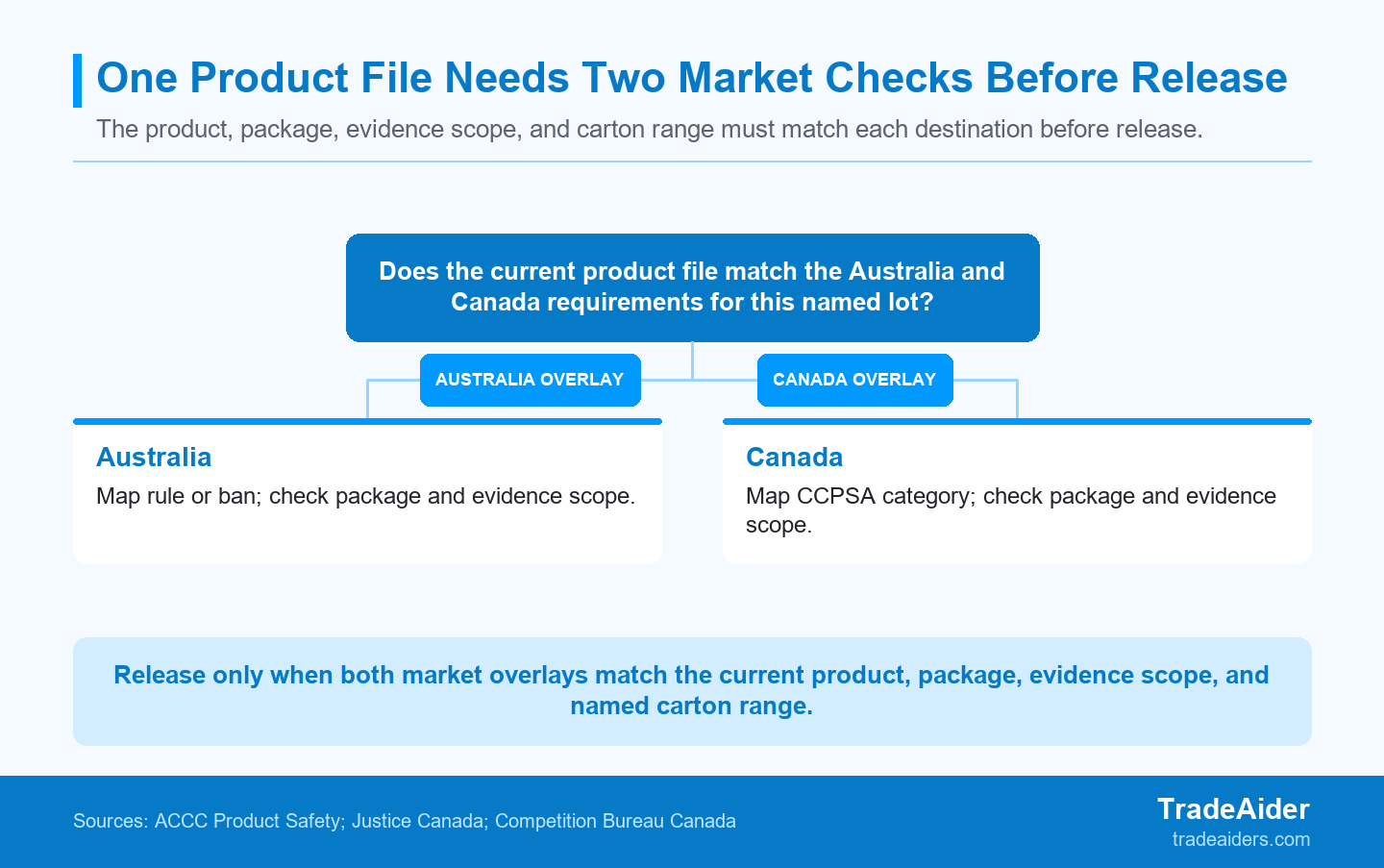
Keep one product identity file, but complete separate Australia and Canada checks before releasing the named lot.
A finished lot is the identifiable completed units or cartons covered by one release decision. Define it with a SKU or model, package revision, production date or batch marker, and carton range. Then apply the Australia and Canada overlays to that same population. The decision should state what was checked, which evidence version was used, what remains unresolved, and exactly which cartons may move.
This is a control principle, not a shortcut around product-specific advice. If the relevant rule is unclear, the correct outcome may be a hold and a request for technical or legal clarification. A narrow, documented hold is usually more decision-useful than asserting that all cartons are safe or that the whole order has failed.
Illustrative Scenario: One Packaging Change, Two Market Checks
In the illustrative scenario, a revised bilingual Canadian package and unchanged Australian package are separated by carton range; the importer holds the Canadian-version cartons until label and evidence scope are confirmed.
This example is illustrative, not a TradeAider client case or a legal conclusion. An importer has a 4800-unit household-product order across 240 cartons. The hardware is unchanged, but 96 cartons carry revised Canadian artwork while 144 cartons retain the Australian-version package. The factory’s evidence file still shows the earlier artwork.
Compare, Contain, Then Recheck the Changed Cartons
The importer compares the final Canadian package, current evidence scope, and named carton range before releasing the affected population.
The importer asks the factory for final Canadian package files, package-face photos, SKU mapping, and a carton map. The 4800 units across 240 cartons have separate Australian and Canadian package versions, so the buyer can make a focused decision rather than lose sight of the affected goods inside the whole order.
The comparison finds that the hardware remains the same but the evidence file does not yet demonstrate how the revised Canadian package fits the current market review. The importer holds the 96 Canadian-version cartons while keeping the 144 Australian-version cartons separately identifiable. The hold is not a compliance verdict on either population; it is a boundary that prevents unsupported release.
Next, the buyer obtains a written scope comparison, confirms the Canadian package information with the appropriate specialist, and reconnects the final package to the applicable evidence. The affected cartons can be rechecked only after the package, product identity, evidence scope, and carton range all point to the same configuration. This illustrative example shows evidence control, not an approval outcome.
Send a Factory Brief That Keeps the Two Market Files Separate
A useful two-market factory brief names the destination, product and package version, applicable rule question, evidence request, and finished-lot boundary.
Ask the factory to return those fields in one controlled record. Specify the SKU or model, material and component version, package artwork code, consumer claims, Australia question, Canada question, evidence requested, production date, and carton range. If a point is unknown, mark it as unresolved rather than filling the file with a generic declaration.
- Classify the current product for each destination.
- Collect final package images and artwork versions.
- Match every report to the current configuration.
- Name the finished lot or cartons for release.
For a finished-goods check built around that boundary, request a pre-shipment inspection plan from TradeAider.
Frequently Asked Questions
Can one test report support sales in Australia and Canada?
Sometimes, but only when the current product configuration, test scope, and applicable rules align for each market; a report is not a universal market clearance. Compare the tested sample, product version, package, consumer claims, relevant requirement, and destination before relying on it. A category-specific adviser may still be needed where the applicable rule is unclear.
Do Australia and Canada require the same package labels?
No, a shared package design still needs market-specific review because Australian product rules and Canadian consumer-package requirements are not one interchangeable label system. The relevant product category, safety or information standard, consumer claims, language, and package presentation determine what must be checked. Keep separate artwork versions and approval records when the markets use different consumer-facing packages.
When should a packaging change trigger another review?
A packaging change should trigger another review when it changes claims, warnings, consumer information, identity, components, or the evidence link to the current product. The review need not assume the product has failed. Its purpose is to determine whether earlier evidence still describes the product and package that the importer plans to release for the destination market.
What factory records matter after the goods ship?
The useful records are the ones that connect supplier, product version, package version, production date, and lot or carton range to the evidence file. They make it possible to reconstruct what was supplied and what evidence supported the release decision. Store records in a format that the importer can retrieve without depending on a single employee’s memory or scattered email attachments.

Related Articles



Grow your business with TradeAider Service
Click the button below to directly enter the TradeAider Service System. The simple steps from booking and payment to receiving reports are easy to operate.

