
- About Us

- Our Services
- Your Industry
- Resources
- News & Blog

Baby changing table quality control starts by assembling units from the shipment's packed cartons. Check the delivered hardware and instructions, then inspect the joints, barriers, changing surface, moving mechanisms and labels. Use the applicable test methods to assess structural integrity, stability and restraint performance: pushing a display unit by hand cannot establish those results.
A Practical Changing Table Inspection Checklist
Record the model, production date, carton identifier, assembly configuration and agreed standard edition. Use the checklist to prepare the visit and capture findings; the acceptance values must come from the product's applicable specification and full test methods.
| Inspection area | Action | Acceptance basis | Record your finding |
|---|---|---|---|
| Carton assembly | Count parts and hardware; assemble with the supplied instructions; examine all structural joints. | Approved drawing, parts list, assembly method and any specified torque. | Missing part/joint: ___; measurement: ___ |
| Barriers and openings | Inspect the side and end barriers, pad retention and accessible gaps; perform applicable probe and retention tests. | Product-specific barrier, entrapment and retention requirements. | Location: ___; method/result: ___ |
| Structural integrity | Apply the specified load in the required support configuration. | Applicable structural-integrity method; consumer-installed secondary support omitted where required. | Configuration: ___; load/result: ___ |
| Stability | Run the separate stability method in the prescribed configuration. | Applicable stability requirements; do not borrow the structural test setup. | Setup: ___; outcome: ___ |
| Hardware and restraints | Operate locks and steps; inspect fasteners and protective caps; test the applicable restraints and release mechanisms. | Clause-specific force, torque, retention and movement limits. | Component: ___; force/torque: ___; result: ___ |
| Labels and instructions | Read actual unit markings and supplied instructions; compare warnings with the applicable edition. | Required hazard wording, identifiers, contact details and manufacture date. | Artwork/mark: ___; discrepancy: ___ |
Separate routine shipment observations from tests that need special loading apparatus, probes or conditioning. A properly equipped factory can perform specified methods; otherwise arrange the necessary laboratory work. Keep tests not performed clearly identified so they cannot be mistaken for passes.
Build the Sample as the Customer Will
Select packed cartons across the relevant models and production groups. Count the supplied brackets, fasteners, inserts and other components against the parts list before assembly. Follow the included instructions using the specified tools and torque values where provided. Note instructions that omit a step, show different hardware or cannot be followed with the supplied parts.
Examine the primary changing surface support, legs, base and side assemblies. Check for misaligned holes, gaps at joints, cracked wood, damaged inserts and fasteners that bottom out before clamping the joint. If a unit rocks on a level surface, identify the affected joint or foot before assuming the cause. A visible gap can indicate misfit or incorrect assembly; it does not by itself prove a particular manufacturing defect.
The US changing-product rule explains restrictions on wood screws and sheet-metal fasteners in key structural wood components assembled by the consumer, and anti-loosening features for manufacturer-installed metal fasteners and inserts. These provisions have a specific exception for qualifying clothing storage units; that exception does not exempt a convertible dresser from all changing-product requirements. Check its applicable clothing-storage requirements separately.
Compare construction with the approved drawing rather than accepting an improvised fastener substitution because the joint feels tight. TradeAider's inspection-standard guidance explains how the buyer's specification and defect criteria are incorporated into the inspection plan.
Schedule the pre-shipment inspection when production is 100% complete and at least 80% packed for export. The 80% is a packing threshold, not permission to inspect an unfinished order. Packed cartons let the team check the delivered parts and instructions as well as the assembled unit.
Inspect Barriers, Pad Retention and Entrapment Points
Check the raised side and end barriers for damage, loose fixings and incomplete assembly. Inspect any contoured pad or add-on changing unit for correct fit and retention. Barrier height is only one feature: the applicable program also addresses retention, openings, enclosed-space entrapment, scissoring, shearing and pinching, small parts, and sharp points and edges.
Examine the perimeter of the changing surface, gaps beside drawers or storage spaces, and moving parts in every intended position. Use the specified probes and test fixtures for compliance checks; a ruler reading or finger check does not replace them. If a measurement is close to a limit, confirm measurement uncertainty and the agreed decision rule before deciding the result.
For removable changing tops, record the furniture model on which the top is mounted. Check the actual attachment and instructions for that combination. A top assessed on one supporting unit should not automatically be treated as suitable for every dresser in the supplier's range.
Keep Structural Integrity and Stability Tests Separate
Structural integrity assesses whether the product withstands the specified loading without prohibited damage or failure. Stability assesses resistance to tipping under its own method. For products with a consumer-installed secondary support beneath the changing surface, the applicable structural-integrity method requires testing without that support. This is not a universal instruction to remove supports during stability testing.
Record the loading arrangement and support configuration with each result. An otherwise detailed report can be unusable if it only says “load test: pass” and leaves the setup unclear. For convertible or lift-up designs, check which configurations the applicable changing-product method covers, and assess the other advertised functions under their own requirements.
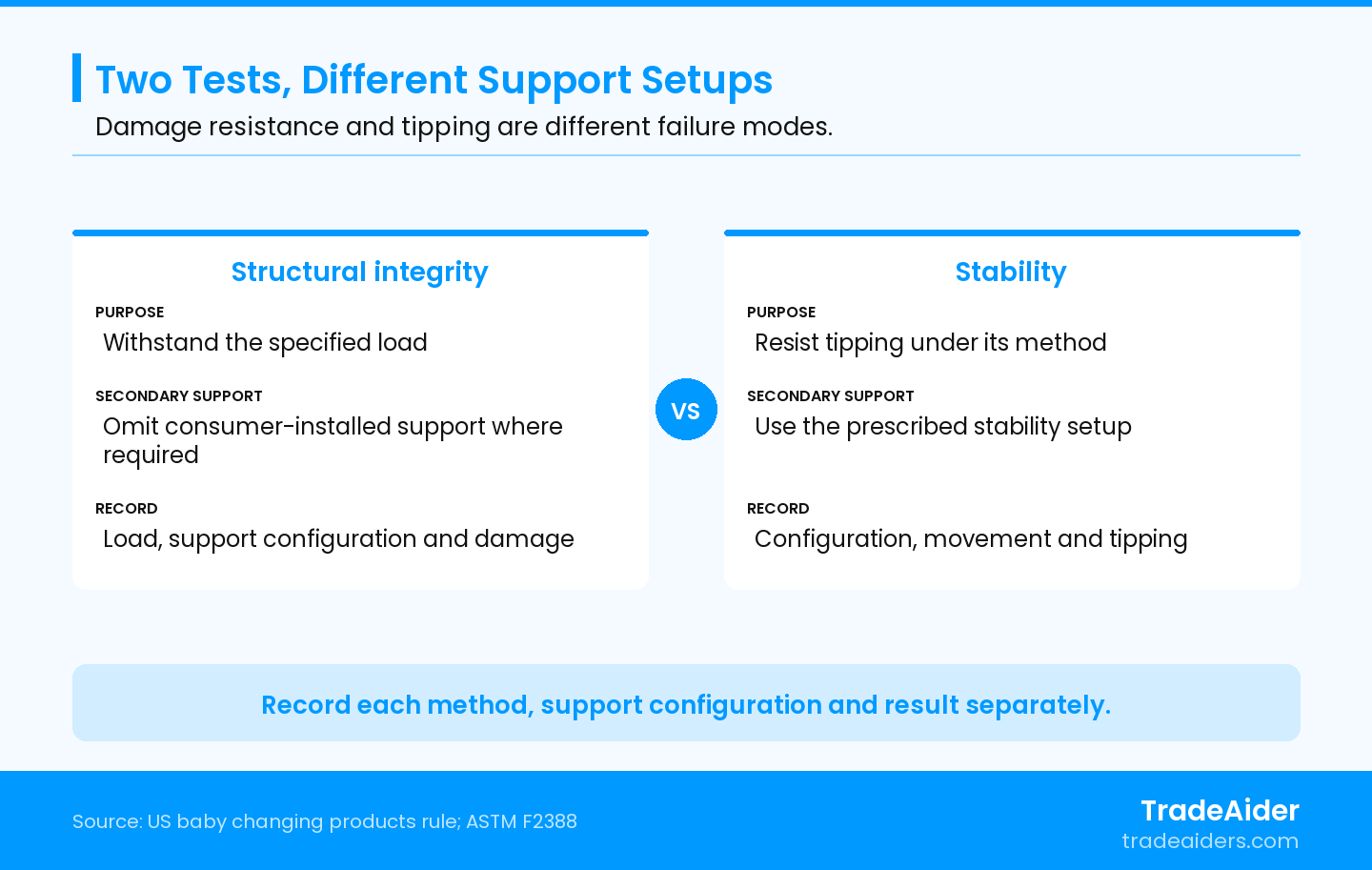
The consumer-installed secondary-support omission applies to the specified structural-integrity test; set up stability by its own method.
Where a restraint is fitted, the published US method described in the rule applies a 30-pound pull in four directions. It limits breakage or separation and permits no more than one inch of movement from the initial adjustment. A restraint that is present and fastens correctly can still fail that test. Use the complete applicable procedure to set the force application and acceptance criteria.
Check Locks, Steps and Protective Components
Operate any fold, lift, slide or step mechanism repeatedly through the agreed inspection sequence. Look for incomplete engagement, unwanted release, binding and damaged hardware. Check protective caps, sleeves and plugs for missing pieces or looseness that exposes a sharp edge or other hazard. Use the relevant retention test where required.
For a self-folding step with a single-action release, the published requirement specifies 10 lbf (45 N) for a pull or push release, or 4 lb-in (0.5 N-m) for a twist or turn release. These are mechanism-specific values, not a general force limit for every lock on a changing table. First identify the mechanism and applicable clause.
A publicly posted model test report records a protective-component torque procedure at 3 lbf-in (0.3 N-m) over 5 seconds. It illustrates the detail to expect in a clause-level result; it is not a test result for your product or a substitute for the full applicable standard. Ask for the component tested, method, torque, timing and outcome for the supplied model.
Read the Warning and Check Permanent Identification
Compare the actual warning artwork with the applicable US requirements, including the FALL HAZARD and SUFFOCATION HAZARD statements and the instruction to stay in arm's reach of the child. Check legibility and placement on the production unit. An older artwork date alone does not establish a failure; the printed wording and format must be compared with the requirements that apply.
Under 16 CFR 1130.4, durable infant or toddler products must carry permanently affixed English information identifying the domestic manufacturer or importer, its required US address and telephone number, the model or equivalent identifier, and the manufacture date. That date must identify at least month and year and may be coded. A marking that identifies only a quarter and year does not meet the stated date precision.
Check the assembly, use, cleaning and maintenance instructions supplied in the carton. They should match the delivered hardware and configuration, including any support the consumer installs. Inspect labels and instructions on sampled packed goods rather than approving only the supplier's master artwork.
Choose the Correct Market and Product Scope
ASTM F2388 addresses domestic changing tables, changing table accessories, add-on changing units and contoured changing pads for children up to 30 lb (13.6 kg). A freestanding table and a changing accessory may therefore need different configurations even within the same standard. Commercial changing tables used in public facilities fall under a separate product category associated with ASTM F2285. A flat, non-contoured hygiene mat should not simply be assessed as a contoured changing pad.
United States: match the accepted edition to manufacture date
The current 16 CFR part 1235 incorporates ASTM F2388-21. The 2022 update made that edition mandatory from July 31, 2022; previously covered production used F2388-18. Check the manufacture date and the report's standard reference. For US children's product certification, the manufacturer or importer issues the Children's Product Certificate based on the required CPSC-accepted third-party testing.
Europe: confirm the agreed edition and product-safety duties
The current European changing-unit reference is EN 12221:2026, which replaces the former two-part structure and addresses domestic changing units, changing pads and accessories. Review the product's scope and the buyer's contractual edition. Publication of the new edition does not automatically create a manufacture-date-based legal changeover or invalidate every earlier report.
General Product Safety Regulation (GPSR) has applied in the EU since December 13, 2024. Covered products require the relevant responsible economic operator, risk assessment, technical documentation and safety information. The Northern Ireland guidance explains importer obligations in that jurisdiction; do not apply it indiscriminately to Great Britain. These duties sit alongside the product's test and inspection requirements.
Example: A Packed-Carton Unit Has a Loose Joint
Illustrative example: two identified sub-lots of 3,000
A US importer orders 6,000 convertible changing tables, split into two identified sub-lots of 3,000. In this hypothetical example, a unit selected from a numbered carton in the second sub-lot has a gap at its leg-to-base joint and rocks on a level surface after assembly. The supplier's structural test note also shows the consumer-installed secondary support fitted, although the applicable method requires its absence.
The buyer holds the second sub-lot while the supplier diagnoses the joint problem and arranges the correct structural-integrity test. The supplier corrects the confirmed assembly defect and ten fresh units are rebuilt from randomly selected cartons in that sub-lot. The team checks the repaired joints, repeats the required structural test without the secondary support, and assesses stability separately under its own method. Ten units is the example's recheck allocation, not a universal acceptance plan.
The first sub-lot is assessed on its own applicable results; a pass on corrected units from the second does not release it. If carton records cannot reliably identify the two groups, the buyer cannot limit the concern to the second group. The practical lesson is to record which carton produced the observation and which test configuration was actually used, rather than relying on the display unit's appearance.
Book the Checks the Model Actually Needs
- Inspect units assembled from packed cartons with the supplied hardware and instructions.
- Request separate structural-integrity and stability results with the support configuration stated.
- Check warnings and permanent identification on production goods, including a month-and-year manufacture date.
Set the workmanship defect classes, inspection level, sample size and acceptance numbers before the visit. Use the acceptance quality limit (AQL) sampling calculator for the agreed attribute plan, and specify separate allocations and acceptance rules for applicable functional and safety tests. A good workmanship count does not resolve a failed load test or missing warning.
Send the model, drawings, hardware list, assembly instructions, manufacture dates, destination requirements and packing status when you contact TradeAider to scope a changing table inspection. Confirm the available equipment and qualified personnel, report contents and any laboratory work before booking.
Frequently Asked Questions
What should I request with a supplier's certificate?
Request the underlying test report with its model identification, standard edition, sample description, methods and results. Compare the tested construction with the supplied drawings and production version. Also request shipment inspection findings for the relevant packed goods. A certificate or approved-sample report does not describe every carton's hardware and assembly condition.
Should a joint gap be rejected immediately?
Compare the gap with the drawing, assembly instructions and agreed tolerance. It may indicate a wrong part, misfit or incomplete assembly, but appearance alone does not establish the cause. If the joint's safety or compliance remains unresolved, stop the shipment decision for the affected goods until the discrepancy is assessed under the appropriate method.
Can I use a stability result for the structural load check?
No. The checks address different failure modes and may use different support arrangements, loads and acceptance criteria. Request separate results identifying the configuration for each method. In particular, the secondary-support removal provision belongs to the applicable structural-integrity test; it should not be copied into the stability setup without a basis in that method.
Related Articles


Grow your business with TradeAider Service
Click the button below to directly enter the TradeAider Service System. The simple steps from booking and payment to receiving reports are easy to operate.

