
- About Us

- Our Services
- Your Industry
- Resources
- News & Blog
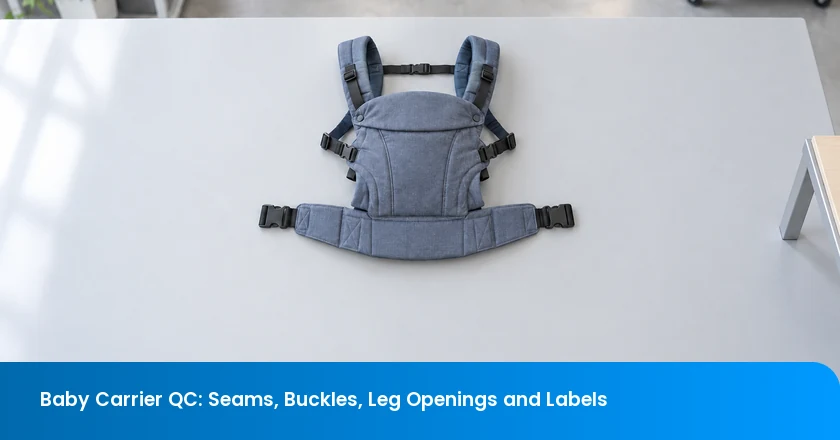
Baby carrier quality control should follow the child-supporting assembly from the seat panel through its seams, straps and buckles, then check the adjusted leg openings and supplied warnings. Keep construction observations separate from the performance tests they cannot replace. Before shipment, also reconcile the instructions with the occupant limits and carrying modes supported for that model. A carrier can match its approved construction sample while its printed instructions still authorize an unsupported use.
What a Baby Carrier Inspection Must Resolve
- Whether the load-bearing construction matches the approved design, including reinforcement hidden beneath outer fabric.
- Whether the specified buckle, webbing and opening checks have results for the correct configuration.
- Whether product labels and packed instructions describe the same supported model, occupant and use limits.
Identify the Carrier Type and Applicable Requirements
For quality control (QC), “baby carrier” is too broad a category on its own. Establish whether the product is a soft infant and toddler carrier, sling, frame carrier or hand-held carrier. A marketing name or similar fabric appearance does not settle the applicable route. The focus here is a sewn soft carrier used close to the caregiver, rather than a universal checklist for every product sold under the carrier name.
For US soft infant and toddler carriers, 16 CFR part 1226 incorporates ASTM F2236-24 in the current available September 10, 2026 regulatory snapshot. Confirm the applicable version and any relevant timing provisions for the actual goods. Requirements for a different carrier category or destination should be established separately, rather than importing this US reference without a scope check.
The technical owner should supply the accepted procedures and criteria, not just a standard number. Load application, fixtures, conditioning, adjustment and sample allocation can affect what a result means. Agree which checks can be performed properly at the factory and which need a laboratory. Never use an infant or child as the inspection test load.
Keep the other applicable product requirements in view, including materials, small parts and required product information. Seam, buckle and opening checks address important fall-risk mechanisms, but passing those checks alone does not establish complete conformity.
Define the Supported Child and Carrying Configuration
Use TradeAider’s company background to evaluate the organization behind the proposed inspection, then discuss the equipment and methods available for your carrier. Confirming a provider’s background is useful; confirming the actual assignment scope determines which results the visit can produce.
Define the supported child and carrying configuration before samples are selected. Supply the model revision, occupant limits, approved carrying positions, adjustment instructions and any required insert or accessory. The inspection references should identify the same construction and intended use as the goods in the order.
Include the fabric, webbing, thread and hardware specifications alongside the construction drawing. Where reinforcement is concealed, provide a controlled construction reference that explains how it is formed and how it can be verified. A sealed comparison sample may help with appearance while revealing little about the stitching inside a padded attachment.
Send the approved label artwork and instruction version at the same time. Specify the languages, location and permanence criteria to be checked under the applicable requirements. This allows the inspector to compare the carrier and its information as one supplied product, instead of postponing the instructions until after the physical findings have been accepted.
Baby Carrier Inspection Checklist: Evidence to Record
Connect every finding to the load-bearing feature or information requirement it addresses. Record the sample identifier, model revision, adjustment, method and acceptance reference. A photograph of tidy stitching establishes an appearance observation; it should not be filed as the result of a load test that was never performed.
The following checklist organizes the evidence an importer should request. Product-specific limits, fixtures and test sequences must come from the accepted procedure. Use the final column to explain what remains unresolved when the planned evidence is absent or a criterion is not met.
| Inspection area | Compare with the approved reference | Record for review | Unresolved finding |
|---|---|---|---|
| Load-bearing seams | Panel assembly, reinforcement, stitch construction and materials | Location, sample identity and required construction or load-test result | Missing reinforcement, damage or unverified concealed construction |
| Buckles and webbing | Hardware identity, threading, engagement and adjustment | Retention result, slippage observation and test setup | Release, breakage, incorrect routing or missing required test |
| Leg openings | Configured carrier, adjustments and specified fixture | Relevant opening-test result and adjustment state | Failed criterion or a result from the wrong setup |
| Warnings and instructions | Supported occupant, carrying modes and current artwork | Product and packed-document versions, readability and attachment | Unsupported use claim, missing text or mixed versions |
Ask for an overview image showing where each finding sits on the carrier, followed by a close view of the feature. Mark any adjustment or disassembly performed during inspection so the reviewer knows whether a photograph shows the delivered state or a later investigative step. Preserve the original condition before the factory attempts a repair.
TradeAider’s inspection-standard guidance can support the discussion of inspection criteria and defect reporting. Add the controlled carrier methods to that general basis. For a disputed result, the buyer needs both the observation and its reference, rather than a pass/fail label with no way to reconstruct the decision.
Seam Load: Inspect the Complete Load-Bearing Construction
Follow the load path through the complete assembly: the fabric supporting the child, the reinforced attachments and the straps transmitting that load. Identify which seams are structural and which are decorative or serve only to close a lining. Do not assume that a conspicuous outer stitch row is the only construction carrying force.
The September 2016 Lenny Lamb Buckle Onbu recall identified missing internal stitching as a fall hazard. That specific finding illustrates the limitation of an exterior appearance check: concealed construction can matter even when the outside looks finished. It supports checking the approved load-bearing assembly, not inventing a universal stitch pattern for all carriers.
Compare seam location, stitch formation, thread specification, seam allowance and reinforcement with the controlled drawing or approved construction reference. Record skipped or broken stitches, fabric damage, loose thread ends where relevant and attachment asymmetry. A different stitch count is a discrepancy to evaluate against the specification; a higher count is not automatically an improvement.
Use the agreed verification method for concealed features. This may require production records, a controlled construction sample or authorized examination of allocated units, depending on the plan. State what was actually examined. Do not claim that every hidden seam in the shipment has been inspected merely because a reference sample was opened.
Load performance needs its own evidence. Apply the specified static or dynamic procedure only with the appropriate apparatus, conditioning and sample allocation. Document any separation, deformation or other outcome required by that method. Hand pulling can reveal an obvious concern, but it cannot establish compliance with a defined test. A missing required result should remain identified for follow-up.
Buckle Security: Check Engagement and Webbing Retention
Check buckle engagement and webbing retention as related but distinct functions. A buckle can appear connected while the strap is incorrectly threaded or fails to hold its adjustment. Verify the hardware identity and the intended webbing route before interpreting how the assembled connection behaves.
In the April 2008 Beco Butterfly carrier recall, shoulder-strap buckles could unexpectedly release tension, allowing the strap to slip through and creating a fall hazard. The reported mechanism was not simply a buckle being left open. For inspection, this makes strap movement and retention important observations alongside engagement.
Compare the installed buckle and adjuster with the approved part references, including webbing width and construction where specified. Look for damaged molded features, incomplete engagement, incorrect threading and missing strap-end details. Photograph the routing clearly enough that the technical reviewer can distinguish a hardware problem from an assembly mismatch.
Perform the agreed fastening, release and retention checks under their specified conditions. Record the adjustment before and after testing if the method requires it, with the relevant loading direction and sample identity. Do not infer a holding force from a click, and do not lubricate or modify the component to obtain a favorable result without an approved technical instruction.
If slippage or unintended release occurs, retain the condition long enough to document it. Identify the buckle, webbing and assembly references so the investigation can address the whole interface. Replacing a buckle with a visually similar item changes that interface; it should not be accepted as a routine cosmetic substitution.
Leg Openings: Evaluate the Adjusted Carrier, Not Flat Fabric
Leg-opening checks belong to the adjusted, assembled carrier. A flat pattern dimension or a tape measurement across loose fabric may not represent the opening under the setup required by the procedure. Identify the carrying mode, adjustment and any intended accessory before recording the result.
An April 2026 CPSC safety warning concerning Yemkezo carriers identified failures involving leg openings, fasteners and strap retention. This was a product safety warning, not an agreed recall. It shows that the opening and retention requirements need distinct evidence; a satisfactory buckle observation cannot stand in for the required opening result.
Use the appropriate test fixture or probe and the prescribed method. Record the adjustment setting in a reproducible way, using the product instructions or technical reference. Where the required setup includes a particular insert or occupant condition, confirm that it is the configuration supported for the supplied model. Do not add padding or an unapproved accessory merely to reduce an opening.
Check both the initial setup and any later state required by the procedure. Strap adjustment can alter how the carrier supports its occupant, so an unexplained change between photographs weakens the record. If a test exposes slippage, tell the reviewer which opening result belongs to the carrier before that event and which belongs to its subsequent condition.
An unavailable fixture is a reporting issue to resolve, not permission to guess. Identify the unperformed check and arrange the proper verification. The report should distinguish a dimensional observation, a completed opening test and a limitation in scope; those entries lead to different acceptance decisions.
Warning Labels: Match Instructions to the Supplied Carrier
Treat warnings and instructions as part of the delivered carrier. Start by comparing the intended-use statements with the controlled model: who may be carried, in which positions and with which adjustments or accessories. Then inspect the physical label and packed information against the approved artwork and applicable criteria.
TradeAider’s pre-shipment inspection service includes agreed checks on finished goods and packaging. Its stated readiness is 100% of the order quantity complete and at least 80% packed for export. Schedule pre-shipment inspection (PSI) with access to the actual packed instructions and labels, so the visit can record what the buyer will receive rather than only a factory artwork file.
The CPSC soft infant and toddler carrier guidance includes labeling alongside physical performance requirements, and distinguishes tracking and other durable-product information. Obtain the exact required warning content and presentation from the applicable standard and the responsible technical reviewer. A generic care label is not a substitute for that review.
Check the approved warning wording, language, legibility, location and required attachment or permanence. Reconcile model identification, use limits and instruction illustrations with the actual carrier. Keep printing defects separate from content defects: an exceptionally clear statement can still authorize a use that the model does not support.
For multilingual material, use an approved translation tied to the same controlled version. Inspect whether packed leaflets, sewn labels and retail packaging have been mixed across revisions. An obsolete leaflet remaining in a sealed pack can undo an otherwise correct label replacement, so the correction record must address every affected information carrier.
Keep Workmanship Acceptance Separate from Unresolved Safety Evidence
A satisfactory physical observation does not close a conflict in the supplied instructions. Keep unresolved construction, performance and documentation findings visible in the shipment decision. Name the affected product or print version and the evidence needed to resolve it, rather than allowing an overall workmanship result to conceal the open issue.
For US children’s products, the domestic manufacturer or importer issues the Children’s Product Certificate (CPC) on the required testing basis, as explained in CPSC certificate guidance. Reconcile that evidence with the model and applicable requirements. A factory inspection report records its actual observations; it does not itself confer the required certification or expand the product’s permitted use.
Choose the corrective action from the finding. A missing structural seam may require an engineering-approved correction and further verification. A wrong instruction version requires reconciliation of the supported use and controlled replacement. An unperformed test requires a suitable test arrangement. The record should make those different tasks and their owners clear.
An acceptance quality limit (AQL) plan can still organize agreed workmanship sampling. Use TradeAider’s AQL calculator for that calculation while keeping unresolved safety requirements outside any assumption that an acceptable cosmetic count settles them. The importer needs the open findings and technical disposition as well as the sample result.
Illustrative Example: Correct Carrier, Wrong Occupant Instructions
Consider an illustrative order of 720 soft carriers. The controlled model is intended only for children who can sit unassisted. Completed, packed goods are available, and the observed construction matches that model. However, every pack contains a print version stating newborn use. No physical test failure is assumed here; the conflict is between the supported occupant group and the information supplied with all 720 carriers. This is a hypothetical example, not a TradeAider client result.
The matching construction does not justify the newborn claim. The importer keeps the order on hold while the technical owner reconciles the model and its intended use. Accepting the print because it is readable would miss the issue: it directs a caregiver toward a use outside the controlled model’s scope. The decision concerns that documented conflict, not an invented rate of defective seams or buckles.
The technical owner approves the corrected instructions and labels, and the factory controls their replacement in the affected packs. Verification reconciles print-version quantities, checks the corrected product and packed information, and identifies any additional testing needed before the importer makes the disposition. Changing a label or adding an insert does not demonstrate newborn suitability. The occupant restriction belongs to this illustrative model; it is not a universal age limit for all soft carriers.
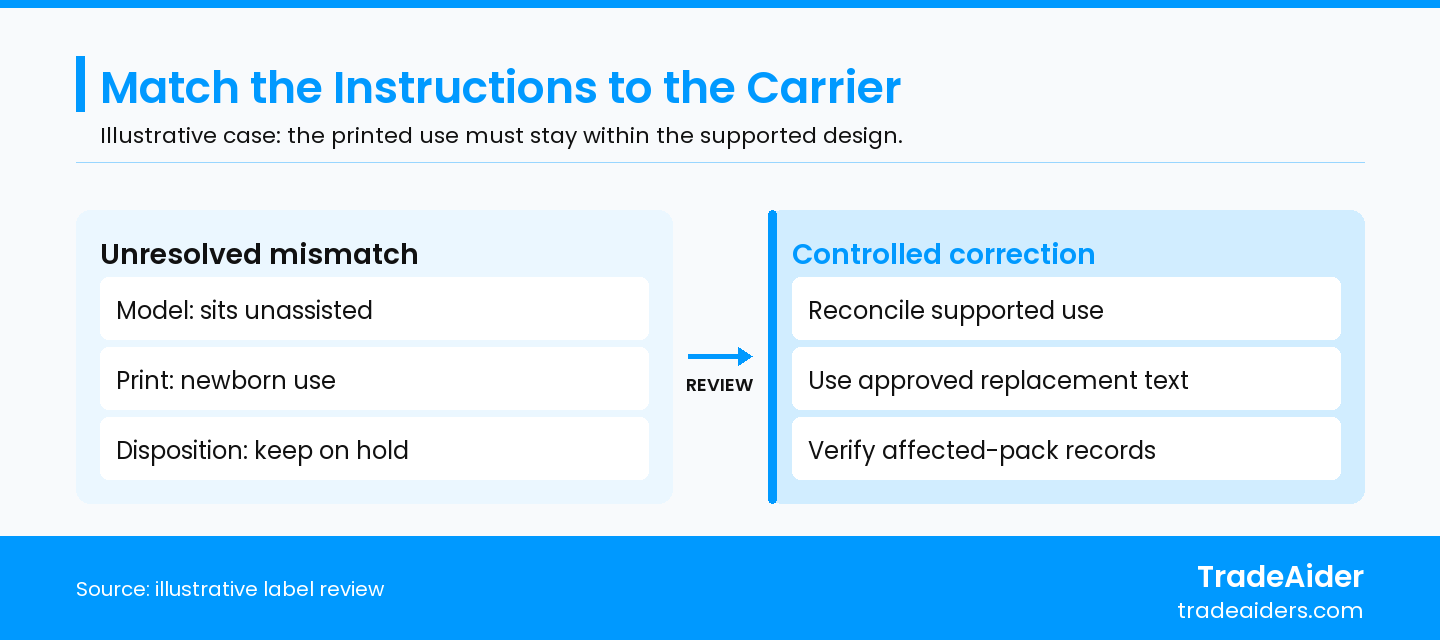
Illustrative document correction: changing the text does not create a new approved carrying mode.
Prepare a Baby Carrier Inspection Request
Prepare the carrier model, destination, approved occupant limits and carrying configurations before requesting the visit. Include construction drawings, component revisions, label artwork, instructions and the methods and acceptance criteria you need checked. State which evidence is already available and which findings remain open.
Add order quantity, packing status, factory location and access requirements. Ask the team to confirm the feasible factory scope and any separate test arrangements. The expected deliverable should identify the sampled goods and their construction, functional, measurement and packaging observations, supported by useful photographs and clearly stated limitations.
Contact TradeAider to plan your baby carrier inspection with those references. Keeping the product and its approved information together helps the inspection report support a specific correction or shipment decision.
Frequently Asked Questions
Does a fabric test report establish the strength of the finished carrier?
No. A material report can support the property it actually measures, but the finished carrier also depends on seams, reinforcement, webbing and attachments. Match the report to the supplied material and obtain the assembled-product evidence required by the applicable method. Do not substitute a fabric result for a carrier load test.
Can the factory add stitching to repair a weak seam?
Only through an approved correction with the necessary verification. Additional stitching can change the assembly and may damage fabric or alter how force is transferred. The technical owner should define the correction, affected units and required reassessment. A neat repair photograph alone does not show that the original failure has been resolved.
Can a replacement buckle be accepted because it fits the webbing?
No. Physical fit does not establish the required strength, release behavior or strap retention. Identify the replacement part and its material and dimensional references, then have the technical owner determine the necessary assessment of the assembled interface. Keep the change traceable to the units that received it.
Can an insert make an older-child carrier suitable for newborns?
Not without support for the complete intended configuration and applicable requirements. An insert can change fit and support, so it is not simply a way to reduce a leg opening. Require the manufacturer’s approved configuration, compatible instructions and relevant evidence before treating it as a permitted use.
Related Articles


Grow your business with TradeAider Service
Click the button below to directly enter the TradeAider Service System. The simple steps from booking and payment to receiving reports are easy to operate.

