
- About Us

- Our Services
- Your Industry
- Resources
- News & Blog
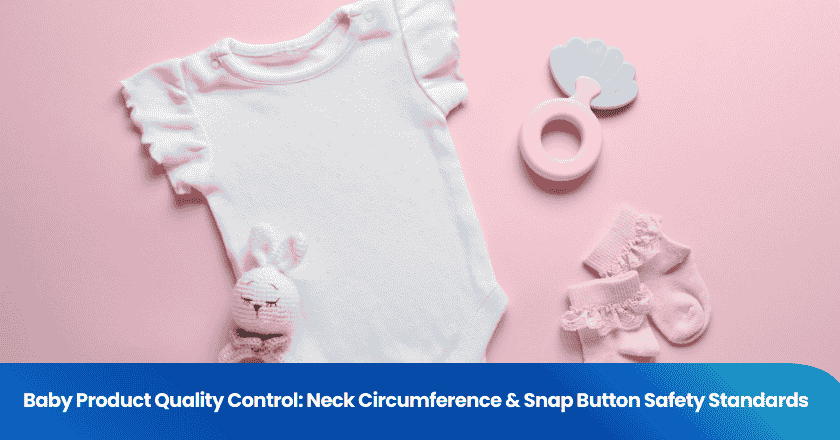
In the infant apparel industry, quality assurance is synonymous with life-saving precision. Unlike adult fashion, baby products are governed by strict mechanical and chemical safety standards to prevent the primary risks of strangulation and choking. A professional baby products inspection focuses on two high-risk fail points: the accuracy of neck circumference to ensure airway safety and the structural fastness of snap buttons to prevent accidental ingestion. By implementing comprehensive quality checks, manufacturers and buyers can ensure 100% compliance with global regulations such as CPSIA and EN 71.
Key Takeaways
- Airway Safety: Accurate neck circumference prevents both restricted breathing (too tight) and entanglement (too loose).
- Choking Hazard Prevention: Snap buttons must withstand a minimum pull force of 90N (20 lbs) for 10 seconds.
- Standard Compliance: Inspection protocols must align with ASTM F963 (USA) and EN 71-1 (Europe) physical testing.
- AQL Zero Tolerance: Detached small parts are categorized as critical defects with a zero-acceptance limit.
- Real-Time Auditing: Digital oversight systems allow for immediate on-site corrective actions during production.
Neck Circumference: The Critical Science of Sizing
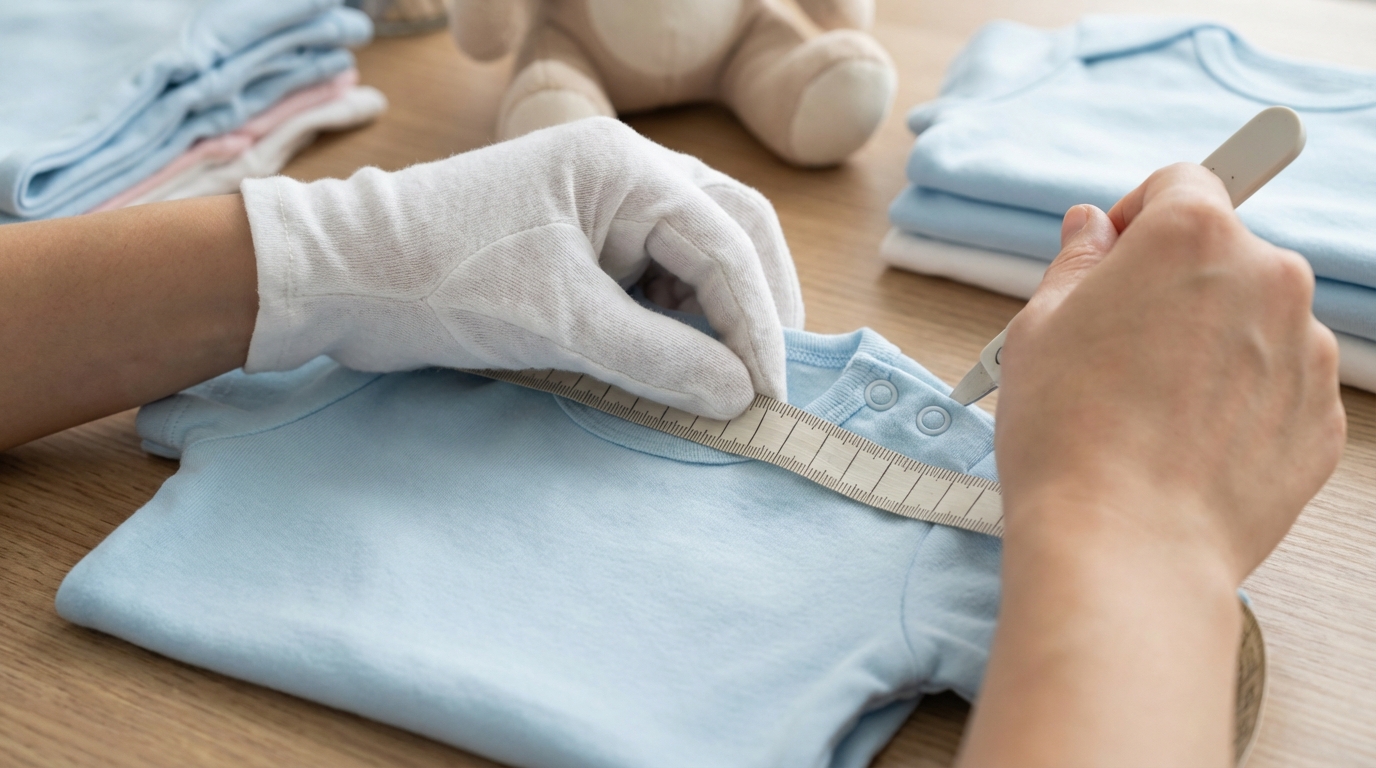
Neck measurement in infant wear is not just a fit preference; it is a vital safety metric. The space between the garment's neckline and the infant's neck must be balanced to provide ergonomic comfort while ensuring the garment cannot be pulled over the head or chin in a way that obstructs the face. A professional quality control inspection utilizes standardized measuring boards and flexible tapes to audit these dimensions across multiple size sets.
Sizing Tolerances and Measurement Accuracy
During the dimensional verification phase, inspectors measure the neck opening in both "Relaxed" and "Extended" states. This is particularly important for rib-knit necklines. If the extended measurement is insufficient, the infant may struggle during dressing (Donning/Doffing), which increases the risk of skin abrasion or restricted blood flow. Common industry tolerances for neck circumference are ±0.5cm—much stricter than the ±1.5cm allowed in adult clothing.
| Age Group | Recommended Neck Opening (Inner Circ.) | Measurement Tolerance |
|---|---|---|
| 0 - 3 Months | 22.0 cm - 24.0 cm | ± 0.5 cm |
| 3 - 9 Months | 24.5 cm - 26.5 cm | ± 0.5 cm |
| 9 - 18 Months | 27.0 cm - 29.0 cm | ± 0.5 cm |
| 18 - 36 Months | 30.0 cm+ | ± 1.0 cm |
"Safety in infant sizing is a matter of millimeters. An undersized neckline can cause immediate distress, while an oversized one invites the risk of 'Chin-Tuck' entrapment."
Snap Button Testing: Preventing Small Part Detachment
Snap buttons, often made of brass or stainless steel, are the most convenient fasteners for rompers and onesies. However, they are also a high-frequency fail point. If the snap is not attached with the correct "Clamping Pressure," it can detach during rough play or washing. For children under 36 months, any detached part that fits inside a "Small Parts Cylinder" (31.7mm diameter) is a potential death hazard.
Technical Standards for Pull Force Testing
Inspectors utilize a calibrated Snap Tester (such as the SafQ Pull Tester) to perform destructive testing on a random sample set. According to ASTM F963-17 and EN 71-1, a snap fastener must withstand a steady pull of 90 Newtons (approx. 20 lbs) for a duration of 10 seconds. If the snap breaks, detaches, or the surrounding fabric tears, the entire production lot is rejected.
| Test Type | Standard Force (N/Lbs) | Technical Objective |
|---|---|---|
| Static Tension Test | 90N / 20 lbs | Verify clamping integrity between snap and fabric. |
| Torque Test | 0.34 Nm | Ensure the snap head cannot be twisted off by a child. |
| Compression Test | 110N / 25 lbs | Test the snap's resistance to being crushed into sharp shards. |
| Wash Fatigue Test | 50 Cycles | Check for oxidation and looseness after repeated laundering. |
Material Selection and Fabric Density
The success of a snap button attachment often depends on the "Interlining" and the "Fabric Weight." If the fabric is too thin (e.g., 120 GSM single jersey), the snap will easily rip through the fibers. Professional apparel quality control requires the use of non-woven reinforcement tape behind the snap area to distribute the tension across a larger surface area.
Metal Compliance and Chemical Safety
Beyond mechanical strength, snaps must be chemically safe. Inspectors verify that all metal hardware is:
- Lead-Free: Must contain less than 90ppm total lead content.
- Nickel-Free: Must meet EN 1811 standards for nickel release to prevent allergic dermatitis on sensitive baby skin.
- Needle-Detection Compatible: Snaps must be made of non-ferrous metals to pass through factory metal detectors without triggering false alarms.
Digital Transparency: Real-Time Monitoring in QC
The traditional method of receiving inspection reports days after production is no longer viable for modern safety-first brands. Through TradeAider's inspection services, clients not only receive an official inspection report within 24 hours, but can also view inspection progress and identified issues during the inspection via TradeAider’s online service system. During inspections, inspectors use mobile devices to record key safety and quality checks—such as snap pull tests, neck circumference measurements, seam integrity, and material compliance—and capture high-definition photos and videos for accurate documentation.
By reviewing the Online Real-time Report, brands can authorize shipments based on live data, monitor on-site rectification efforts, and make timely decisions—whether to accept products commercially, require corrections with the support of TradeAider inspectors, or reject items before shipment. This approach ensures that only safety-approved baby products are packed, shipped, and paid for, helping brands reduce losses, maintain regulatory compliance, and uphold a flawless safety record.
| Audit Phase | Key Verification Point | Deliverable |
|---|---|---|
| Pre-Production (PPI) | Snap-clamping pressure calibration. | Machine Approval Log. |
| During Production (DPI) | In-line neck size audit (10% of batch). | Early Defect Warning. |
| Final PSI | Destructive pull tests on AQL samples. | Official Certification Report. |
Best Practices for Infant Apparel Sourcing
To maintain a low defect rate, brands should request a "Pre-Production Meeting" (PPM) to align with the factory on the "Golden Sample." Furthermore, implementing a "Needle Log" is essential—if a sewing needle breaks, all pieces must be recovered and taped to a log before a new needle is issued, ensuring no metal shards remain in the baby's clothing.
Ready to secure your product quality before shipment?
As your third-party inspection, testing & certification partner in China, TradeAider supports brands and sourcing teams across the entire production process, helping you identify quality risks early, ensure compliance, and strengthen your team’s capabilities before shipment.
Book an Inspection or Testing Service with TradeAider today, or for tailored solutions and expert guidance, contact us at services@tradeaider.com.
FAQ
What is the "Small Parts Cylinder" test?
It is a technical tool used to determine if a detached component (like a snap head) is a choking hazard. If a part fits completely into the cylinder—which mimics an infant's throat—it is illegal for use on products for children under 3 years old.
How many snap buttons are tested in a typical inspection?
Inspectors usually test snaps on 10% of the sample size defined by the AQL (Acceptable Quality Level). For a standard order, this might mean performing destructive tests on 20 to 50 individual snaps to ensure the entire batch is secure.
Why is "Nickel-Free" mandatory for baby clothes?
Babies have extremely sensitive skin and haven't built up resistance to heavy metals. Nickel is a common allergen that can cause "Contact Dermatitis" (rash and irritation). High-quality snap manufacturers utilize "Eco-Friendly" plating to meet Oeko-Tex standards.
Can a neck measurement change after the factory inspection?
Yes, due to "Relaxation Shrinkage." If the fabric was over-stretched during the knitting or sewing process, it may shrink significantly after being removed from the forms. Quality control includes a 24-hour "Rest Period" before final measurements are taken.
What happens if a single snap button fails the pull test?
In baby products, snap failure is a "Critical Defect." A single failure results in the entire lot being rejected. The factory must then perform a 100% manual check and re-clamping of every snap on every garment before a re-inspection can occur.
Related Articles


Grow your business with TradeAider Service
Click the button below to directly enter the TradeAider Service System. The simple steps from booking and payment to receiving reports are easy to operate.

