
- About Us

- Our Services
- Your Industry
- Resources
- News & Blog
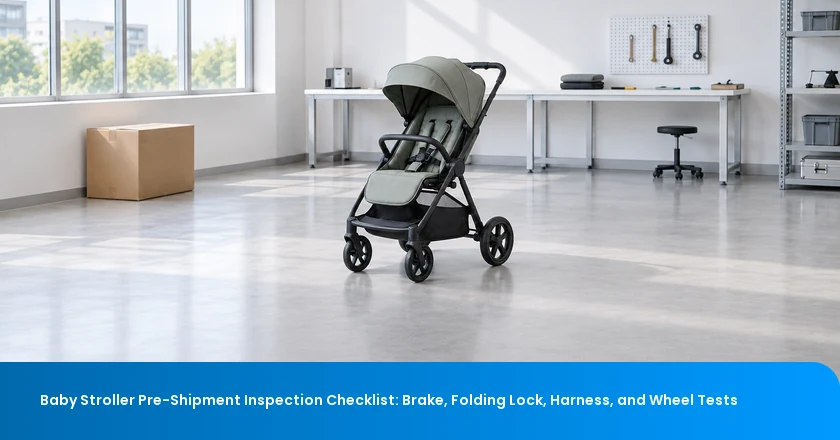
A baby stroller pre-shipment inspection (PSI) should check brake holding, folding-lock retention, the complete harness, wheel attachment and accessible pinch points against an approved method. Record the configuration and result for each check. Hold safety-related failures for technical review, even if the stroller looks finished or the workmanship sample is acceptable.
The checklist below helps importers brief a factory inspection and interpret its findings. It is not a substitute for destination-specific safety testing. The US requirements cited here are a regulatory example; buyers supplying another market need the applicable local standard and an appropriate technical reviewer.
What a Stroller Inspection Must Establish
- The inspected model and configuration match the approved references.
- Each recorded pass comes from the agreed method, with the required equipment available.
- Functional failures, unperformed tests and unresolved corrections remain visible in the shipment decision.
Set the Inspection Method Before the Factory Visit
Agree the exact stroller configuration, approved instructions and test method before the visit. A checklist that says only “brake OK” leaves the inspector and buyer free to apply different conditions. Specify the seat position, wheel arrangement, accessories and intended use that the inspection must cover.
Give the inspector the current model list, bill of materials or controlled component references, approved sample photographs and assembly instructions. Identify any production revision affecting the brake cable, latch, buckle, wheel hub or frame. A similar appearance is not enough to establish that a substituted part matches the tested construction. Ask the responsible technical team to resolve that question before treating the old report as applicable.
For every requested test, name the method and revision, acceptance criterion, sample scope, fixtures, loading arrangement, duration or repetitions, and evidence to retain. The values must come from the applicable standard or an approved buyer procedure. Do not borrow a force or slope from an unrelated stroller design. Confirm who supplies suitable equipment and who is qualified to use it; missing facilities should be discovered before the appointment.
Choose the inspection provider with the assignment in mind. Review TradeAider’s company background when assessing the organization, then confirm the actual visit scope with its team. Company credentials alone do not establish that a particular laboratory test can be performed at the factory.
Confirm the Destination Standard and Laboratory Evidence
For US carriages and strollers, the current federal rule incorporates ASTM F833-21, the stroller safety specification published by ASTM International. The controlling reference is 16 CFR part 1227. Check the accepted edition for the product’s manufacture date instead of relying on an undated supplier statement.
Keep the safety test report separate from the factory inspection report. The US Consumer Product Safety Commission (CPSC) explains that the domestic manufacturer or importer issues the Children’s Product Certificate (CPC) using the applicable testing basis. Check product identification, applicable rules, production details and laboratory information against the supplied goods. A general factory pass does not provide that certification. Import certificate filing is also a separate task for the importer; the current CPSC guidance flags electronic filing requirements.
Ask a qualified laboratory or compliance reviewer which configurations and tests the evidence actually covers. This matters for interchangeable seats, car-seat adapters and other supplied combinations. Functional observations during a factory visit can reveal an assembly problem, but they cannot silently extend a test report to a new construction. The following checks are buyer inspection tasks, not a reproduction of the complete standard.
Stroller Inspection Checklist: What to Check and Record
Record the method, configuration and result for each safety-related function; an unperformed test is not a pass. If a required fixture is missing, describe the gap and leave the test unresolved. That distinction lets the buyer arrange the missing evaluation without mistaking a visual observation for measured performance.
Use this table as a briefing checklist. Add the approved method reference and actual result to each applicable row; do not insert generic loads or repetition counts simply to fill a form. TradeAider’s inspection-standard guidance can help align inspection references and defect reporting before the visit.
| Check | Factory task under the approved method | Evidence to retain | Hold or escalation trigger |
|---|---|---|---|
| Parking brake | Engage, release and verify holding in the specified setup | Control position, setup, observed movement and result | Failure to engage, loss of holding or unexpected release |
| Folding lock | Open fully and verify each required lock retains the frame | Lock position, indicator and retention result | Partial engagement, damaged latch or unintended folding |
| Harness | Check routing, buckle engagement, adjustment and anchors | Installed strap path and specified functional result | Unintended release, slipping or damaged attachment |
| Wheels and swivels | Assemble, roll, steer and check retention as specified | Hub/axle identity, installed state and retention result | Loose retention, detachment, binding or damaged mount |
| Pinch points and frame | Observe moving gaps, covers and exposed edges safely | Location and operation that exposes the concern | Accessible hazardous gap, missing guard or damaged frame |
| Packing and instructions | Unpack and assemble the delivered configuration | Contents, instructions, accessories and identification | Wrong parts, unclear assembly or function changed after packing |
Movement and retention answer different questions. A pedal moving, a lock clicking, a buckle closing or a wheel turning establishes only the observed action. The report must also show the relevant holding or attachment check under the agreed conditions. Keep both observations tied to the same identified sample.
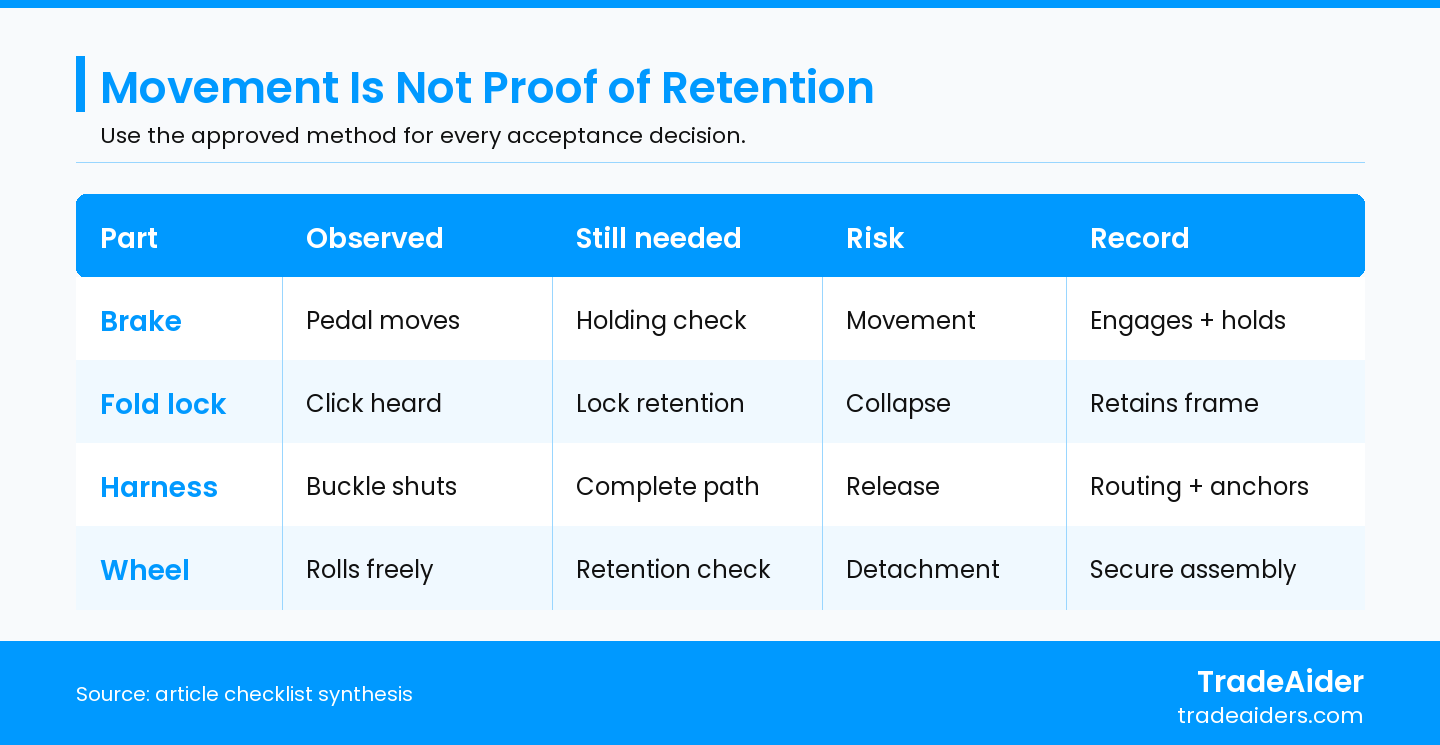
Record the specified functional evidence; a visible movement alone is not a passing result.
Brakes: Verify Engagement and Holding
A recalled stroller brake could fail to engage or unexpectedly disengage, according to CPSC’s Guava Roam recall notice. These are distinct failure modes: a control may not set the brake, or a brake that initially sets may lose engagement. The notice illustrates the mechanism, not a defect-rate estimate for other strollers.
Start by checking that the fitted brake parts and cable routing match the reference. Operate the control as instructed and observe the mechanism it is meant to engage. Where a linked control operates both sides, confirm the intended engagement on both sides. A photograph of a depressed pedal does not show whether the intended braking action occurred.
Perform the approved holding check with the specified loading, surface and orientation. Record actual movement or loss of engagement, not just the operator’s impression. Release the brake and confirm the expected free movement without persistent drag. If the method includes checks after folding, assembly or another operation, retain the before-and-after results. Do not erase an intermittent failure because the next attempt succeeds.
Folding Locks: Confirm Retention and Check Pinch Points
A stroller folding hinge was recalled because it could pinch a child’s finger; the CPSC Graco recall notice describes laceration and amputation hazards. Lock retention and moving-gap hazards therefore deserve separate observations. A frame can remain open while a hinge still presents a concern during folding.
Follow the intended opening sequence and inspect every required latch or locking element. Check visible indicators against the instructions, then apply the specified retention check. Listen for a click only as an observation; it does not establish full engagement. Look for partial seating, uneven engagement, missing hardware, deformation and interference from fabric or cables. Record which side or joint is affected.
For folding, check the intended release sequence and whether the frame moves without unexpected obstruction. If the design has a secondary lock or release action, inspect it as part of the approved mechanism rather than assuming every stroller uses the same arrangement. Keep the transport latch, which retains the folded package, distinct from the lock that holds the stroller open for use.
Observe the moving joints from a safe position. Do not place fingers in closing gaps to judge clearance. Flag missing covers, exposed shear points or a newly accessible opening for qualified evaluation using the proper probes and procedure. A visual check can identify a reason to investigate; it does not measure compliance with every entrapment or pinch-point requirement.
Harness: Check Routing, Buckles and Anchor Points
Inspect the complete restraint path, not only whether the buckle closes. Compare the installed straps with the approved routing: shoulder, waist and crotch elements where specified, adjusters, seat slots, stitching and attachment points. Check for twists, cuts, skipped stitching and routing that transfers the load differently from the approved arrangement.
Operate each buckle component and adjuster according to the instructions. Record whether the connections engage as intended, whether the release behaves correctly and whether straps slip during the specified check. Use the agreed fixture and force method for any retention or strength assessment. Pulling by hand without a defined procedure is not evidence of a laboratory-strength result.
Seat position also belongs in the record. A harness that is routed correctly in one configuration may be assembled differently after the seat is removed or reclined. Check the configurations included in the brief, and identify any combination that was unavailable. Photograph the full strap path as well as a close-up of a defect so the technical reviewer can understand the installation.
TradeAider’s pre-shipment inspection service is scheduled when the order quantity is 100% complete and at least 80% packed for export. Its published scope includes functional and specified on-site checks, packaging and an inspection report. Confirm the feasible stroller checks in advance; the packing threshold does not mean that 80% production completion is sufficient.
Wheels: Separate Free Rolling from Secure Retention
Wheel and swivel assembly detachment is among the performance requirements listed in CPSC’s stroller business guidance. Free rolling and secure retention are different properties. A wheel may turn smoothly while an axle, clip or hub connection still needs a separate attachment check.
Verify that each wheel assembly matches the approved version and position. Assemble removable wheels exactly as instructed, including any prescribed locking indication or installation check. Inspect the attachment area for missing components, incomplete seating, damage or an unapproved replacement. Do not apply a generic tightening torque to a connection whose specified method is different.
Check rolling and steering under the agreed setup, then perform the specified retention assessment. Record the swivel-lock position where relevant. Binding, excessive play or unexpected release needs a location-specific finding: identify the wheel, assembly state and operation that produced it. A vague “wheel issue” makes corrective work harder to verify.
Keep removable components matched to their original inspected sample through testing. Substituting a wheel from another unit may help an engineer investigate, but it changes the configuration. Record the swap and keep the original finding open until the responsible reviewer determines the cause, correction and affected production scope.
Check the Assembly the Customer Will Receive
Repeat the approved assembly sequence from the retail package, using the instructions and parts the customer will receive. Confirm wheel bags, fasteners, accessories and protective packing. Watch for cables trapped by the fold, abrasion against hardware or a component supplied in the wrong orientation. Retest the specified functions after unpacking where the inspection brief requires it.
For US durable infant or toddler products, CPSC requires a registration form attached to the product and an electronic registration option, as explained in its registration-form guidance. Check the approved form and its placement; a loose generic leaflet is not evidence that the required registration arrangement has been supplied.
Also reconcile the model and production identification, warnings and instruction version with the approved artwork. Record any mismatch between the carton and the stroller. Packaging checks should establish what is actually delivered, rather than merely show that a retail box looks undamaged. Leave any missing required document or accessory visible in the final report.
Handle Safety Failures Separately from Workmanship Sampling
A safety-related functional failure needs containment and technical disposition, even when workmanship sampling is acceptable. Define that rule in the inspection brief so an importer receives the failure immediately and the potentially affected goods remain on hold while its significance is assessed.
The acceptance quality limit (AQL) is used in acceptance sampling for defined defect classes. Use an AQL calculator to plan the agreed workmanship sample, while keeping the safety-related functional checks and their acceptance criteria explicit. A favorable cosmetic count cannot cancel an observed brake, lock or restraint failure. Nor does a sample with no observed failure prove every uninspected unit is safe.
Ask the supplier to identify the affected production scope using component batches, assembly records and packing history. If the records cannot distinguish affected goods, the hold needs to cover the potentially affected lot. Have the responsible engineer determine the cause and approve the correction. The inspection report should preserve the original condition, the corrective work and the subsequent verification as separate evidence.
For unperformed tests, identify the missing method, fixture or access and assign a resolution owner. “Not tested” and “failed” require different follow-up, but neither should disappear inside an overall pass. The importer’s shipment decision should state which unresolved items prevent release and which evidence will close them.
Illustrative Example: A Brake Failure After Repacking
Consider an illustrative order of 800 folding strollers supplied with removable wheels. The lot is complete and retail-packed, and the approved assembly instructions are available. A sampled stroller’s brake holds before repacking. After the documented unpacking and assembly sequence, the brake intermittently fails to engage. The inspector records a displaced cable near the folding frame.
In this illustrative example, the changed result makes the packing and assembly sequence an investigation lead. The displaced cable does not by itself prove the cause. Because available records cannot yet isolate affected production, all 800 strollers remain potentially affected; holding only the failed sample would leave the unresolved risk in the shipment.
Supplier engineering should investigate the mechanism and packing process, determine the cause and approve any product or packing correction. The importer also needs a technical decision on whether that correction changes the construction covered by the existing safety evidence. Simply repositioning the cable for a successful demonstration would not establish that the fault cannot recur.
After the approved correction, repeat the specified pack-unpack and functional verification, retain results and reconcile the corrected units with production records. The importer can then make a disposition based on the technical findings, verification and remaining evidence. One successful retry does not close an intermittent failure, and this hypothetical scenario does not establish a universal stroller repair method.
Send an Inspection Brief That Can Be Executed
Send the model configuration, approved test methods and packing status to scope the inspection. Include the destination market, safety-report references, assembly instructions, component changes and required fixtures. State the sample scope and the photographs or measurements needed for each acceptance decision.
Ask TradeAider to confirm which checks can be performed at the factory and which require separate facilities or technical review. Its inspection findings and photographs can document the checked goods and packing; your compliance and engineering reviewers resolve questions beyond that agreed scope. Provide a contact who can authorize containment when an unexpected functional failure is found.
Contact TradeAider to scope your stroller inspection. Share the checklist with the approved methods attached so the visit produces usable results, identified exceptions and a clear basis for the next shipment decision.
Frequently Asked Questions
Can a stroller inspection cover a supplied car seat?
Only if its separate scope and the approved stroller interface are explicitly included. A supplied car seat introduces its own product requirements. Ask the technical reviewer to confirm the applicable evidence for both the seat and the combination. Do not describe a stroller-only inspection as approval of the complete travel system.
Can I use a child to check the harness fit?
No. Use the specified fixtures or test devices under a qualified method, never a child as an inspection load or fit-test subject. The same principle applies to stability and brake checks. If suitable equipment is unavailable, record the test as unperformed and arrange the proper evaluation.
Can destructive test samples go back into saleable stock?
Keep destructive or potentially damaged test samples segregated from saleable stock. Mark them clearly, record the sample identity and agree their disposition with the responsible technical team. A stroller that still looks intact after a test may have damage that an ordinary visual check does not establish or rule out.
Can a supplier video replace the factory visit?
A video can document a defined check, but it does not establish independent lot selection or the condition of unseen units. Request sample identification, the complete setup and an uninterrupted view of the relevant operation. Treat it as evidence within the agreed verification plan, not as proof that the entire shipment has been inspected.
Related Articles
Grow your business with TradeAider Service
Click the button below to directly enter the TradeAider Service System. The simple steps from booking and payment to receiving reports are easy to operate.

