
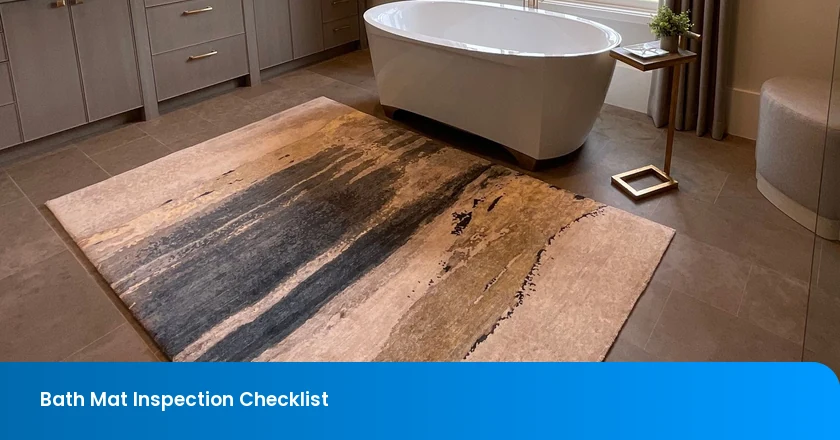
An absorbent bath mat can still move across damp tile, and a mat that stays in place can still have poor traction on its wet face. Buyers need to assess both contact surfaces alongside the product’s construction and care requirements. This checklist covers slip resistance, absorbency, backing adhesion, pile loss, odor and size for bathroom-floor mats. It explains what to inspect, which conditions affect the result and how to choose checks that apply to the ordered textile, rigid mineral, PVC or rubber construction.
Start with These Six Bath Mat Checks
| Check | What to do | How to judge it |
|---|---|---|
| Slip resistance | Assess mat movement and top-surface traction separately with the agreed floor, wetness, loading and method. Inspect curled edges. | Each applicable result meets its own criterion. A dry-floor result cannot establish grip on damp polished tile. |
| Absorbency | Apply the defined water amount over the specified area; record uptake under the agreed initial state, elapsed time and handling. | The stated uptake or time criterion is met. Drainage and drying are different properties. |
| Backing adhesion | Look for separation, bubbles and cracks in bonded layers; use the approved peel method if strength is specified. | Workmanship and any required measured bond result meet their limits. An intact bond is not proof of floor grip. |
| Pile loss | Describe loose fibers, pulled tufts (bundles of pile yarn anchored in the mat) or abrasion separately; use the specified retention or wear method where applicable. | The relevant count, quantity or test result meets its criterion. Mark textile-only checks inapplicable to mats without pile. |
| Odor | Record the first unpacking observation under the agreed sensory conditions; compare with the reference and acceptance criterion. | The sensory result is acceptable. Smell does not identify chemicals or establish safety. |
| Size | Measure the defined complete mat, border or pile area without stretching; repeat after the agreed care sequence if required. | Drawing tolerances and any specified care-related change are met; check thickness and edge curl separately. |
Use the approved sample and specifications for the complete product, including any supplied pad or underlay. Define the floor and wetness conditions for grip checks and the initial specimen state for water uptake. These details matter to the comparison: changing the floor or weighing a mat with uncontrolled surface water can change the result without showing a production defect.
Three Distinctions That Prevent Misleading Results
- Check top-surface traction separately from whole-mat movement
- Measure absorption separately from runoff, drainage and drying
- Choose backing, pile and care methods for the actual construction
Define the mat construction and intended bathroom use
A bath mat inspection schedule should identify the face material, backing or bonded layers, edges, intended floor surfaces, care instructions, and size reference. Bathroom floor mats beside a bath or shower need a different use assessment from inside-tub suction mats or bath-support products. Do not apply one product's test results to those different uses.
Distinguish textile pile mats, rigid mineral or diatomite-based mats, and polyvinyl chloride (PVC) or rubber constructions. Some have separate bonded backing layers; others do not. Record a genuinely inapplicable pile or layer-bond check as not applicable, with the construction identified. A mat without textile pile has not “passed” a tuft-retention test that was never relevant.
Dorai describes its Bath Stone as combining diatomaceous earth with recycled paper and says its supplied foam pad goes between floor and stone to form the base and distribute weight. Dorai Bath Stone instructions
Provide the approved sample, material declarations, construction drawing, dimensions, care artwork, packaging, and test schedule. For each performance check, specify the specimen condition, equipment, liquid or substrate, sequence, and acceptance criteria. Use the TradeAider inspection standard to align reporting and defect descriptions, then add the product-specific methods and limits.
Assess both slip interfaces under the intended conditions
Bath mat slip resistance involves different contact interfaces: the mat's underside against the floor and the contact surface on top. Record which interface a test evaluates. A backing that remains in place does not establish the traction of the wet face, while a textured face does not establish that the whole mat resists moving across a smooth floor.
Match the backing check to the floor and contamination state
Use the agreed floor substrate and document its preparation, surface condition, and wetness. A dry textured tile and a damp polished tile are different test conditions. Cleaning-product residue can introduce another condition that needs defined treatment rather than a casual factory substitution. Record the mat orientation, loading or fixture, movement criterion, and actual method.
If the specification uses a friction coefficient, identify the measured interface and procedure. A coefficient is a ratio involving friction force and the load perpendicular to the contact surface under defined conditions; a number detached from its method is difficult to interpret. Do not transfer a threshold intended for a hard floor or another contact material directly to a bath mat's underside.
HSE describes floor roughness, contamination and pedestrian use as factors in its flooring slip assessment, and says its subjective tool does not directly measure frictional properties. HSE slip assessment FAQ
HSE’s tool concerns workplace pedestrian flooring, not bath-mat backing certification. The transferable lesson is to record the actual contact conditions; its flooring assessment does not supply a bath-mat test method or pass threshold.
Use approved equipment and trained testing personnel for quantified performance. Do not ask an untrained person to stand, slide, or lose balance on a wet mat as a demonstration. If the factory cannot perform the agreed test safely or reliably, record the evidence gap and arrange an appropriate assessment instead of improvising a passing result.
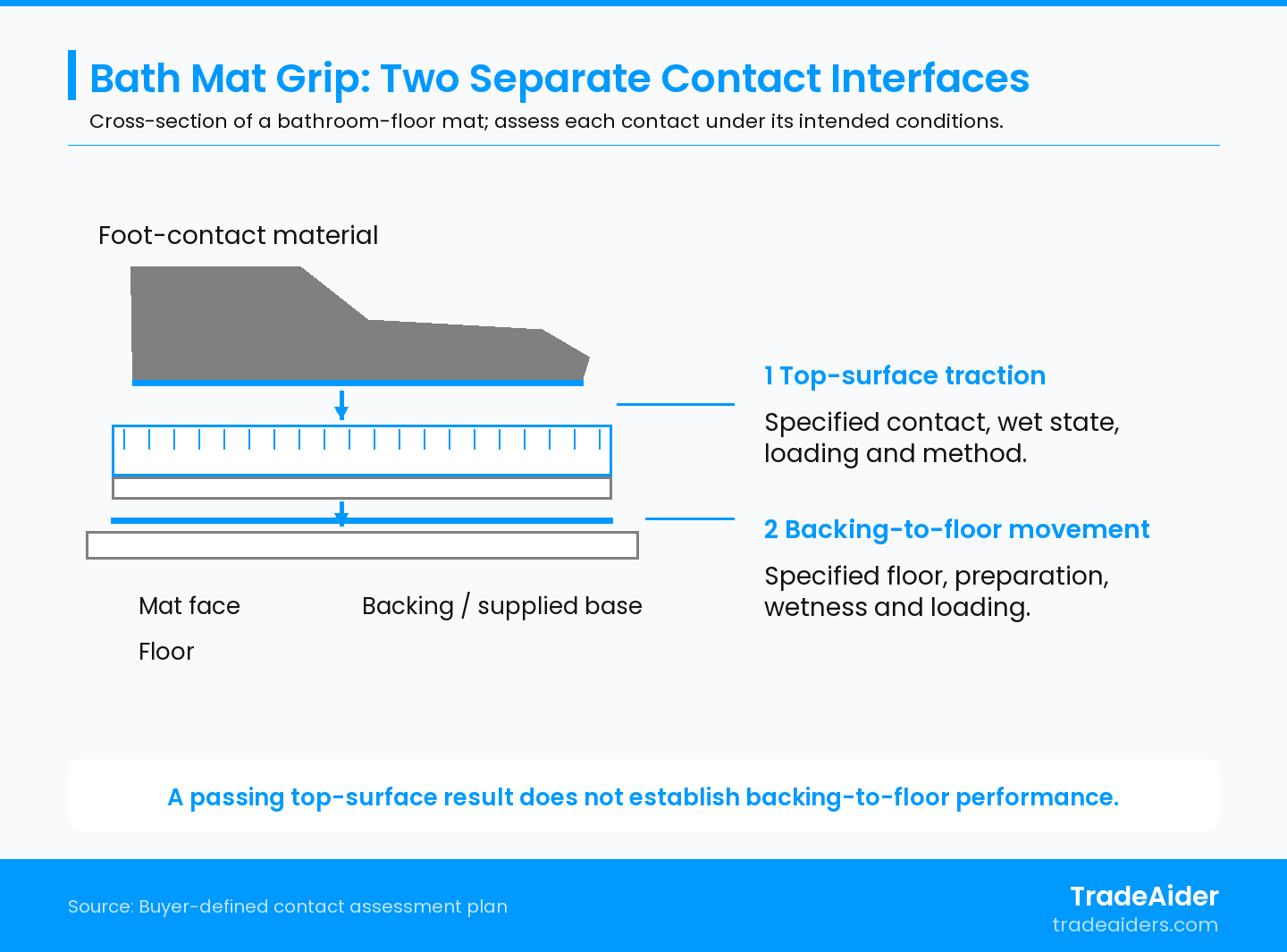
The exploded schematic separates the two contacts. Match each assessment to the intended materials, wetness, loading and method; inspect edge curl separately.
Keep surface grip, mat movement, and edge condition distinct
Review the top surface under the use conditions included in the specification. Identify whether the agreed method represents the intended contact material and wet state; do not equate a dry hand-rub observation with a controlled surface-traction assessment. Record coatings, worn-looking areas, or surface contamination that may require further evaluation, without inventing a coefficient from appearance.
BS 8445:2012 assesses foot slippage and mat slippage for mats used inside bath or shower trays. Hospital/care-home use is outside its scope; it says the covered mats are not designed for profiled textured surfaces. BS 8445:2012 scope
The inside-tray method is not the applicable method for a bathroom-floor mat beside the shower. Only the distinction between foot-to-surface slippage and whole-mat movement is borrowed here; select an appropriate floor-mat assessment for the intended construction and use.
Inspect curled edges, corners, folds, and uneven placement separately from friction. A mat may resist sliding yet have an edge condition that needs correction under the buyer's specification. Keep the report's descriptions specific: whole-mat movement, surface-traction exception, and edge curl are different findings with different possible actions.
Acceptance quality limit (AQL) is a parameter used in an attribute acceptance-sampling scheme. Use the AQL calculator to prepare the agreed random-inspection plan, then separately allocate units for functional or laboratory tests. Passing an attribute sample does not establish every mat's slip performance or validate an “all floors” advertising claim.
Measure water uptake under a defined method
Absorbency checks should state what is measured: water taken up, water remaining on the surface, runoff, or time to achieve the specified result. These are related but different observations. Agree the water amount, application area, initial mat condition, observation time, and reporting unit before comparing production with the approved sample.
For a buyer-approved mass-based check, record the initial conditioned mat mass and its mass after the defined exposure and handling procedure. The difference represents retained water under that method, not total mat mass. State how dripping or surface water is handled so two operators do not weigh different quantities. Do not compare an arbitrary splash on one unit with a controlled application on another.
Use a method suitable for the actual material. A towel-like textile face, a rigid porous mineral surface, and a non-absorbent PVC structure do not answer the same uptake question. Water passing through drainage holes is not necessarily absorption into the material. If the product claim concerns rapid drying or repeated use, request the corresponding evidence rather than treating initial uptake as proof.
ASTM D4772-26 measures how terry fabric (cloth with a looped pile surface) rapidly absorbs and retains water from surfaces; its scope excludes non-terry fabrics and decorative terry not used for water absorption. ASTM D4772-26
ISO 9073-6:2025 evaluates nonwoven fabric (made without weaving or knitting) for liquid absorbency time, absorptive capacity and wicking rate; it does not apply to fabrics containing superabsorbent materials. ISO 9073-6:2025
Check bonded backing without confusing adhesion with grip
Backing adhesion concerns the bond between applicable layers, while floor grip concerns contact with the substrate beneath the mat. Check both where relevant. Inspect edge separation, bubbling, cracks, unbonded areas, and changes after the agreed care or exposure sequence. An intact-looking coating does not prove a quantified bond-strength requirement.
For an agreed peel or delamination assessment, define the specimen, direction, preparation, test rate or method, and acceptance criterion. Keep destructive samples identifiable and separate. A hand-pried edge is a workmanship observation unless it follows the specified controlled procedure; it should not be labeled a standardized adhesion result.
ASTM D3936-21 measures resistance to delamination of secondary backing applied to some pile-yarn floor coverings. ASTM D3936-21
Distinguish loose fibers, tuft retention, and surface breakdown
Pile-loss inspection should describe the actual phenomenon. Loose residual fibers on a textile face, pulled-out tufts, abrasion damage, and filling-like debris are not interchangeable findings. Use the agreed preparation and observation method so vigorous rubbing or repeated cleaning does not change the condition being assessed without a record.
If tuft retention or abrasion performance is specified, select the appropriate material and specimen method. A single thread pulled by hand does not establish a laboratory retention result. Record the affected area, observed amount or count where the method calls for it, and any relation to seams, edges, or care treatment. Compare with the approved criteria rather than describing every visible fiber as the same defect.
ASTM D1335-21(2026) measures the force needed to pull or break a tuft from cut- or loop-pile floor-covering samples. ASTM D1335-21(2026)
For a rigid mineral mat, assess cracks, chipping, surface crumbling, and other applicable material conditions instead of reporting textile pile loss. For PVC or rubber constructions without pile, identify relevant tears, surface wear, or layer issues. State why a textile-only test is not applicable; do not mark an omitted test as a pass.
Record odor as a sensory finding with a clear boundary
An odor check needs agreed unpacking, conditioning, and observation conditions. Identify when the mat was opened, what was observed, and whether packaging or a specific component can be assessed separately and safely. Compare with the buyer's sensory acceptance criteria and reference rather than accepting an undefined “normal material smell.”
A noticeable odor does not identify a chemical or determine toxicity, and absence of odor does not establish chemical safety. Material restrictions, emissions, antibacterial or anti-mold claims need appropriate evidence for the construction and destination. Do not label a mat chemically compliant because a brief sensory check is acceptable, or invent a material fault solely from smell.
EPA explains that odor does not reliably establish whether a product or indoor environment is safe; harmful substances can also be odorless. EPA guidance on odor
Measure size and care-related changes in the agreed state
Bath mat size should be checked at defined reference points with its condition recorded. Distinguish the complete mat from the pile area, border, or a shaped design's maximum dimensions. Measure thickness and edge details where specified. A stretched, wet, or flattened specimen may not be comparable to the drawing's defined dry state.
Where dimensional change after care is part of the purchase requirement, use the agreed care sequence and remeasure under the defined conditions. Check the printed instructions against the approved material and backing. Include relevant changes in backing, pile, edge curl, and appearance, instead of considering length and width alone.
ISO 2551:2020 specifies determination of dimensional changes and out-of-plane distortion of textile floor coverings and tiles exposed to varied water and heat conditions. ISO 2551:2020
Act on Failed Grip or Changed Construction
Keep the tested stock, construction and conditions identifiable when a result fails. A replacement backing, altered surface finish or different underlay changes the configuration to assess. Verify the affected properties under the intended use and relevant care conditions before accepting the change. Keep the original failure alongside the new result; absorption or dry-floor grip cannot replace a failed damp-floor assessment.
Illustrative example: a dry-floor result cannot support an all-floor claim
Consider a hypothetical importer order of 1,400 textile bath mats, split into 800 larger units and 600 smaller ones, awaiting shipment review. The supplier supports an “all floors” non-slip statement only with a dry textured-tile backing check. Intended use includes damp polished tile. A matching-condition assessment of the larger SKU does not meet the buyer's approved criterion, even though its absorbency result is acceptable.
The buyer holds the larger SKU and the unsupported claim while the supplier proposes a suitable backing or alternative model for assessment on damp polished tile. The acceptable absorbency result does not resolve that grip failure. Removing the broad claim may correct the advertising issue, but the product still needs to meet the agreed bathroom-use requirement; telling customers to avoid that intended condition does not demonstrate a correction.
The proposed suitable configuration undergoes the approved dry/wet floor matrix and relevant care exposure before the buyer decides the supported release scope. Records identify the tested interface and stock rather than assuming the smaller SKU is identical. This illustrative example uses hypothetical counts and outcomes; it is not a TradeAider client case or a universal friction threshold. Matching test evidence supports a bounded decision, not a guarantee that slipping cannot occur.
Send the Mat Construction and Intended Floor Conditions
Send the construction, approved sample, intended floor surfaces and wetness conditions, performance methods, limits, care artwork, dimensions and lot details. Identify any supplied underlay and how it is packed. Confirm the trained operator, fixtures and specimens needed for quantified grip, absorption, bond or tuft testing, and which checks require a separate laboratory assessment.
Resolve material, backing, and construction differences before production when possible. TradeAider describes Pre-Production Inspection as checking raw materials and components before production and comparing samples with bulk products. Discuss the proposed Pre-Production Inspection scope with the intended floor/use conditions and confirm any specialized assessment separately. A routine inspection visit should not be presented as certification of universal slip resistance.
TradeAider’s Pre-Shipment Inspection takes place when the finished order is 100% complete and at least 80% packed for export, using randomly selected shipment samples. Agree the product-specific inspection and separate performance testing before booking.
Contact our team with the bath mat specification and test schedule for scope and quote review. Include the intended floor conditions and supplied underlay.
Frequently asked questions
Can different color variants use the same performance report?
Only when the tested construction and conditions are confirmed to apply to the variants, rather than assuming similar appearance proves identical performance. Compare relevant materials, surface finishes, backing, dimensions, and care instructions. Where the construction is genuinely unchanged, document the evidence coverage instead of duplicating tests unnecessarily. A changed backing formulation or finish needs review of the affected characteristics and appropriate verification.
Can a care-label change replace a failed care test?
A revised care instruction needs a controlled product and claim review; it does not by itself correct the failed result or establish acceptable normal use. Identify the condition that caused the exception and evaluate whether the proposed instructions fit the intended product. Reconcile the specification, retail artwork, and relevant test evidence before acceptance. Preserve the original failure and the reason for any approved change.
How should a buyer inspect a set containing different mat constructions?
Identify each construction and its applicable checks, then verify the set's assortment instead of assuming one mat's test results cover all pieces. A textile floor mat and a rigid mineral piece may need different specimens and methods even when sold together. Record what belongs in each retail pack, which results apply to each item, and any checks that are genuinely not applicable with the reason.
Can a separate underlay be omitted from the retail pack?
Only if the approved construction and use instructions do not depend on that underlay; otherwise omission changes the configuration the buyer has assessed. Check the specified pad, size, orientation, instructions, and retail-pack count when it is part of the product. Do not silently replace it with a generic alternative. Grip or support evidence for a mat-and-pad assembly does not automatically apply to the mat alone.
Related Articles

Grow your business with TradeAider Service
Click the button below to directly enter the TradeAider Service System. The simple steps from booking and payment to receiving reports are easy to operate.