
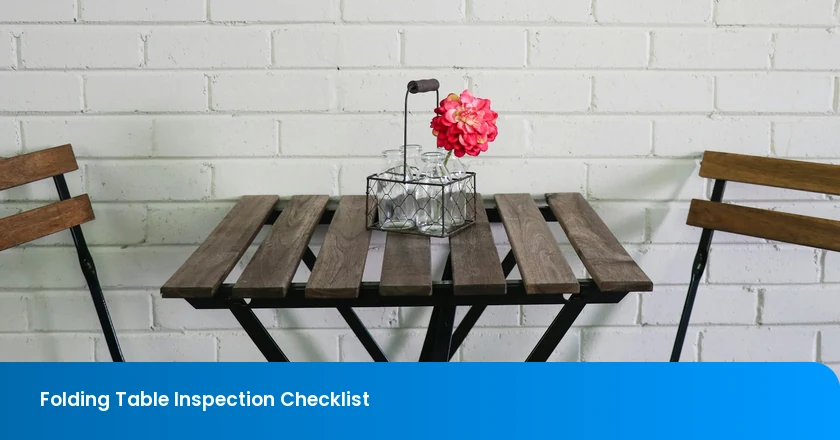
A folding table can look straight and well finished while a leg brace is only partly engaged. Problems may also appear after the table is packed: a bent bracket, displaced foot cap or damaged corner can change how it opens and stands. For importers, the useful question is whether production units work correctly through unpacking, setup, use and folding.
A folding table inspection checklist should cover every locking mechanism, the specified load arrangement, rocking and sideways movement, accessible pinch points, foot caps and packaging protection. Start with units selected from production cartons and the instructions supplied to customers. The checks below are for portable folding tables; agree the model, intended use, test conditions and acceptance limits before the visit.
Folding Table Inspection Checklist: Six Checks Before Shipment
Use this checklist alongside the approved sample, drawings and inspection specification. Record the unit ID, result and a photograph or measurement for each finding. Mark a check as not assessed when its necessary test conditions are missing; an improvised trial is not a pass.
- Locking mechanisms: Open the table using its instructions. Check each leg brace, tabletop latch and height-adjustment lock that the model has. Confirm full engagement and retention under the prescribed check; stop if a support can fold unexpectedly.
- Load: Apply the agreed mass, distribution and duration at the specified height. Compare loaded displacement, damage and remaining deformation after unloading with the written limits. Record the setup, not just the weight.
- Wobble and stability: Check foot contact on a verified flat surface, then assess sideways movement and the specified tipping conditions separately. Identify whether movement comes from the floor, feet, frame or joints.
- Pinch points: Observe hinges, braces, center folds and adjustment mechanisms throughout opening and closing. Use the applicable assessment method and probes where specified; never use fingers to test a closing gap.
- Feet: Compare cap type, fit and seating with the specification. Check for missing, split or loose caps and exposed tube ends. Assess retention using the agreed method, then repeat the standing check.
- Carton damage: Record the unopened carton, inspect the protection at corners and hardware contact points, and unfold the table after unpacking. Following any specified transport test, repeat the relevant functional checks.
Check the Locks Before Applying a Load
Opening a folding table and locking it are separate observations. Follow the supplied sequence, then look directly at the parts that prevent the legs or tabletop from folding back. A click is useful feedback only if the intended engagement can also be confirmed.
Different constructions use sliding rings, catches, spring pins or automatic latches. A fold-in-half tabletop may have a separate center lock, while an adjustable-height table also needs its leg settings secured. Check both ends and every adjustable support; one engaged mechanism does not establish that the others are seated.
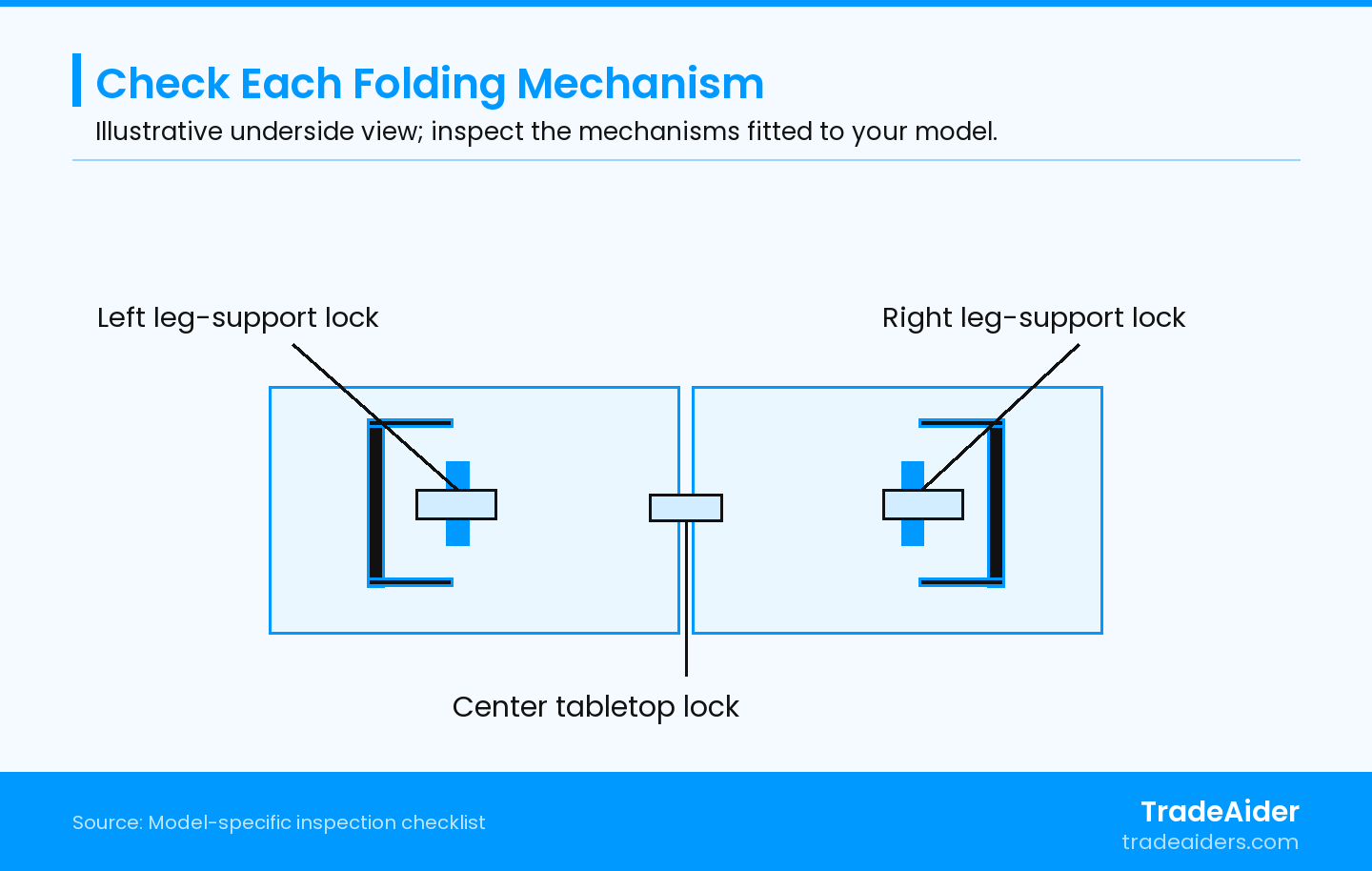
Illustrative locations, not a universal construction: inspect every fitted leg-support and tabletop locking mechanism using the instructions for the ordered model.
Lifetime describes the safety locking ring on its 80126G folding table as a two-stage mechanism intended to secure the table against accidental closure. That description identifies a feature to inspect on that model. It does not establish that another supplier's similarly shaped ring provides the same protection.
The CPSC's 2021 seminar-table recall concerned model 80176: its brace arms could fail to lock the legs, allowing the table to collapse. The lesson for inspection is specific: check engagement and the intended travel of the brace, rather than judging the table only by its upright appearance. This historical recall concerns the identified product, not all folding tables or other models from that manufacturer.
Complete the agreed opening-and-closing sequence and recheck the locks afterward. Note sticking catches, loose pivots, distorted brackets and mechanisms that need unmentioned manual adjustment. Keep hands clear and support the table as its instructions require. Do not force a brace beyond its stop or alter the mechanism to obtain a passing result. If a load-bearing lock fails, stop loading that unit and investigate the affected production scope.
Define the Load Setup Before Judging Capacity
A folding table's load result depends on where the weight is placed, how long it remains and how the table is configured. Weight spread over the top is a different condition from the same weight concentrated at the center or near an edge. Copy the approved arrangement, including contact areas and loading pads, rather than choosing a convenient stack of weights.
Confirm the test mass, position, duration, table height, supporting surface and acceptance limits in advance. Measure the tabletop at identified reference points before loading, while loaded and after the specified recovery period. Deflection means displacement under load; remaining deformation is the shape change left after unloading. Record these separately so temporary flex is not confused with permanent damage.
For an adjustable-height model, identify which positions the test plan covers. Record the actual setting and confirm that every adjustment pin is fully engaged before loading. A result obtained in the lowest position should not silently become a claim about every height. If several sizes or support designs share a carton label, keep their configurations separate in the inspection record.
The public scope of BS EN 1730:2012 covers methods for assessing table stability, strength and durability, but explicitly provides no requirements. A method reference alone therefore does not supply a universal test weight or pass limit. Obtain the applicable product requirements and complete method from the buyer or qualified laboratory before describing a check as standards-based.
Watch the supports as well as the top: bracket movement, loosening fasteners, cracking around attachments and unintended release are material findings. After unloading, confirm that the table still opens, locks and folds correctly. Use suitable loading equipment and a controlled area; standing or sitting on the table is not a repeatable substitute for the specified test. Keep any destructive or extended durability testing separate from routine saleable samples.
Separate Uneven Foot Contact from a Loose Frame
Rocking, sideways movement and tipping describe different problems. Rocking occurs when the feet do not maintain contact with the supporting surface. Sideways movement may come from flexibility or looseness in the frame and connections. Tipping involves the table rotating about its support edge. Passing one check does not settle the others.
Begin on a verified flat, rigid surface with the table fully locked. Inspect the foot contact points and, on adjustable models, confirm that all settings match. If one corner lifts, move or rotate the table onto another verified position and repeat the observation. A defect that follows the table suggests looking at its feet or geometry; a result that changes with position calls for checking the surface before rejecting the product.
For a specified movement test, use the agreed force, direction and measurement point. Record whether movement occurs at the tabletop joint, leg attachment or brace pivot. A subjective description such as “slightly wobbly” gives the supplier little basis for correction. Do not slip cardboard under a short foot or retighten loose hardware before recording the as-received condition. Corrections can then be evaluated through a separate recheck.
Observe Pinch Points Through the Entire Folding Motion
A pinch-point inspection needs the table in motion as well as fully open. Observe where hinge leaves, brace arms, tabletop halves and telescoping legs move toward each other. Pay particular attention to places the user is instructed to grip or release, because a safe-looking final position says little about an intermediate closing gap.
Have a trained operator follow the setup and folding instructions while the observation area remains clear. Check the position and retention of guards, the accessibility of release controls and any exposed sharp edges. Where an applicable standard specifies probes or clearance measurements, use that method in the stated positions. A ruler measurement at one convenient angle cannot establish safety throughout the mechanism's travel.
For relevant non-domestic applications, BS EN 15372:2023 covers table safety, strength and durability and includes a normative annex on finger-entrapment test methods. Its scope excludes several other categories, including outdoor tables and tables for educational institutions. Confirm the intended use before choosing a standard. A general folding-table checklist is not evidence of compliance with every furniture or children's-product requirement.
If the stated operating sequence places a hand near an uncontrolled closing mechanism, record the exact step and refer the design for assessment. Adding a warning should not be treated as proof that the mechanism is acceptable. Avoid approving a redesign or declaring a gap safe without the applicable criteria.
Inspect Foot Caps as Functional Parts
Foot caps influence contact with the floor and cover the ends of the legs. Check that each supplied cap matches the approved design, sits fully on the tube and remains attached under the agreed retention check. Look for splits, molding defects, uneven seating and exposed metal edges.
Compare cap dimensions and fitted height where they affect level standing. A replacement cap can look similar yet seat differently, leaving one corner raised. On adjustable tables, inspect the leg pins and holes as well as the caps; a partly engaged pin can be mistaken for a foot-height problem. Recheck the table after any authorized replacement. A claim that caps will not mark floors needs an agreed surface and assessment method, not a visual judgment alone.
Connect Carton Damage to Product Function
Inspect the carton before opening it, then trace dents, punctures or crushed areas to the corresponding product position. Check whether corners, folded legs, hinges and protruding fasteners have the specified protection. Look for abrasion or impact marks inside an apparently sound carton too: movement between packed parts can cause damage without a conspicuous outer tear.
Photograph the packed arrangement before removing separators. Confirm the shipping orientation, carry-handle position, accessory placement and protection between metal parts and the tabletop. After unpacking, inspect the underside and operate the folding system. A cosmetic carton dent and a bent hinge bracket need different decisions, even when they appear in the same location.
ISTA's test-selection guidance distinguishes parcel delivery, less-than-truckload delivery and other distribution routes when choosing packaged-product tests. Match the packaging validation to the shipping route and packed product. An agreed on-site drop check can reveal damage, but it does not establish completion of an entire transport simulation. Following the specified sequence, inspect the product and repeat the lock, standing and folding checks affected by transport damage.
Use the Findings to Decide What Needs Correction
Agree defect descriptions and acceptance criteria before sampling. Record functional failures separately from appearance defects, and keep the sample identity attached to both. TradeAider's inspection-standard guidance provides the service context for customer specifications and sampling; the table's actual load and safety criteria still need to come from its applicable requirements.
Hypothetical example: In a shipment of 500 folding tables, one of 20 units selected for an agreed functional check rocks on the test surface. The foot caps match and the surface check is satisfactory. Closer observation shows that a brace on the rocking unit has not reached its intended locked position. Pressing down on the tabletop to make it sit flat would conceal the cause rather than resolve it.
Record that unit's condition before adjustment, stop its load check and investigate why the brace does not engage. After the supplier corrects the identified cause, repeat setup, engagement, standing and the prescribed loading checks on the agreed samples. Those sample counts are illustrative, not a recommended sampling plan. Successful correction of the one table does not establish how many other units were affected.
TradeAider schedules pre-shipment inspection when the order is 100% complete and at least 80% packed for export. Send the table specification, instructions, approved sample references, load-test conditions and packaging requirements before booking. This lets the inspection scope reflect the actual folding design and the equipment needed. Contact TradeAider to arrange your folding table inspection and confirm the checks and reporting scope.
Frequently Asked Questions
Does a one-piece tabletop need a center-lock check?
No. A center-lock check applies only when the design includes a folding tabletop and that locking feature. A one-piece top still needs checks of the leg supports, attachments and any height adjustments. Mark genuinely absent features as not applicable, rather than recording them as passed or rejecting a design for lacking a mechanism it does not use.
Can inspectors reopen tested tables and sell them as normal stock?
Only if the agreed inspection plan permits it and the units remain suitable for sale. Some checks leave marks, damage packaging or subject parts to loads and cycles that require the sample to be set aside. Identify test units beforehand, record their disposition and confirm whether replacement cartons or other authorized repacking are needed.
Can one test report cover several table sizes?
Do not assume it can. Ask which variants the report identifies and how its coverage was established. A change in tabletop span, leg spacing, hinge design or material can change the relevant performance. Compare the ordered model and configuration with the report, and ask the laboratory or responsible technical team to resolve any proposed extension of coverage.
How many opening-and-closing cycles should an inspection include?
Use the count and sequence in the agreed inspection specification or applicable test method. A short functional check can reveal sticking or missed engagement, but it does not establish long-term durability. If the order has a durability claim, obtain the corresponding test conditions and results rather than inventing a cycle count during the factory visit.
Related Articles

Grow your business with TradeAider Service
Click the button below to directly enter the TradeAider Service System. The simple steps from booking and payment to receiving reports are easy to operate.