
The best country to source from besides China is the country where supplier capability, component access, inspection coverage, logistics reliability, and buyer-side quality controls all fit the SKU. In 2026, Vietnam, Mexico, India, Thailand, Indonesia, and Turkey are practical alternatives, but none should be chosen by labor cost alone.
China remains the benchmark for many consumer-goods categories because supplier depth, component ecosystems, tooling support, packaging vendors, testing access, freight options, and third-party inspection coverage are unusually dense. A China+1 strategy does not mean pretending those advantages do not exist. It means deciding where another country is strong enough for a specific SKU, volume, compliance requirement, and customer promise.
For importers, quality-control infrastructure is the practical filter. A country may offer lower labor cost or tariff advantages, but the order still needs reliable factories, clear specifications, production monitoring, final inspection, corrective action, packaging control, and export logistics. If those pieces are thin, the buyer's savings can disappear in rework, delay, warehouse sorting, or supplier churn.
This 2026 comparison ranks countries from the perspective of an English-speaking buyer that needs a real supplier base and a workable inspection plan, not just a theoretical sourcing destination.
The Direct Answer
Vietnam is often the best first China+1 option for light manufacturing, Mexico is strongest for North American nearshoring, India is strongest for scale and selected categories, Thailand is strongest for mature industrial clusters, Indonesia is a developing scale play, and Turkey is useful for European speed and selected soft goods.
The World Bank's 2023 Logistics Performance Index is still the latest global LPI edition available as of May 22, 2026. It ranks logistics systems by factors such as customs, infrastructure, international shipments, logistics competence, tracking, tracing, and timeliness. Logistics is not the same as QC infrastructure, but it is a useful proxy for how reliably evidence, goods, and corrections can move through a sourcing country.
Trade.gov Country Commercial Guides and market pages are also useful because they describe market structure, trade conditions, leading sectors, and doing-business context. For quality decisions, the buyer should combine that country-level view with supplier-specific audit, product testing, PSI, and loading evidence.
2026 Country Ranking By QC Infrastructure
This ranking favors countries where a buyer can realistically build supplier verification, inspection, corrective action, and shipment evidence around the order.
| Rank | Country | Best Fit Categories | QC Infrastructure Strength | Buyer Watchout |
|---|---|---|---|---|
| 1 | Vietnam | Apparel, footwear, furniture, electronics assembly, bags, light consumer goods | Good China+1 path, improving supplier base, familiar export orientation | Component depth and supplier maturity vary by category |
| 2 | Mexico | Automotive, appliances, furniture, packaging, industrial and nearshore goods | Nearshore speed for U.S. buyers and USMCA-linked supply planning | Higher labor cost and category fit must be checked |
| 3 | India | Textiles, home goods, metal, leather, pharmaceuticals, selected electronics | Large supplier base and growing manufacturing policy push | Quality consistency can vary sharply by region and supplier |
| 4 | Thailand | Automotive parts, electronics, appliances, food-related packaging, rubber products | Mature industrial clusters and relatively strong logistics indicators | Not always the lowest-cost option for simple consumer goods |
| 5 | Indonesia | Furniture, footwear, apparel, natural-material products, selected consumer goods | Large labor pool and long-term scale potential | Inspection planning and supplier qualification need more care |
| 6 | Turkey | Apparel, textiles, home textiles, furniture, regional consumer goods | Fast access to Europe and strong selected categories | Less suitable for buyers needing China-style category breadth |
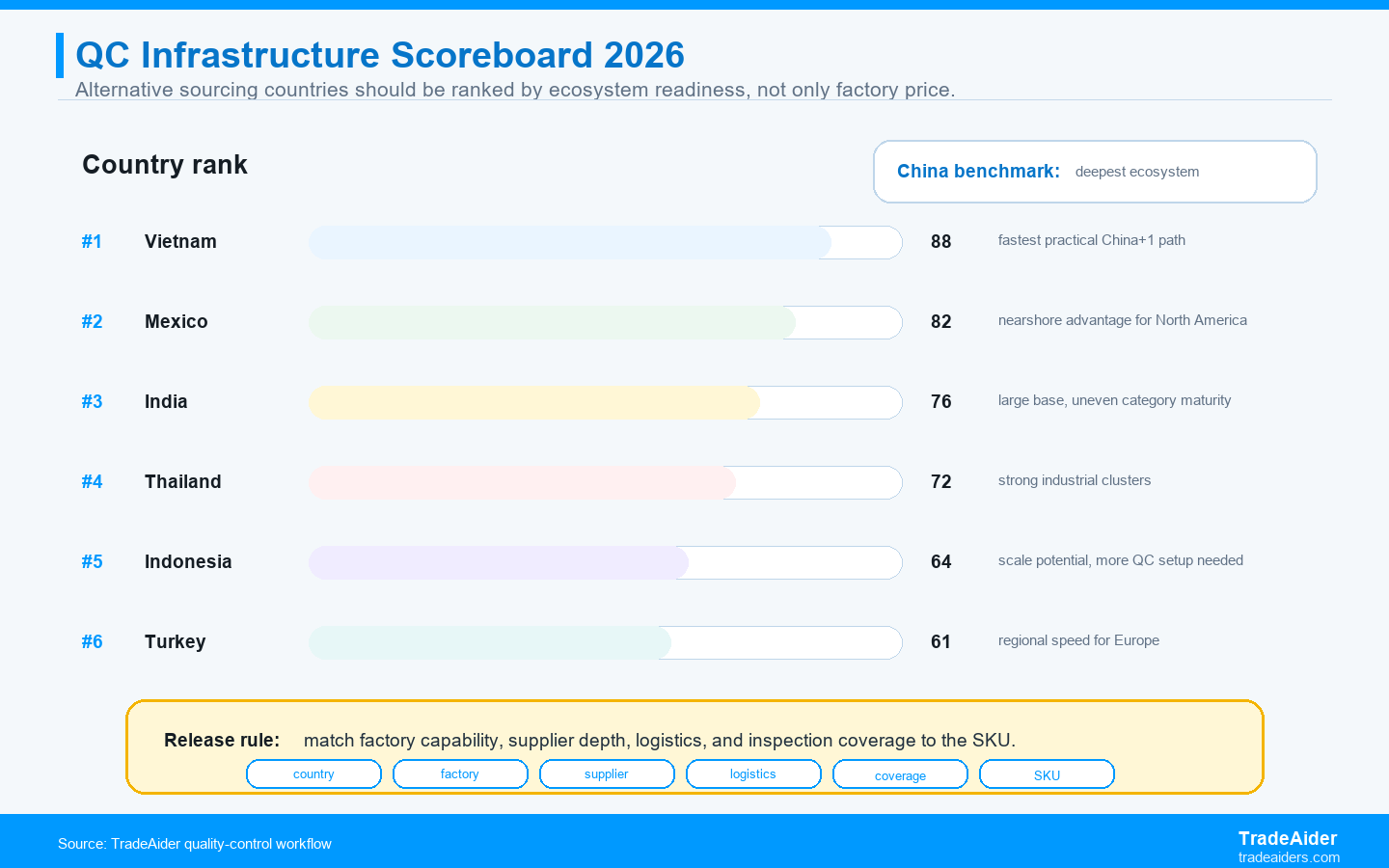
A sourcing alternative is strongest when factory capability, inspection access, and logistics all fit the SKU.
#1 Vietnam - Best First China+1 Option For Light Manufacturing
Vietnam is the easiest first alternative for many buyers that already source consumer goods from China. It has strong export orientation in apparel, footwear, furniture, bags, and electronics assembly, and many buyers already use it as part of a China+1 portfolio.
The QC watchout is component depth. Some Vietnam production still depends on imported materials, components, molds, packaging inputs, or technical support. Buyers should audit supplier capability, confirm where key inputs originate, and inspect first orders carefully.
#2 Mexico - Best Nearshore Option For North American Buyers
Mexico is attractive when speed, time zone, shorter transit, and regional integration matter. For U.S. and Canadian buyers, nearshoring can reduce replenishment risk and make supplier visits easier.
The QC watchout is category fit and total cost. Mexico is not a universal replacement for China. Buyers should confirm whether the supplier base, tooling, packaging vendors, testing access, and inspection coverage match the product before moving volume.
#3 India - Best Scale Option For Selected Categories
India offers scale, a large labor market, and strong selected categories such as textiles, leather, metal products, home goods, and regulated sectors with established exporters. It can be attractive when buyers need diversification beyond East Asia.
The QC watchout is consistency. Supplier performance can vary by region, product category, and management system. First orders should use supplier audit, clear specs, production monitoring, and PSI rather than relying on exporter reputation alone.
#4 Thailand - Best Mature Industrial Cluster Option
Thailand has mature industrial clusters and strong regional logistics indicators, especially for automotive parts, electronics, appliances, rubber-related goods, and some packaging categories.
The QC watchout is economic fit. Thailand may be a better quality and stability play than a pure lowest-cost option. Buyers should use it where cluster maturity and reliability justify the cost structure.
#5 Indonesia - Best Long-Term Scale Potential
Indonesia has a large labor base and meaningful categories such as footwear, furniture, apparel, and natural-material consumer goods. It can be attractive for buyers with time to develop suppliers.
The QC watchout is setup discipline. Supplier qualification, specification control, inspection instructions, and shipment evidence should be more deliberate, especially when the buyer is new to the market.
#6 Turkey - Best Regional Speed Option For Europe
Turkey can be strong for apparel, textiles, home textiles, furniture, and selected consumer goods where European buyers value shorter lead times and regional flexibility.
The QC watchout is category breadth. Turkey is useful for specific categories and speed-sensitive programs, but buyers should not expect the same component ecosystem breadth as China.
How To Compare QC Infrastructure Country By Country
A country comparison should be made at SKU level, not at slogan level.
Start with supplier density. If a country has many factories for your SKU, the buyer has backup options, better benchmarking, and stronger negotiation leverage. If only a few suppliers can make the product, the buyer may face longer development time and weaker correction options.
Next, check component and packaging depth. A finished-goods factory may look capable, but quality depends on materials, accessories, labels, cartons, manuals, molds, tooling, and test equipment. If key inputs come from another country, the buyer needs earlier material checks and more lead-time buffer.
Then evaluate inspection coverage. The buyer needs access to third-party audit, PPI, DPI, PSI, product testing support, and loading supervision. A sourcing country is less useful if the buyer cannot verify the supplier and shipment in a timely way.
Finally, compare logistics and correction windows. A failed inspection is not a disaster if the supplier can sort, rework, replace, repack, and reinspect before shipping. A country with weak corrective-action speed can turn a small defect into a launch delay.
What A Country Ranking Cannot Tell You
Country rankings are a shortlist tool, not a supplier approval tool.
A ranking can help a buyer decide where to investigate, but it cannot prove that a specific factory can make a specific SKU. Two factories in the same country can have completely different quality systems, subcontracting habits, documentation discipline, and corrective-action speed. The buyer still needs supplier audit, production evidence, and pre-shipment inspection.
Country-level logistics data also hides local variation. A factory near a major port and inspection hub is not the same as a remote factory with limited access, fewer backup suppliers, and longer transport time. If an inspection fails, the local correction environment matters as much as the national headline.
The buyer should therefore use the ranking to create a country shortlist, then run a pilot order. A pilot should be small enough to manage risk but large enough to reveal production behavior. The buyer should track defects, rework time, communication quality, on-time delivery, inspection pass rate, and customer feedback before moving more volume.
A Practical Pilot Plan For A New Country
The safest China+1 move is a controlled pilot, not a sudden category migration.
Choose one SKU that fits the target country's strengths. Avoid the most complex SKU as the first pilot unless the business case requires it. Send a complete specification, packaging file, approved sample record, AQL standard, and inspection checklist before production starts.
For a first pilot, combine supplier audit with at least one production-stage inspection and one PSI. If the supplier is new, a DPI can reveal process drift before all goods are finished. PSI then checks the final packed lot before payment and release. If the shipment fails, reinspection should verify correction before scaling.
After arrival, compare the actual total cost against the old country baseline. Include inspection cost, defect rate, rework, freight, delay, management time, and customer issues. That is the real country comparison.
Where TradeAider Fits In China+1 Decisions
TradeAider helps buyers keep China and non-China sourcing decisions evidence-based.
TradeAider's core value in a China+1 decision is not telling every buyer to leave China or stay in China. The value is helping the buyer compare supplier capability and shipment evidence. A China supplier, Vietnam supplier, Mexico supplier, or India supplier should all be judged against the same commercial question: can this factory deliver the specified product at the required quality level, on the required schedule, with enough evidence before payment and release?
For China orders, TradeAider can support factory audit, PPI, DPI, PSI, reinspection, and loading supervision. For non-China alternatives, the same control logic applies even when local execution partners differ: audit the supplier, define the spec, check production risk, inspect before release, and document loading where transit evidence matters.
SPAR Scenario: Moving One SKU, Not The Whole Supply Chain
The buyer made a better sourcing decision by moving only the SKU that fit the alternative country.
Situation: A U.S. home brand sources 40 SKUs from China and wants to diversify. Management asks whether Vietnam can replace China in 2026.
Problem: The buyer discovers that Vietnam is strong for two fabric-and-wood storage SKUs but weaker for several plastic SKUs that require specific molds, color matching, and Chinese component suppliers.
Action: The buyer keeps plastic SKUs in China, pilots the fabric-and-wood SKUs in Vietnam, audits the new supplier, sends a detailed spec, books DPI for the first run, and uses PSI before final payment.
Result: The buyer gets real diversification without forcing the wrong product into the wrong ecosystem. The decision is based on SKU fit and QC readiness, not a broad country slogan.
Action Card: Country Selection Checklist
Choose the sourcing country after the control plan is visible.
- List the product category, materials, components, packaging, and compliance requirements.
- Compare supplier density and backup supplier availability.
- Check whether key inputs are local or imported from another country.
- Confirm audit, DPI, PSI, reinspection, and loading-supervision coverage.
- Compare total landed cost after inspection, rework, freight, and delay risk.
- Pilot one SKU before moving a full product line.
If you are comparing China with a second sourcing country, send TradeAider the SKU, current supplier, target country, order value, compliance concerns, and launch timeline. The next step is to ask TradeAider to build a QC comparison plan before moving production.
Frequently Asked Questions
What is the best country to source from besides China in 2026?
Vietnam is often the best first China+1 option for light manufacturing, but the best country depends on the SKU, component needs, supplier maturity, inspection access, and destination market.
Can Vietnam replace China completely?
Vietnam can replace China for selected categories and programs, but many buyers still need China for supplier depth, components, tooling, packaging, and category breadth.
Is Mexico better than Vietnam for U.S. importers?
Mexico can be better when nearshore speed and North American supply planning matter, while Vietnam can be better for many light consumer goods and China+1 programs.
How should I test a new sourcing country?
Pilot one SKU, audit the supplier, define the specification, monitor early production, inspect before final payment, and compare actual defect and delay cost before scaling.
Related Articles


Grow your business with TradeAider Service
Click the button below to directly enter the TradeAider Service System. The simple steps from booking and payment to receiving reports are easy to operate.

