
- About Us

- Our Services
- Your Industry
- Resources
- News & Blog

The best pre-shipment inspection service for apparel and softline importers in 2026 is the one that combines AQL discipline with size-color coverage, measurement checks, label verification, workmanship classification, packing review, clear defect photos, and useful reinspection support. A cheap factory visit is not enough if it misses fit, labels, trims, or carton assortment.
Apparel and softline importers often compare PSI providers by price and speed. That is understandable, but the best provider is the one that protects the release decision. Clothing, bags, and textiles fail through subtle variation: measurements, shade, trims, labels, packing ratio, size spread, fabric defects, and workmanship. A provider that only counts visible defects may miss the most expensive issues.
The service should also match the buyer's files. A good PSI provider asks for tech pack, size chart, approved sample photos, label artwork, trim card, packing method, carton marks, AQL values, defect classes, and known failure history. If the provider does not ask for those files, the inspection may become a generic checklist rather than a release decision.
- Best for apparel: AQL plus measurements, size-color coverage, labels, trims, workmanship, and packing.
- Best for bags: AQL plus straps, hardware, zipper, lining, dimensions, logo, odor, and packaging.
- Best for textiles: AQL plus fabric defects, shade, size, set completeness, labels, odor, and carton presentation.
- Decision rule: choose the provider by report usefulness, not by the lowest visit fee.
The Direct Answer
A strong softline PSI service should prove whether the shipment matches the buyer's AQL plan, measurement specs, label files, trim standards, packing method, and release rule.
ISO/IEC 17020:2026 specifies requirements for competence, impartiality, and consistent operation of inspection bodies. Source: ISO/IEC 17020:2026.
ISO 2859-1:2026 is the current ISO standard for AQL-indexed sampling procedures for lot-by-lot inspection by attributes. Source: ISO 2859-1:2026.
FTC apparel labeling guidance explains labeling duties for textile and wool products, including fiber content, country of origin, and responsible business identity. Source: FTC apparel labeling.
FTC care labeling guidance covers care-instruction requirements for covered textile wearing apparel and certain piece goods. Source: FTC Care Labeling Rule.
These sources do not rank providers. They define the qualities a buyer should evaluate: competence, sampling consistency, and attention to product files. A provider that cannot handle measurement specs, label files, and size-color spread is not the best fit for apparel and softline release decisions.
2026 Softline PSI Scorecard
Use a practical scorecard instead of a generic best-service list.
| Selection Factor | What Good Looks Like | Why It Matters | Red Flag |
|---|---|---|---|
| AQL discipline | Lot, sample size, defect class, Ac/Re, and result are clearly reported | Supports pass/fail decision | Arbitrary sample count |
| Measurement plan | Defined points, tolerances, and size coverage | Protects fit and sizing | Only visual garment checks |
| Size-color spread | Samples cover size range, colorways, carton locations, and batch clues | Finds variation-specific defects | Only front cartons sampled |
| Label verification | Care, fiber, country, size, barcode, hangtag, and carton labels checked | Prevents compliance and receiving problems | Labels treated as minor details |
| Photo evidence | Defects, measurements, labels, trims, packing, and cartons documented | Helps supplier correction | Few staged photos |
| CAPA and reinspection | Failed findings become sorting, rework, and focused reinspection | Stops repeat problems | Report ends at pass/fail |
This scorecard helps buyers compare providers without pretending there is one universal ranking. The best service for a basic repeat T-shirt order may not be the best service for a complex outerwear launch, premium bag order, or multi-color bedding set.
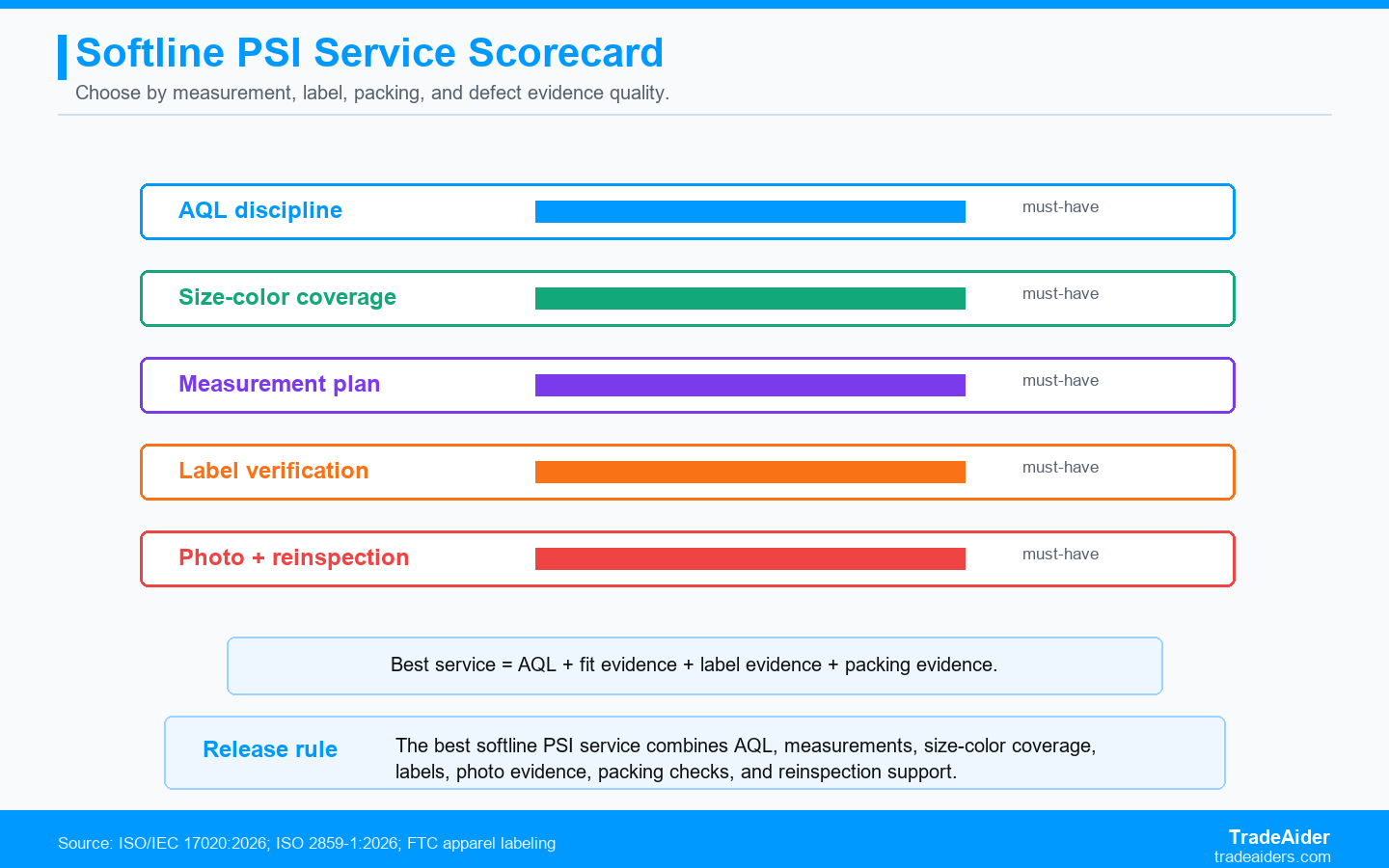
The best softline PSI service combines AQL, measurements, size-color coverage, labels, photo evidence, packing checks, and reinspection support.
What The Report Must Show
A softline report should be useful after the inspection day is over.
The report should show sample distribution, inspected sizes, inspected colors, measurement results, defect photos, label photos, trim checks, packing checks, carton marks, and the AQL result. A buyer should be able to tell whether the sample represented the shipment or only the easiest cartons.
Measurement reporting should be clear. It should show points of measurement, target specs, tolerance, actual readings, size, and result. A report that simply says measurements checked without data is not strong enough for apparel fit decisions.
Label and packing evidence should be visible. The report should show care labels, fiber labels, size labels, country-of-origin labels, hangtags, barcodes, polybags, carton marks, ratio checks, and any e-commerce or retailer presentation requirements. Many softline failures happen after goods are accepted into the warehouse, so release evidence must include packing and labeling.
Which Provider Scope Fits Your Order?
Service depth should follow product complexity and commercial exposure.
For a low-risk repeat order, standard PSI may be enough if the supplier has stable history and the buyer has clear files. The inspection should still cover AQL, measurements, labels, and packing, but the scope can stay focused.
For a new style, new supplier, new fabric, new wash, new trim, or launch-critical order, the buyer should request a deeper PSI and possibly DPI. Early inspection can catch shade, cutting, sewing, washing, printing, embroidery, label, and packing issues before the full lot is finished.
For bags and textile goods, the buyer should add product-use checks. Bags need strap, zipper, hardware, lining, and dimension checks. Textiles need size, shade, hem, set completeness, odor, and packing checks. The best PSI service customizes those checks instead of forcing every product into a garment template.
Where TradeAider Fits For Apparel And Softline Importers
TradeAider fits by turning buyer files into softline release evidence.
TradeAider can provide Pre-Shipment Inspection for apparel and softline goods, including AQL sampling, measurements, workmanship, labels, trims, packing, cartons, and report photos before release.
TradeAider can add During Production Inspection when risks need earlier control during cutting, sewing, washing, finishing, or packing. If supplier reliability is unclear, factory audit service can review production and quality systems.
The business fit is evidence depth. TradeAider helps buyers avoid a PSI report that counts defects but misses the release issues that customers and retailers care about.
SPAR Scenario: The Best Service Was The One That Measured
A cheaper inspection would have missed the main risk.
Situation: A clothing importer compares two PSI options for a new size-inclusive dress order. One provider offers a low-cost visual check. The other includes measurement data, size-color spread, label photos, and packing ratio checks.
Problem: The order's main risk is fit consistency across sizes, not only sewing appearance. A visual report would not prove whether the plus-size garments match the spec.
Action: TradeAider scopes a PSI with measurement coverage across all sizes, AQL workmanship checks, label verification, and carton ratio review. DPI is added for the next order because cutting accuracy appears to be a recurring risk.
Result: The buyer catches out-of-tolerance measurements before shipment and avoids a return pattern that would have been much more expensive than the inspection difference.
Action Card: How To Choose A Softline PSI Service
Ask what evidence the report will produce, not only when the inspector can visit.
- Ask how AQL, sample size, defect class, and Ac/Re will be reported.
- Ask how sizes, colors, carton locations, and fabric batches will be represented.
- Ask whether measurements will show target, tolerance, actual reading, and result.
- Ask whether labels, care instructions, fiber labels, hangtags, barcodes, and packing ratios are checked.
- Ask for sample report pages showing defect photos, measurement tables, and carton evidence.
- Ask how failed findings lead to sorting, rework, CAPA, and reinspection.
The buyer should also evaluate communication. A strong provider asks questions before inspection, explains what cannot be checked without files, and identifies whether lab testing or legal review is outside PSI scope. That honesty matters because inspection is only one part of quality control.
Buyers should track provider performance over time. Did the report predict customer complaints? Did reinspection verify corrections? Did measurement data help supplier negotiation? Did photos support internal release decisions? The best provider is the one whose evidence improves decisions across seasons.
The buyer should not expect the provider to invent a brand standard. Provide tech packs, samples, label files, trim cards, packing specs, carton marks, and defect history. The better the files, the better the inspection.
Questions To Ask Before Booking
The provider's pre-inspection questions often reveal whether the service will be useful.
Before booking a softline PSI, ask how the provider will choose samples across size, color, carton location, and production batch. A provider that cannot describe sampling coverage may still produce a report, but the buyer may not know whether the report represents the actual shipment. This is especially important for apparel programs with many sizes or colorways.
Ask whether measurement results will be shown as a table with target, tolerance, actual value, and pass or fail result. Apparel buyers should not accept a report that says measurements checked without showing the data. Fit problems are often systemic, so a measurement table helps the buyer see whether one size, one measurement point, or one production batch is drifting.
Ask how labels and packaging will be documented. The provider should show care labels, fiber labels, size labels, country-of-origin labels, hangtags, barcodes, polybags, assortment ratios, carton marks, and set contents where relevant. Softline shipments often fail at receiving because the product is acceptable but the label or packing evidence is wrong.
Ask how the provider handles a failed inspection. A useful service should help the buyer decide whether to sort, rework, reinspect, or hold the shipment. The report should provide enough photos and carton identity to guide supplier action. If the provider only sends a pass or fail summary, the buyer may still have to rebuild the evidence from the beginning.
Finally, ask what is outside scope. PSI cannot prove every fiber claim, shrinkage claim, flammability claim, or chemical requirement. A good provider will say which points can be checked on site and which points need lab reports, buyer documents, or legal review. That boundary protects the buyer from false confidence.
For larger programs, ask how the provider will preserve learning between orders. The best softline PSI setup should carry forward defect history, measurement drift, supplier rework patterns, and return feedback. A provider that treats each visit as a fresh isolated job may repeat the same shallow checks even after the buyer has already seen a predictable defect pattern.
This is also why buyers should keep their own release log. Record which shipments passed, which failed, which issues required reinspection, and which issues later appeared in customer complaints. Over time, the best provider becomes easier to identify because its reports reduce uncertainty and improve supplier behavior, not merely because it visits the factory on schedule.
The final choice should feel evidence-led: the buyer should know exactly what decision the report will support before the inspection is booked.
If you are choosing a PSI provider for apparel, bags, or textiles, send TradeAider the product files, risk history, order value, and release deadline. The next step is to ask TradeAider to scope the best pre-shipment inspection service for your softline shipment.
Frequently Asked Questions
What is the best PSI service for apparel?
The best service covers AQL, size-color sampling, measurements, labels, workmanship, packing, photos, and reinspection support.
Should softline PSI include measurements?
Yes. Measurements are critical for apparel fit and should be reported separately with target, tolerance, actual reading, and result.
Can the cheapest PSI service be enough?
It can be enough for low-risk repeat orders if the scope is clear, but it is risky for new styles, complex sizes, new suppliers, or retailer launches.
Does TradeAider inspect bags and textiles, not only apparel?
Yes. TradeAider can inspect apparel, bags, textile goods, and related softline products with category-specific checklists.
Related Articles
Grow your business with TradeAider Service
Click the button below to directly enter the TradeAider Service System. The simple steps from booking and payment to receiving reports are easy to operate.

