
Supplier QC is an internal production control function, while third-party inspection is independent buyer evidence for payment and shipment release. A smart importer can use both, but should not confuse factory self-checks with an independent release decision.
Many suppliers have their own QC teams. Some are capable, disciplined, and genuinely useful. They check incoming materials, production setup, process stability, workmanship, packaging, and final output. A strong supplier QC department can reduce problems before a third-party inspector ever arrives.
The issue is not whether supplier QC is worthless. The issue is whether supplier QC is independent enough to protect the buyer's final payment and shipment decision. The factory's QC team works inside the supplier's organization. Its priorities, reporting lines, and incentives are not identical to the buyer's risk.
For importers sourcing from China, the practical answer is to treat supplier QC as a process signal and third-party inspection as release evidence. Supplier QC helps production improve. Third-party inspection helps the buyer decide whether to pay, ship, hold, rework, reinspect, or reject.
The Direct Answer
You can use supplier QC, but you should not rely on supplier QC alone for high-value, first-time, branded, marketplace, retailer, or compliance-sensitive shipments.
Trade.gov's due diligence guidance advises businesses to carefully select and evaluate foreign partners because good due diligence helps protect against problems, loss, and liability. In sourcing, quality evidence is part of that due diligence mindset. The buyer should verify the supplier and verify the shipment.
A supplier's QC report can be a useful first layer. It can show that production was checked internally and can help the buyer spot issues before booking independent inspection. But it should not be the only evidence used to release final payment. The supplier is evaluating its own work, often under shipment pressure.
TradeAider's Pre-Shipment Inspection service exists for the final buyer-side checkpoint: checking finished goods when 100% of production is complete and at least 80% is packed. That timing gives the buyer independent evidence before the goods leave the factory.
Supplier QC And Third-Party Inspection Compared
The two systems answer different questions, so the buyer should not force one to replace the other.
| Question | Supplier QC | Third-Party Inspection |
|---|---|---|
| Primary role | Internal process control | Buyer-side shipment release evidence |
| Incentive structure | Supports production output and factory targets | Supports the buyer's specification and risk decision |
| Sampling independence | May follow internal factory habits | Uses the buyer-approved sampling plan and checklist |
| Report value | Useful for daily production communication | Useful for payment, shipment, and dispute decisions |
| Best timing | During production and before factory claims completion | Before final payment and shipment release |
| Best use | Early issue detection and process improvement | Independent verification of finished goods |
Supplier QC is closest to production, which is valuable. It can catch problems early, push operators to correct processes, and help the factory keep output stable. Third-party inspection is closer to the buyer's decision, which is also valuable. It checks whether the finished shipment meets the buyer's requirements before money and goods move.
The strongest programs use both layers. The supplier checks during production. The buyer or inspection partner verifies before shipment. When both layers are honest and documented, quality control becomes less reactive.
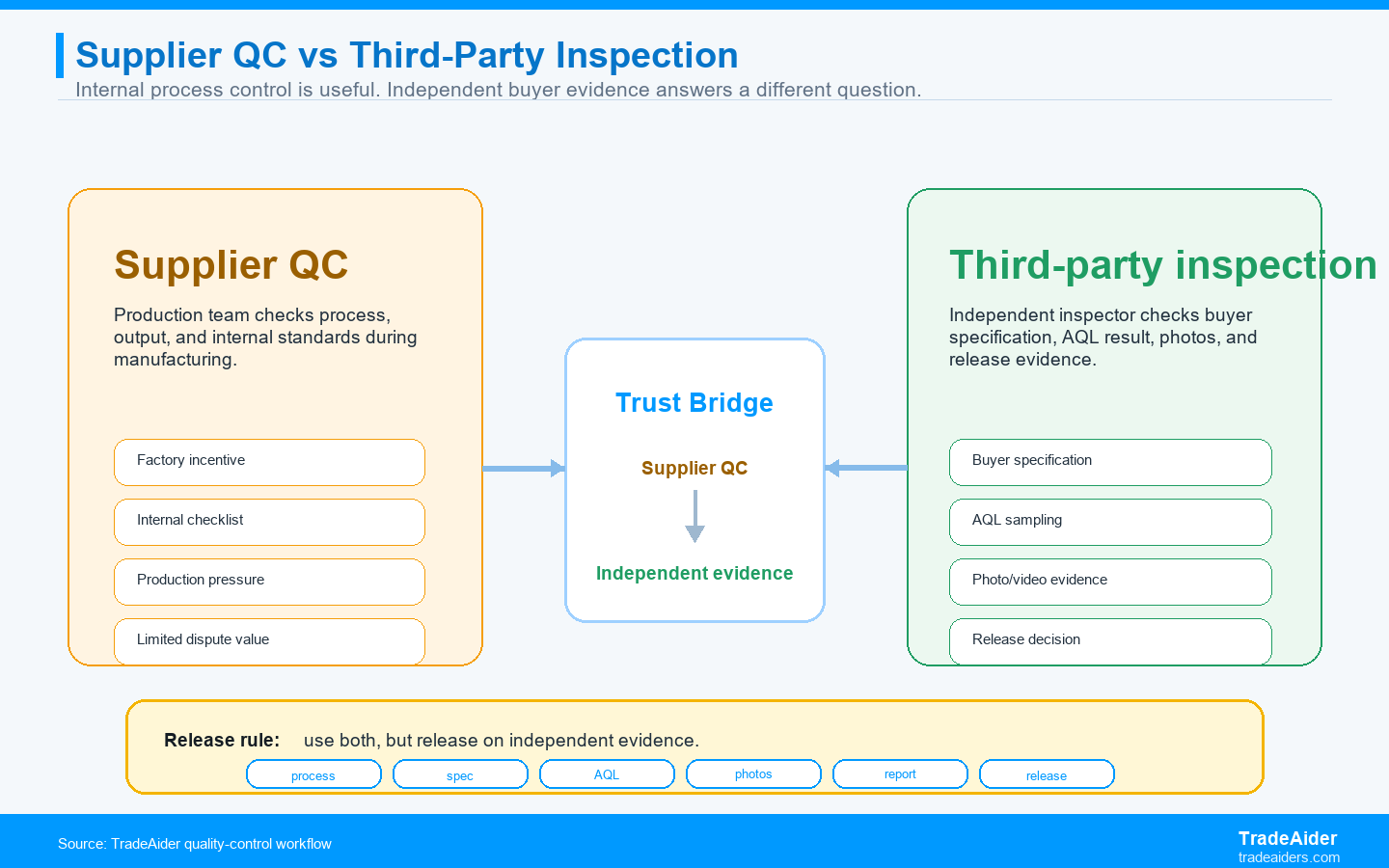
Supplier QC improves production control; third-party inspection gives the buyer independent release evidence.
Why Supplier QC Can Miss Problems
Supplier QC can miss issues because it sits inside the same organization that needs the shipment to pass.
The first limitation is incentive. The factory wants to ship, collect the balance, keep production moving, and avoid delay. Internal QC may face pressure to classify borderline defects as acceptable, reduce sample checks, or focus on issues the factory considers important rather than the buyer's customer expectations.
The second limitation is standard mismatch. A supplier may use its own standard, not the buyer's spec. The factory may think a scratch, shade variation, carton compression, label offset, or function tolerance is commercially acceptable, while the buyer's retailer or marketplace customers may reject it.
The third limitation is evidence. Supplier QC reports may be brief, selective, or unsupported by enough photos. Even when accurate, they may not carry the same dispute value as an independent report because the supplier is checking its own shipment.
When Supplier QC Is Actually Useful
Supplier QC is most useful before third-party inspection, not instead of it.
A good supplier QC team can identify process drift early. It can check incoming materials, line setup, first pieces, in-process defects, packing flow, carton marks, and final readiness. If the supplier shares honest internal findings, the buyer can fix problems before the PSI date.
Supplier QC is also useful for daily communication. The buyer can ask the supplier to send pre-inspection photos, packing progress, carton marks, label samples, measurement records, and internal defect summaries. Those files help the buyer decide whether the lot is ready for independent inspection or whether the factory needs more time.
The buyer should encourage supplier QC, not ignore it. The mistake is treating it as independent. Supplier QC should prepare the order for buyer verification. It should not replace that verification when the risk is meaningful.
What Third-Party Inspection Adds
Third-party inspection adds independence, buyer-specific criteria, structured sampling, and report evidence.
An independent inspector follows the buyer's checklist and the agreed sampling plan. The inspector checks the lot presented at the factory, records quantity and packing status, selects samples, checks visible and functional requirements, documents defects, and provides a conclusion the buyer can use before final release.
The value is not only in finding defects. The value is in creating a decision record. If the order passes, the buyer has evidence for shipment approval. If the order fails, the buyer has evidence for correction, reinspection, negotiation, or rejection. If the supplier disputes the findings, the report gives both sides a shared reference.
TradeAider's real-time visibility can make this even more practical. When issues surface during inspection, the buyer can review evidence sooner and may be able to clarify requirements or request supplier action while the inspector is still on site.
This independence is especially useful when the buyer and supplier both want the shipment to move quickly. A clear third-party report slows the decision just enough to make it factual. It gives the buyer a documented reason to approve, hold, request rework, or reinspect. It also gives the supplier a concrete defect list instead of a vague complaint. That shared evidence can reduce conflict because the conversation becomes about specific samples, photos, measurements, and acceptance limits.
Independent inspection should be treated as a control point in the buying process. It is not a sign that the buyer distrusts every supplier. It is a normal way to separate production enthusiasm from shipment release evidence, especially when the buyer cannot stand inside the factory every day.
The Independence Test: Seven Questions To Ask
The more questions supplier QC cannot answer independently, the stronger the case for third-party inspection.
- Who does the QC team report to inside the supplier's organization?
- Does the QC checklist match the buyer's written specification or only the factory's internal standard?
- Are defect photos complete enough to support a release decision?
- Was sampling random and representative, or did the factory select the samples?
- Were packed cartons, labels, barcodes, manuals, and accessories checked against final files?
- Can the report support a payment or dispute conversation?
- Would the QC team have authority to stop shipment if the order fails?
If the answer to any of these questions is unclear, supplier QC should be treated as an input, not as the final control. Independent inspection reduces the buyer's reliance on internal factory reporting.
When Third-Party Inspection Is Especially Important
Independent inspection becomes most important when the buyer's downside is large or the supplier history is thin.
Use third-party inspection for first orders, new suppliers, high-value shipments, branded packaging, retailer orders, marketplace inventory, seasonal launches, custom tooling, strict measurements, complex functions, regulated products, and any order where a defect would be expensive to correct after arrival.
Also use it when the supplier is a trading company, when the factory identity is unclear, when production was delayed, when the supplier resists sharing photos, when internal QC reports are unusually brief, or when previous orders showed repeated defects. These are not proof of bad faith, but they are signals that the buyer needs independent evidence.
For mature suppliers, the buyer can adjust frequency and scope. A stable repeat supplier may not need the same intensity every order. But the decision should be based on performance history, not hope.
SPAR Scenario: Supplier QC Passed, Third-Party PSI Found The Real Issue
The supplier checked the product, but the buyer needed the shipment checked against the final sales channel requirement.
Situation: An Australian brand ordered 3,600 bathroom accessories from a Guangdong supplier. The supplier sent an internal QC checklist showing acceptable appearance and function.
Problem: The buyer's final packaging file required a specific barcode location and warning label. The supplier QC team checked product appearance but did not compare every packaging detail against the buyer's latest file.
Action: The buyer booked third-party PSI before final payment. The inspection found that one carton batch used the previous barcode placement and that several inner boxes missed the updated warning line. The factory separated affected cartons and reworked packaging before shipment.
Result: The supplier QC report was not fake; it was incomplete for the buyer's release decision. Third-party inspection caught a channel-specific requirement before the goods reached the warehouse.
How To Combine Supplier QC And Third-Party Inspection
The best system turns supplier QC into preparation and third-party inspection into verification.
Before production, send the supplier the same checklist that the third-party inspector will use. Ask the supplier to run internal checks against that list and share photos before booking PSI. This reduces surprises and encourages the supplier to align with the buyer's standard.
During production, request internal QC updates for high-risk checkpoints. These might include materials, first-piece approval, packaging print, label version, carton marks, or function testing. If supplier QC finds an issue early, fix it before the final inspection window.
Before shipment, use third-party PSI to verify the finished and packed lot. If the report fails, require corrective action and reinspection when the correction affects shipment release. This structure lets supplier QC do what it does best while preserving independent buyer evidence.
Action Card: Trust Supplier QC Without Depending On It Blindly
Trust is strongest when it is supported by verification.
- Ask the supplier for internal QC records before PSI.
- Send the same buyer checklist to the supplier and the inspector.
- Use supplier QC to catch early process issues.
- Use third-party PSI before final payment and shipment release.
- Require reinspection when failed findings need verified correction.
- Adjust inspection frequency only after the supplier proves stable performance.
If you are unsure whether supplier QC is enough for your next shipment, send TradeAider the supplier history, SKU, order value, destination market, and internal QC documents. The next step is to ask TradeAider to build an independent inspection plan for the shipment.
Frequently Asked Questions
Is supplier QC useless?
No. Supplier QC is useful for production control and early issue detection, but it should not replace independent buyer evidence for meaningful shipment release decisions.
When can I rely more on supplier QC?
You can rely more on supplier QC after the supplier has stable performance history, clear standards, transparent records, and low order risk, but periodic independent verification is still prudent.
Why is third-party inspection more independent?
Third-party inspection is performed for the buyer against the buyer's checklist and agreed sampling plan, so the evidence is less tied to the supplier's internal production incentives.
Should I show the supplier the third-party checklist?
Yes. Sharing the checklist before inspection helps supplier QC prepare the shipment against the buyer's actual requirements and reduces avoidable failures.
Related Articles

Grow your business with TradeAider Service
Click the button below to directly enter the TradeAider Service System. The simple steps from booking and payment to receiving reports are easy to operate.

