
The best time to book a Pre-Shipment Inspection in China is usually 5 to 7 days before the planned inspection date, after the factory confirms the goods will be 100% completed and at least 80% packed for export by the inspection day. For high-risk products, peak seasons, remote factories, or first orders, book earlier so rework and reinspection remain possible.
Many importers book PSI too late. They wait until the supplier says the goods are ready, the final balance is due, the forwarder is asking for loading details, and the vessel cut-off is already close. At that point, inspection becomes a report before shipment instead of a control point before release. The difference is huge.
A realistic China sourcing timeline treats PSI as a decision gate, not a paperwork step. The buyer needs time to confirm production status, send approved files, schedule the inspector, inspect the finished goods, receive the report, request rework if needed, reinspect if needed, and still load without panic. A one-day gap between inspection and loading may be enough for a clean shipment, but it is not enough for a failed shipment.
- Normal booking: reserve the PSI window 5 to 7 days before the planned inspection date.
- Safer booking: reserve 10 to 14 days ahead for peak season, new suppliers, remote factories, or complex products.
- Inspection readiness: 100% of order quantity completed and at least 80% packed for export.
- Release rule: leave time for rework or reinspection before final payment and loading.
The Direct Answer
Book PSI before the factory finishes packing, before final balance payment is released, and before the forwarder turns the shipment into a loading emergency.
TradeAider fits the booking timeline by helping the buyer reserve the inspection window, confirm readiness, inspect the shipment-ready lot, and decide release, rework, reinspection, or loading supervision before the goods leave the correction window.
A PSI is useful because it sits before import-side problems become expensive. The CBP basic importing and exporting guidance reminds importers that goods entering the marketplace need to be genuine, safe, and lawfully sourced. For quality control, the practical implication is that importers should not wait until arrival to discover obvious defects, wrong labels, missing accessories, or packaging problems.
For regulated consumer products, timing also affects evidence. The CPSC testing and certification page states that manufacturers and importers must test many consumer products and certify compliance where applicable. PSI does not replace lab testing or certificates, but it can check whether the finished lot, labels, warnings, packaging, and model details match the evidence file before shipment.
The buyer should book PSI early enough to keep choices open. If the shipment passes, release can proceed. If the shipment fails, there is still time to sort, rework, relabel, replace accessories, repack cartons, update documents, or reinspect. That is the point of booking early: not to make the report arrive sooner, but to keep a failed result solvable.
A Realistic PSI Booking Timeline
A good PSI timeline starts before the goods are ready and ends only after release or corrective action is documented.
The timeline below assumes a standard finished-goods order from China with planned loading on Day 0. Adjust earlier for complex products, new factories, remote locations, holidays, peak season, or shipments where a failed inspection would require major rework.
| Timing | Buyer Action | Factory Requirement | QC Decision |
|---|---|---|---|
| T-14 to T-10 | Confirm production ETA, packing plan, loading date, and final payment milestone | Share realistic completion and packing schedule | Decide whether PSI alone is enough or DPI is still needed |
| T-7 to T-5 | Book PSI window and send PO, sample, spec, label files, carton marks, AQL, and checklist | Confirm goods will be inspection-ready on the booked date | Reserve inspector before schedule pressure rises |
| T-3 to T-2 | Run PSI when 100% of order quantity is completed and at least 80% is packed | Provide access to packed and unpacked goods, records, and samples | Release, hold, rework, sort, or reinspect |
| T-1 to Day 0 | Approve loading only after acceptable findings or corrected issues | Do not move goods to port before release approval | Use loading supervision if container evidence matters |
This timeline is intentionally conservative. Some inspections can be arranged faster, and some clean shipments can move soon after the report. The problem is not whether fast service is possible. The problem is whether the buyer still has leverage if the result is not clean.
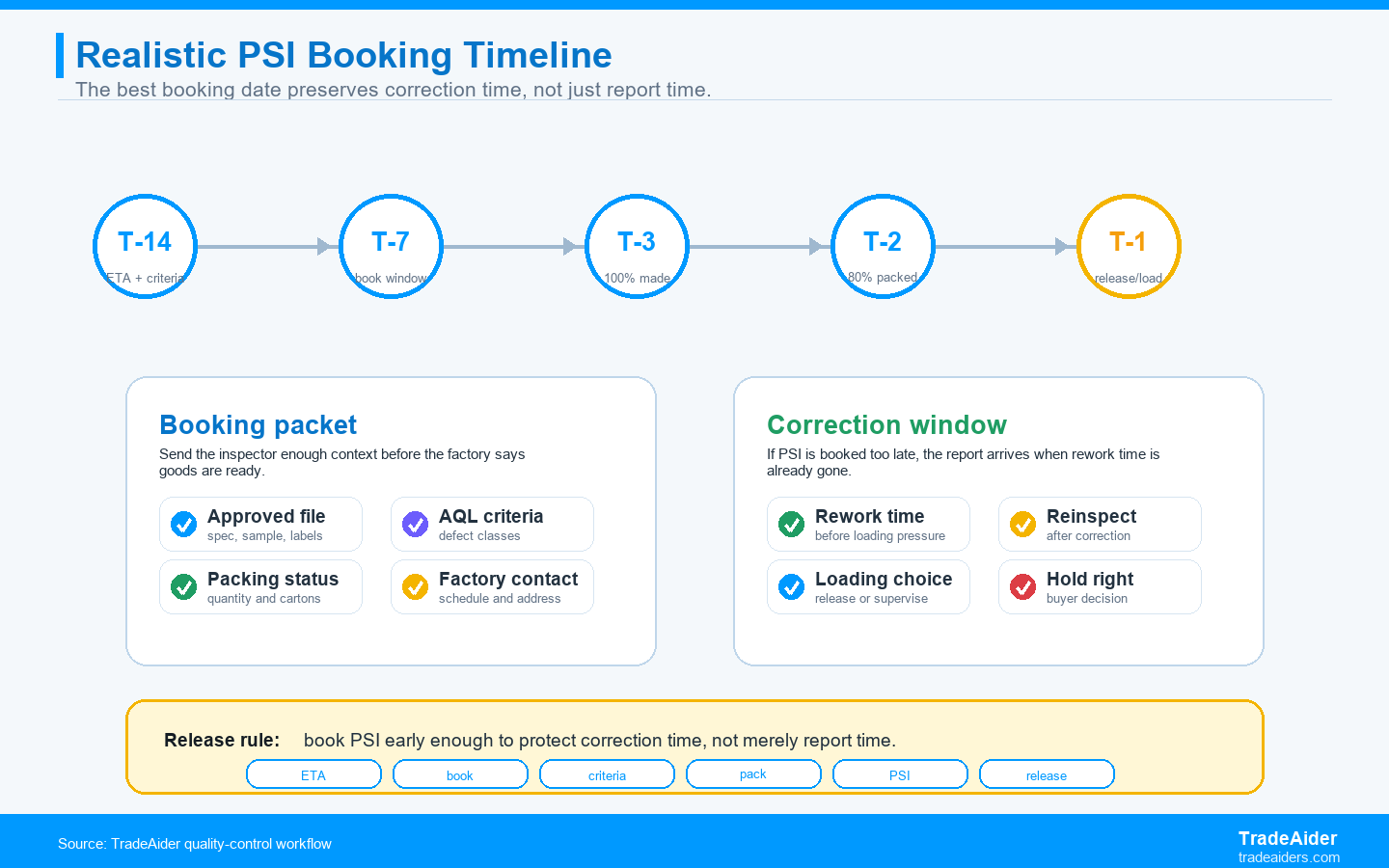
Book PSI early enough to protect the correction window, not merely to receive a report before loading.
What Counts As Inspection-Ready
Inspection-ready means the shipment is complete enough to represent what the buyer is about to release.
For TradeAider PSI, the shipment should have 100% of the order quantity completed and at least 80% packed for export. The 80% threshold refers to export packing, not production completion. That distinction matters. If production is only 80% complete, the inspector cannot fairly judge the entire order. If most goods are not packed, the inspector cannot properly check final cartons, labels, carton marks, retail packaging, assortment, or shipping marks.
Inspection-ready also means the buyer has sent the right files. The inspector needs the purchase order, approved sample photos or sample reference, specification sheet, artwork, barcode list, warning labels, carton mark requirements, packaging method, quantity breakdown, AQL level, known defect risks, and any special function or measurement checks. If the buyer sends these files after the inspector arrives, the inspection becomes less precise.
The factory also needs to prepare access. Packed cartons should be available for random selection, not stacked behind locked doors or already loaded on a truck. If the goods are at a subcontractor, warehouse, or forwarder facility, the buyer should know that before the booking. Location surprises are one reason late bookings fail.
When To Book Earlier Than Normal
Book earlier when a failed inspection would require more than a simple sort or label correction.
Peak season, Chinese holidays, new factories, new products, remote locations, mixed-SKU shipments, custom packaging, regulated products, battery or electrical items, food-contact goods, cosmetics, toys, and large retail launches all justify earlier booking. These shipments may need more coordination, more detailed checklists, or more correction time after findings.
The ITA product standards page reminds exporters and importers that products can face country-specific standards, CE marking, CCC requirements, ISO references, and other technical regulations. That does not mean PSI is a compliance certificate. It means the buyer should coordinate testing evidence and shipment inspection before the physical lot moves.
Book earlier if final payment is due before inspection. The better practice is to make final payment conditional on acceptable PSI findings. If the payment term cannot be changed, the buyer should at least complete inspection before releasing the last balance. Once the factory has full payment and the goods are booked for loading, the buyer's ability to demand correction is weaker.
Where TradeAider Fits In The Booking Timeline
TradeAider fits best when the buyer books early enough for inspection findings to change the shipment decision.
TradeAider's Pre-Shipment Inspection checks the finished shipment against the buyer's approved requirements before release. The report can support approval, rework, sorting, relabeling, replacement, or reinspection while the goods remain in China. That timing is the main commercial value.
If the factory is still early in production and risk is already visible, During Production Inspection may be better than waiting for PSI. If the order is a first production run, Pre-Production Inspection can verify materials, components, samples, and setup before the factory produces too much inventory in the wrong direction.
After the product is accepted, Container Loading Supervision can document container condition, carton condition, loading quantity, loading sequence, and seal number. It should not replace PSI. Loading supervision belongs after the product-quality decision, not as a last-minute substitute for it.
What To Do If The Factory Says It Is Too Late
If the factory says inspection is too late, the buyer should slow the release decision before the goods move beyond correction control.
A factory may say inspection will delay shipment, the goods are already packed, the forwarder is coming, or the product was already checked internally. These statements may be true, but they do not answer the buyer's risk question. The buyer should ask whether the goods can still be accessed, whether final payment has been released, whether the loading date can move, and whether the defect risk is worth skipping evidence.
If the goods are already at a forwarder warehouse, PSI may still be possible, but the inspection scope can become weaker because rework access is limited. If the goods are already in a sealed container, product inspection is usually too late; the buyer may only be able to document loading or arrival issues. If the goods have not left the factory, the buyer should consider holding shipment long enough to inspect. A missed vessel may be cheaper than receiving a defective lot.
The buyer should also preserve written records. If the factory pressures shipment before inspection, respond with the PO clause, approved checklist, payment condition, and requested inspection date. A clear paper trail helps prevent the supplier from reframing the issue later as buyer delay rather than supplier readiness or quality risk.
SPAR Scenario: The PSI Booked One Day Too Late
The buyer did not need a faster report; the buyer needed correction time.
Situation: A UK importer orders 8,000 pet grooming brushes from a Ningbo factory. The forwarder books container loading for Friday. The buyer asks for PSI on Thursday after the supplier says goods are packed.
Problem: The inspection finds 12% of sampled units with loose handle screws and two retail label versions mixed across cartons. The factory says there is no time to sort before loading. The buyer has already planned a marketplace launch and is tempted to ship anyway.
Action: The buyer delays loading, asks the factory to sort the affected cartons, tighten screw assemblies, and prepare corrected label lots. TradeAider reinspects the corrected batches early the next week before release.
Result: The shipment misses the original sailing, but the buyer avoids importing mixed-label goods and a likely return problem. For the next order, the buyer books PSI a week before planned loading and requires the supplier to confirm inspection readiness before the final balance invoice is issued.
Action Card: Book PSI At The Right Time
The right PSI booking date is the one that leaves time for an unpleasant result.
- Ask the factory for realistic completion, packing, final payment, and loading dates at least two weeks before shipment.
- Book PSI 5 to 7 days before the planned inspection date, earlier for high-risk or peak-season orders.
- Inspect when 100% of order quantity is completed and at least 80% is packed for export.
- Send approved samples, specs, labels, barcode files, carton marks, AQL rules, and defect concerns before inspection.
- Leave time for rework and reinspection before final payment and container loading.
If your supplier says the order will be ready soon, send TradeAider the PO, product spec, approved sample status, packing schedule, factory address, final payment date, loading date, and known defect risks. The next step is to ask TradeAider to reserve the PSI window before final packing and loading pressure.
Frequently Asked Questions
How many days before shipment should I book PSI in China?
Book PSI 5 to 7 days before the planned inspection date for normal orders. Book 10 to 14 days ahead for new suppliers, peak season, remote factories, complex products, or high-risk categories.
Can PSI happen when production is 80% finished?
No. TradeAider PSI should happen when 100% of the order quantity is completed and at least 80% is packed for export. The 80% threshold refers to export packing, not production completion.
Can I inspect after goods are at the forwarder warehouse?
Sometimes, but it is weaker than factory inspection because rework and sorting are harder. The best inspection point is before goods leave the factory correction environment.
Should I pay the final balance before PSI?
The safer practice is to make final balance conditional on acceptable PSI findings. Paying before inspection reduces leverage if the shipment fails.
Can TradeAider arrange urgent PSI?
TradeAider can support urgent inspection when schedule and location allow, but the better practice is to book early enough for rework or reinspection if the result is not acceptable.
Related Articles
Grow your business with TradeAider Service
Click the button below to directly enter the TradeAider Service System. The simple steps from booking and payment to receiving reports are easy to operate.

