
- About Us

- Our Services
- Your Industry
- Resources
- News & Blog
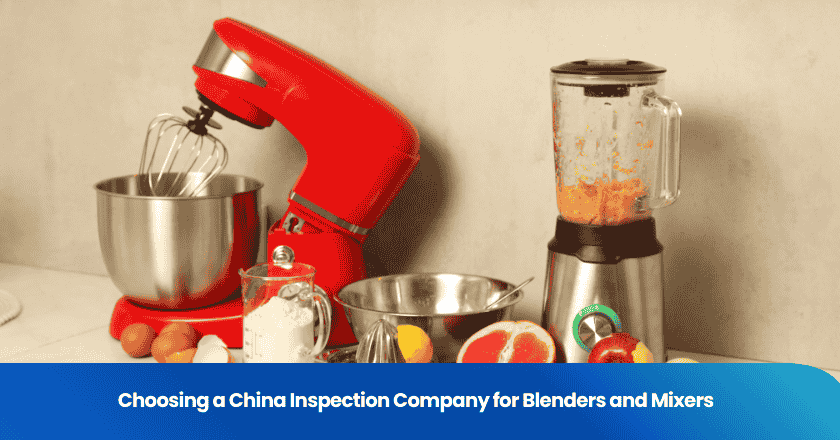
Blenders and mixers look straightforward until a shipment lands in your warehouse and customers start reporting overheating motors, leaking gaskets, and blade assemblies that won't lock. By that point, your only options are costly reworks, returns, or silence. The right China inspection company catches these issues at the factory — before they become your problem. This guide explains exactly what to look for when selecting a third-party inspector for kitchen appliance imports, and what separates a capable partner from a box-checking service.
Key Takeaways
- Blender and mixer inspections must cover electrical safety (motor load, heat dissipation, insulation) in addition to visual and dimensional checks.
- Require inspectors with appliance-specific checklists aligned to your target market's standards (UL, CE, RoHS, CCC).
- Real-time inspection reporting lets you make go/no-go decisions without waiting 24–48 hours for a PDF.
- A During Production Inspection (DPI) is often more valuable than a Pre-Shipment Inspection alone for blender orders above 500 units.
Why Blenders and Mixers Require Specialist Inspection
High-Stress Mechanical and Electrical Components
Unlike passive consumer goods, blenders and mixers operate under significant mechanical stress. The motor — typically rated between 300W and 1500W for consumer models — must sustain continuous operation without overheating. A blender motor running at 38,000 RPM generates substantial heat, and any compromise in thermal management, insulation quality, or component grading leads directly to safety risks. An inspector without appliance experience may check that the product powers on, then move on. A trained appliance inspector runs a motor rotation speed test, measures input power consumption against the rated spec, and checks the strain relief on the power cord — all of which are failure-prone areas in China-manufactured blenders.
The blade assembly adds mechanical complexity. Blade mounting torque, locking mechanisms, and the PC jug's resistance to impact (for polycarbonate jugs rated to 2.0L) are product-specific checkpoints that only appear in a well-constructed inspection checklist for this product category. General-purpose inspection checklists simply don't include these.
Market Certification Requirements
Blenders exported to the US must meet UL 1082 (household electric ranges) and UL 197 (commercial electric cooking appliances) for relevant sub-types, plus FDA requirements for food-contact materials. EU-bound products require CE marking covering the Low Voltage Directive (LVD), RoHS compliance for restricted substances, and EMC conformity per EN 60335 standards. China's domestic CCC certification covers GB 4706 safety standards, which were updated in 2024 with new GB/T 4706.1-2024 requirements effective August 2026 — aligning more closely with IEC 60335-1 international norms. Your inspection company must understand which certification applies to your destination market and know which test items on their checklist map to which standard requirement.
What to Look for When Evaluating an Inspection Company
Appliance-Specific Inspection Checklists
The most reliable signal of whether an inspection company can handle blenders and mixers is whether they have a product-specific checklist — not a generic electronics checklist adapted on the fly. For blenders, a proper checklist should include:
| Inspection Category | Key Check Items |
|---|---|
| Electrical Safety | Hi-pot test, insulation resistance, input power consumption vs. rated spec, cord strain relief |
| Motor Performance | Rotation speed, no-load and load testing, heat dissipation, motor locking test |
| Food Contact Safety | Material certification (BPA-free, LFGB/FDA), blade material grade, gasket integrity |
| Functional Testing | All speed settings, pulse function, timer accuracy (35/60/90 min if applicable), on/off switch |
| Workmanship & Visual | Casing cracks, color consistency, seam gaps, printing adhesion, label placement |
| Packaging | Drop test, carton compression, quantity verification, shipping mark accuracy |
If an inspection company cannot show you a sample report for blenders or similar kitchen appliances before you book, treat that as a red flag. Ask for a sample report specific to household electrical appliances — not just a generic "electronics" report.
AQL Sampling and Inspection Levels
A credible inspection company works within the AQL (Acceptable Quality Limit) framework under ISO 2859-1. For blenders, the standard approach is AQL 2.5 for major defects (functional failures, electrical hazards) and AQL 4.0 for minor defects (cosmetic issues). Inspection Level II is the default for most consumer appliance orders. If a company quotes a flat "we check 100 units" without reference to AQL, they either lack structural methodology or are pitching you a higher-cost service than you need. Use the AQL framework to define your risk tolerance, then verify the company applies it consistently.
Inspector Qualifications for Electrical Appliances
Not all inspectors are trained to test electrical products. For blender and mixer inspections, your inspector should be able to operate a multimeter, understand basic circuit safety principles, and conduct a functional test under load conditions — not just observe whether the blender turns on. Ask the inspection company whether their inspectors covering your product category hold any electrical or electronics engineering background, and whether they receive product-specific training before deployment. This is especially relevant for orders from Guangdong or Zhejiang factories, where the majority of China's blender production is concentrated.
PSI vs. DPI: Which Inspection Type Fits Your Order?
Pre-Shipment Inspection (PSI) — Default Choice for Smaller Orders
A Pre-Shipment Inspection (PSI), also called a Final Random Inspection (FRI), takes place when at least 80% of the order is finished and packed. This is the most common inspection type for importers buying blenders in quantities under 300–500 units. The inspector draws a statistically valid sample per AQL, runs through the full checklist, and delivers a pass/fail report — typically within 24 hours. For buyers placing a pre-shipment inspection, TradeAider's real-time platform lets you monitor the inspection live as the inspector uploads photos and findings from the factory floor.
During Production Inspection (DPI) — Better for Larger or Higher-Risk Orders
A During Production Inspection (DPI), also known as DUPRO, happens when 10–35% of the order is complete. For blenders — where motor quality, blade assembly, and food-contact compliance are difficult or expensive to rework after full production — catching defects early is dramatically more cost-effective. An importer ordering 2,000 blenders who finds a systematic motor wiring defect during production can correct it at the factory for a fraction of the cost compared to discovering it post-shipment. DPI services are priced at the same man-day rate as PSI and offer far greater leverage over quality outcomes.
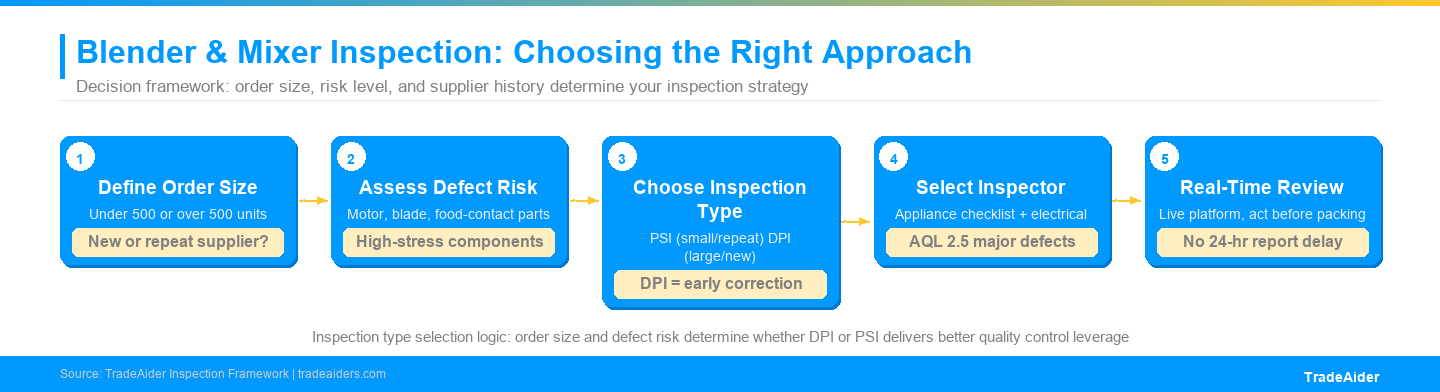
Inspection type selection logic for blender and mixer imports: order size, defect risk, and correction window determine whether DPI or PSI delivers better quality leverage.
Red Flags When Evaluating Inspection Companies
No Sample Reports for Kitchen Appliances
If a company can't provide a sample report for blenders, mixers, or comparable kitchen appliances, they likely don't have structured experience in this product category. A real appliance inspection report should show photographs of the product under test, measurements taken, AQL sample size used, defect classification (critical/major/minor), and results for each functional test item.
Pricing Without Transparency
Weekend surcharges, holiday fees, and travel add-ons are common sources of unexpected costs in China inspection services. TradeAider's pricing is $199/man-day, all-inclusive — covering weekends and public holidays without hidden fees. If a company's quote requires a fine-print read to understand the final cost, budget conservatively or negotiate a fixed all-in rate before booking.
Inspector Assigned Without Product Briefing
A quality inspection is only as good as the inspector's understanding of your product. Ask whether the company shares your product specifications, golden sample, and key risk areas with the assigned inspector before the inspection date. An inspector arriving at a blender factory without knowing the rated motor speed, the target market's certification requirements, or which components were flagged as high-risk on a previous order is effectively starting from zero.
How Real-Time Inspection Reporting Changes the Calculus
Traditional inspection companies deliver a PDF report the morning after the inspection. For buyers in different time zones, that means a 24–36 hour gap between the inspector leaving the factory and the buyer having information to act on. In that window, a factory may pack and dispatch goods despite a quality issue — putting the importer in a difficult position.
Real-time visibility closes that gap entirely. During a TradeAider inspection, buyers can follow progress on the platform as the inspector documents findings, uploads photos, and flags concerns in real time. This lets you request additional sample pulls, redirect the inspector's attention to a specific component, or call a halt before goods are packed — without waiting for any report. For blender orders where motor or blade issues are found mid-inspection, this capability is particularly valuable. Learn why real-time visibility separates TradeAider from conventional inspection providers.
Frequently Asked Questions
How much does a blender inspection in China cost?
Most third-party China inspection services price by man-day, typically ranging from $149 to $320 depending on the provider and scope. TradeAider charges $199/man-day, all-inclusive with no weekend or holiday surcharges. A standard PSI for a blender order of 500–1,000 units typically requires one man-day. Larger orders or orders requiring extended electrical testing may require two man-days.
Can a standard inspection detect motor quality issues in blenders?
Yes — if the inspector uses a product-specific checklist that includes functional and electrical tests. A general visual inspection will not catch motor performance problems. Ensure your inspection checklist includes a motor rotation speed test, no-load and load functional testing, and input power consumption measurement against the rated specification.
Should I book a PSI or DPI for my blender order?
For orders under 500 units with an established supplier, a PSI is usually sufficient. For orders over 500 units, new suppliers, or products with known quality risks (motors, blade assemblies, food-contact materials), a DPI during production gives you the opportunity to catch and correct defects before the full batch is produced — which is far more cost-effective than rework or rejection post-shipment.
What certifications should my China-manufactured blenders carry for the US market?
For the US market, blenders typically require UL listing (UL 1082 or applicable sub-standard), FDA compliance for food-contact materials, and energy efficiency considerations under DOE guidelines for relevant models. Your inspection company should verify that the certification marks on the product match the documentation on file, and that any certification has not expired or been issued for a different product version.
Is one inspection company enough, or should I use multiple?
One well-chosen inspection partner with demonstrated appliance expertise is preferable to splitting orders across multiple providers. Consistency in inspector training, checklist structure, and reporting format makes trend analysis across orders possible — helping you identify systemic factory issues over time. If you're placing orders across multiple product categories or factories, ensure your inspection partner has adequate geographic coverage across Guangdong, Zhejiang, and other key appliance manufacturing regions.
Ready to book an inspection for your blender or mixer order? Contact our team to schedule your inspection or get a quote — we cover all major appliance manufacturing regions in China, with same-day real-time reporting included at no extra cost.
Related Articles


Grow your business with TradeAider Service
Click the button below to directly enter the TradeAider Service System. The simple steps from booking and payment to receiving reports are easy to operate.

