
- About Us

- Our Services
- Your Industry
- Resources
- News & Blog

Before electrical or lighting goods leave the factory for Colombia, establish which product rules apply, confirm that the conformity evidence covers the actual configuration, and compare the completed goods with the accepted references. A certificate number and a successful switch-on test do not, by themselves, settle those three questions. The importer should resolve regulatory scope with the appropriate conformity assessment body; the factory inspection should document what was actually made and packed.
Three Decisions Before the Goods Leave
- Confirm the applicable product scope and regulatory basis with the Colombian importer.
- Verify that the conformity evidence describes the actual factory, model and configuration.
- Compare the completed goods and packing with accepted references, and resolve exceptions before dispatch.
Separate Electrical Products from Lighting Products
RETIE covers specified electrical products, while RETILAP has a separate scope for lighting products. RETIE is Colombia’s technical regulation for electrical installations; RETILAP is its technical regulation for lighting and public lighting. Their names refer to installations, but both also contain product requirements. That does not mean every kettle, extension lead and LED luminaire needs identical evidence under both regulations. See RETIE Book 2 for its product list.
Start with the product description, intended use and construction. RETIE Book 2 identifies covered categories, including low-voltage plugs, extension cords and power strips, with category-specific conditions. For a lighting order, use the RETILAP product list and its applicable exclusions instead of inferring coverage from the presence of a power cord. A mixed purchase order needs an item-by-item scope review.
Ask the Colombian importer to record the proposed classification beside each model, together with the regulation, product category and person responsible for confirming it. Attach photographs and specifications that distinguish a complete product from a component. A catalog description such as “electrical accessories” is too broad to guide either certification or factory verification.
Treat tariff classification and technical scope as related checks, not interchangeable decisions. A shipping description can remain unchanged while the product’s intended use or construction changes. If an exclusion is being claimed, retain its factual basis and the provision relied upon. Do not turn a supplier’s verbal “not applicable” into a release instruction. Equally, absence from these two regulations does not prove that no other Colombian requirement applies; ask the importer to identify any additional applicable controls before finalizing the order specification.
Check the Regulation Behind the Certificate
The Ministry’s current pages identify June 23, 2026 revisions to both regulations: Resolution 40284 for RETIE and Resolution 40286 for RETILAP. The official RETIE publication page and RETILAP publication page provide the current books alongside earlier versions. These references were checked on September 11, 2026. The older material remains useful for tracing a certificate, but should not be mistaken for the latest consolidated text.
For each conformity document, record the regulation and edition, issuing organization, certificate number, product identification and any applicable transition explanation. Save the complete document, including annexes. A cropped first page can hide the model list or a limitation that determines whether the order is covered.
The practical question is not simply whether a document displays “2026.” Ask why its stated regulatory basis is usable for this product and transaction. The answer may depend on the type of assessment, the issuer’s current scope and a transition provision. Obtain that explanation before using the document as the inspection reference, particularly when a supplier has supplied an older certificate with a newly revised product sheet.
Do Not Reject a Certificate by Its Year Alone
RETILAP Resolution 40286 preserves the validity of current ONAC accreditation under Resolution 40150 of 2024 and allows those product-certification bodies to continue issuing under that resolution, subject to the transition provisions. Article 3 of the 2026 resolution also sets a deadline of 12 months from issuance for those bodies to update their accreditation scope. This is a specific RETILAP transition, not a general exemption for all electrical goods.
The same article says that granting, surveillance and renewal processes under the 2010 RETILAP framework cannot continue from January 1, 2026. It separately addresses the use of products previously certified under that framework. Those are different situations. A document’s date alone therefore cannot establish either its acceptance or rejection for a new consignment.
Send the actual certificate and proposed shipment details to the responsible body or importer for a written applicability decision. Record what was confirmed: the product, the regulatory basis and the intended transaction. An explanation about an existing installation, for example, should not be reused as proof that a new product import meets its own requirements.
Match the Certificate to the Factory and Model
RETIE Book 4 requires product-certificate information that connects the issuer, regulatory scope, production site and identified product. Under article 4.2.3, relevant fields include the model or reference, certification scheme, applicable dates and supporting test-report references. Production-site coverage matters; the text also specifies a multisite exception for Scheme 5, subject to its conditions. A certificate for a related factory is not automatically evidence for the factory making this order.
Build a short cross-reference from the purchase-order model to the certificate annex and approved specification. Include the trading brand where it differs from the factory’s designation. Ask the issuer to resolve unclear mappings instead of accepting a spreadsheet created only by the supplier. A shared housing or similar catalog photograph is not a dependable substitute for a documented model relationship.
For a document covering a particular lot, compare its identifying details with the production records and the goods selected for dispatch. For other schemes, establish the relevant status and follow-up position rather than treating the printed expiry date as the only question. The importer and issuing body should settle the conformity implications; the buyer needs a clear reference against which the factory can be checked.
Finally, ask whether anything has changed since the assessed configuration: factory location, driver, protective device, cable construction, enclosure material or another relevant component. This is an information request, not a declaration that every change has the same legal effect. It identifies what the qualified body must evaluate before the supplier describes the current product as covered.
Verify the Issuer and Its Accredited Scope
ONAC’s directory separates testing laboratories, inspection bodies and product-certification bodies. Use the energy-sector accreditation directory to locate the relevant type of organization, then inspect its actual scope and status. A laboratory listing is not, by itself, a product-certification authorization. Nor does an installation-inspection listing establish the authority to certify the products inside a carton.
Use contact details obtained independently from the issuer or its official directory entry to verify doubtful documents. Ask about the certificate number, holder, model annex and relevant scope. If the proposed conformity route relies on another permitted recognition mechanism, have the responsible party explain that mechanism and provide the necessary evidence. Do not assume that the domestic directory is the only possible route, or that any overseas test report is automatically acceptable.
Keep this verification separate from choosing the commercial inspection provider. Reviewing TradeAider’s company background helps assess that supplier relationship, but does not confer Colombian regulatory authority on a factory inspection. The two providers may contribute to the same shipment decision while delivering different forms of evidence.
Approve Product Markings and Spanish Information
RETILAP Book 2 requires Spanish product information, together with the marking and instructions applicable to the specific lighting product. Article 2.2.1 addresses instructions, technical information and product markings; it permits digital access to certain instructions while retaining physical marking requirements. Prepare a product-specific information checklist rather than copying the same label template across an entire lighting range.
For factory preparation, freeze the approved artwork, instruction version and technical sheet before packing begins. Identify which markings belong on the product and which information is supplied through packaging or an accessible digital route. Test any QR link from an ordinary device, and confirm that it opens the correct Spanish material for the exact model. A functioning link to a generic catalog does not demonstrate that the required instructions are available.
The buyer should also compare the information with the product’s actual use. An indoor luminaire should not carry artwork that suggests an unapproved outdoor application. A carton should not advertise a performance value that belongs to a different variant. Ask the conformity specialist to identify the applicable requirements and the supplier to provide the accepted reference; the inspector can then report discrepancies without inventing acceptance criteria.
Electrical products outside the lighting scope need their own applicable marking review. Do not borrow RETILAP’s checklist merely because it is available in Spanish. Keep each approval attached to the model and revision it describes. Where the required marking durability needs a prescribed test, a visual check cannot establish that test result. Define whether the visit will check presence, legibility, placement or an agreed feasible test, and identify any remaining laboratory evidence separately.
Use inspection-standard guidance to organize these observations into a practical checklist. The approved reference should tell the inspector what to compare, where to look and how to record a difference; it should not leave the inspector to decide which Colombian regulation applies on arrival.
Turn Approved References into Factory Checks
A certificate addresses conformity within its stated scope; a factory inspection compares the available goods with agreed references and checks. Neither should be asked to answer the other’s question. If the configuration has changed, first resolve its relationship to the accepted evidence. Otherwise, a neat inspection report may describe a product whose technical status remains unsettled.
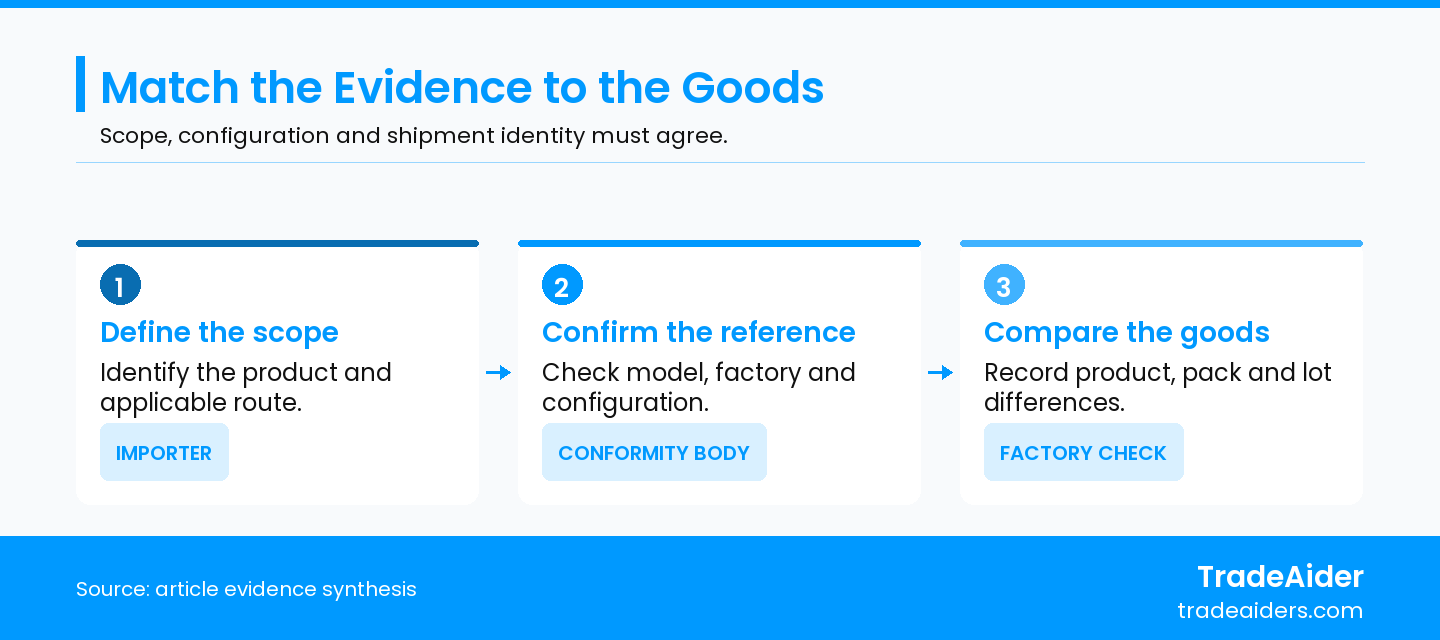
Confirm the applicable evidence before comparing the goods with the accepted reference.
| Accepted reference | Factory observation | Escalation trigger |
|---|---|---|
| Model and component list | Compare visible identity and agreed accessible components | Unlisted driver or unexplained variant |
| Marking and instruction files | Check product marks, retail pack and instruction access | Wrong revision or missing model information |
| Purchase order and packing list | Reconcile quantities and identifiable cartons | Mixed variants or unexplained quantity difference |
| Agreed test plan | Record results of feasible specified checks | Failure or test that cannot be performed as agreed |
Set the inspection method before the visit. State which components can be accessed safely, whether opening products is authorized and what equipment is available. Record a check that cannot be performed as a limitation, rather than converting an external appearance observation into a claim about internal construction. Specialized safety or lighting-performance assessment must follow the applicable technical route. Agree how each sampled unit will be identified in the photographs and records. If a nameplate cannot distinguish two internal versions, specify the additional traceability evidence needed to tell them apart before the visit.
TradeAider schedules pre-shipment inspection when 100% of the order quantity is complete and at least 80% is packed for export. That is a readiness condition for the visit, not a regulatory approval threshold. For the pre-shipment inspection service, provide the approved model references, packing specification and agreed checkpoints so the findings can be connected to identifiable products. Allow time to investigate discrepancies and verify corrections before the intended dispatch date.
Illustrative Example: One LED Model, Two Drivers
In this illustrative example, a Colombian importer orders 600 indoor LED luminaires. The order is complete and packed. The supplier provides the original approved component reference, but production records show that 200 units were assembled with a substitute driver after the original driver ran short. The retail model and external housing are unchanged.
In this illustrative example, an undocumented driver change needs a separate conformity decision even if both versions switch on. A driver controls power supplied to the LEDs; observing light output during a simple functional check does not establish the product’s assessed construction. RETILAP Book 4’s certification provisions specifically address component changes during the certification cycle. The buyer should send the change record to the responsible certification body rather than decide equivalence from appearance. Where the certification body finds that components or materials have changed, those provisions require treatment as a new product and a record of the verification.
The importer segregates the identified 200 units and pauses their release while the body determines the necessary assessment. An alternative may be restoring the approved configuration, subject to the accepted technical instructions. The factory records the corrective work and maintains identification through repacking. A subsequent check compares the corrected physical units and component records with the accepted decision.
The remaining 400 units are not automatically cleared: their identity, conformity documentation and ordinary shipment checks still need to be satisfied. If the production records cannot reliably distinguish the changed units, the claimed 200-unit boundary is not dependable and the hold must be reconsidered. The example illustrates a traceability-based decision, not a measured defect rate or a promise of partial release.
Workmanship sampling can still be planned with an AQL calculator, where AQL means acceptance quality limit. That sampling decision does not resolve the driver’s technical acceptability. Keep the reason for segregation separate from the count of cosmetic or assembly defects, so a favorable sample result cannot accidentally close the unresolved component question.
Reconcile the Evidence with the Actual Consignment
The dispatch file should identify the actual consignment and outstanding decisions, rather than simply collect certificates. Create an index linking each shipped model and quantity to the accepted conformity reference, current artwork, relevant production revision and inspection findings. Preserve any issuer clarification alongside the document it explains. A folder containing several certificates without a model mapping is difficult to use when a discrepancy appears.
After corrective work, reconcile the final packing list again. Repacking may change carton counts or move units between pallets, even when the total order quantity stays the same. Record which goods were rechecked and which document revision governed that check. If only part of an order will ship, confirm that its identification and conformity arrangements support that actual consignment.
The importer should separately confirm the customs and import-document requirements for the transaction. A satisfactory factory result does not authorize customs clearance, and an apparently complete import file does not prove that the cartons match the approved specification. Before dispatch, name the person responsible for each open issue and retain the evidence that closed it. If a critical scope question is still awaiting a decision, reflect that status explicitly instead of burying it beneath an overall inspection result.
Prepare a Focused Inspection Request
A useful inspection request supplies accepted references and clearly identifies questions that still need a conformity decision. Send the model list, relevant certificate annexes or other accepted evidence, Spanish marking and instruction files, component revisions and current packing status. Include photographs that show the differences the inspector must distinguish. State the planned dispatch date and whether corrected goods will need a follow-up check.
TradeAider can use those inputs to confirm the feasible factory checks and visit scope. Request findings and photographs tied to the checked products and packaging, with inaccessible or unperformed checks clearly identified. Keep approval of the regulatory route with the importer and the responsible conformity body; do not ask an inspection booking to resolve a certificate exception that has not yet been assessed.
Contact TradeAider to scope your inspection with those references and a short list of unresolved discrepancies. A focused request makes it easier to agree what the visit will establish and what further evidence is needed before you decide whether the goods can be dispatched.
Frequently Asked Questions
Does a CE mark replace Colombian conformity evidence?
A CE mark alone does not settle the Colombian conformity route for a covered product. Ask the responsible body which evidence is acceptable under the applicable regulation and recognition mechanism. Keep any underlying test reports available for that assessment, but do not substitute a logo on the product for a verified conformity decision.
Can a QR code replace every printed label?
No; digital access to instructions does not remove product-specific physical marking requirements. RETILAP article 2.2.2 also says that access to the information must not require a purchase, registration or membership. If the information is not supplied with the packaging, the packaging must clearly indicate how to obtain it. A scan that leads to a login requirement therefore needs correction.
Can one file cover a split shipment?
Use the accepted conformity documents only within their scope, and reconcile each consignment separately. Record which models, quantities and lot identifiers are leaving in each shipment. If the evidence is lot-specific, ask the issuer or importer how the proposed split should be documented. Do not silently reuse the full-order quantity for every dispatch.
Does a product certificate approve the building installation?
No; product conformity and assessment of the installed system answer different questions. The building’s design, construction and installation assessment may have their own responsibilities and regulatory basis. Give the installer the relevant product documentation, but do not represent a certificate inside the product file as approval of the completed installation.
Related Articles


Grow your business with TradeAider Service
Click the button below to directly enter the TradeAider Service System. The simple steps from booking and payment to receiving reports are easy to operate.

