
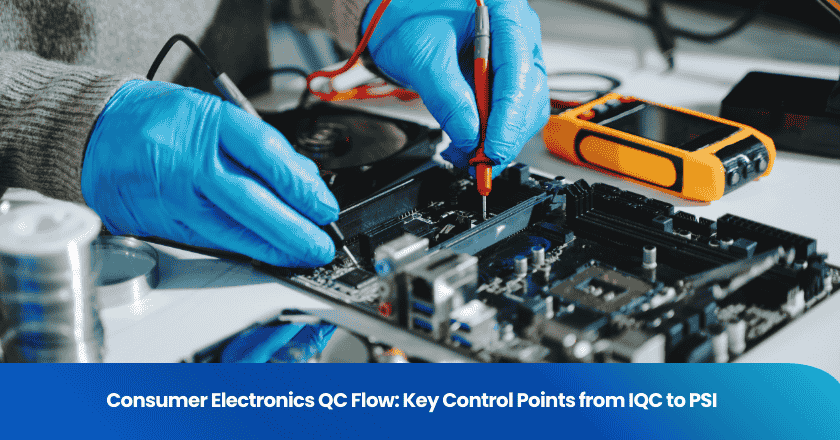
When a batch of Bluetooth speakers or wireless earbuds fails inspection at the Amazon fulfillment center, the cost isn't just the return—it's the delayed restock, the negative reviews, and the account health penalty. For most global buyers sourcing consumer electronics from China, quality failures don't happen suddenly. They compound quietly across production stages that were never properly monitored. Understanding the full quality control flow—from the moment raw components arrive at the factory gate to the day finished goods are ready to ship—is the difference between a clean shipment and a costly surprise. This guide walks through each critical checkpoint: IQC, IPQC, FQC, and PSI, explaining what gets checked at each stage, why it matters, and how buyers can use this knowledge to protect their supply chain.
Key Takeaways
- Incoming materials account for roughly half of all product quality outcomes—IQC is the first and most leverage-rich checkpoint in the entire QC flow.
- IPQC (In-Process Quality Control) catches process drift before it compounds—defects caught mid-production cost a fraction of what they cost post-production.
- Pre-Shipment Inspection (PSI) is your final independent verification, applied when production is ≥80% complete and goods are packed, using AQL-based sampling against your defect classification.
- AQL 0 / 2.5 / 4.0 is the industry-standard defect tolerance framework for consumer electronics—zero critical defects, up to 2.5% major, up to 4.0% minor.
Why the Electronics QC Flow Is Different from Other Product Categories
Complexity Creates More Failure Points
A garment has perhaps 15–20 quality attributes that matter to a buyer. A consumer electronics product—say, a USB-C hub or a smart home speaker—may have hundreds: PCB solder joints, firmware behavior, RF performance, electromagnetic compatibility, mechanical fit, packaging integrity, barcode accuracy, and more. Each attribute creates a potential failure point, and each failure point is tied to a specific stage of production. A solder bridging defect on the PCB is a factory floor issue—it must be caught during IPQC, not at shipment. A packaging labeling error is a final-stage problem—it surfaces at FQC or PSI. Mapping your control points to production stages is how experienced buyers avoid chasing defects at the wrong moment.
The 50% Rule: Why IQC Deserves More Attention Than It Gets
In electronics manufacturing, incoming materials—the components, sub-assemblies, and raw parts purchased from sub-suppliers—account for approximately 50% of the factors that determine final product quality. Design accounts for roughly 25%, the manufacturing process another 20–25%, and storage and transportation the remainder. That means if a Chinese factory's component supplier ships counterfeit capacitors or off-spec connectors, no amount of in-process monitoring will fully compensate. Buyers who verify that the factory has a functioning IQC process—not just a QC department that exists on paper—are systematically reducing half their quality risk before production even begins.
Stage 1: Incoming Quality Control (IQC)
What IQC Covers in Consumer Electronics
IQC is the factory's incoming checkpoint for raw materials, electronic components, and sub-assemblies before they enter the production line. For consumer electronics, a well-run IQC process covers several categories of checks. Component identity verification confirms that part numbers, manufacturer codes, date codes, and batch numbers on arriving components match purchase orders and approved vendor lists—a critical step for detecting counterfeit or substituted parts. Visual and dimensional checks inspect leads, connectors, and housing components for physical damage, deformation, and out-of-spec dimensions. For PCBs and sensitive electronic components, moisture sensitivity level (MSL) compliance is verified, since over-exposed moisture-sensitive components can cause latent failures post-production. Documentation review confirms that Certificates of Conformance (CoC) and material safety data align with specifications. Finally, sample functional testing may be applied to critical active components where parameter drift could affect finished product behavior.
The Constructional Data Form (CDF): Electronics Buyers' IQC Tool
For products assembled from multiple electronic sub-components, buyers can require factories to maintain a Constructional Data Form (CDF)—a document listing every component used in the product, its specification, its approved source, and its IQC acceptance criteria. When combined with supplier CoCs, the CDF gives a buyer traceability from finished product back to component level. This matters enormously when a quality issue surfaces post-shipment: the CDF allows root-cause analysis to identify whether the failure was a component problem (IQC failure), a process problem (IPQC failure), or a design margin issue.
What Buyers Should Ask Factories About IQC
When evaluating a new supplier, ask for a copy of their IQC procedures and a recent IQC monthly summary. A credible factory will have documented sampling plans (typically based on AQL or ISO 2859-1), records of non-conforming material handling, and traceability between incoming component lots and finished goods batches. Factories that cannot produce these documents—or produce them only when requested—typically have IQC systems that exist for certification purposes rather than operational quality control. A factory audit that specifically evaluates the supplier's QMS (quality management system) is the most reliable way to independently verify whether IQC is operational rather than cosmetic.
Stage 2: In-Process Quality Control (IPQC)
The 4M1E Framework: What IPQC Actually Monitors
IPQC refers to quality monitoring conducted continuously throughout the manufacturing process—from the first production run through to final assembly. Unlike IQC, which is a discrete checkpoint, IPQC is a patrol system: inspectors and production supervisors periodically check not just the product, but the conditions that produce it. The standard framework is 4M1E—Man, Machine, Material, Method, and Environment. Any quality deviation in a mature production process can typically be traced to variation in one or more of these five factors. An operator using an incorrect soldering temperature setting (Method) produces defective solder joints. A pick-and-place machine running out of calibration (Machine) causes component misalignment. A reel of components from a different supplier lot (Material) introduces dimensional variance. IPQC's job is to catch these deviations before they affect hundreds or thousands of units.
Critical IPQC Checkpoints in Electronics Assembly
In a typical consumer electronics production line, the most important IPQC checkpoints are concentrated around the PCB assembly and final assembly stages. During solder paste printing, Solder Paste Inspection (SPI) systems verify paste deposition volume, alignment, and shape before components are placed—catching setup errors before the reflow oven. After SMT component placement, Automated Optical Inspection (AOI) verifies correct component orientation, polarity, and absence of missing parts. Post-reflow, AOI runs again to detect solder bridging, tombstoning, and cold joints. During final assembly, IPQC includes first-article inspection (verifying the first unit of each production batch against an approved golden sample), operator compliance checks (ESD precautions, torque settings, cable routing), and process parameter logging for critical steps such as ultrasonic welding and adhesive curing.
First Article Inspection: The Linchpin of IPQC
One of the highest-leverage interventions available to buyers is requiring factories to perform a First Article Inspection (FAI) at the start of production and to share the results. The FAI validates that the first unit produced on the mass production line—using mass production tooling, components, and processes—matches the approved pre-production sample in every critical dimension and functional parameter. Skipping the FAI step is one of the most common causes of large-scale production failures: without it, a factory may not discover that a revised component lot or a retooled mold has introduced a dimensional shift until hundreds of units are already built. Buyers placing orders above 1,000 units should routinely require FAI documentation as a contractual deliverable before full production continues. TradeAider's During Production Inspection (DPI) service provides independent third-party IPQC, giving buyers real-time visibility into production status and the ability to issue corrective instructions mid-run.
Stage 3: Final Quality Control (FQC) and Outgoing Quality Control (OQC)
FQC vs. OQC: Understanding the Distinction
In Chinese electronics factories, FQC (Final Quality Control) and OQC (Outgoing Quality Control) serve distinct but complementary roles. FQC inspects finished products before packaging, while OQC inspects finished goods after packaging using AQL sampling. FQC's focus is on the product itself—functionality, cosmetic quality, completeness of accessories and documentation. OQC's focus is on shipment readiness—correct product in correct packaging, accurate quantity, proper labeling, and package integrity. For consumer electronics exports, both stages matter: FQC catches assembly defects and non-conforming units; OQC catches packing and labeling errors that would trigger rejection at the customer's warehouse or, worse, at Amazon's fulfillment center.
What FQC Covers for Consumer Electronics
A comprehensive FQC for consumer electronics includes functional testing (power-on, all operating modes, connectivity), cosmetic inspection (scratches, warping, flash marks, color consistency), completeness check (correct accessories, manual language, cable types), dimensional and weight verification against specification, and safety checks (no exposed conductors, correct voltage labeling, no sharp edges). For products targeting US or EU markets, FQC should also verify regulatory marking—FCC ID, CE marking, RoHS declaration—is correctly applied. Errors in regulatory labeling discovered post-shipment can prevent customs clearance entirely.
Stage 4: Pre-Shipment Inspection (PSI)
How PSI Fits into the QC Flow
Pre-Shipment Inspection is the buyer's independent quality verification—conducted by a third party, not the factory's own QC department. It takes place when production is ≥80% complete and goods are packed, giving inspectors access to units in finished condition. PSI is not a substitute for IQC, IPQC, or FQC—it is the final check that confirms those upstream processes worked. Buyers who skip upstream controls and rely entirely on PSI are playing a more expensive game: defects discovered at PSI after 100% of production is complete leave far fewer remediation options than defects caught mid-production. PSI is most powerful when it confirms that a well-monitored production run delivered what was promised.
AQL-Based PSI for Consumer Electronics: Setting the Right Thresholds
The industry standard defect classification for consumer electronics PSI is AQL 0 / 2.5 / 4.0—zero tolerance for critical defects, up to 2.5% major defects acceptable, up to 4.0% minor defects acceptable. Critical defects in consumer electronics include safety hazards (exposed conductors, incorrect voltage rating), regulatory non-compliance (missing FCC/CE marking), and complete functional failure. Major defects include functional issues (a mode that doesn't work, incorrect connectivity behavior), significant cosmetic damage visible in normal use, and incorrect accessories. Minor defects include surface marks visible only under close inspection and minor cosmetic variations that don't affect salability.
According to the American Society for Quality (ASQ) 2024 findings, companies that align AQL and inspection rigor with actual product risk profiles reduce their defect rate by up to 35%. For electronics, this means using tighter thresholds (AQL 1.0 for major defects instead of 2.5) for high-value or safety-adjacent products, and standard thresholds for commodity accessories. The calculation is straightforward: TradeAider's free AQL Calculator allows buyers to input lot size, inspection level, and AQL values to determine the exact sample size and accept/reject numbers for any shipment.
What a Complete PSI Covers in Consumer Electronics
A well-structured pre-shipment inspection for consumer electronics should cover quantity verification (carton count, units per carton), workmanship and cosmetic inspection against an approved sample, full functional testing across all operating modes, packaging and labeling audit (barcodes, FCC/CE labels, shipping marks, language), dimensional and weight spot-check, and basic safety checks. The inspection report should include photographic evidence for every finding, a defect tally by severity, and an overall pass/fail result. TradeAider's Pre-Shipment Inspection service delivers a real-time online report during the inspection—buyers can monitor findings as they happen and give live instructions to the inspector—plus an official PDF report within 24 hours.
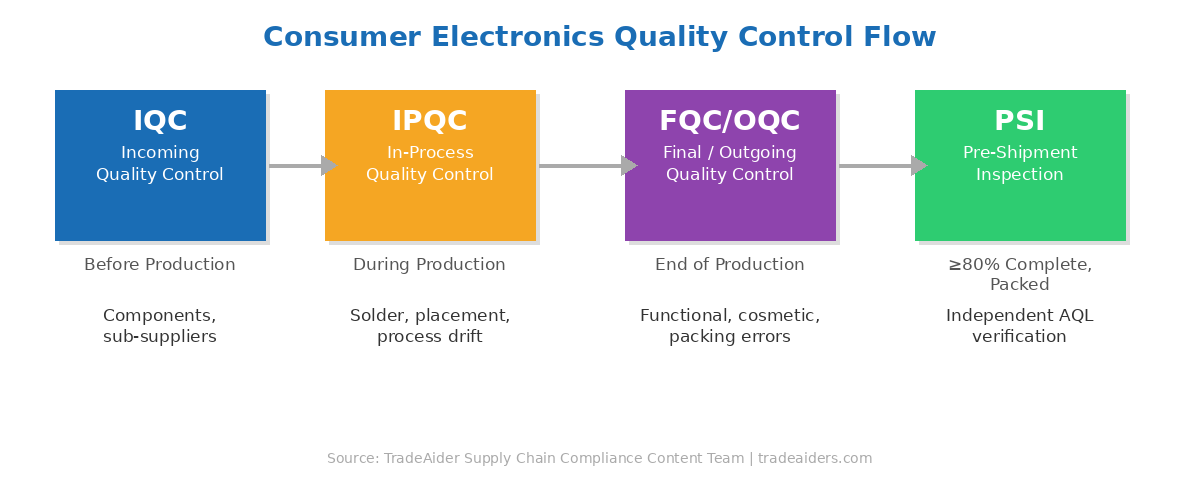
The four-stage QC flow for consumer electronics manufacturing: IQC → IPQC → FQC/OQC → PSI
Comparing the Control Stages: What Gets Caught Where
| QC Stage | Timing | Who Conducts | Key Defects Caught | Cost to Fix Defects Found Here |
|---|---|---|---|---|
| IQC | Before production | Factory QC / third party | Counterfeit components, off-spec materials, incorrect parts | Lowest — component replacement before any labor invested |
| IPQC | During production | Factory QC / third party DPI | Solder defects, misaligned components, process drift, assembly errors | Low-medium — rework before more units are built |
| FQC / OQC | End of production | Factory QC | Functional failures, cosmetic defects, packing errors, labeling issues | Medium — 100% of production complete, rework or sort required |
| PSI | ≥80% production, packed | Third party (independent) | Final verification: any defect type that escaped upstream controls | High — goods already packed; rework delays shipment |
Integrating Third-Party Inspection into Your QC Flow
Which Stages Benefit Most from Independent Verification
Factory self-inspection at IQC, IPQC, and FQC stages is necessary but not sufficient for buyers who cannot physically visit the production site. The fundamental limitation of factory QC is the incentive structure: a factory QC department reports to factory management, whose primary goal is meeting shipment deadlines. Independent third-party inspection removes this conflict. The stages that deliver the highest ROI for third-party involvement are the Pre-Production Inspection (PPI)—which verifies components and factory readiness before mass production commits—the During Production Inspection (DPI), which audits IPQC execution mid-run, and the Pre-Shipment Inspection, which provides the buyer's final, independent sign-off before goods leave the factory. For buyers placing orders above $5,000, the cost of a PSI ($199/man-day at TradeAider's flat rate) represents a fraction of the risk it mitigates. See TradeAider's Inspection Charge Calculator to estimate costs for your specific order.
Connecting the Flow: PPI → DPI → PSI
The most robust quality control strategy for consumer electronics buyers combines all three third-party checkpoints. A Pre-Production Inspection verifies that the factory has received correct and conforming components and that tooling and processes are ready. The During Production Inspection audits the factory's own IPQC execution when production is 20–50% complete, catching process deviations while the majority of the order can still be corrected. The Pre-Shipment Inspection provides independent AQL-based verification of finished goods. Each checkpoint feeds information forward: PPI findings flag component risks for the DPI inspector to monitor; DPI findings inform the PSI inspector's focus areas. This is how buyers build a quality audit trail, not just a final snapshot. For a deeper look at defect prevention strategies within production, see How to Minimize Quality Defects in Manufacturing Processes.
Frequently Asked Questions
What is the difference between IQC and PSI in electronics manufacturing?
IQC (Incoming Quality Control) and PSI (Pre-Shipment Inspection) operate at opposite ends of the production cycle. IQC is a factory-level checkpoint applied to incoming raw materials and components before production begins; its goal is to prevent defective inputs from entering the manufacturing process. PSI is a buyer-commissioned inspection of finished, packed goods conducted by an independent third party; its goal is to verify that the completed order meets specifications before shipment is approved. A factory can have strong IQC and still fail a PSI if IPQC and FQC controls broke down during production—which is why the full QC flow, not just endpoint inspections, determines consistent quality.
How should I set AQL levels for consumer electronics PSI?
The electronics industry standard is AQL 0 for critical defects (zero tolerance), AQL 2.5 for major defects (functional or significant cosmetic), and AQL 4.0 for minor defects (cosmetic only). For high-value products or those with safety implications, tightening major defect tolerance to AQL 1.0 is advisable. The exact sample size is determined by your lot size and inspection level (General Level II is standard). TradeAider's AQL Calculator generates sample sizes and accept/reject numbers automatically for any combination of lot size and AQL values.
Can a factory's own QC department replace third-party PSI?
No—and this is a critical point for buyers sourcing electronics in China. Factory QC departments are accountable to factory management, who have a direct financial interest in shipping on schedule. Independent third-party PSI eliminates this conflict of interest. A professional third-party inspector follows your inspection criteria and reports directly to you, without any relationship with the factory's production team. This independence is the core value of third-party QC: the inspector's job is to give you an accurate picture of shipment quality, not to help the factory clear its outbound schedule. Industry-standard electronics QC calls for independent verification at the PSI stage for exactly this reason.
What is IPQC and why does it matter for electronics buyers?
IPQC (In-Process Quality Control) is the ongoing monitoring of quality during production—as opposed to IQC (before production) or PSI (after production). It matters for electronics buyers because the most common and costly defects in electronics manufacturing—solder joint failures, component misalignment, assembly errors—originate during the production process, not at the final inspection stage. A factory with strong IPQC catches these defects at the unit or small-batch level, when rework cost is low. A factory without IPQC only discovers problems at final inspection, when the entire order is already built and the cost of rework or scrapping is highest. Buyers can independently verify IPQC execution through a During Production Inspection (DPI), which audits both the product quality and the factory's process controls mid-run.
Defects in consumer electronics compound across production stages—by the time they show up in a PSI, they're already expensive to fix. TradeAider's inspection services cover every stage of the QC flow: Pre-Production, During Production, and Pre-Shipment, each with real-time reporting so you can act on findings before they become shipment-blocking problems. See how Pre-Shipment Inspection works → or use the Inspection Charge Calculator to estimate costs for your next order.
Related Articles

Grow your business with TradeAider Service
Click the button below to directly enter the TradeAider Service System. The simple steps from booking and payment to receiving reports are easy to operate.

