
Private-label Amazon products usually need deeper pre-shipment inspection than resale products because the seller controls the brand promise, packaging, claims, accessories, and supplier relationship. Resale products still need identity, condition, barcode, and carton checks, but private label adds product-conformity, packaging-artwork, compliance-label, and customer-experience risks that can directly damage the seller's own brand.
Amazon sellers often use the same word, product, for two very different sourcing models. A reseller may buy finished branded goods and focus on authenticity, condition, barcode, quantity, and packaging integrity. A private-label seller may create or customize the product, packaging, insert, label, bundle, and listing promise. The inspection burden is different because the seller's control is different.
For private label, the factory is not only supplying goods. It is producing the seller's brand experience. If the product arrives with weak function, wrong color, poor packaging, missing accessories, or unsupported claims, the customer blames the seller's brand. For resale, the seller may not control the product design, but still must prevent wrong SKU, wrong condition, damaged packaging, mixed cartons, or barcode problems before inventory enters FBA.
- Private label: inspect product conformity, brand packaging, claims, accessories, function, and supplier process.
- Resale: inspect identity, authenticity evidence, condition, quantity, barcode, carton match, and prep readiness.
- Shared Amazon risk: FBA barcode, set packaging, carton marks, and customer-visible condition.
- Decision rule: inspect what the seller controls and what customers will hold the seller responsible for.
The Direct Answer
Private-label inspection should be brand and supplier-control driven; resale inspection should be identity and condition driven.
Amazon public FBA guidance discusses barcode identity, including manufacturer barcodes, Amazon barcodes, and Transparency codes. Both private-label and resale sellers need barcode control before shipment. Source: FBA barcode guidance.
Amazon public packaging guidance also emphasizes secure unit packaging, set labeling, and covering or making irrelevant outside barcodes unscannable. These checks apply to both models, but private-label sellers usually own more of the packaging design. Source: FBA packaging guidance.
The inspection plan should follow the seller's authority. If the seller designed the packaging, the inspector should compare it to approved artwork. If the seller created the accessory kit, the inspector should count and verify the kit. If the seller is reselling a finished branded item, the inspector should focus on whether the goods match the purchase order, condition, packaging, and FBA-ready identity.
Private Label vs Resale Inspection Compared
The difference is not only product type; it is who owns the customer promise.
| Inspection Area | Private Label Focus | Resale Focus | Buyer Decision |
|---|---|---|---|
| Product identity | Model, variation, approved sample, listing promise | Brand, SKU, condition, UPC/EAN, PO match | Confirm the right sellable unit |
| Packaging | Approved artwork, warning, insert, brand presentation | Original packaging condition and damage | Protect customer expectation |
| Barcode/FBA | FNSKU or barcode strategy, old code covered | Correct identifier and condition label | Avoid receiving mismatch |
| Function and accessories | Core function, kit completeness, custom parts | Completeness and damage of finished item | Prevent returns |
| Compliance and claims | Seller-controlled claims, warnings, age, material, rating labels | Authenticity and condition evidence | Avoid unsupported selling risk |
| Supplier leverage | Direct factory correction and next-order improvement | Often limited to vendor claim or replacement | Choose rework, reject, or supplier claim |
This comparison shows why a private-label seller should not rely only on warehouse receiving checks. The deeper risk is whether the product actually keeps the promise the seller wrote into the listing and packaging. A resale seller may not change the product, but still needs enough evidence to prevent wrong or damaged goods entering inventory.
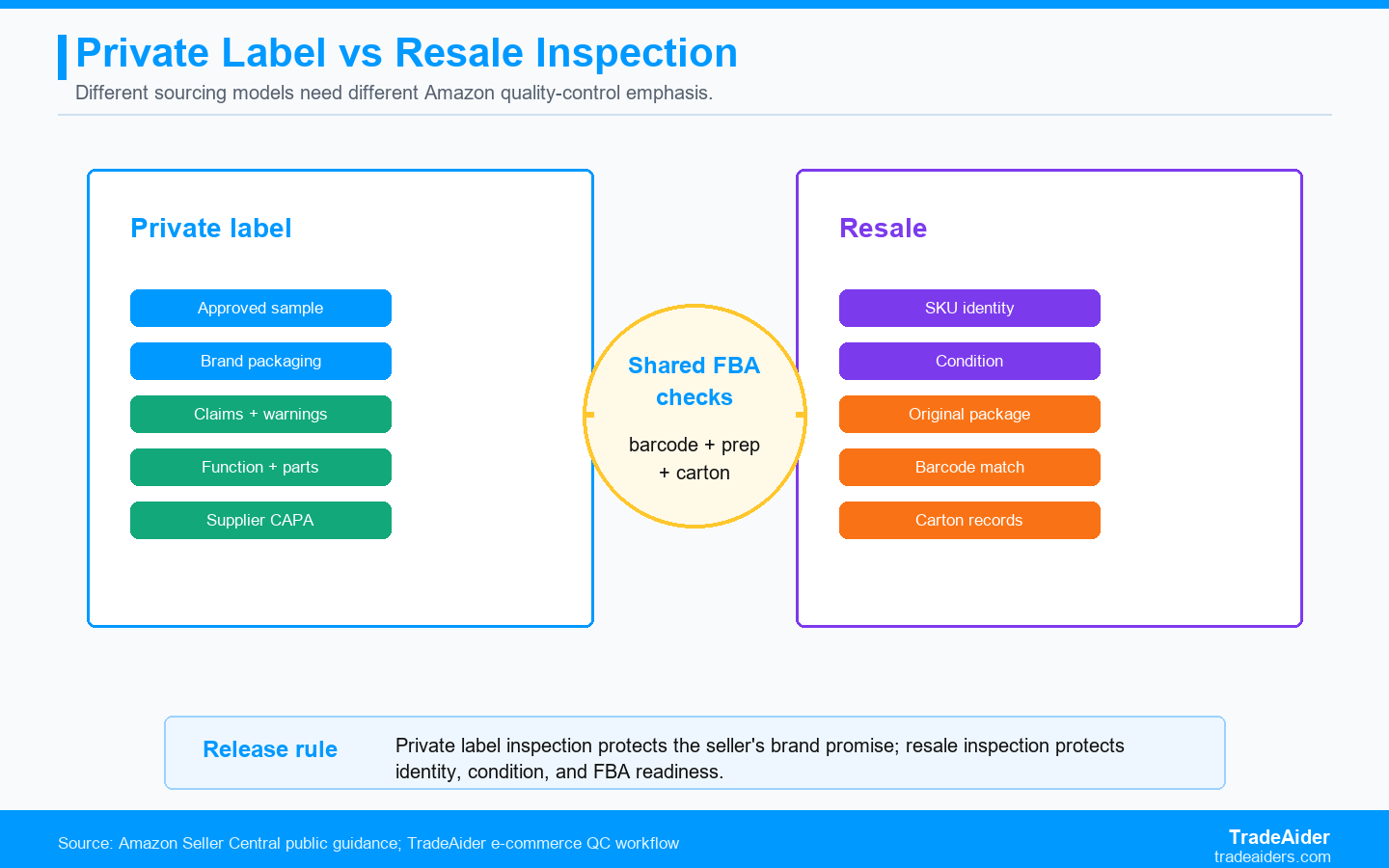
Private label inspection protects the seller's brand promise; resale inspection protects identity, condition, and FBA readiness.
Private Label Inspection Needs
Private label needs a buyer-specific checklist because the product is built around the seller's own offer.
Private-label inspection should start with the approved sample and product specification. The inspector should check visible appearance, function, material, size, color, assembly, accessory count, insert, warning text, package artwork, barcode, carton mark, and any seller-specific quality promises. If the listing says premium, giftable, BPA-free, heavy-duty, travel-size, or child-friendly, the inspection should verify the physical evidence that supports that claim.
The seller should also inspect the packaging system. Private-label packaging is often part of brand value. A crushed box, wrong color, old insert, weak closure, or label mismatch can create returns even when the product inside works. Packaging checks should include retail pack, inner pack, carton, barcode, country-of-origin mark, warning, and set wording where applicable.
Private label also needs supplier-learning feedback. If inspection finds repeated loose screws, weak adhesive, color drift, or missing inserts, the next order should add a DPI or stronger process checkpoint. The seller owns the supplier relationship and can improve the control plan over time.
Resale Inspection Needs
Resale inspection focuses on whether the seller is receiving the exact goods and condition promised.
Resale inspection is often narrower but still important. The seller may not control manufacturing, but can verify brand identity, model, SKU, condition, quantity, packaging damage, expiration or date information where relevant, barcode, bundle configuration, and carton records. Wrong condition or damaged packaging can create returns and account complaints.
Authenticity and chain-of-supply evidence may matter for resale. Inspection cannot replace legal sourcing documentation, but it can document physical identity, condition, carton labels, and obvious mismatch. If the goods are supposed to be new, sealed, and retail-ready, the inspection should verify that condition before shipment or FBA delivery.
Resale sellers should be careful with mixed lots. A carton containing mixed models, conditions, or packaging versions can create receiving and customer problems. The inspection should compare the packing list to physical cartons and identify whether each sellable unit matches the intended SKU.
When The Two Models Overlap
Some Amazon sellers operate between pure resale and pure private label, so the checklist should follow the actual control level.
Many Amazon sellers are not purely one model. A seller may buy a standard product and add a private-label insert. A seller may resell a branded product but create a bundle. A seller may buy a white-label product with only packaging customization. These middle cases need a hybrid inspection plan.
The key question is which part of the offer the seller changed or owns. If the seller changed packaging, inspect packaging like private label. If the seller created a bundle, inspect component completeness and set labeling. If the seller only buys finished branded goods, inspect identity, condition, and carton control more heavily.
| Hybrid Case | Extra Risk | Inspection Add-On | Release Decision |
|---|---|---|---|
| White-label item with custom box | Artwork, barcode, warning, insert mismatch | Packaging file and label verification | Release only if pack matches approved files |
| Resale bundle | Missing component or set separation | Open sampled sets and count items | Hold if bundle is incomplete |
| Standard product with private insert | Wrong language, claim, or instruction | Insert version and placement check | Correct before shipment |
| Resale with prep center labels | Factory cartons may not match downstream label plan | Carton and SKU identity photos | Release only with clean records |
A hybrid model is where sellers most often under-inspect. They think the product is standard, but the customer-facing offer has changed. Inspection should follow the offer customers receive, not the supplier's category label.
Where TradeAider Fits For Amazon Sellers
TradeAider fits by matching the inspection checklist to the seller's sourcing model.
For private-label sellers, TradeAider can use Pre-Shipment Inspection to verify the finished lot against approved samples, packaging files, FNSKU labels, carton marks, accessories, and product-specific function checks.
For resale or mixed inventory, TradeAider can focus on identity, quantity, condition, carton match, label accuracy, and FBA-readiness evidence. TradeAider's e-commerce quality solutions are relevant when Amazon handling and customer-return risk are part of the release decision.
The business fit is precision. A private-label inspection should not be too shallow; a resale inspection should not become an unnecessary product-development audit. TradeAider helps align the checklist with the seller's actual risk.
SPAR Scenario: Same Category, Different Inspection Plan
Two sellers bought desk organizers, but the inspection risk was not the same.
Situation: Seller A buys a private-label desk organizer with custom packaging, accessory trays, and branded inserts. Seller B resells a finished branded organizer purchased through a distributor.
Problem: Seller A risks wrong insert text, weak accessory fit, color mismatch, and poor packaging presentation. Seller B risks wrong model, damaged retail boxes, mixed condition, and barcode mismatch.
Action: TradeAider checks Seller A's order against approved sample, packaging artwork, function, accessory fit, and carton marks. For Seller B, TradeAider focuses on SKU identity, quantity, condition, barcode, original packaging, and carton records.
Result: Both sellers use inspection, but the checklist follows their business model. Seller A protects brand promise; Seller B protects inventory identity and condition.
Action Card: Choose Your Amazon Inspection Scope
Start with the sourcing model, then add FBA-specific checks.
- Use deeper product, packaging, and supplier-process checks for private label.
- Use identity, condition, quantity, barcode, and carton checks for resale.
- Apply FBA barcode, set, prep, and carton rules to both models.
- For private label, send approved sample photos, artwork, insert files, and defect rules.
- For resale, send PO, SKU list, condition requirements, barcode files, and packing list.
The seller should update the scope after returns. If private-label customers complain about function, add function checks. If resale buyers complain about damaged boxes, strengthen packaging and carton-condition checks. Inspection should follow real customer pain.
The seller should also decide who can correct the issue. Private-label defects can often be corrected at the factory because the seller controls the supplier relationship. Resale defects may require supplier claim, distributor replacement, repackaging, or rejection rather than factory rework. That difference changes the inspection deadline and the negotiation path.
For private label, the strongest inspection files are approved sample photos, engineering or product specs, artwork, barcode files, insert files, carton marks, and known defect history. For resale, the strongest files are PO, model list, condition standard, authenticity or sourcing documentation where relevant, barcode plan, and packing list. Good files make the same inspection day more decisive.
For the next reorder, keep two checklist versions if the seller uses both models. One version should protect brand-owned requirements; the other should protect resale identity and condition. Mixing them into one vague file usually creates missed checks and unnecessary checks at the same time.
This separation also makes supplier conversations cleaner because each failed finding points to the party that can actually correct it.
It also keeps inspection budget focused.
The model should guide the evidence requested.
When the evidence request changes, the inspector's photo plan, sample focus, and supplier correction path should change as well, because inspection value comes from matching the control to the commercial model.
If you are deciding how much inspection your Amazon product needs, send TradeAider the sourcing model, SKU list, files, supplier history, FBA label plan, and return risk. The next step is to ask TradeAider to build an Amazon inspection checklist for private label or resale inventory.
Frequently Asked Questions
Do resale products need inspection?
Yes, when quantity, condition, barcode, carton identity, or packaging damage could create FBA or customer problems. The scope is usually different from private label.
Why does private label need deeper inspection?
Private label sellers control the brand promise, packaging, claims, accessories, and supplier relationship. Customers hold the seller responsible when those details fail.
Are barcode checks the same for both models?
Both models need correct scannable barcode logic, but private label sellers often control label application more directly while resale sellers must verify that existing identifiers match the inventory plan.
Can one checklist work for both?
A shared FBA-readiness checklist can work as a base, but private label and resale need different product-risk sections.
Related Articles

Grow your business with TradeAider Service
Click the button below to directly enter the TradeAider Service System. The simple steps from booking and payment to receiving reports are easy to operate.

