

For an importer, a third-party inspection is not a substitute for choosing the right factory or writing a clear specification. Its value is narrower and more useful: it creates an independent record at a defined point in the order, so the buyer can decide whether to hold, correct, recheck, or release a named scope of goods. That distinction matters most when a balance payment, shipment, or correction window depends on evidence rather than reassurance.
A supplier's own checks still matter. The outside visit becomes valuable when the buyer, factory, and inspector are all working from the same current requirement and the result can be attached to a real lot, production window, or carton range. Without those links, even a detailed report can leave the buyer with photographs and no clear commercial next step.
Third-Party Inspection Is a Decision System, Not a Supplier Vote of Confidence
A good third-party visit should give an importer more than a verdict on whether the supplier looks reliable. It should create four decisions that can be acted on before money is released or goods are loaded:
- Reference: Which approved sample, specification, artwork, label, or pack-out instruction controls the check?
- Scope: Which lot, shift, line, carton range, or completed quantity does the observation represent?
- Response: Does the finding call for release, a limited hold, sorting, correction, or further review?
- Verification: What evidence must exist before corrected goods are treated as ready?
This is a practical buying model, not a universal inspection standard. A buyer may still have product-safety, contractual, or marketplace obligations outside the report. But the model stops a common failure: treating a short list of defects as though it automatically explains what must be held, what can proceed, and what needs another check.
Independence Works Only With a Shared Reference
A third-party inspection gives the buyer a verification record created by a party separate from the factory's own production team.
That separation can make conversations more precise. It does not mean that the inspector invents the product standard or decides the supplier's commercial fate. The buyer supplies the acceptance basis, the factory presents the goods and records, and the inspector documents what is observed against that basis. The result is especially useful when a buyer is managing an order remotely and needs a record that both sides can review without relying on a verbal status update.
The inspector, supplier, and buyer need the same current reference.
Send the approved sample or specification together with the current drawing, artwork, labeling, dimensions, packing sheet, and change history that actually control the order. A factory may have an older file that was correct last month but no longer matches the buyer's latest instruction. If a change has gone live during production, ask for the effective date, line, shift, or carton sequence. That small record is what makes it possible to distinguish verified output from output that may have been exposed to an earlier condition.
ISO says ISO 9001 defines requirements for establishing, implementing, maintaining, and continually improving a quality management system. The ISO overview does not turn an inspection into a factory-system audit; it reinforces why the buyer should keep the approved reference and the order record separate from a supplier's general assurance statement.
A Sample Supports a Lot Decision, Not a Promise About Every Unit
NIST says acceptance sampling is used to decide whether a lot is likely acceptable, rather than to estimate the lot's quality. Its acceptance-sampling guidance also makes clear why a sample is not the same thing as a root-cause investigation or a guarantee about every unit.
This is an important limit for importers. A passed sample supports a decision on the defined lot under the agreed plan. It does not prove that every unit is defect-free, and a failed sample does not by itself explain why the problem occurred. The useful questions are therefore: What population was sampled? Which requirements were applied? What acceptance and rejection rule was agreed? What additional action follows if the sample exposes a material risk?
ISO 28590:2017 provides a general introduction to acceptance sampling by attributes and the ISO 2859 series. The ISO overview describes this as selection guidance for attribute-sampling systems, not a single plan that fits every product or order.
ISO 2859-1:2026 describes sampling schemes indexed by Acceptance Quality Limit (AQL) for lot-by-lot inspection. The current ISO 2859-1 page makes the point concrete: an AQL reference belongs to a defined sampling scheme and lot decision, not to an assumption that every unit is defect-free.
ISO 2859-2:2020 specifies sampling plans indexed by limiting quality (LQ) for isolated lot inspection. The ISO 2859-2 overview is a useful reminder that a one-off lot can require a different sampling context from a continuing production sequence. Record whether the order is a recurring series or an isolated lot before applying a plan label.
When buyers use Acceptance Quality Limit (AQL) language, it should mean a defined sampling-plan reference with agreed acceptance and rejection numbers for a named population. It should not be used as shorthand for "acceptable defects everywhere." Align that plan with the product risk, the order terms, and the inspection criteria. TradeAider's inspection standard resource can help frame the criteria discussion, but the order still needs its own current reference and release rule.
Choose the Inspection Stage by the Decision You Need
Inspection timing should follow the decision that remains possible. Before bulk production, a buyer needs readiness evidence. During production, the priority is preserving enough time and traceability to correct a condition. Once the order is complete and packed, the question shifts to shipment readiness. These are connected controls, but they are not interchangeable services.
Choosing the wrong stage can make a technically sound report less useful. A final inspection cannot recreate an early material or specification decision. A very early check cannot confirm the finished carton presentation. Match the visit to the risk you want to reduce and to the action you can still require from the factory.
Before Production: Confirm Readiness and Requirements
TradeAider says its Pre-Production Inspection is conducted upon receipt of raw materials to verify factory readiness and understanding of product requirements. Its Pre-Production Inspection service is therefore an early control point, before large quantities make a material, specification, or pack-out misunderstanding costly to unwind.
Use this stage when the buyer needs confidence that the factory is working from the correct sample, components, and instructions. It is particularly useful after a new supplier is approved, when the product has a sensitive material or finish, or when a late change could otherwise be carried into bulk production. The decision is not "ship or do not ship" yet. It is whether the order is ready to begin in a controlled way.
During Production: Keep a Correction Window Open
During-production inspection is most useful when the buyer can still identify the output exposed to a condition and keep a correction window open.
TradeAider offers a dedicated During Production Inspection service. The During Production Inspection service page identifies the in-process service path. At this stage, a report can help the buyer ask the factory to contain a process, sort a defined quantity, replace a component or instruction, and demonstrate that the change worked before later output is mixed in. Before issuing that request, identify the affected line, shift, carton sequence, and time window. That turns a general concern into a scope the factory can sort and a later reinspection can test. The value comes from the remaining ability to act, not from a fixed percentage of completion.
Before Shipment: Make a Finished-Lot Release Decision
TradeAider describes its Pre-Shipment Inspection service for orders that are 100% complete and at least 80% packed for export. Its Pre-Shipment Inspection service is built around the later question of whether the finished lot, packing, and shipment presentation are ready for release.
A finished-lot check can validate the condition of the order at that point, but it should not be expected to replace earlier specification confirmation or an in-process correction window. For many importers, the most resilient plan uses early readiness control for critical inputs, an in-process checkpoint for changeable risks, and a final release decision before shipment.
Turn a Finding Into a Bounded Commercial Decision
A usable finding names the exposed scope, response owner, action, and verification condition.
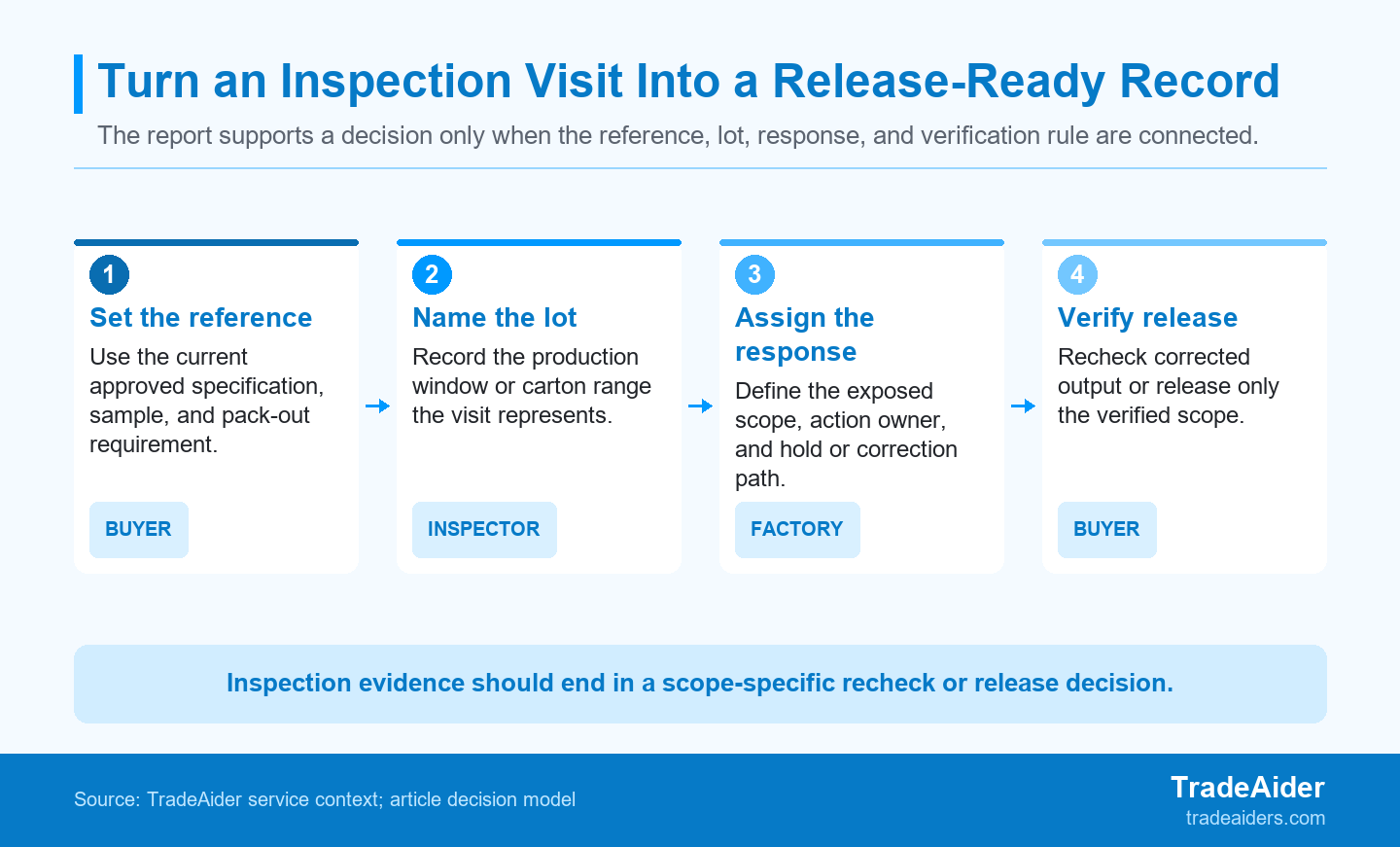
An independent inspection becomes commercially useful when every finding can be tied to a current requirement, a named lot, a response owner, and a verification decision.
Start with the scope. If a label error appears in cartons numbered 301 through 500, the response should identify that range rather than vaguely flagging the whole order. If a production line uses an unapproved component during one shift, name the shift and the output made under that condition. This discipline does not minimize the problem; it gives the buyer and factory a shared basis for deciding what must be separated and what remains eligible for release.
Then make the response explicit. The factory may need to sort, rework, replace a packing sheet, correct a setting, or supply missing records. The buyer decides whether payment, shipping, or release is affected. Finally, set the verification condition: a focused reinspection, a documented count, a photo set tied to cartons, or a new sample from the corrected output. A report becomes commercially valuable when it ends in that complete chain, not when it simply labels a finding as minor or major.
ISO 10005:2018 gives guidance for establishing, reviewing, accepting, applying and revising quality plans. For an importer, that supports a simple discipline: record the applicable reference, the affected scope, the corrective action, and the evidence that closes the recheck.
Illustrative Scenario: A Carton Mix-Up Is Found Before the Final Payment
The following worked example is illustrative, not a verified TradeAider client case.
The buyer can release the earlier verified carton range while holding the later mixed range for reconciliation and reinspection.
The numbers below are a decision model, not a universal sampling rule. They show how carton traceability can prevent a local packing issue from turning into either an unsupported all-order rejection or an unexamined shipment risk.
Contain the Carton Range, Then Reinspect It
The buyer can release the earlier verified carton range while holding the later mixed range for reconciliation and reinspection.
Buyer context: An importer is preparing private-label storage organizers for a seasonal retail launch. Each export carton must contain the approved color assortment, because mixed cartons would create receiving and fulfillment errors after arrival.
Order context: The illustrative order contains 6,000 units in 500 cartons. Two packing shifts handled the order, and cartons 301 through 500 were packed during the later shift.
Readiness state: Production is complete, the buyer is reviewing the final balance, and the factory can identify the later carton-number range. It cannot initially provide a completed carton-by-carton reconciliation for the packing station used on that shift.
First observation: Four of 32 sampled cartons from the later range contain a mixed color assortment that does not match the approved carton pack-out sheet.
Second observation: The mixed assortment appears across more than one carton position, while earlier cartons in the order match the approved sheet. The evidence points to a traceable packing-range problem, not a confirmed defect in all 500 cartons.
Analysis: The buyer should not ignore the mismatch, but neither should the buyer pretend that the sample proves every carton is wrong. The useful boundary is cartons 301 through 500, because that is the later range associated with the uncertain packing record. Earlier cartons can remain separate while the later range is reconciled.
Decision: Hold the later carton range for a carton-level count and reconciliation. Do not authorize that range for shipment until the factory can show the corrected assortment against the approved pack-out sheet and the buyer has the agreed reinspection evidence.
Corrective action: The factory segregates cartons 301 through 500, opens and sorts the mixed cartons, confirms each color count against the pack-out instruction, and records the completed carton map. It keeps the resolved later range physically and numerically distinct from the earlier verified range.
Verification gate: A focused follow-up check samples the corrected later range and compares it with the approved pack-out sheet. The buyer reviews both the reinspection result and the completed carton map before lifting the hold on that range.
Boundary: This example does not prescribe an AQL value, a defect threshold, or a universal payment rule. It illustrates a split-release geometry: separate a traceable subset, correct it, and verify it before combining its release decision with the rest of the order.
Give the Inspector a Decision-Ready Brief
Before booking, send a compact brief that names the approved reference, the current order status, the lot or carton scope to be inspected, the requirements that matter most, and the person who can make a hold, correction, or release decision. Include any late change, its effective point in production, and the evidence that would close a recheck. This gives the inspector a usable basis for the visit and tells the factory what records to have ready.
Keep the release rule practical. For example: confirm whether cartons 301 through 500 match the current pack-out sheet; if a mismatch recurs, keep that range separate; after reconciliation, verify a focused sample and provide the carton map for review. A clear rule lets everyone understand what the report is expected to support without claiming that an inspection can remove every possible risk.
When the product reference, order status, and decision path are ready, Schedule your inspection with TradeAider and share that brief with the service team.
Frequently Asked Questions
What Does a Third-Party Inspector Check During an Inspection?
A third-party inspector checks a defined lot against the buyer's agreed requirements and records the observations for a decision. The scope may include appearance, dimensions, components, labels, function, packing, carton marks, or documents, but it should always be tied to the current approved reference. The key question is not how long the checklist is. It is whether the checks address the risks and release criteria that matter for this order.
Can Third-Party Inspection Guarantee Quality for an Entire Order?
No, third-party inspection does not guarantee that every unit in an entire order meets every requirement. A third-party result supports a decision on the defined scope and plan; it does not transfer the importer's responsibilities. Sampling is an evidence tool with stated limits. Buyers should use the result together with clear specifications, supplier management, appropriate testing where needed, and a response rule for any finding that affects the defined lot.
When Should an Importer Schedule an Inspection?
Schedule the visit at the stage where the decision you need for the order can still be acted on: readiness, correction, or release. A pre-production visit can validate materials and understanding before bulk work starts. A during-production visit can preserve time to correct a traceable issue. A pre-shipment visit can support a final-lot release decision once the goods and export packing are ready.
What Should an Importer Send Before Inspection?
Provide the approved reference, production or packing status, lot scope, acceptance rules, and the decision owner. Add the current purchase-order requirements, drawings or artwork, labeling and pack-out instructions, and any change notice that affects the goods being checked. The more clearly the buyer identifies the decision needed after the visit, the more useful the inspection record will be when a finding requires action.

Related Articles


Grow your business with TradeAider Service
Click the button below to directly enter the TradeAider Service System. The simple steps from booking and payment to receiving reports are easy to operate.

