
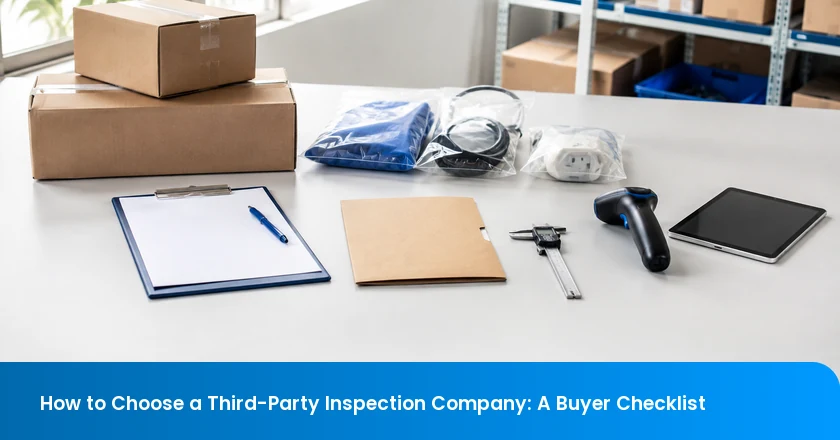
A third-party inspection company is useful only when its work can support a decision you actually need to make: approve a sample, control a live production risk, hold a shipment, or release a defined lot. “Third party” alone does not establish that. A buyer still needs to know what will be checked, where the provider is competent to work, how conflicts are controlled, how findings will be tied to goods, and what happens when the result is unclear. That is why the strongest provider comparison starts with evidence, not day rate or a broad credential statement.
The practical objective is modest but important: appoint a provider only after you can connect its scope, field method, report format, and route for unresolved exceptions to the same product and decision. TradeAider can work to an agreed buyer scope; it does not replace the buyer’s own supplier, compliance, testing, certification, or release decisions.
Start With the Decision the Inspection Must Support
A provider can be evaluated only after the buyer defines the product, decision and evidence the inspection must support. Put that decision in the request before comparing quotations. Name the product configuration, factory or warehouse, production stage, order or lot identifier, relevant revision, inspection checkpoints, acceptable evidence, and the person who can act on an exception. A proposal becomes comparable when every provider is answering the same operational question rather than offering its own generic service menu.
- Decision: What may change after the visit: sample approval, production continuation, shipment release, or a hold?
- Population: Which units, cartons, pallets, variants, or production window must the result cover?
- Evidence: Which photos, measurements, records, and report fields let the buyer apply the result to that population?
- Exception route: Who receives a critical finding, how quickly, and what must be verified before the hold is lifted?
Use the same terms in the purchase order, supplier brief, and inspection request. A useful inspection standard gives the provider checkpoints to follow, but the buyer still needs to decide which observations matter to the order. This is the difference between buying a visit and buying a usable control.
Separate Inspection, Testing, Certification, and Buyer Release
Inspection observations are not automatically laboratory results, certification, or a buyer's release decision. The distinction is not wordplay. NIST’s overview of conformity assessment treats inspection, testing, certification, and accreditation as related activities with different roles. In plain terms, an inspection body is an organization that evaluates goods against defined requirements; which requirement and activity matter. A field inspection may compare goods with an agreed specification, while a laboratory test addresses a defined test method and a certification scheme has its own rules. The buyer’s release decision is a separate commercial decision that should use the appropriate evidence.
Ask each provider to state its deliverable in those terms. If a requirement calls for a test report, a generic inspection report is not a substitute. If a retailer, regulator, or certification scheme requires a particular approval, do not assume an inspection visit satisfies it. Conversely, a provider does not need to claim authority it does not have to produce a well-scoped inspection report.
Verify Competence in the Scope You Will Actually Buy
A credential is useful only when its stated scope matches the inspection activity, product risk and location in question. Do not reduce due diligence to “Does the company have a certificate?” ILAC describes accreditation as an independent evaluation of conformity-assessment bodies for specific activities, including inspection. That word, specific, is the buyer’s prompt to keep reading. An activity, a product category, a location, and a method may all limit what the evidence actually covers.
For a complex or regulated order, request the provider’s current scope statement and ask which part maps to your assignment. Then ask who will perform the work, whether the inspection method is suitable for the product’s risk, and whether the provider can work at the named location. NIST’s general requirements for a conformity-assessment body likewise focus on the competence needed for the intended activity; that is a useful boundary, not a reason to make an unverified claim about a provider. A pre-production inspection can be the right stage to settle these questions before approved samples, tooling, or labels become production assumptions.
For example, a visual carton check, a functional product check, a measurement activity, and a lab test do not create the same competence question. The buyer brief should therefore state the method-sensitive risks: assembly function, product safety evidence, dimensions, labeling, packaging, count, or document-to-lot traceability.
Ask for Scope Evidence, Not a Logo
The buyer should verify the named activity, limits and current evidence behind any accreditation or capability claim. A logo in a proposal does not answer those questions. An accreditation scope is the named activities and locations for which formal recognition is stated. NIST defines an accredited inspection body in terms of formal recognition for specified inspections. In a designation context, NIST also explains that recognition is connected to the relevant scheme and its defined scope; see its outline of designation requirements.
Request the current document or public record, then record the issuer, expiry or status date, activity wording, and limitations in the comparison file. If the assignment is outside that wording, treat the claim as context only and ask what other competence evidence supports the work.
Test Independence Before You Compare Day Rates
Where a provider cites accredited activity, the buyer should ask how impartiality is safeguarded for the stated inspection scope. Price may be easy to compare, but an unmanaged conflict can change the practical value of every other promise. ILAC notes that accreditation is intended to support confidence in impartiality and competence in defined activity areas on its overview, and explains the importance of a defined scope in its guidance collection. Neither statement removes the need for a buyer to test the assignment in front of them.
NIST’s introduction to accreditation also frames it as a way to establish technical competence in defined contexts. It is a useful reason to examine the stated basis for a claim, not a reason to assume every proposed assignment is already covered.
Ask whether the proposed provider, its parent, affiliate, subcontractor, or reviewer has a commercial role connected to the goods. The answer may be acceptable, but it must be specific. A good provider can explain the relationship, the control used, and the person who reviews the outcome if the relationship presents a risk.
Make the Conflict Question Specific
A buyer can test independence by asking who sells, manufactures, repairs, certifies, approves, and reviews the same goods. Send that question before appointment, in writing. Add design, sourcing, commission, repair, rework, and laboratory roles if they are relevant to the order. Do not expect a one-word declaration to resolve it. The practical question is whether someone connected to the inspection outcome also benefits from a particular supplier, remedy, test, or release result.
Keep the answer with the proposal. It can become important later if a finding requires a second opinion, reinspection, or a decision to hold goods. This is not an accusation; it is a way to make the control legible before it is needed.
Ask How Conflicts Are Controlled and Reviewed
A credible response identifies the control, the reviewer, and the action when an impartiality risk cannot be managed. Look for an operating answer rather than a slogan. It might state that the assignment is declined, a separate reviewer is used, a subcontractor is disclosed, or an escalation is made to a named quality contact. The response should also say whether the buyer will be told before the assignment starts. If the provider cannot describe the control, the buyer has learned something material before placing reliance on a report.
Keep the same discipline here: assess the stated control for this assignment, not an abstract label.
Compare Method, Report, and Escalation as One Control
A useful service comparison connects the inspection method to a report that names the checked population and an escalation route for unresolved findings. Here, escalation means the agreed action when an unresolved finding changes the next decision. Ask to see a redacted sample report or a field-by-field report specification. It should show the product and revision, location and date, population and sampling basis where applicable, checkpoints, evidence, severity or decision logic, and the exceptions that remain open. A polished PDF that cannot identify what was checked is hard to use when a supplier challenges a finding or a shipment must be split.
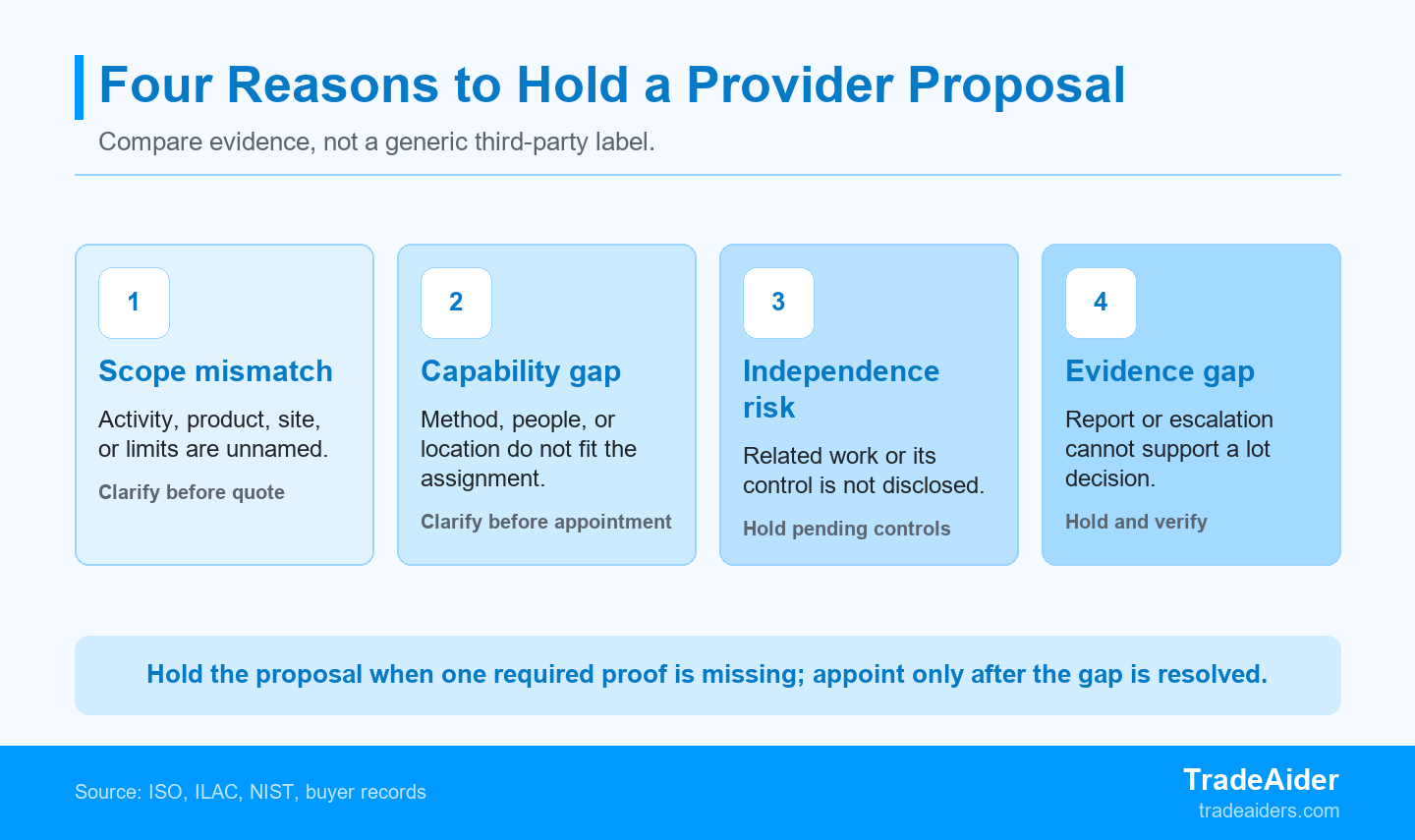
Hold a proposal for clarification when any required scope, capability, independence, or traceable-evidence proof is missing.
| Provider proof | Evidence to request | Hold the proposal when |
|---|---|---|
| Scope | Named activity, product, site, and limits | The wording does not map to the assignment |
| Method | Checklist, sample basis, and evidence format | The method cannot test the buyer’s decision |
| Report | Lot, carton, or production-window traceability | A finding cannot be applied to a defined population |
| Escalation | Critical-finding contact and verification step | No owner can act before goods move |
ILAC’s policy material is useful background for the distinction between an accreditation policy and the buyer’s own assignment controls. The buyer should still state who receives the report, what counts as a critical finding, and which evidence must be present before the next decision.
Worked Example: A Report That Cannot Identify the Checked Cartons
When a report cannot identify the checked population, the buyer needs a full hold and a verification path rather than a generic pass. Consider an illustrative importer comparing two providers for a private-label household product. The order contains 8,000 units in 400 master cartons, and finished goods are already packed as the shipping window approaches. The buyer’s request requires a report that can support a lot-level release decision, not merely a statement that a visit occurred.
One proposal promises a pass/fail summary but cannot identify the sampled cartons or the carton ranges connected to a finding. It also cannot state which records would let the buyer distinguish verified cartons from the rest of the packed lot. A second proposal sets out carton identification, the record trail, the evidence fields, and a route for notifying the buyer when that traceability breaks.
The first proposal does not let the buyer separate acceptable goods from an unverified population. The right response is not to treat the summary as a partial release signal. The buyer holds all 400 cartons until the records can be reconciled and a verification method can identify the checked population. The point is not to punish the provider; it is to prevent an untraceable result from being applied more broadly than its evidence allows.
The supplier compiles the missing carton records and the provider issues a revised inspection plan. A verification inspection names the checked cartons, evidence, and any remaining exceptions before the buyer reconsiders release. This illustrative scenario is a buyer-control example. It does not determine regulatory compliance, certification, or a provider’s actual accreditation status.
Choose the Service Stage After the Control Design Is Clear
The best inspection timing follows the change point and decision window, not a provider's generic service menu. Start the request at the point where a useful action remains possible. If the buyer needs to validate a sample, specification, label, or construction before production, the decision belongs before the line starts. If a component, workmanship, or process change needs to be caught while correction is still feasible, a during-production inspection may be more useful than waiting for finished goods. If the central question is whether a named packed lot is ready to move, the request should be built around final evidence and a release rule.
Do not ask a provider to promise that every stage is equally appropriate. Ask which stage best exposes the risk, what records will connect the observation to the order, and whether enough time remains for correction and verification. The provider’s answer should be consistent with the buyer brief, not merely with the provider’s available service labels.
Stage selection also affects the evidence request. Before production, the relevant proof may be the approved sample, specification, construction, or label. During production, it may be a defined production window and a corrective-action deadline. Near shipment, it is usually a named packed population, current records, and a clear hold or release rule. A proposal that cannot explain this connection is not yet comparable, even if its visit description is detailed.
Use a Buyer Brief That Makes Proposals Comparable
A comparable provider proposal starts with the same product scope, checklist, population map, reporting requirements and escalation rule. Send one brief to every prospective provider. It should contain the product name and revision, supplier and site, order quantity, target stage, required checkpoints, sample or population expectation, report fields, photo or measurement evidence, critical-finding contact, and the rule for holding or verifying goods. Ask each provider to mark what it can cover, what is outside its scope, and what assumptions it needs resolved. That makes omissions visible before an appointment is made.
At this point, evaluate the working approach as well as the quotation. Apply the same evidence test to any provider you are considering: the relevant comparison is not who promises a pass, but who can define the scope, document the work, and surface an exception in time for the buyer to act. To see how TradeAider describes its own role, review TradeAider's inspection approach
Read every reply against the same five checks. First, does it name the activity, product, location, and timing? Second, does it identify the people, method, and limitations relevant to the assignment? Third, does it state how impartiality risks are handled? Fourth, does it show how a finding will identify a product, carton, pallet, or production window? Fifth, does it say who receives an exception and what must be verified before a decision changes?
A clear “outside scope” answer is often more useful than an overbroad promise. It lets the buyer decide whether to revise the brief, arrange another evidence source, or use a different control at an earlier stage. The comparison becomes reliable when assumptions and exclusions are written down before the visit, because the report can then be assessed against the same agreement rather than against a memory of what was requested.
Use the final comparison to assign responsibility before any visit is booked. Confirm who supplies the current specification, who makes a commercial hold decision, who pays for any additional verification, and how a late change is reported. Those simple ownership points stop an otherwise clear report from becoming an unresolved email chain when goods are already packed.
For finished goods, close the brief with the shipment decision, named lot, required evidence, and escalation contact. If you need a provider to work from that defined release question, request a scoped pre-shipment inspection proposal
Frequently Asked Questions
Does every inspection company need ISO/IEC 17020 accreditation?
No; an inspection company does not always need ISO/IEC 17020 accreditation for every buyer assignment, location, or requested activity. Start with the activity, location, and decision the provider is being asked to support, then verify any accreditation claim against its actual scope. Accreditation can be relevant evidence for specified activities, but it is not a universal substitute for a buyer’s defined checklist, report requirements, and release rule. Ask what the claimed scope covers and what evidence supports work outside it.
Can inspection replace product testing or certification?
No; an inspection can document observations against an agreed scope, but it does not automatically replace a laboratory test or certification. Inspection, testing, certification, and a buyer’s release decision are different conformity-assessment activities that may need different evidence. Identify the required deliverable before appointing a provider, and connect each evidence type to the same current product or lot.
What must an inspection report identify before goods move?
It should identify the product configuration, checked population, findings, evidence, and any unresolved condition that changes the release decision. Where carton, pallet, or production-window traceability matters, the report should also make clear how the finding applies to that population. If the buyer cannot tell which goods the report covers, a generic pass should not be used as a release instruction.
How can buyers ask about conflicts of interest?
Ask whether the provider or related parties manufacture, sell, repair, certify, approve, source, or otherwise benefit from the goods being evaluated. Then ask what control applies, who reviews the assignment, and what happens if the risk cannot be managed. Record the response with the proposal so the buyer can assess it before relying on the report, not after a dispute or shipment hold.

Related Articles


Grow your business with TradeAider Service
Click the button below to directly enter the TradeAider Service System. The simple steps from booking and payment to receiving reports are easy to operate.

