
An electric shaver can switch on and still arrive with a poorly seated head, the wrong charging accessory, or a battery that falls short of the agreed runtime. A useful inspection checks the complete retail set: how it charges, how long it runs, whether the cutters and protective surfaces fit correctly, how securely the head stays attached, and what happens when the assembled unit operates.
For importers and quality managers, the starting point is the ordered model and its instructions, not a generic demonstration unit. Select samples from production cartons, compare them with the approved sample and specification, and establish the conditions for any timed or measured tests before the factory visit. The six checks below cover handheld electric shavers with straight or circular shaving heads. They help identify assembly and functional defects while keeping longer performance tests and electrical safety evaluations within their proper scope.
Six Checks to Put on an Electric Shaver Inspection Sheet
An electric shaver inspection sheet should pair each function with an operation and a comparison. Record the sample identifier, model suffix, charging equipment and observed result so a failure can be traced to the tested set. Use the following list as the working checklist, adding the approved limits and test conditions for the model.
- Charging: Inspect the cable, connector and included adapter or dock. Connect the specified supply and check the charging indication and full-charge endpoint against the instructions.
- Runtime: Start from the specified battery condition and run the agreed mode, load and operating schedule. Record elapsed operating time and the defined endpoint; do not treat a brief power-on check as a completed runtime test.
- Blade alignment: With the unit switched off and disconnected, examine the cutting assembly for damage, incorrect seating and mismatched parts. Refit only the removable parts covered by the inspection procedure.
- Guard security: Check the in-use protective foil (the thin perforated surface between the cutter and skin) or rotary guards, their frame and the head attachment. Confirm that they stay correctly seated through the specified operation. Check the separate storage cap for fit afterward.
- Noise: Listen for scraping, grinding and rattling in the fully assembled unit. Where a numerical limit applies, measure under the agreed acoustic method and compare the same acoustic quantity.
- Accessories: Count and identify the contents against the approved packing list. Check the fit of supplied attachments, charging accessories, cap and case, and confirm the correct instructions and retail labels.
These checks do not establish electrical safety compliance. IEC 60335-2-8:2022 covers household and similar electric shavers and related appliances rated up to 250 V, including battery-operated and DC-supplied products. Where the destination requirements or buyer's specification adopt this standard, obtain the relevant full test requirements and model-specific reports. Its public scope does not provide a universal factory test voltage, force or pass limit.
Check Charging with the Supply Intended for the Model
A charging light confirms that an indication has appeared; it does not by itself show that the battery reaches its full-charge condition. Check the complete charging path, using the cable, adapter, stand or dock specified for the ordered model. Inspect for damaged insulation, loose connectors, bent contacts and a plug that will not fully seat.
Compare the printed ratings and part identifiers with the approved documents. A connector that fits is not proof of electrical compatibility. For a USB-charged model, identify the required supply characteristics and whether the power adapter is included in the retail set or must be provided separately. An inspector's suitable bench adapter can support a functional test, but it cannot make an incorrect supplied adapter acceptable.
Follow the documented indication sequence from connection to charging and, where the test schedule permits, to the full-charge endpoint. Some lights change color or stop flashing; others turn off after a delay. Photograph the relevant states and note the starting battery condition. If the connection is intermittent during normal handling, describe the movement that caused the interruption rather than simply recording “charging failed.”
Corded operation is model-dependent. Philips shaver troubleshooting guidance explains that many wet-shaving models have a safety mechanism preventing operation while connected to a power outlet. They must be charged and unplugged before use. For such a model, failure to run while connected is expected behavior; the relevant check is whether it charges correctly and then operates disconnected.
Keep the charging setup dry and within the instructed operating conditions. Stop the check if the unit or supply is damaged, smells abnormal or becomes abnormally hot. Do not bypass a safety mechanism, short the battery, or open a sealed battery compartment to complete a routine inspection. Specialized electrical testing needs its own approved procedure and competent personnel.
Measure Runtime from a Defined Charge and Operating Condition
Runtime results are comparable only when the initial charge, operating mode, load, duty cycle and stopping point are defined. A duty cycle is the pattern of running periods and pauses. Choose that pattern from the claimed use or adopted test procedure, and identify whether the recorded time means accumulated motor-on time or total elapsed time.
For a full-charge runtime check, prepare the selected samples using the specified charging method and endpoint. Record the charge completion, any required waiting period, room conditions and test start. Where the shaver offers different operating modes, use the mode required by the specification. Do not invent a high-speed setting for a single-mode model or switch modes halfway through a comparison without recording it.
A continuously running motor without a cutting load can screen basic battery and motor behavior, but it does not reproduce shaving under every beard condition. If the purchase specification claims shaving duration or cutting performance under load, agree the applicable fixture, test medium and operating schedule in advance. Separate that evaluation from a simple unloaded factory run.
Full-charge runtime and quick-charge performance are different promises. In its model-specific FAQ, Braun's Series 9 Pro 9465cc page describes one hour to charge a fully depleted unit, up to one hour of shaving capacity after that charge, and a five-minute quick charge for one shave. These are manufacturer claims for that model, not universal shaver limits or a disclosed factory bench-test protocol.
Define the endpoint before starting: for example, the specified automatic shutdown or loss of the required operating performance. Record unexpected stops separately from planned pauses. If a test cannot finish during the visit, report the actual observed duration and arrange completion on identified samples. A supplier's older battery report can support a different evaluation, but should not be presented as the result of an unfinished inspection test.
Inspect Blade Alignment without Disturbing Matched Parts
Blade alignment inspection checks that the cutting parts are correctly seated, undamaged and compatible with the head assembly. Switch off and disconnect the shaver before examining or removing permitted parts. On a rotary shaver, each circular guard covers its associated cutter.
Under suitable lighting, look for dents, tears, distorted openings, burrs and damage to the head frame. Compare the pattern and shape with the approved sample so normal perforations are not mistaken for defects. Check the accessible locating features and drive connection for correct seating. Do not press a tool into a thin foil or use fingers to check a moving blade.
Rotary components may need to remain paired. The Philips manual covering S693, S791, S793 and S794 describes cutters and guards as matching sets, advises handling one set at a time during thorough cleaning, and requires the retaining frame to be locked after reassembly. This supports a practical inspection precaution: do not mix loose cutters and guards to make a sampled unit appear complete. Follow the actual model's construction rather than transferring that assembly sequence to every shaver.
Where the approved check permits head removal, retain the sample's parts together and verify that the reassembled head attaches without force. Check replacement-head identifiers against the ordered model as well; a visually similar spare can still be incompatible. After confirming that the protective surfaces and attachment are sound, operate the closed assembly using the normal controls.
A visual alignment check cannot establish blade sharpness, long-term wear or shaving comfort. If cutting quality is part of acceptance, use the agreed performance procedure and hygienic test arrangements. Passing a motor-on check is insufficient when the cutting result is the buyer's actual concern.
Distinguish the In-Use Guard from the Storage Cap
Guard security concerns the protective surface used during shaving and the parts that hold it in position. The removable storage cap protects the head when the shaver is put away. A well-fitting cap does not compensate for a damaged foil, loose rotary guard or insecure shaving-head frame.
For a foil shaver, the protective foil stays over the moving cutter during normal use; the storage cap is removed from the shaving head before operation. Check the foil and its frame for damage, correct seating and secure attachment. Then check the separate cap for proper fit in the storage configuration. These are different inspections because the foil separates the skin from the cutter while the cap protects the stored head.
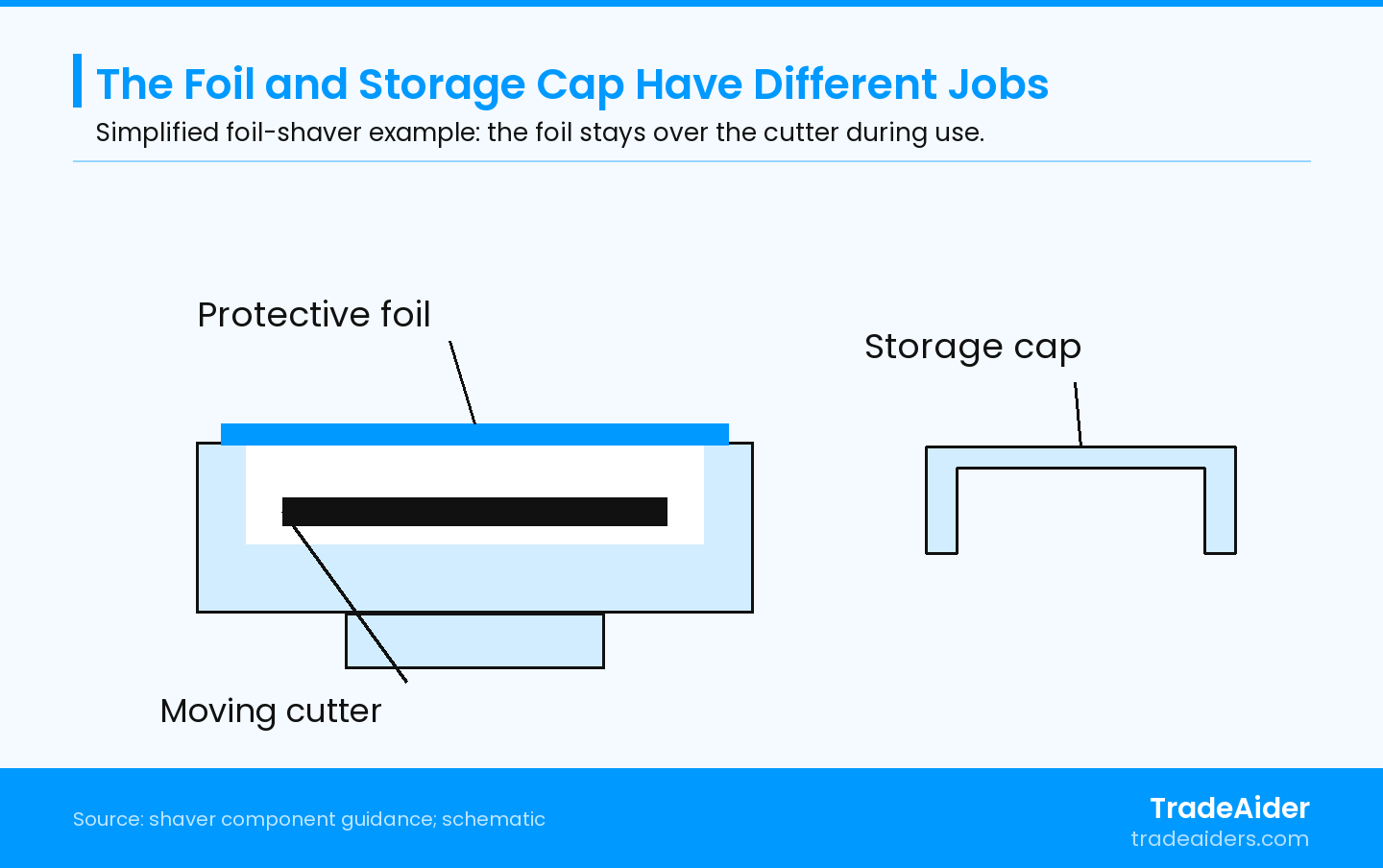
Simplified foil-shaver example, not to scale. The foil remains over the cutter during use; the separate cap protects the head in storage. Follow the actual model construction.
Confirm that the head, cassette or retaining assembly engages its intended fastening features. A cassette is a removable assembly containing the foil and cutters on models built that way. Check release buttons and catches with normal operation, comparing permitted movement with the approved sample. Some heads intentionally pivot or float to follow facial contours; movement alone is not a defect.
If the specification calls for a retention-force or repeated attachment test, use the defined fixture, direction, load and number of operations. A hand pull can reveal an obviously loose component but does not establish a numerical retention result. Avoid applying force directly to delicate perforated surfaces. Isolate a head with a tear, sharp edge or insecure protective part before powered testing or any skin-contact evaluation.
Separate Abnormal Sounds from a Measured Noise Limit
Listening is useful for finding an unexpected rattle, scrape or grind; a numerical noise judgment requires a repeatable measurement setup. Compare fully assembled units in the same operating mode and battery condition, with the same head configuration. Note whether each test is unloaded or uses the agreed cutting load.
Keep the support arrangement, microphone position, orientation and background conditions consistent with the adopted method. A shaver held in a hand can sound different from one resting on a resonating tabletop. Nearby production machinery can also mask a fault or contaminate a reading. Record the setup and instrument used so the result can be interpreted.
For standardized acoustic evaluation, IEC 60704-2-8:2020 provides a particular noise test code for household and similar electric shavers, clippers and trimmers, including mains- and battery-powered products. The edition is intended for use with IEC 60704-1:2010. Its public description identifies the product scope and companion edition; the complete adopted method is needed to establish the actual arrangement and calculation.
A limit expressed only as “dB” needs clarification. Sound pressure describes the level measured at a specified position; sound power describes the acoustic output of the source determined by a defined method. They are different quantities. An unqualified phone reading at an arbitrary distance cannot demonstrate that either specified limit has been met.
When a sampled unit makes an abnormal sound, switch it off before checking accessible head seating and damaged parts. Compare it with another correctly assembled sample under the same conditions. Record the symptom and follow the approved diagnostic procedure; a noise observation alone does not identify a defective battery or prove a particular internal cause.
Hypothetical Example: A Rattle after Head Reassembly
Consider a hypothetical inspection in which one rotary shaver begins rattling after its head has been removed and refitted for the permitted assembly check. Another sample of the same model runs normally. The inspector switches off and disconnects the noisy unit, then finds that its retaining frame is not fully locked. After correct reassembly, the shaver runs without the rattle under the same operating conditions.
This observation supports an assembly explanation for that sample, but it does not show that every noisy shaver has the same problem. Preserve the initial finding, check whether the instructions and fastening features make correct assembly clear, and repeat the affected operation on identified samples. If a properly locked frame loosens during the specified operation, the concern changes from a one-time assembly error to a possible retention defect requiring supplier investigation.
Check Accessory Compatibility as Well as the Count
An accessory check should establish both completeness and usability. Lay out the retail contents against the model-specific packing list, including the quantities and identifiers for the cable, adapter if supplied, charging dock, replacement heads, trimming attachments, brush, storage cap, pouch or case. Optional accessories advertised separately are not automatically missing from the order.
Fit each supplied attachment using the instructions. Confirm that a trimming attachment seats securely, the charging dock accepts the correct body, and the storage cap protects the head without deforming it. Where a cleaning station is included, check its model compatibility, supplied consumables and accessible operation under the instructed conditions. Do not substitute water or another liquid for the specified cleaning fluid.
Check the model suffix on the unit and carton, the applicable plug configuration and the instruction language against the purchase order. Confirm that warnings, charging information and cleaning directions match the actual retail configuration. A cable-only version and a version supplied with an adapter need different packing checks, even if they share the same main shaver body.
Inspect how the set is restrained inside its packaging. The head and foil should be protected from contact with loose accessories, and the controls should not be pressed by the tray or case. Where a travel lock is fitted, verify its normal operation and the specified packing state. Repack checked units using the approved arrangement, keeping wet, contaminated or specially tested samples separate from untouched saleable stock.
Turn the Shaver Findings into Specific Supplier Actions
The next action should follow the finding: correct a wrong accessory, investigate an unstable charging connection, or complete a missing performance test. Keep those results distinct so a buyer can see which defects were observed and which claimed properties remain unevaluated.
- Damaged or insecure protective parts: Isolate the affected samples, identify the head or fastening defect, and define the supplier correction before checking the corrected assembly.
- Charging, runtime or noise failures: Retain the tested configuration and conditions. Request investigation of a reproducible failure; repeat an invalid comparison using the correct setup.
- Wrong contents or incomplete testing: Correct the retail configuration and verify it against the packing list. Complete outstanding timed or specialized evaluations rather than treating their absence as a passing result.
Agree sample coverage and defect classifications before inspection. TradeAider's inspection standard describes its sampling approach and customer-specific checks. Sampling determines which units are examined; it does not supply the runtime claim, head-retention load or acoustic limit for an electric shaver.
For a finished order, pre-shipment inspection can address the assembled products and their retail packing. TradeAider's readiness condition is that the order quantity is 100% complete and at least 80% packed for export. Plan any full-charge runtime or specialized evaluation early enough that its results are available when needed.
To arrange the factory checks, contact TradeAider with the model list, approved sample and packing specification, charging instructions, runtime conditions and applicable noise or retention criteria. These materials let the team confirm the inspection scope and report the observed results, with longer or specialized tests identified separately.
Frequently Asked Questions
Does a washable head prove that the whole shaver is waterproof?
No. A removable head that can be rinsed does not by itself establish protection of the complete body, charging socket or power supply. Follow the exact model's cleaning and wet-use instructions, and obtain the relevant test results for the claimed water protection. A rinse demonstration cannot replace a defined ingress-protection evaluation. Keep any non-washable charging equipment out of that demonstration.
Can the inspection include shaving on a person's face?
Only through an agreed hygienic procedure; do not pass one sampled shaver between inspectors as an informal cutting test. Establish who may use it, how the test is conducted and how the used sample is identified afterward. Where a controlled test medium or fixture can answer the specified cutting question, use the agreed procedure. Keep skin-contact test samples separate from stock represented as unused.
Can an inspection verify how long the battery lasts in storage?
A normal factory visit cannot establish a storage-duration claim that requires a much longer observation period. Agree the initial charge, storage conditions, observation interval and measurement before arranging a separate test. Brief operation on the inspection day only shows the sampled unit's condition at that time. It does not quantify self-discharge over weeks or months or predict battery aging through repeated charge cycles.
Can one tested model represent every shaver in a mixed order?
Not automatically. Establish which variants share the relevant battery, charging supply, head assembly and accessories before deciding how results can be applied. Differences in those parts may require separate checks even when the housings look alike. Identify the tested model suffix and configuration in the report, and document the technical basis for any grouping rather than extending one sample's result across the order by appearance.
Related Articles

Grow your business with TradeAider Service
Click the button below to directly enter the TradeAider Service System. The simple steps from booking and payment to receiving reports are easy to operate.