
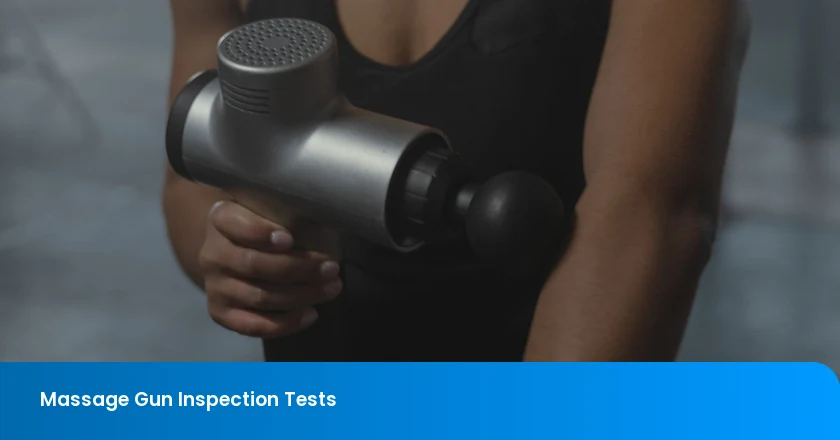
A massage gun inspection should show how the finished device behaves across its operating settings, with its supplied attachments and charging equipment. Check the response to the approved load, the actual change between speeds, attachment retention, temperature during the specified operation, battery runtime and abnormal noise. A motor that starts normally has answered only a small part of that question. Stall protection concerns the response when a load stops the driven movement.
For purchasing and quality managers, the challenge is making the results comparable without turning a factory visit into an improvised safety test. Start with the ordered model, approved sample and current instructions. Agree the methods for timed, loaded and measured checks before selecting units from production cartons. The matrix below covers handheld percussive massage guns, whose heads move repeatedly outward and back. It keeps routine function checks separate from laboratory evaluations of electrical safety and abnormal operation.
A Working Test Matrix for Finished Massage Guns
Use a massage gun test matrix that identifies the operation, comparison and result for each promised function. Record the sample identifier, model, attachment, speed setting, initial battery condition and test method alongside the observations. Add the model-specific limits to this working matrix before the visit; a sampling plan does not supply those performance limits.
| Test | Operation and conditions | Judgment reference | Result to record |
|---|---|---|---|
| Stall protection | Use the validated load procedure and fixture, within its defined force, duration and stopping conditions. Never block the head by hand. | Specified protective response and recovery; separate resistance to stalling from protective shutdown. | Applied condition, response, indications and restart behavior. |
| Speed variation | Select every available setting. Measure repeated head cycles with the agreed method under the defined load. | Speed ranges, tolerances and control sequence for the model. | Setting, measured rate, load and unstable or missing modes. |
| Attachment fit | Fit each supplied head with the power off. Check seating and the specified retention operation, then inspect after the running sequence. | Correct part, fastening method and permitted movement. | Part identifier, seating, looseness, wear or detachment. |
| Heat | Measure the specified surfaces during the defined run and charging checks; evaluate intentional heating modes separately. | Temperature or temperature-rise limits, locations and operating conditions. | Starting conditions, measurement locations, temperatures and elapsed times. |
| Battery runtime | Start from the specified full-charge condition; use the agreed head, speed, load and running/pausing schedule. | Claimed duration under matching conditions and a defined endpoint. | Motor-on time, pauses, shutdown reason and unfinished test duration. |
| Noise | Listen for faults on the assembled unit. Measure numerical noise claims using the adopted acoustic setup. | Approved sound character or the specified acoustic quantity and limit. | Head, mode, support, microphone position, reading or abnormal sound. |
Routine checks can establish whether controls work, heads fit and the sampled units exhibit visible or audible defects. Numerical performance results require the right instruments and conditions. Where a validated load method, suitable fixture or competent tester is unavailable, identify the missing evaluation and arrange it separately. Do not substitute an improvised demonstration and mark the corresponding property as passed.
Check Stall Protection against the Intended Response
Resistance to stalling and protection during a stall are different properties: one concerns maintaining movement, while the other concerns the device's response to an abnormal condition. A claim such as “anti-stall” does not establish that a protective shutdown has been tested.
Ask the supplier for the specified operating-load test and, separately, the protective-function procedure. The latter should define the fixture, selected head and speed, battery condition, applied force or obstruction, duration, expected response, stopping conditions and recovery sequence. A controlled test might evaluate a defined current-limiting or shutdown response where that feature exists. Do not assume every massage gun should stop, automatically restart, or use the same protection design.
The safety context also matters. IEC 60335-2-32:2024 covers household and similar electric massage appliances, including handheld massagers and battery-operated products. Where the product and adopted destination or contractual requirements call for this standard, obtain the full applicable procedures and model-specific reports. The public scope does not authorize a particular factory blockage method or supply a universal stall force.
Use qualified personnel and the validated procedure for any deliberate obstruction or protective-function check. Keep hands, clothing and loose items away from the moving head and its pinch points. Stop at the procedure's limits, and stop immediately for abnormal heat, smoke, odor, damaged parts or an attachment coming loose. Do not repeatedly force a stalled unit to restart.
Record what happened before and after the response. A battery reaching its normal endpoint, an ordinary session timer expiring, and a load-triggered protective action can all look like “the device stopped.” The elapsed time, indications, applied condition and documented restart behavior help distinguish them. If the required trigger cannot be established, the protective-function result remains unresolved.
Measure Speed Changes, Not Just Changing LEDs
Speed variation checks should establish that each selected setting produces the specified rate of head movement. A changing display or LED pattern shows that the control indication changed; measure the motion where a numerical speed requirement applies. Use the approved sensor or observation method without touching the moving attachment.
Control arrangements vary by model. The Theragun Mini third-generation manual describes three speed selections—low, medium and high—with corresponding LED indications. It also tells users to avoid excessive pressure that impedes normal operation. This is a model-specific control example, not a three-speed requirement for every massage gun or a load-test instruction.
For a reciprocating head, count one complete outward-and-return movement as one cycle. Percussions per minute, often written PPM, describe the rate of those cycles under the agreed counting convention. If a measuring instrument reports rotational speed, confirm how the drive rotation relates to head movement before comparing that reading with a head-cycle specification. Check that the instrument is not counting both directions as two complete cycles.
Stroke length describes the head's travel between its retracted and extended positions; cycle rate describes how often it completes an outward-and-return movement. Measure the same reference point at both extreme positions when checking travel, and count complete cycles over time when checking speed. A faster cycle rate does not by itself establish a longer stroke. Confirm what the supplier means if its specification uses “amplitude” rather than a clearly defined travel distance.
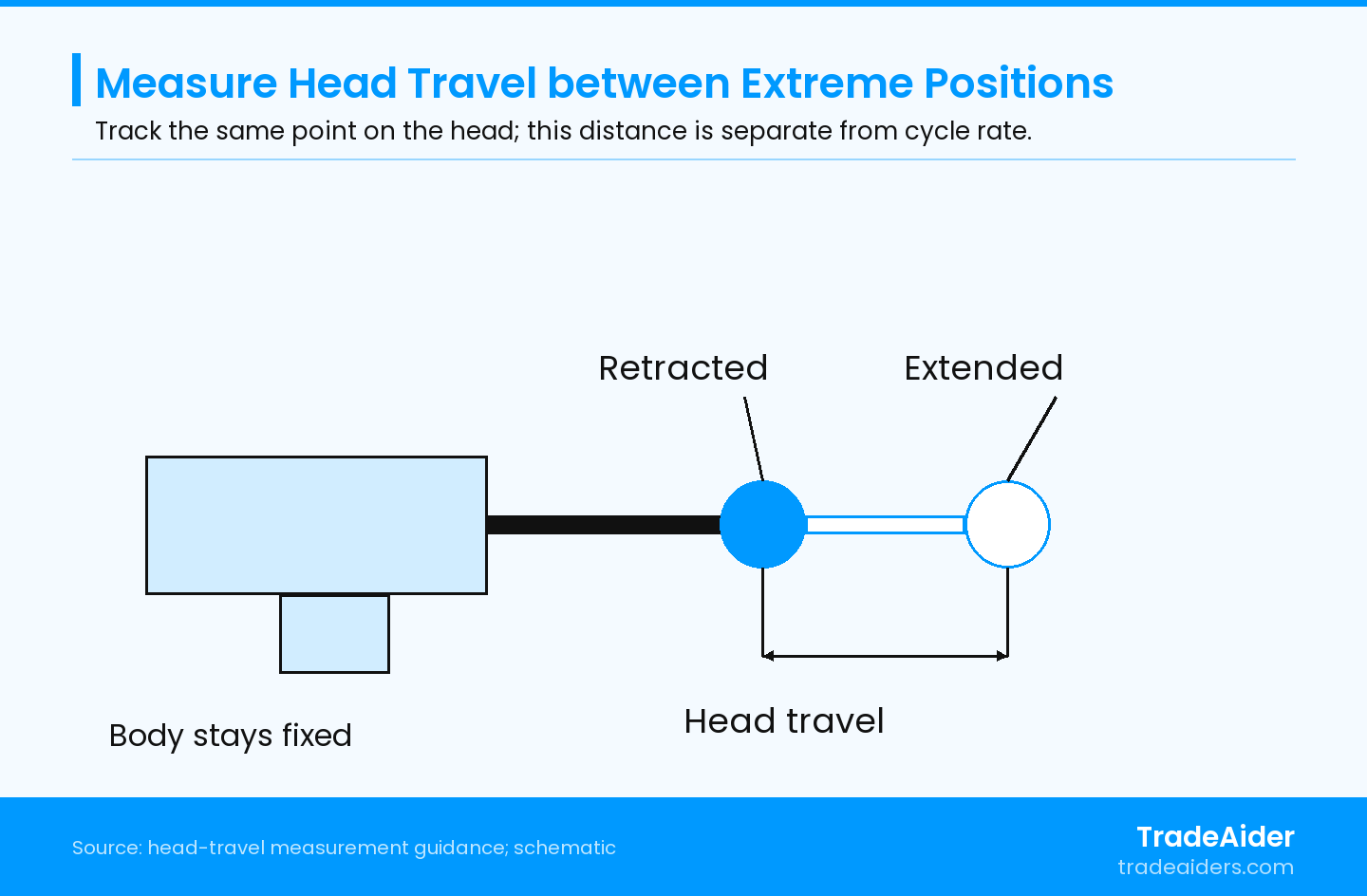
Simplified head-travel schematic, not to scale. The two outlines show the same head at different positions. Use the supplier-defined reference point and measurement method; no travel value is specified.
Test the settings in the instructed sequence, allowing stabilization before each measurement. Keep the attachment, battery preparation and measurement method consistent. If loaded speed is part of the claim, use the defined load for that comparison. Report speed hunting, a missing setting or a measured rate outside the agreed tolerance, rather than judging performance solely by how strongly the gun vibrates in a hand.
Fit Every Supplied Attachment Using Its Actual Fastening Method
Attachment fit inspection checks whether each supplied head seats correctly and stays attached through the specified operation. Switch off the device before installation or removal, and inspect the connector for cracks, burrs, distortion and missing fastening features. Compare the head identifiers and quantities with the approved packing list.
Do not assume every head is a straight push fit. The Theragun Prime Plus manual instructs users to insert an attachment, twist clockwise and lock it in place, with the device powered off. It warns against placing a finger between the attachment and the arm. That instruction belongs to this assembly; other models may require a different connection.
Check the installed position and permitted movement against the approved sample or drawing. Compliant material in an attachment can deform by design, while looseness at the connector is a different observation. Identify where the movement occurs. If insertion or removal force is specified, measure it with the approved fixture, direction and rate; a hand-fit assessment cannot establish a numerical force result.
Examine each head again after the agreed operating sequence. Look for a head backing out, a damaged connector, fresh wear debris or contact marks at the housing. Recheck any supplied heated or other powered attachment for its required electrical connection as well as mechanical seating. A head that looks similar to the approved part may still have an incompatible connector or different operating requirements.
Measure Heat Where and When the Requirement Applies
Heat inspection should identify the component, measurement location and operating condition behind each temperature result. Measure the specified housing, grip, battery-area and charging-equipment surfaces using the adopted method. Record room temperature and the starting condition, especially if acceptance concerns temperature rise above the surroundings rather than an absolute surface temperature.
Use the required head, mode, load, running duration and pauses. Keep ventilation unobstructed and the support arrangement consistent. A cool housing after a brief unloaded run does not describe the temperature reached during a longer loaded sequence. Likewise, measuring the same sample immediately after another heating test can change its starting condition and invalidate a comparison.
Choose the sensor and surface preparation required by the method. Shiny metal, soft polymers and small measurement areas can complicate infrared readings; confirm that the instrument and setup suit the surface. Touch is useful for noticing a concern, but it cannot establish a measured temperature limit. Do not open a sealed battery enclosure merely to add a sensor during routine inspection.
Inspect charging equipment separately from the running device. In a Health Canada recall dated August 20, 2026, the charger for the Theragun G4PRO was identified as capable of overheating while charging its removable battery pack. The notice states that the G4PRO device itself is not affected, but cannot be used with other chargers. This specific example makes charger identity and charging behavior relevant even when the massage gun operates normally.
Where an attachment intentionally heats, check its selected heating function against its own temperature controls and limits. Keep that result separate from unwanted heat in the grip, motor housing or charger. Abnormal heat, odor, swelling or a protection indication calls for stopping the test and supplier investigation; completing the planned runtime is not the priority in that condition.
Run the Battery Test with the Claimed Configuration
A battery runtime result needs a defined initial charge, attachment, speed, load, optional heating state, operating schedule and endpoint. Agree whether the duration means accumulated motor-on time or elapsed time including pauses. Otherwise, two reports can use the same word “runtime” while measuring different operations.
Prepare the samples with the specified charging equipment and full-charge indication. Check the supplied cable, connector and adapter or charger identifiers before starting. Keep the charging environment within the model's instructions, and operate cordlessly where required. A suitable bench supply used during preparation does not make a wrong retail charger acceptable.
Use published durations as claims to investigate, not generic acceptance limits. Hyperice's Hypervolt model page lists three hours of battery life for the Hypervolt 2 Pro. The listed duration does not disclose every load and operating condition needed for an independent comparison. Ask for the applicable claim method before treating that figure, or another supplier's advertised duration, as a factory test target.
Log the test start, operating periods, scheduled pauses and reason for stopping. If a normal session timer interrupts operation, follow the approved test method and restart instructions; do not silently count the pause as powered runtime. A continuous unloaded run can screen basic operation, but it does not demonstrate the duration of a loaded massage or a mode using a heated attachment.
Arrange completion outside the visit when a full test exceeds the available time. Identify the samples and preserve the actual conditions so later results can be connected to the inspection. Battery markings and supplier reports may support separate checks, but neither converts a short factory demonstration into a completed runtime evaluation.
Compare Noise under a Consistent Acoustic Setup
A noise check should first distinguish an abnormal rattle, scrape or intermittent knock from the expected sound of the assembled massage gun. Use the same attachment, operating setting, battery condition and support arrangement for comparisons. A loose head or a fixture that resonates can change the sound without identifying the internal cause.
If a numerical limit applies, specify the instrument, microphone position, orientation, background conditions and loaded or unloaded operation. Clarify the acoustic quantity: sound pressure is measured at a position, while sound power describes the source's acoustic output as determined by a defined method. An unspecified “dB” claim is not a usable judgment criterion.
For an appropriate sound-power evaluation, ISO 3744:2025 describes engineering methods that determine sound power from sound-pressure measurements over a surface surrounding the source, in an essentially free field over a reflecting plane. This is a general acoustics method, not a massage-gun-specific noise limit. Use it only where the adopted test plan and acoustic environment are suitable.
A phone recording can help document a reproducible sound for investigation, but an arbitrary phone reading does not establish standardized sound power. If an unexpected sound appears during the sequence, stop before examining the accessible attachment and housing. Record the setting, elapsed time and conditions that reproduce it; avoid concluding that a bearing, battery or motor is defective from the sound alone.
Hypothetical Example: A Shutdown That Does Not Prove Stall Protection
Consider a hypothetical inspection where a massage gun stops during a permitted loaded running check. The inspector initially suspects a protective response. A comparison sample then stops after the same operating interval without the applied load, and the model instructions identify a normal session timer. The load was present in the first test, but the observations do not establish that it triggered the shutdown.
The inspector records the timer-related interruptions separately, follows the documented restart sequence for the running test, and keeps the protective-function evaluation outstanding until its defined trigger can be checked. If the selected speed drops outside its specified range before the timer expires, that is a separate performance finding. This distinction prevents an ordinary operating feature from being recorded as proof of abnormal-condition protection.
Match Each Massage Gun Finding to the Next Test or Correction
Give the supplier the observed problem and the conditions that reproduce it. Separate a wrong attachment or charger, a failed measured function, and an evaluation that could not be completed. Each needs a different response, and correcting one does not settle the others.
- Loose heads or incorrect accessories: Correct the identified part or assembly problem, then repeat the affected fit and operating checks on the corrected configuration.
- Speed, temperature, runtime or noise failures: Preserve the valid measurement conditions and request investigation of the reproducible result. Repeat comparisons made with mismatched setups.
- Unverified protection or unfinished testing: Arrange the defined competent evaluation and retain its sample identity. Keep the missing result visible rather than substituting a normal power-on demonstration.
Set sample coverage and defect classifications before the visit. TradeAider's inspection standard describes its sampling approach and customer-specific checks. Sampling decides which finished units are examined; the massage gun specification and adopted methods determine the limits for their measured performance.
For a finished order, pre-shipment inspection can check product operation and retail packing. TradeAider's readiness condition is that the order quantity is 100% complete and at least 80% packed for export. Allow for full runtime checks or separately arranged safety evaluations when planning the inspection date.
To confirm the factory scope, contact TradeAider with the model and attachment list, approved sample, packing specification, operating instructions and completed test matrix. Include the load procedure, measurement limits and any outstanding laboratory requirements so the team can confirm the checks and report their observed results.
Frequently Asked Questions
Should Bluetooth or app control be included in the inspection?
Yes, where that function is supplied or promised for the ordered model. Check pairing, the mapped controls, disconnection behavior and any specified recovery sequence with the agreed phone and app versions. Keep physical-button operation and app operation distinguishable in the record. An optional app feature should not be treated as included solely because a related model supports it.
Can a wipe-clean massage gun be tested by rinsing it?
No. Wipe-clean instructions do not establish that the device can be rinsed or immersed. Follow the model's cleaning method and check separate water-protection claims against their specified tests. Liquid exposure can affect the charging port, connectors and body even when an attachment itself tolerates cleaning. Dry and identify any appropriately cleaned test samples before repacking them.
Does passing the function matrix prove that retail packing protects the gun in transit?
No. The matrix evaluates the sampled device's functions; packaging protection needs its own assessment of the complete packed set. Check how the body, heads and charging equipment are restrained and protected, then use the agreed shipping simulation where required. Recheck affected functions afterward. A packing arrangement that allows a loose accessory to strike the controls or housing can create a different problem from an initial functional defect.
Does a passed inspection support claims that the massage gun treats a medical condition?
No. Assembly and performance checks do not establish clinical effectiveness or authorize medical claims. The product's intended use, labeling and destination-market classification need a separate review, with the relevant evidence for the actual claim. Keep the inspection report focused on the tested functions and conditions rather than turning a successful motor, battery or temperature check into a treatment recommendation.
Related Articles
Grow your business with TradeAider Service
Click the button below to directly enter the TradeAider Service System. The simple steps from booking and payment to receiving reports are easy to operate.