
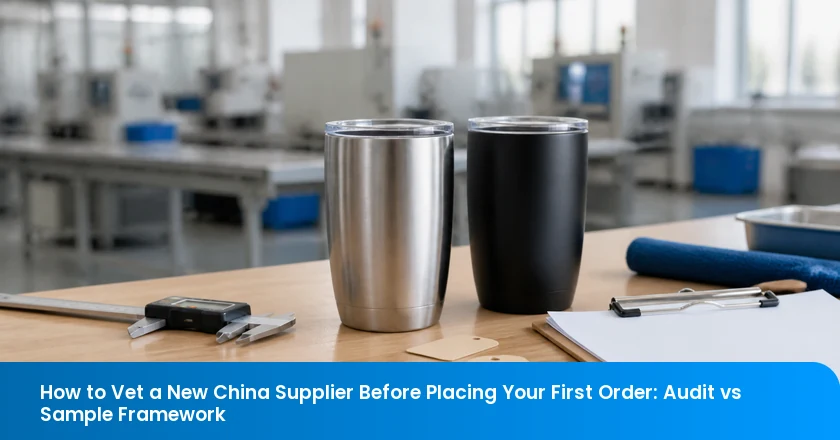
A good sample and a positive factory audit are not two versions of the same approval. A sample can show that one observed product build looks, fits, or functions as intended. An audit can show whether a named site has the people, records, controls, and process discipline that the buyer needs to examine. For a first order, the practical question is not “Which one is better?” It is “Which uncertainty could make the next commitment unsafe, and can both records be tied to the same production source?”
That distinction matters before a deposit, tooling release, or a large purchase order. A buyer can receive an excellent tumbler sample from a workshop that is not the factory described in the audit file. Or the buyer can audit a capable factory that has never made the exact finish, label, or assembly requested in the order. In either case, a green tick on each document is not enough. The evidence has to join.
Use a Proof Join Before You Approve the First PO
- Audit the source when the source is uncertain: a named factory, its controls, records, and ownership of risk-bearing work.
- Approve the build when the build is uncertain: the identified unit, revision, finish, function, and acceptance notes.
- Join the two records: seller, manufacturing site, sample identifier, revision, and critical-process owner must be readable in one order file.
- Add an execution gate only when needed: a pre-production, live-production, or finished-lot check should answer the risk that remains after qualification and sample approval.
Treat a first PO as conditionally approved until one readable record connects the source, the build, and the next execution check.
For buyers who need independent confirmation before a deposit or first run, TradeAider can turn that proof join into a defined review scope rather than a generic pass/fail request.
What an Audit Proves—and What a Sample Proves
An audit evaluates objective evidence against defined criteria for a named system or site; it is not automatic approval of every future unit. Here, objective evidence means verifiable records, observations, or measurements used to judge a requirement. NIST’s audit definition centers on that documented comparison, while ISO/IAF guidance distinguishes management-system confidence from product certification and universal conformity. In procurement terms, an audit can test who owns a process, how incoming materials are checked, whether gauges are controlled, how nonconformities are recorded, and whether the factory can trace a job through the work it says it performs.
A credible onsite review does not rely on a supplier presentation alone. The Responsible Business Alliance’s assessment model, for example, combines document review, interviews, and a visual site survey. That is useful because a buyer can compare what a procedure says with what workers, work areas, records, and equipment show. The relevant audit scope still needs to name the site, the product family or process, the criteria, and the time window. Otherwise, the report can be technically sound but commercially too broad to use.
A sample demonstrates an observed product build, not necessarily the production controls that will make every future unit. The buyer can check dimensions, material appearance, assembly, finish, function, packaging mock-ups, and label placement. That makes a sample the better early tool when the uncertainty is the product itself. It becomes meaningful only when the buyer gives it an identifier, a date, a revision, and a written acceptance record. “Same as sample” is not a specification; it is a reminder to attach the sample to one.
Neither proof carries the other’s burden. A system result can raise confidence in how an organization works, but it does not approve a specific product or every future unit. The inverse is also true: one appealing sample does not establish that the proposed factory controls the process that will reproduce it. The buyer should record this boundary beside the first-order approval condition so that a later teammate does not mistake a useful report for universal permission.
| Decision question | Factory audit | Product sample |
|---|---|---|
| What is examined? | A named site, process, records, controls, and responsible people. | An observed product build, revision, finish, function, or pack concept. |
| Best evidence | Observed practice matched to documents, interviews, facilities, and records. | Measured and approved characteristics of the identified unit or set. |
| Decision it supports | Whether to qualify or conditionally approve the proposed production source. | Whether the buyer accepts the defined product configuration. |
| Core blind spot | It does not prove an unlinked sample, future lot, or changed route. | It does not prove site capability, capacity, or controlled repeat production. |
| Field that must link | Legal seller, audited address, and process ownership. | Sample ID, revision, and the site/process that made it. |
| Likely next gate | Sample approval, first-production review, or corrective-action closure. | Audit, pre-production check, or a revision-confirmation step. |
Based on this comparison, use an audit to test the source and a sample to test the build. Approve the first PO only when the source named by the audit and the source behind the sample can be reconciled. If the two records cannot be joined, the correct result is not “probably fine.” It is “not yet proven.”
Choose the First Gate by the Uncertainty That Could Damage the Order
The cited FDA context illustrates a risk-based selection of complementary activities. Complementary verification activities may be selected according to risk in that context. Start with the uncertainty that would make the buyer’s next commitment difficult to reverse. If the issue is whether the seller is the real producer, whether the site exists, whether the quoted capacity is plausible, or whether a critical operation is controlled, audit first. If the supplier identity is sufficiently clear but the design, finish, fit, or function is still uncertain, request a controlled sample first. If both uncertainties are material, use both before bulk approval rather than asking one document to carry two decisions.
A regulated food example makes the general logic visible without setting a rule for unrelated products. In its Foreign Supplier Verification Program discussion, the FDA names records review, sampling and testing, and onsite auditing as activities that may be used alone or in combination according to risk and supplier performance. For general import procurement, the transferable idea is not the food regulation. It is that different evidence methods answer different risk questions, so the choice should follow the unresolved risk.
- Audit before sample: use this sequence when the proposed site, factory role, critical equipment, process ownership, or basic control system is the largest unknown. A scoped factory audit service can check the named site before a material deposit is released.
- Sample before audit: use this sequence when the buyer is still deciding whether the product can meet a visual, functional, dimensional, or material specification and the sample commitment is limited.
- Audit and sample in parallel: use this when lead time is tight but the buyer can keep the full PO conditional. The condition should state what must match before deposit or production release.
The sequence should not become a ritual. A simple, low-consequence catalog item may need a modest sample and clear commercial controls. A custom product with tooling, multiple finishes, a safety-sensitive application, or a new outsourced operation needs a deeper proof chain. The buyer’s job is to name the irreversible decision—not to maximize the number of reports.
Make the Two Proofs Refer to the Same Supplier and Build
The reliable decision is a proof join, not two green ticks. Before the buyer treats an audit pass and an approved sample as first-order approval, both should point to one record: the legal selling entity, the manufacturing site, the product revision, the sample identifier, and the owner of every critical process. This is a procurement control, not a statutory form. Its value is simple: it exposes the gap before the buyer’s money and schedule depend on an assumption.
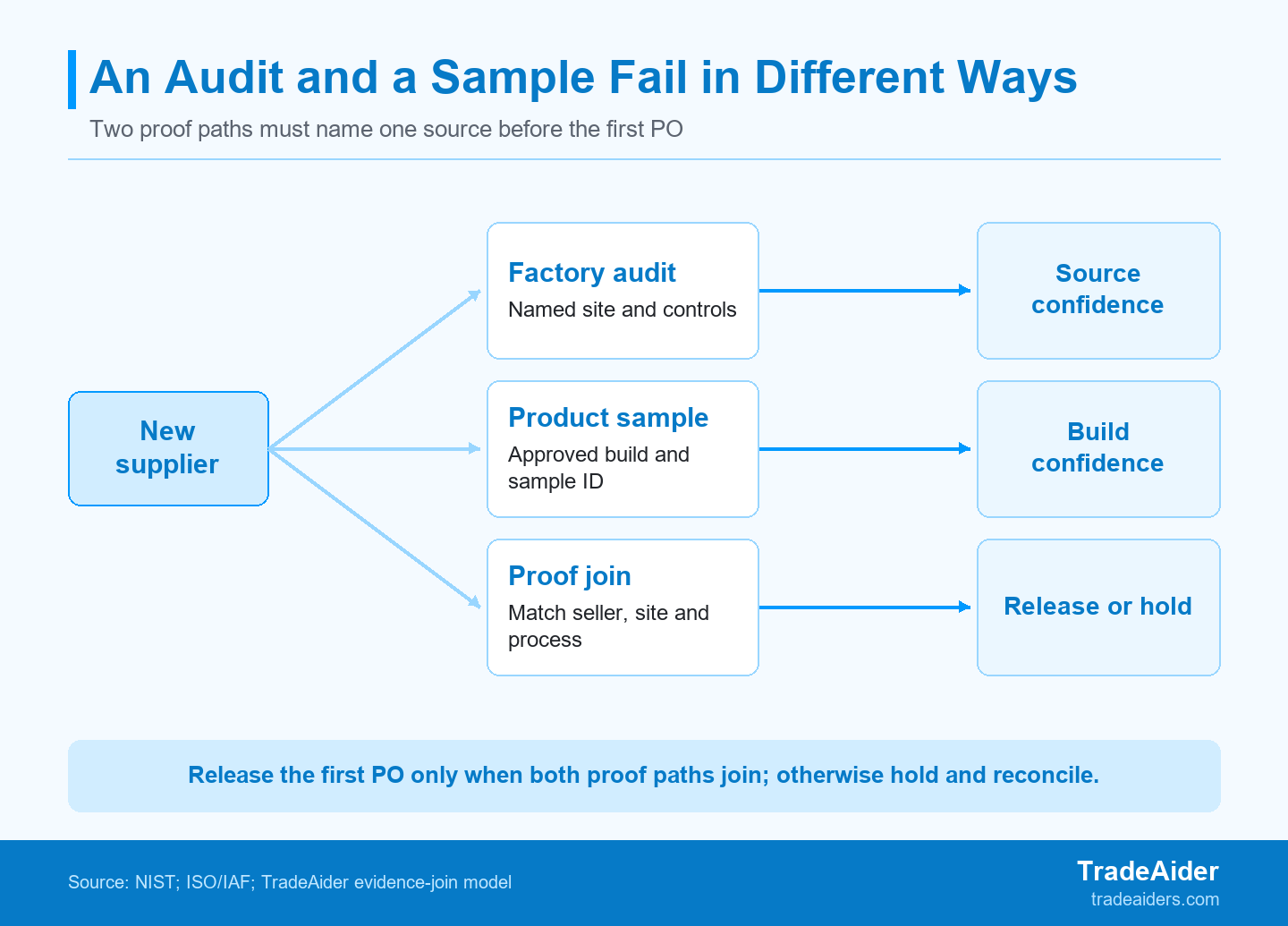
An audit evaluates the production system and a sample evaluates the product build; release the first PO only after both proofs identify the same source.
That join should be evidence-led. NIST-hosted audit guidance describes gathering objective evidence by asking questions, observing activities, and examining facilities and records. See the APLAC audit guidance for that evidence-triangulation approach. Apply it here by asking the seller to show how the sample identifier, work order, manufacturing address, and process map relate. A video call, invoice, or photograph can add useful context, but it should not replace a readable record when the order risk is meaningful.
Match the Seller and Manufacturing Site
Map the selling entity and audit site before treating the audit as supplier approval. The buyer should be able to see who will sign the order, where the goods will be made, and whether the audited address is that production location or merely an office, warehouse, or related facility. Request the supplier’s written explanation if the contract entity and manufacturing entity differ. If a trading company manages the order, record that role without assuming it owns the factory. The purpose is transparency, not a prejudice against a business model; it lets the buyer decide which entity and location the evidence genuinely covers.
Match the Product Revision and Sample Identifier
Freeze the sample identifier and revision that the PO approves. Attach the versioned drawing or specification, colour or finish reference, packaging requirements, and acceptance notes to the order record. Include the sample date, responsible approver, and any measurement or functional result that explains the acceptance. If the sample is a showroom unit, prototype, hand-finished presentation unit, or earlier revision, say so. The buyer then knows that a new pre-production sample or first-unit confirmation is still required before it can represent bulk production, rather than discovering too late that a visual reference lacked an executable specification.
Name the Critical Process Owner
Name the owner of each critical process before deciding that it is covered. A critical process is a step whose ownership or control can change whether the product meets the buyer’s requirements. It may be injection moulding, coating, laser marking, battery assembly, food-contact treatment, stitching, testing, or final packing. Record whether it is in-house or subcontracted, the proposed location, the responsible contact, and the change-notification rule. For outsourced work, ask whether the subcontractor will handle the same operation that made the approved reference. A sample may look right while a future order uses a different source for exactly the step that matters.
Know When Audit Plus Sample Is Still Not Enough
A system or sample result does not automatically prove the current order's execution. Supplier qualification and sample approval are early approval states. They do not by themselves answer the later question: are the actual goods being made, packed, and presented for release in line with the order? The third gate should target the remaining execution risk. Before bulk work expands, that may be a pre-production check of materials, labels, the approved reference sample, and the first production conditions. During a sensitive run, it may be an in-process review. When the shipment is ready, it may be a finished-lot inspection.
Again, scope matters. FDA guidance for dietary supplements gives a narrow example: finished-product testing does not necessarily demonstrate that a supplier established and followed the appropriate controls throughout production. That FDA guidance is not a universal rule for tumblers or every consumer product. It does, however, illustrate why an outcome check and a process check are not interchangeable. A sample can confirm a desired outcome; an audit can evaluate a system; neither alone proves what happened on the buyer’s current order.
Set the third gate against the earliest point where the remaining risk can be seen and corrected. If the concern is the approved material or label before a long run begins, check before production. If the concern is an operation that can drift during assembly, inspect while work is underway. If the buyer must decide whether complete cartons can ship, use a final gate that identifies the lot, the specification, and the packing status. This keeps the first-order process proportionate: add evidence only when the decision unit changes.
Worked Scenario: The Tumbler Sample Came From a Different Site
Hold full-order approval when the sample and audit cannot be tied to the same production source. The following is an illustrative evidence decision, not an allegation about a supplier and not a substitute for product-specific compliance or legal review.
Reconcile the Source Before Approving Bulk Production
Hold the order until the proof paths identify the same production source. An importer is considering a first order of 2,400 insulated stainless-steel tumblers in four finishes. The buyer approves an early sample because its lid fit, surface finish, and packaging concept meet the written requirements. Separately, the buyer receives an audit file for Site A. Before the purchase order is released, the sample carton identifies another workshop, and the seller cannot yet map where laser marking and coating will occur for the bulk order.
The evidence is not automatically bad; it is incomplete. The audit file names Site A, the sample identifier points to another workshop, and critical-process ownership is not recorded. The audit may give useful information about Site A, and the sample may demonstrate an observed tumbler build. But the buyer cannot show that Site A will make the approved configuration, or that the unlisted workshop and finishing route are controlled by the same system. Treating either record as final approval would hide the exact uncertainty the first-order framework is meant to surface.
The decision is a full hold on bulk approval, not a rejection of the supplier. Ask for a short provenance map that names the selling entity, audit address, sample identifier, product revision, coating owner, laser-marking owner, and proposed production location. If the mapped build differs from the approved sample, request a revised confirmation or representative pre-production sample. Then conduct a pre-production check of the matched materials, reference sample, labels, and first production conditions before the 2,400 units expand into bulk work. This scenario is illustrative; the exact control should fit the product, contract, and risk.
Turn the Framework Into a First-Order Release Sequence
Release commitments only after the evidence that belongs to their decision state is complete. A simple first-order sequence does not need a large administration layer, but it does need one named owner for the record and one written condition for the next release.
- Define the order object. Write the product revision, target market requirements, key characteristics, planned volume, proposed site, critical processes, and decision that the buyer will make next.
- Run the first evidence gate. Audit the named source when the factory/system is uncertain; control the sample when the product build is uncertain. Record what the check covers and what it does not.
- Join the records. Match seller, manufacturing address, sample ID, revision, and critical-process owner. Hold the PO if a field is blank, contradictory, or changed without a replacement record.
- Set the execution gate. For a first run, use a pre-production check when the buyer needs confirmation before bulk work expands. Use a live-production or final check only when it answers a remaining, time-specific risk.
- Keep the release condition visible. Put the condition in the order file: for example, “bulk production may proceed after the approved sample and Site A/process map are matched and the first production setup is checked.”
TradeAider’s role in this sequence is not to turn every order into an audit project. It is to scope the check around the evidence the buyer is missing. Where the supplier, sample, and first-production conditions must be tied together, a pre-production inspection gives the buyer a chance to verify the matched record before rework, packing, or balance-payment pressure makes correction harder.
Before You Issue the First PO
A named evidence packet turns a service request into a release decision. Assemble the following before you ask a supplier, auditor, or inspection team to confirm a first-order gate:
- the PO, drawing, specification, or acceptance sheet, with its revision date;
- the approved sample identifier and the exact characteristics it represents;
- the legal selling entity, manufacturing address, and contact responsible for production records;
- the in-house and subcontracted critical-process list, including any change since sampling; and
- the current production status and the release decision that the evidence must support.
State the timing as clearly as the product details. A review team needs to know whether production has not started, is underway, or is complete; otherwise it may assess the right evidence at the wrong moment. Include the inspection location, quantity available, planned shipping date, carton status, and the exact decision that is pending. If a supplier proposes a revised material, another factory, or a different finishing route after sample approval, flag that change before the check is booked. The review scope can then test the changed condition instead of merely confirming an earlier record.
If the goods are already complete or nearly complete, the next question is no longer whether the sample looked acceptable. It is whether the identified lot meets the PO and is ready to release. In that position, provide the same packet to TradeAider for the finished lot and schedule a pre-shipment inspection.
Frequently Asked Questions
Can I skip the audit if the sample is excellent?
Usually no when the remaining uncertainty is the factory, process ownership, capacity, or control of a meaningful first order. An excellent sample can prove what the buyer observed in that unit, but it cannot show who will make the bulk goods or how the critical process will be controlled. If the site and seller are already well evidenced and the order is low consequence, document why a lighter approach is acceptable instead of assuming the sample did that work.
Should I audit before requesting a sample?
Audit first when supplier or site identity is the dominant uncertainty; sample first when the product specification is still unproven and the commitment is small. For a custom, high-value, safety-sensitive, or tooling-dependent order, it is often sensible to run both checks before bulk approval. The sequence should follow what could make the next payment or schedule commitment unsafe, not a fixed rule about China sourcing.
What must match between an audit and a sample?
At minimum, match the selling entity, manufacturing address, product revision, sample identifier, and every critical in-house or subcontracted process. Also record whether the audited site made the sample and whether any material, finish, assembly, label, or packaging route will change for bulk production. If a field differs, ask for a clear map and decide whether a new sample, focused audit, or pre-production check is necessary.
Does an ISO certificate replace a factory audit?
No. A certificate may be useful context, but it does not replace a buyer-defined review of the actual site, scope, current operations, and product-specific risks. Confirm the certificate’s holder, scope, dates, and relevance to the proposed work. Then decide whether the buyer still needs direct evidence from the manufacturing location, especially when the order relies on a particular process, subcontractor, or product configuration.
What check comes after the sample and audit pass?
Choose a pre-production, during-production, or pre-shipment check according to when the remaining risk can first be observed in the actual order. Use pre-production review for sample, material, label, and setup questions; use an in-process check when a live operation needs confirmation; use a final check when the release decision concerns completed goods and packing. Keep the gate tied to the current order rather than repeating an earlier qualification report.
Related Articles
Grow your business with TradeAider Service
Click the button below to directly enter the TradeAider Service System. The simple steps from booking and payment to receiving reports are easy to operate.

