Effective communication with a quality inspection company in China starts with a usable order brief and continues through confirmed instructions, on-site questions and report follow-up. Give the team current references, agree who can answer technical and commercial questions, and keep the outcome in a written record. More messages alone do not make an inspection better; the messages need to resolve the decisions that affect the work.
Communicate the decision, not just the instruction
A useful inspection message identifies the product, explains the question and asks the right person for a specific response. “Please check quality carefully” leaves the inspector guessing about scope. “Use the approved drawing revision, measure the identified feature and record the result against the stated limit” gives the team an instruction it can confirm or question.
For an importer or sourcing agent, the aim is a shared understanding among the buyer, factory and inspection team. The factory prepares the goods and access; the inspection team performs the agreed checks; the buyer’s designated contacts resolve requirements and commercial decisions. Agree these responsibilities at the outset instead of assuming that everyone copied into a chat has authority to approve a change.
Start with an inquiry the inspection team can act on
An initial inspection inquiry can start with the information you already have: product, order quantity, factory location, destination, intended dates and known concerns. Mark missing details clearly. You can discuss the appropriate stage and feasible scope before every technical requirement is finalized.
Inquiry message: “Please advise on an inspection for [product/model] under [purchase order], at [factory/location], for delivery to [destination]. The current production status is [status] and the intended shipping date is [date]. Our main concerns are [features/problems]. Attached are [available specifications/photos]. Please identify the additional information needed to confirm scope, timing and a quotation.”
Keep the request separate from the completed result. ASQ’s glossary distinguishes a checklist of important actions from a check sheet used to record data. Sending a checklist tells the team what matters; a completed inspection record shows what was actually checked and found.
Use the following brief to turn the inquiry into a confirmed assignment. Fill the blanks and ask for the confirmation in the last column; an attachment sent without acknowledgment is still an open handoff.
| Brief item | Fill in | Confirm together |
|---|---|---|
| Goods | Order: ___; models/quantities: ___ | Products and lots covered |
| References | Drawing revision: ___; sample ID: ___ | Applicable approved versions |
| Checks | Feature/method: ___; criterion: ___ | Feasible scope and limitations |
| Visit | Site: ___; readiness/date: ___ | Access, timing and preparation |
| Responses | Technical contact: ___; backup: ___ | Response window and decision authority |
Confirm the product, method and acceptance criteria
Inspection needs an identifiable basis for the comparison. ISO describes inspection as examining an item and determining conformity with requirements. Those requirements can come from standards, regulations, contracts or internal specifications. Asking only for “international-standard inspection” leaves the actual product requirements unresolved.
For each important feature, identify what to examine, the method, the unit, the acceptance criterion and the evidence you need. Specify the applicable document and revision. A drawing can establish dimensions, an approved sample can illustrate an appearance reference, and a separate method can define a performance check. Resolve conflicts between them before treating them as interchangeable.
Describe defects as well as naming their categories. ASQ’s defect-classification definition calls for careful preparation and tailoring to the products being sampled. A label such as “major” does not explain which scratch, missing component or functional problem belongs in that category for your order.
Sampling language also affects the result’s meaning. NIST explains acceptance sampling as using a random sample to support a lot acceptance or rejection decision, rather than estimating the lot’s quality. Agree the applicable plan and defect criteria instead of interpreting a sample result as a guarantee for every unit.
Ask the technical owner to resolve a missing tolerance, test method or market requirement. Do not let an example value become the default specification. Where a specialized test is needed, agree who will perform it and how its result relates to the order inspection. A photograph of a label and a test of the product are different evidence.
Make language, files and channels work together
Clear language works best with a read-back of the actual assignment. Use short, specific instructions, consistent feature names and annotated photographs. If Chinese and English documents are used, identify the agreed technical reference and ask the responsible owner to resolve any difference in meaning.
Read-back request: “Please confirm which drawing and sample you will use, where you will measure [feature], which unit and criterion apply, and how you will record the result. Please flag any check that cannot be completed with the proposed equipment or access.”
This is more useful than asking only “Do you understand?” A different measurement point or an unavailable fixture becomes visible in the reply. For appearance, mark the relevant surface and show acceptable and unacceptable examples with their limits. A general product photograph may not communicate an edge, hidden surface or texture requirement.
Choose channels that all parties can access under their actual working arrangements. Use messaging for an urgent alert or call coordination; retain the confirmed instruction, attachments and decision in the agreed record location. After a call, summarize the product, question, agreed action and owner in writing. A chat read receipt is not confirmation that a technical interpretation is correct.
Give files meaningful revision names and identify withdrawn versions. Avoid sending different instructions to separate groups without updating the shared assignment. Maintain a respectful, factual tone: describe the observation and the requested resolution rather than making assumptions about a person’s intentions or national business culture.
Confirm readiness, timing, access and costs
Readiness is a concrete scheduling question. TradeAider’s pre-shipment inspection is conducted when the order is 100% complete and at least 80% packed. The packing threshold does not mean production can be incomplete. Confirm actual readiness with the factory rather than relying only on the planned completion date.
Before the visit, confirm the production site, factory contact, access arrangements, available goods, inspection space and any equipment or preparation needed for the agreed checks. If the factory reports a change, ask what it affects before assuming the original appointment remains suitable.
Write dates in full and identify the time zone. Separate the visit date, deadline for the buyer’s response, expected report timing and shipping cutoff. Where a report turnaround is discussed, confirm what event starts the period and how an incomplete visit or missing evidence will be handled. Also confirm local working schedules and holiday availability with the actual contacts.
Visit confirmation: “Please confirm [site/contact], [visit date and local time], goods readiness, access and preparation for the agreed checks. Our technical contact is [name/contact], available during [dated response window/time zone]; the backup is [contact]. Please advise how incomplete goods or unavailable equipment would affect the visit and report.”
Confirm the quotation’s scope separately: planned inspection workload, included reporting, travel or other additional charges, and the treatment of delays, cancellations, repeat visits or extra checks. Request written confirmation of changes. A quoted man-day is a unit of inspection workload; it does not by itself define every fee, output or scheduling condition.
Route on-site questions to the right person
For an unresolved instruction or criterion, the inspector records the observation and affected goods, the designated technical owner clarifies the requirement, and the authorized buyer decides the commercial disposition. Agree the actual contacts for those roles. A supplier’s explanation or a buyer’s acknowledgment should not silently become permission to accept a deviation.
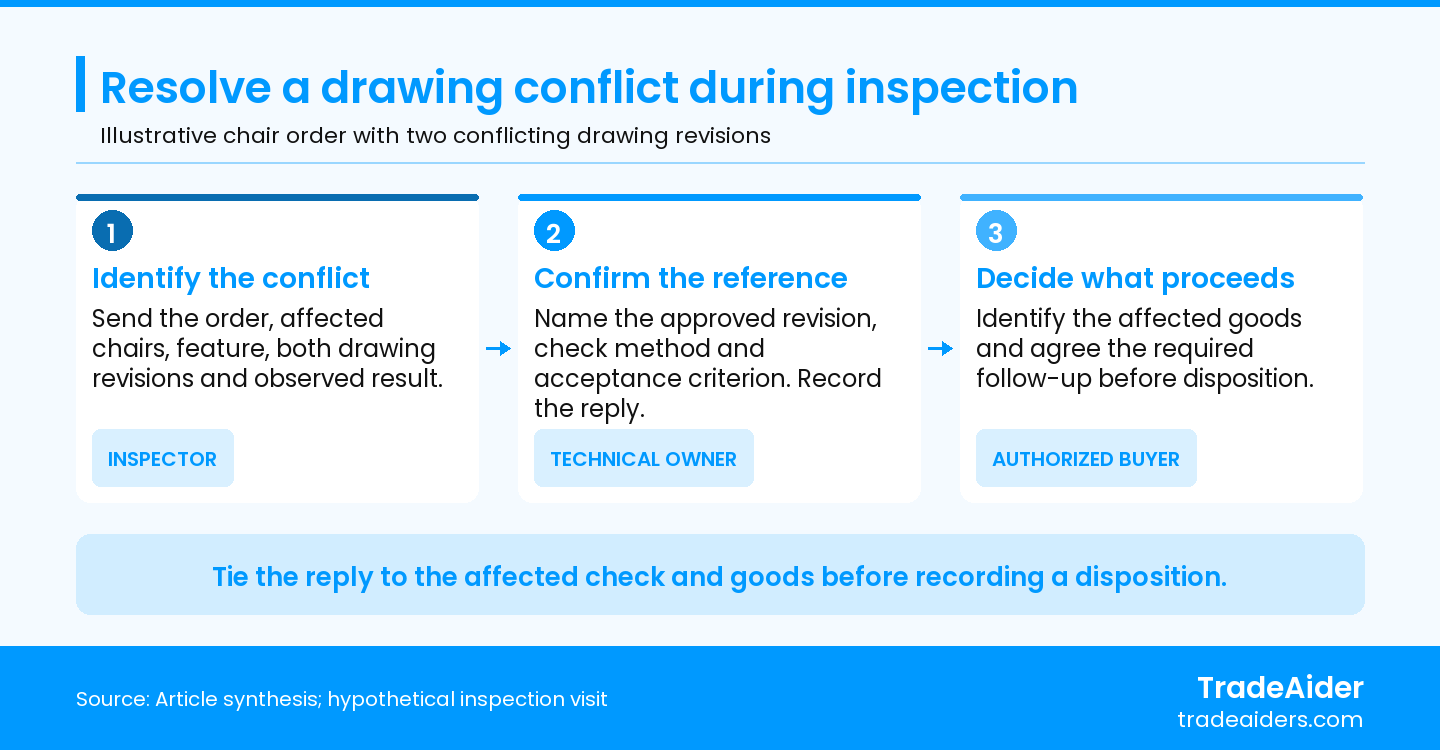
Illustrative chair order. Keep the affected check pending until the approved revision and criterion are confirmed, then record the buyer’s separate disposition decision.
Set update points around decisions that may still be useful during the visit. Examples include unavailable goods, a conflicting reference, a check that cannot be performed, or a finding requiring the buyer’s response. Routine progress can follow an agreed schedule; an urgent question needs a subject line, affected product, evidence and a specific request.
On-site escalation: “Action requested for [order/model/lot]: the observed finding is [finding] at [feature/location]. The applicable reference is unclear because [conflict/missing item]. Attached are [identified photos/measurements]. Please ask [technical owner] to confirm [specific question] by [date/time/time zone]. Please also confirm who can authorize any proposed commercial disposition.”
If no answer arrives during the agreed response window, use the documented backup route. Record the unresolved question and its effect on the work. The team can discuss whether unrelated checks remain feasible; it should not invent a missing criterion or mark an unperformed check as passed merely to complete the report.
Agree what real-time viewing, messaging or remote observation is actually available for the assignment. An online photograph, video call and completed measurement record serve different purposes. Confirm the evidence needed from the agreed checks rather than assuming that a live connection provides complete visibility of the goods.
Ask precise questions about the inspection report
A report clarification should point to the exact item and the missing information. Identify the order, model or lot, report section, relevant photograph or measurement, and the requirement being compared. Ask whether a statement records an observed result, an unavailable check, a document mismatch or a conclusion against an agreed criterion.
Clarification request: “For [report/item/photo reference], please confirm the affected product and quantity, reference revision, method and actual result. The current entry does not explain [specific gap]. Please distinguish information already recorded during the visit from any new check required, and identify any limitation that remains.”
For measurement questions, method context can matter as much as the displayed number. NIST’s uncertainty-reporting guidance calls for describing what was done and keeping referenced measurement-process documents current. This is metrology guidance, not a blanket requirement for an uncertainty budget in every order inspection. Its useful communication lesson is to identify the method actually used before comparing records.
If two measurements disagree, ask about the feature, unit, measurement points, setup and relevant conditions. Refer a borderline technical interpretation to the responsible specialist instead of assuming that extra decimal places prove one result correct. Ask which information can be clarified from existing records and which would require additional work.
When the report is corrected, retain the original and identify the revised version, reason and affected entries. Clarifying an unclear description is different from replacing an inconvenient finding. Any revised conclusion should remain connected to the evidence and applicable requirement.
Close corrective actions and commercial decisions separately
Corrective-action communication should distinguish what the supplier has changed, what evidence verifies it and what decision the buyer has made. Ask the supplier to identify the affected goods, immediate correction, relevant cause investigation and proposed follow-up. The depth of investigation should match the problem and recurrence risk.
Agree the evidence and responsibility for verification. A photograph of repaired units can show a local correction, but it does not establish the condition of unchecked goods. Where further inspection or testing is needed, confirm its scope and timing rather than treating an old pass result as covering the changed product.
Keep commercial negotiation separate from the factual inspection record. A buyer may agree to rework, a concession or another disposition under the order arrangements. Record who authorized it, which goods it covers and any remaining conditions. The inspection findings should still describe what was observed.
Illustrative example: conflicting chair drawings during a visit
This is a hypothetical example, not client data. An inspector arrives for a wooden-chair order. The buyer’s file contains drawing revision B, while the factory presents revision A for the seat measurement. The appointment is time-sensitive, but the documents do not establish which revision covers this lot. The inspector records the identified chair, actual measurement and both reference revisions. The escalation asks the technical owner which drawing applies, rather than asking the factory to choose a convenient tolerance. The buyer’s designated contact receives the same question and the evidence references. If the technical owner confirms revision B and explains its application to the lot, the inspection team records that instruction and completes any remaining feasible comparison. If a further check is needed, its scope is agreed. The authorized buyer separately decides what the result means for the order. If the owner cannot respond during the visit, the affected comparison remains unresolved in the report. The team records what was completed, what is missing and the proposed next action. The shipping deadline does not supply the missing requirement. Once an answer arrives, everyone can see whether clarification of existing evidence is enough or whether additional work is needed.
What should be clear before you rely on the inspection?
- The products, lots and current technical references covered by the assignment.
- The agreed checks, criteria, evidence and limitations.
- The technical response contact, backup route and buyer’s decision authority.
- The record connecting a finding, clarification, follow-up and final disposition.
Discuss the communication plan for your inspection
Send TradeAider the product and order information you have, factory location, destination, intended timing and concerns to begin the discussion. Before inspection, agree the technical references, feasible checks, reporting needs and response contacts. Contact our team to discuss the scope and an inspection report of the agreed checks, findings and limitations.
FAQ
What if the supplier will not share its subcontractor’s address?
Explain the access gap to the inspection coordinator before confirming the visit. Identify where the goods and relevant processes will actually be available and which parts of the proposed scope depend on that location. If access cannot be arranged, agree a revised scope or timing and record the excluded work rather than assuming the supplier’s main office represents the production site.
How should an agent handle confidential buyer prices?
Share the technical information needed for the agreed inspection and keep unrelated commercial fields separate. An agent can prepare a technical order extract while preserving model, quantity, revision and inspection requirements. Agree authorized recipients and access to the files. Do not remove information needed to identify the goods or interpret a requirement merely because it appears beside a price.
Can one message cover several factories in the same shipment?
Use separate site and lot references, even when the goods share a shipment. A summary email can link those assignments, but each site needs identifiable products, instructions, evidence and decisions. State exactly which goods any change or commercial approval covers; one factory’s findings do not establish the result for another factory’s output.

Verwandte Artikel
Erweitern Sie Ihr Unternehmen mit TradeAider Service
Klicken Sie auf die Schaltfläche unten, um direkt in das TradeAider Service System zu gelangen. Die einfachen Schritte von der Buchung und Zahlung bis zum Erhalt der Berichte sind leicht zu bedienen.