
- Über uns

- Unsere Dienstleistungen
- Ihre Branche
- Ressourcen
- Nachrichten & Blog
For importers buying cat trees or scratching posts, a neat finish is only one part of product quality. A stable base, secure joints and firmly attached scratching surfaces matter to how the product will be used. On a multi-level cat tree, the strength of each platform matters as well. A sourcing sample can show the design and finish, but buyers also need to know whether production units assemble correctly and meet the agreed performance requirements.
An effective inspection links those concerns to five practical checks: stability, platform load, fastener retention, covering adhesion and assembly. The checklist below gives buyers a quick overview before the detailed methods explain the setup, observations and judgment criteria for each area. Test loads, conditions and acceptance criteria need to be agreed for the specific model, rather than treated as universal limits.
Five Checks for Cat Trees and Scratching Posts
| Check | What to do | How to judge the result |
|---|---|---|
| Stability | Assemble in the specified use configuration; apply the agreed loads at the defined positions. | Compare sliding, base lift and tipping with the written criteria. |
| Platform load | Load the center and specified accessible edges; measure deflection during and after loading. | Check the specified limits, cracks, insert movement and permanent deformation. |
| Fastener retention | Inspect the joints after the agreed loading sequence, before retightening. | Check backing out, insert movement and joint gaps against the approved requirements. |
| Covering and rope | Check loose edges, rope ends, exposed staples and attachment; use the specified peel or retention method. | Compare the method-specific limit and note whether the adhesive, backing or board fails. |
| Assembly and packing | Build using the enclosed manual and tools; count and identify hardware and restraint parts. | Confirm correct assembly, matching parts and instructions, and adequate carton protection. |
Stability: Check the Base, Floor and Use Configuration
Distinguish sliding, rocking, twisting and tipping when recording movement. Sliding is translation across the floor; rocking is repeated base contact loss; twisting is rotation within the structure or a joint; tipping is rotation about a base edge. Several can occur together, and observing one does not prove the cause of another. Replace “wobbly” with the movement, location and loading condition observed.
For overturning, the applied force and its perpendicular distance from the tipping axis determine the overturning moment. A horizontal force applied higher up can increase that moment; an off-center vertical load can change the balance about a base edge. Base mass, footprint and mass distribution affect resistance. Total weight alone cannot establish stability.
Compare stability results only when the floor, restraints and loading method match. A heavier base or a different footprint may change resistance to tipping, while an added wall restraint changes the tested configuration. Record any approved change to the base mass or footprint. When a replacement unit performs better, identify whether the product or the setup changed before calling it a design improvement.
Humane World’s guidance describes most cats’ preference for a steady scratching post at least 32 inches tall. Treat this as behavior guidance, not a mandatory height or factory test limit. Check the ordered design’s height and scratching position against the approved sample.
Keep the Stability Setup Consistent
Record the support surface, base orientation, unit dimensions and whether the tree is installed with the specified wall restraint. Use the agreed surface for repeat measurements. A hard, level surface is a useful controlled baseline when the protocol calls for it; a carpet-use claim may require an additional agreed configuration rather than an assumption that the hard-floor result covers it.
Identify and weigh the assembled unit, note the installed accessories, and photograph the load point and fixture. Use the same specified wall attachment and support conditions for the retest; extra hand support changes the result.
Test the Intended Scratching and Climbing Positions
Choose load positions from the intended climbing route, scratching position and accessible perch edges. A static edge load and a landing impact are different methods. For a landing simulation, have the responsible engineer define the impact mass, height or velocity, contact geometry, repetitions and stopping conditions. An uncontrolled push or dropped weight does not establish repeatable landing performance.
After unloading, record residual lean, platform alignment, base contact and any new joint gap before adjusting the hardware. Elastic movement that recovers and permanent movement are different observations. Compare each with the written criterion. Stop a test that reaches its defined unsafe condition and retain the failed unit for investigation; use fixtures rather than live animals for load checks.
Platform Load: Check the Center and the Unsupported Edge
A passing center-load result does not cover every accessible edge. For a cantilevered perch, moving the same vertical load farther from its support increases the bending moment at that support. Other platform geometries can behave differently. Mark the approved load positions, apply the defined loads and duration, and record deflection both under load and after removal.
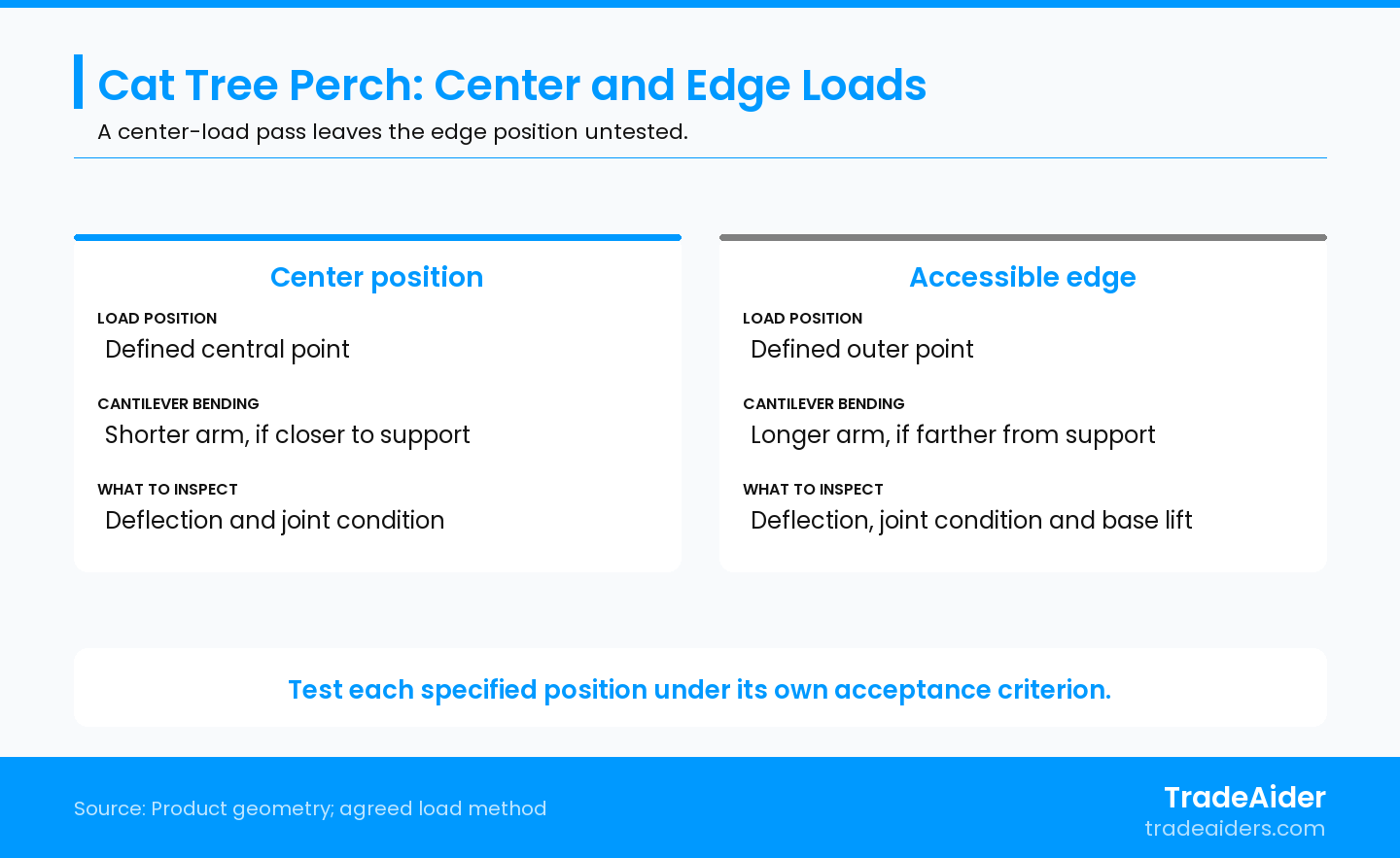
For a cantilevered perch, load distance from the support affects bending. Check the specified positions; this comparison sets no load limit.
Inspect the panel and the attachment as separate parts of the load path. Watch for board cracking, insert movement, joint opening and permanent deformation. Record which event appears first rather than continuing until everything breaks. The agreed method should state whether the check is a production screen, durability assessment or destructive qualification test; the results support different claims.
The Cat Fanciers’ Association Maine Coon profile notes that a mature male can reach or exceed 20 pounds. That illustrates why an assumed “average cat” is a weak basis for a product sold for larger breeds. Use the manufacturer’s declared weight capacity and intended use to define the load plan; breed information supplies neither a safety factor nor a test load.
The CFA profile also notes growth taking up to three years, so a product bought for a kitten may later support an adult cat. Clarify whether the declared capacity covers each perch, the whole tree or multiple occupants.
Confirm the model’s test allocation and apparatus before booking. Schedule your Pre-Shipment Inspection (PSI) with the approved drawings and methods, so a production visit can record the specified checks rather than inventing a load threshold. The visit requires the order to be 100% complete and at least 80% packed for export; the packing threshold is not a production-completion threshold.
Fastener Retention: Inspect Joints Before Retightening
Inspect the screw, insert and bearing surface after the agreed repeated-load sequence. Look for rotation, backing out, damaged threads and new joint gaps. Define the initial tightening method with the supplier so the result can be repeated. Repeated loading can loosen a joint, but the failure and its cause must be observed rather than assumed.
An insert shifting in the panel, a screw rotating and the board crushing around a washer require different investigations. EN 12520:2024 requires load-bearing seating parts not to become unintentionally loose; for cat trees, define the required joint condition in the product brief rather than copying adult-seating loads.
Record the joint condition before retightening: adjustment can erase rotation or a gap. If the method includes torque measurements, distinguish installation torque, residual torque and breakaway torque. They measure different conditions and cannot be substituted for one another.
Use the manual’s maintenance instructions as part of the use configuration, not as permission to ignore a production defect. Escalate a mismatch between the packed hardware and approved drawing to the supplier before acceptance. Reserve identified units for any further qualification work so an altered or repeatedly tightened sample is not reported as untouched production evidence.
Covering and Rope: Inspect Attachment and Identify the Failure
ASTM D903 addresses comparative peel or stripping characteristics of adhesive bonds using defined specimens and conditions. It is not a universal pass limit for carpet glued to a cat-tree panel. If a laboratory method is selected, identify the edition, specimen preparation and any adaptation; describe a different factory pull check as an agreed screen.
Compare coverings only with the specimen width, peel angle, separation rate, conditioning and cure state controlled. Record the force and observed failure mode under the selected method. A hand tug with no defined geometry or force can reveal an obvious loose edge, but it cannot produce a comparable bond-strength number or close a specified peel requirement.
Name whether separation occurred at the adhesive interface, in the textile backing or within the board surface. If the backing tears while the glue remains attached, replacing the adhesive may not address the observed weakness. Photograph both separated faces and identify the material batches so the covering or panel supplier can investigate the actual failure.
Keep method-specific structural units separate from general defect sampling. An Acceptable Quality Limit (AQL) plan addresses specified lot defects; it does not supply a load rating. Use the AQL calculator for the agreed defect sampling plan, and reserve identified units for the loading sequence.
Check rope wraps at the ends and between turns. Record exposed staples, loose loops, missing attachment and gaps against the approved construction and retention method. Inspect horizontal scratching pads and posts on the same basis where those features are present; ordinary surface wear and complete wrap detachment are different findings.
Assembly and Packing: Check the Product the Buyer Receives
Assemble units taken from production cartons using the enclosed instructions and tools. A June 2017 Animaze two-level cat-tree manual instructs assembly vertically from the base and warns against assembling horizontally and then lifting upright. It is a model-specific example of an instruction worth checking, not a universal assembly direction for every cat tree.
That manual also requires the included wall-anchor strap to be installed to help prevent tipping. For a product with that instruction, check the packed strap and fittings and document the specified installation configuration. A restraint requirement cannot be silently removed when inspecting or marketing the product; a wall-supported pass does not establish free-standing performance. See the Animaze manual.
Its maintenance schedule calls for checking screws after two days and monthly thereafter. Apply the delivered model’s actual schedule and hardware instructions, rather than copying this example into another manual. Confirm that the sheet is readable and agrees with the component labels and assembly sequence. See the Animaze manual.
The example declares suitability for cats up to 18.1 kg. This is that model’s declaration, not a limit established for the product category. Compare the actual carton and manual weight claim with the approved model and its supporting test file. See the Animaze manual.
The manual tells the assembler to verify the parts before starting. Count panels, posts, bolts, washers, tools and restraint parts against the model-specific list. Separate missing items from wrong-length bolts or mismatched threaded inserts: the count may match while the customer still cannot build the approved product. See the Animaze manual.
For covered EU products, GPSR Article 11 requires importers to ensure that storage and transport conditions under their responsibility do not jeopardize conformity with the general safety requirement. Review carton protection where crushed edges, moisture or movement could compromise the panels or assembly. A correct parts count alone cannot establish adequate transport protection. See Regulation (EU) 2023/988.
Choose Applicable Requirements Without Borrowing the Wrong Loads
The ISO TS/P 328 proposal identifies gaps in international pet-product standards and the limitations of borrowing methods from products designed for people. It is a proposal for standardization, not a published cat-tree test standard or proof that every market lacks pet-product rules. Confirm the applicable destination requirements and retailer specification for the actual design.
EN 12520:2024 covers domestic seating for adults, with requirements based on users weighing up to 110 kg. It does not make a cat perch an adult chair. Copying its seating loads into a cat-tree inspection would misrepresent the product scope; an adapted method needs a documented engineering rationale and its own agreed acceptance criteria.
One useful principle from the seating standard is to reassess stability after the relevant tests. Apply that comparison to the cat tree under the agreed loading method, because a loosened joint can change the result. This adapted observation does not establish EN 12520 certification. See EN 12520:2024.
The supplier and buyer should identify the drawing revision, maximum intended animal weight, approved sample and test-method revision in the order brief. The TradeAider inspection standard reference helps frame the inspection scope; it cannot create a universal load limit for a different product. Where a required criterion is absent, resolve it before testing instead of choosing a pass mark after seeing the result.
What EU General Product Safety Law Still Requires
For covered consumer products placed on the EU market, Article 9 of Regulation (EU) 2023/988 requires manufacturers to perform an internal risk analysis and prepare technical documentation before placing the product on the market. Article 11 requires importers to verify specified manufacturer obligations. An inspection checklist supports that file; it does not replace the risk analysis or discharge every operator duty.
UK government guidance for Northern Ireland explains the documentation and responsible-operator checks within its stated territorial scope. Record the standards or other evidence actually used and why the methods address the product’s risks. A statement that “no cat-tree standard applies” is not itself evidence of safety, and Northern Ireland guidance should not be presented as the rules for all Great Britain.
Illustrative Example: A Center-Load Pass Leaves an Edge-Load Failure
In this illustrative scenario, a buyer has to decide whether center-load results are sufficient to accept a shipment. The answer turns on two distinct findings: base contact loss at the edge and a joint that remains loose after unloading. The example is constructed, not a TradeAider client case or measured customer result.
What the Same Four Units Reveal
An importer orders 3,000 multi-level cat trees. Production is complete and at least 80% is export-packed. The written method identifies both center and outer-edge platform loading, the use configuration and a no-base-contact-loss criterion. Four selected units are used for this structural comparison; that allocation is separate from the lot’s defect sampling plan.
All 4 units pass the specified center-load check. At the outer-edge position, 2 rotate about the base edge and recover when unloaded. After unloading, 1 of those 2 also has a new perch-to-post gap and a fastener backed out part of a turn. The checked cartons contain the specified hardware and manual.
The edge-load observations fail the written stability criterion; recovery after unloading does not erase that failure. The new gap and backed-out fastener are a separate retention finding. Correct hardware counts do not prove the assembly caused neither problem. The buyer holds release pending investigation of both findings and asks engineering to compare the observed load path with the approved design.
The supplier proposes a corrected design or process after diagnosis. The buyer approves the change and repeats the same specified setup on identified corrected production units, checking stability and joint retention before any retightening. Closure requires both criteria to pass and the corrected-lot scope to be traceable. The example sets no universal load limit and estimates no defect rate from four units.
What to Do When a Check Fails
- Photograph and identify the affected unit before adjusting its hardware.
- Ask the supplier to investigate the failed component and loading condition.
- Approve the correction, then repeat the same specified setup on identified corrected production units.
Prepare the Inspection Visit and Follow Up on Failures
Before booking, list each method, load position, duration, sample allocation and acceptance criterion. Add the drawing and manual revisions and identify who will assess an unresolved result. Structural tests and defect sampling serve different purposes; the report should keep both identifiable.
Send the model, order quantity, packing readiness, instructions and unresolved test requirements before booking. Contact the TradeAider team to confirm the inspection scope and report handoff for this order.
Frequently Asked Questions
Is a cat tree a regulated safety product?
A consumer cat tree can be subject to general product safety and other applicable market requirements even without an identified cat-tree-specific test standard. Determine the destination, materials, claims and intended use before deciding which rules apply. For covered EU products, the GPSR obligations described above remain relevant. A standards-development proposal does not prove a worldwide exemption. See Regulation (EU) 2023/988.
Do I need destructive load testing for a cat tree?
Destructive testing may be needed for load-rating qualification or failure investigation, depending on the applicable method and buyer’s risk assessment. Routine visual checks and agreed production screens cannot establish an untested load rating or durability claim. Define the method and sample allocation before testing, reserve the necessary units, and keep altered or damaged samples separate from saleable goods.
Can I accept a supplier test report instead of inspecting the lot?
Use it as supporting evidence when the tested model, materials, method and configuration match the order. A report on a development sample does not verify the current lot’s fasteners, coverings or packed parts. Check revision and batch traceability, then decide which production checks remain necessary. A changed insert, board or adhesive may require renewed testing as well as inspection.
Verwandte Artikel


Erweitern Sie Ihr Unternehmen mit TradeAider Service
Klicken Sie auf die Schaltfläche unten, um direkt in das TradeAider Service System zu gelangen. Die einfachen Schritte von der Buchung und Zahlung bis zum Erhalt der Berichte sind leicht zu bedienen.

