
A supplier’s test report can support your order only when you can connect its tested sample, methods and results to the relevant current product configuration and requirements. Verify the document, compare each ordered model and variant, and record what changed. A genuine report from a real laboratory can still describe a different material, component or version. The practical outcome is a review of identified coverage and remaining questions, rather than an order-wide pass inferred from a familiar photograph.
Three questions before relying on a supplier report
- Can you verify the complete report and the relevant laboratory credentials?
- Does the tested configuration match each order variant for the requirements being reviewed?
- Which differences, missing records or recipient conditions still need an answer?
Define the report’s purpose and freeze the order references
Start with the product, destination and decision the report is meant to support. The supplier’s document does not transfer every compliance responsibility to its issuer. For example, the EU’s conformity-assessment guidance says manufacturers remain responsible for ensuring the assessment is carried out even when they subcontract design or production. Identify the applicable product rules and route; a laboratory result is supporting evidence within that process.
Write down who will use the evidence: your product team, a distributor, a certification body or a specific sales channel. Ask what tests, report format, product identifiers and acceptance conditions that recipient requires. These conditions can differ. Acceptance of a file by one commercial recipient does not explain whether its sample and technical scope fit a different product or market.
Obtain the complete report, including referenced photographs, model lists, component schedules, appendices and amendments. Record the report number, issue date, revision and page set. A supplier’s summary can help locate the file, but leaves the review incomplete if the sample description or limitations are in pages you have not received. Keep the original document intact while you annotate a separate comparison sheet.
Freeze the current order references alongside it: the purchase-order revision, product specification, model list, materials, critical parts and approved label or packing files. A stock keeping unit, or SKU, is a commercial identifier; it may group more than one technical configuration. The inspection reference guide can help organize the product and packing references used for physical checks, while the laboratory methods and report scope remain separate review items.
Verify the report issuer and the relevant laboratory scope
Verify a laboratory-accreditation claim against the actual status and scope, rather than a logo alone. The International Laboratory Accreditation Cooperation, or ILAC, directs users to the relevant accreditation body for confirmation of accreditation status and scope. That check answers a competence question. It does not establish that the report’s tested sample represents your current order, or that a particular regulator or customer accepts the evidence.
For document verification, use the issuer’s independently located contact details or official verification route. Provide the report identifier and revision and ask whether the document was issued in that form. If the file refers to an amendment or a separate model annex, verify that reference too. Preserve the response or verification record so the buyer can distinguish an authenticated document from an unconfirmed supplier copy.
Read the names by role. The applicant commissioning a test, the manufacturer, the factory location and the report recipient may be different entities. A difference is a question to resolve, rather than proof by itself that the report is false. Ask how the tested sample reaches the supplier’s product and your order, and obtain the relevant identity mapping or issuer clarification.
Where an applicable program requires accreditation or specific laboratory acceptance, check the relevant activity, method and performing location. Do not substitute a laboratory’s general marketing statement for its applicable scope. Conversely, do not invent a rule that every manufacturer’s internal test report is automatically invalid for every purpose. Determine the evidence standard for the actual test, product, destination and recipient.
Keep two conclusions separate in the review record: whether the document was verified, and whether the needed competence or acceptance was established. An unanswered authenticity question should remain open even if the laboratory’s name appears in a directory. A valid directory entry cannot authenticate a particular PDF or explain an altered sample photograph.
Compare the tested sample with every ordered variant
Compare the report’s tested sample with every relevant order variant, using technical references as well as names and photographs. A variant is a version that differs in features such as material, color, component or software. Record which differences matter to the test question, which are supported by documents and which remain unknown. A shared family name or similar outer case does not establish that all configurations were assessed.
| Review line | Record both sides of the comparison | Question or next action |
|---|---|---|
| Report identity and parties | Issuer/report/revision: ___; applicant/manufacturer: ___; order supplier and relevant factory: ___ | Verify the document and explain any identity mapping |
| Model and sample | Tested model/sample/photos: ___; current order model/variant: ___ | Which report entry and specimen description identify this variant? |
| Materials and colors | Tested material/finish/color references: ___; current references: ___ | Which difference can affect the measured property or requirement? |
| Critical parts and configuration | Tested part models/ratings: ___; current parts and relevant firmware/software: ___ | Does the changed part or configuration need further technical assessment? |
| Sample and production scope | Sample source/stage/selection: ___; order version and production references: ___ | What supports using this sample evidence for the present goods? |
| Methods and results | Report method/edition/conditions/results: ___; required criteria and units: ___ | Are the requested tests present, interpretable and relevant? |
| Review outcome | Supported scope: ___; missing/different items: ___; owner and follow-up: ___ | Obtain a recorded answer before extending coverage to an unresolved line |
Use one row set per variant when the differences cannot be represented clearly in a shared entry. Replace descriptions such as “same plastic” or “standard adapter” with the controlled material grade, finish or component model where relevant. For connected products, identify the software or firmware version and enabled functions when those features can affect the assessed requirement. Not every product needs a software field.
Also ask where the laboratory sample came from and what state it represented: development sample, production item, component or prepared material. A supplier-selected specimen is not automatically evidence of independent selection from the shipment. Preserve the selection and production link that the applicable method or program requires; a photo match cannot supply missing provenance.
An acceptance quality limit, or AQL, belongs to an agreed defect-sampling plan. The AQL sampling calculator can support that separate finished-lot discussion. An inspection sample size does not establish laboratory specimen coverage, and an AQL result cannot explain why a report for one material or configuration should apply to another.
Read the methods, criteria and limitations behind the result
Read the reported method and result against the actual product requirement. In its EU context, technical-documentation guidance links product identity, relevant facilities, applicable rules and standards, and critical components and materials affecting evidence such as test reports. For complex products, it calls for mapping parts or functions to the relevant rules and standards. A report should therefore be interpreted within the file it supports.
List the property assessed, method and edition, tested configuration, conditions, units and criterion used for each result you need. Then compare that list with the current request. A pass for a restricted-substance test does not answer a mechanical-strength question. A functional test under one operating condition does not necessarily answer the same question under a different supply, load or enabled feature.
Read exclusions, deviations, unperformed items and any limits on interpretation. If the summary says “pass” but a required result is absent, record the missing result explicitly. Ask the issuer what was tested and how the conclusion was reached; do not fill a blank cell with an assumed pass. Where a value, unit or criterion is unclear, resolve it before comparing results from different reports.
Record the applicable timing rule instead of assigning every report a universal expiry period. Ask whether product changes, a changed requirement or method edition, a periodic-testing duty or a recipient’s stated recency condition affects the present use. The report’s issue date is one input. It is neither proof that everything remains current nor a reason, on its own, to declare the underlying measurement false.
Name the laboratory or responsible technical reviewer who can assess a test method, configuration difference or proposed testing scope.
Ask what changed after the tested configuration
A change review needs the applicable product regime. For US children’s products, the Consumer Product Safety Commission’s material-change guidance addresses design, manufacturing-process or component-source changes that could affect compliance. The regime requires appropriate retesting and a new Children’s Product Certificate, or CPC. Combining earlier results with testing of a changed component is conditional on that change not affecting other parts or other applicable finished-product requirements.
Those conditions illustrate why neither “any change means repeat everything” nor “only the changed part matters” is a sound general shortcut. In the CPSC example, a paint-supplier change and an axle-supplier change can raise different testing questions. For other products and markets, ask the responsible technical reviewer to apply the relevant requirements rather than copy the legal consequence from the children’s-product example.
Ask the supplier for a comparison of the tested and current versions. Include changes to materials, finishes, suppliers, critical components, manufacturing location or process, and relevant software or functions. Ask when each change entered production and which order variants use it. A declaration that the model number is unchanged does not resolve a changed component hidden inside the same enclosure. Attach the supplier’s change notice and the old and new specification references so the reviewer can reconstruct the comparison without relying on email summaries.
Make the question specific: which tested feature changed, which result could be affected, and what evidence would settle the issue? The answer may require a document clarification, a technical comparison or additional testing under the applicable program. Record the basis and the person giving the answer. Do not rewrite the original report to add a component or variant that its issuer has not assessed or identified.
TradeAider’s product testing services provide a route for discussing test objects, methods and sample traceability. Confirm the actual performing laboratory, required acceptance and reporting scope for the assignment. Send the full existing report and the difference list so the discussion addresses the unresolved tests or configurations, without assuming that a service coordinator operates the laboratory or can extend its original findings.
Record supported coverage and unresolved differences separately
Separate supported lines from conditions that still need evidence. For example, CPSC’s component-part testing guidance permits reliance on supplier component evidence only under the relevant conditions, including due care and access to underlying documentation. It also explains that a component result cannot replace testing of the finished product when the applicable rule requires the finished product to be tested. This is a US-regime example, not a universal permission to transfer reports.
Illustrative example: Assume a verified, complete laboratory report identifies a white desk lamp with adapter P1, its tested configuration and the stated methods and conditions. Your order has Variant A with the same documented configuration and Variant B with the same outer case but adapter P2. These are invented report and order details, not TradeAider client data, a prescribed model system or a conclusion about an actual lamp.
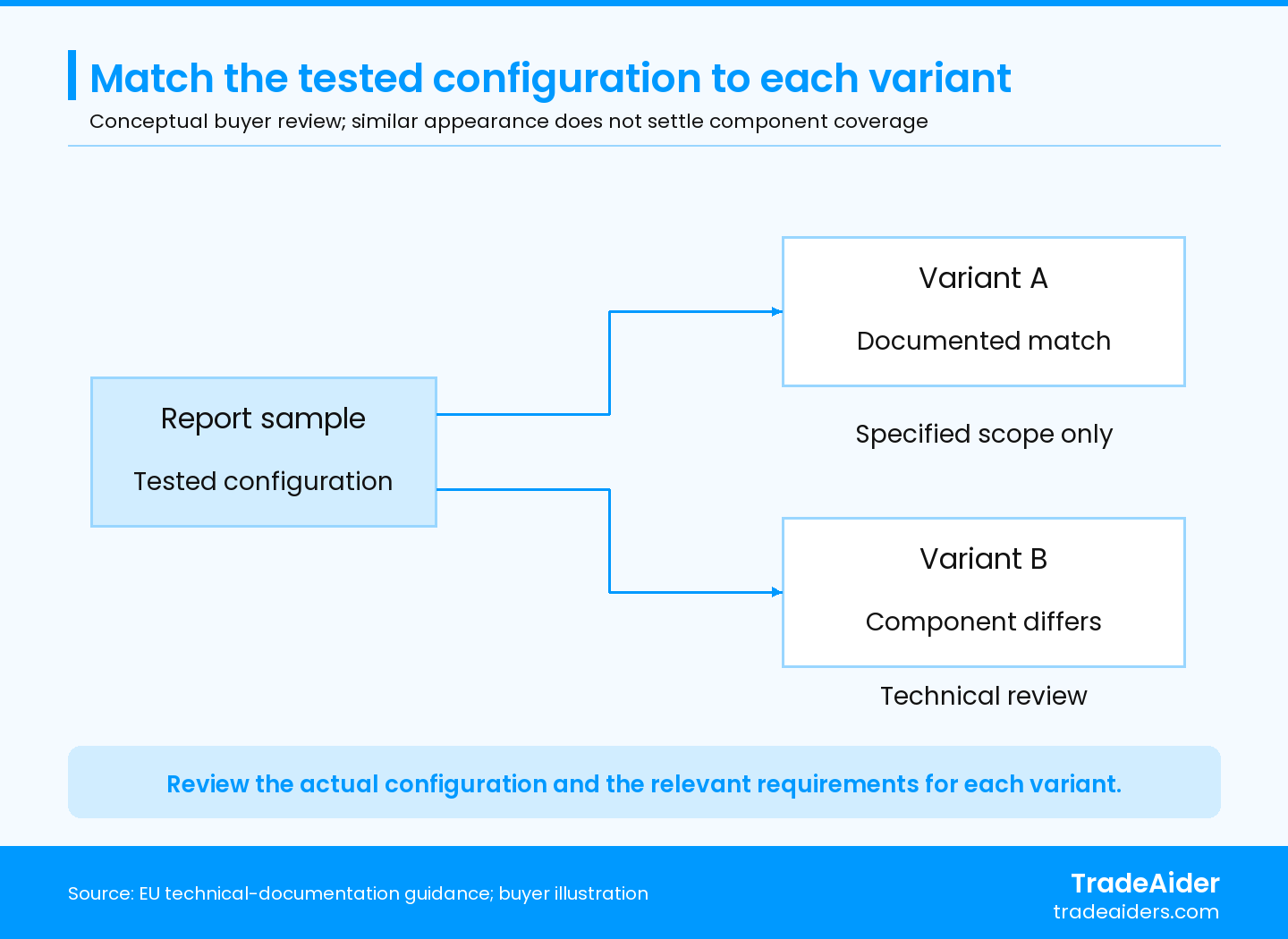
Illustrative report-to-variant comparison. A documented configuration match supports only the relevant established scope; a changed component remains a question for the appropriate technical review. The diagram does not establish legal acceptance or require every change to trigger a full retest.
| Order variant | Comparison recorded | Review outcome |
|---|---|---|
| Variant A | Assumed documented match to the identified P1 configuration | Can support the existing specified test scope, subject to current requirements and recipient conditions |
| Variant B | Same outer case; adapter changed from P1 to P2 | Keep affected coverage open; ask which technical results or further tests address the change |
For Variant A, retain the report entry and current specification that establish the assumed match; do not broaden the result beyond its tested properties. For Variant B, ask the laboratory or responsible technical reviewer to compare the changed adapter and the lamp’s relevant requirements. The difference alone does not tell the purchasing team which tests are necessary or whether every earlier result is unusable.
If the component schedule identifying P1 is missing from the supplied file, the assumed match has not been established for either variant. Request that attachment or an issuer-confirmed clarification first. After the missing reference or technical answer arrives, update the comparison with its document identifier, date and reviewer. An unresolved field should not disappear because the supplier sends another overall pass page.
Record the outcome narrowly: supported for named properties and configuration; clarification required; or technical assessment and further evidence required. Keep the buyer’s shipment disposition separate. A sound test basis still does not show the workmanship, quantity or packing condition of every unit awaiting shipment.
Carry the reviewed references into the factory handoff
Turn the review into a brief that identifies the report, order variants, controlled references and open questions. Send each question to the person who can answer it: the issuer for document authenticity, the supplier for current production identity, the laboratory or technical reviewer for test implications, and the intended recipient for its acceptance conditions. Agreed factory observations can compare goods and references, but do not extend laboratory evidence.
An initial inquiry can begin with available product and order information, the factory, destination and timing, plus the report you have received. List missing attachments and unknown specifications openly. A first-time importer or small purchasing agent should not invent technical criteria to start a discussion; those gaps need an owner and a plan before the work is executed.
Before the visit or sample submission, settle the report revision, current variant list, approved specifications, relevant component references, equipment and methods, and access to the records to be compared. Identify which photographs, model markings, component labels or packing references should be recorded, and which questions require a separate laboratory response. Keep unavailable access and unperformed checks visible in the resulting report.
For Pre-Shipment Inspection, or PSI, the order quantity is 100% complete and at least 80% packed for export. At that stage, agreed observations can compare selected finished goods and packing with the controlled references. The threshold concerns packing readiness. A visible model or component-label check can reveal a discrepancy, while an unobserved internal property still needs its appropriate technical evidence.
Confirm the final report recipient, language, format and acceptance requirements. Keep the reviewed variant list with the order file so a later substitution reopens the affected question. Record who decides the response when a physical item differs from the reviewed configuration, rather than asking the inspector to infer a new laboratory conclusion on site.
To discuss the report gaps and the required testing or inspection scope, contact the TradeAider team with the full available report, current order references and difference list. The useful starting point is a specific unresolved question and the evidence needed to answer it.
FAQ
Can I translate or rebrand the laboratory report myself?
Keep the laboratory’s original report intact and ask the issuer how a translation or requested identity mapping can be documented. A buyer-prepared translation should remain distinguishable from the issued report, with the original retained. Do not replace the applicant, model list, sample photograph or results yourself. A new brand name needs an explained link to the tested product, rather than an edited page that hides the original identity.
What if the laboratory will only speak to the original applicant?
Ask the original applicant to authorize the necessary verification or obtain an issuer-confirmed response for your review. A confidentiality restriction does not, by itself, prove that a report is false. Identify the minimum facts that need confirmation and the route the laboratory permits. If the report or relevant scope still cannot be verified, retain that uncertainty instead of treating the supplier’s forwarding email as laboratory confirmation.
What if part of the testing was subcontracted?
Identify the performing laboratory for the affected results and confirm the applicable competence and acceptance requirements. Ask the issuer which work was subcontracted and how those results are identified in the report. Subcontracting alone does not answer whether the evidence is suitable. The relevant method, performing body, documentation and intended recipient’s requirements still need to fit the actual product and purpose.
Verwandte Artikel
Erweitern Sie Ihr Unternehmen mit TradeAider Service
Klicken Sie auf die Schaltfläche unten, um direkt in das TradeAider Service System zu gelangen. Die einfachen Schritte von der Buchung und Zahlung bis zum Erhalt der Berichte sind leicht zu bedienen.