
- Über uns

- Unsere Dienstleistungen
- Ihre Branche
- Ressourcen
- Nachrichten & Blog
FCC, CE, and RoHS are not three versions of the same electronics certificate; FCC controls US radiofrequency authorization, CE supports EU conformity, and RoHS restricts hazardous substances in electrical and electronic equipment. A device can satisfy one evidence lane and still fail another because radio behavior, EU technical file, and material declarations are different proof systems.
The importer should connect model number, component version, rating label, barcode, manual, test evidence, and finished-lot inspection before release. One undocumented component substitution can reopen three compliance files at once.
For China-sourced electronics, the most common mistake is treating certification as a sticker. A mark on the package is not enough if the model, component, adapter, rating label, manual, and test evidence do not describe the same production version.
- FCC: US-facing radiofrequency authorization and equipment evidence.
- CE: EU conformity route and product responsibility evidence.
- RoHS: Restricted-substance evidence for electrical and electronic equipment.
- Factory release: Verify the packed electronics lot against the evidence file before shipment.
The Direct Answer
FCC is the US radiofrequency evidence lane, CE is the EU conformity evidence lane, and RoHS is the EU restricted-substance evidence lane for electronics.
TradeAider treats electronics compliance as a version-control problem before it becomes a shipment problem: the inspection scope has to connect the radio module, adapter, label, manual, barcode, and packed goods to the same evidence file.
The buyer should not ask a supplier, "Do you have certification?" without naming market, model, and component version. A Bluetooth speaker, LED lamp, smart plug, charging cable, and power adapter can trigger different evidence needs. If the factory changes wireless module, adapter, PCB, enclosure material, plug, or rating label after testing, the compliance file may no longer match the shipment.
According to FCC equipment authorization guidance, many radiofrequency devices need authorization before marketing or import. According to the European Commission CE marking page, CE marking indicates conformity with applicable EU legislation. According to the European Commission RoHS Directive page, RoHS restricts hazardous substances in electrical and electronic equipment. The so what is that electronics importers need separate evidence lanes, not one generic certificate folder.
FCC vs CE vs RoHS Compared
The comparison should answer which market question each evidence lane supports and what the buyer must verify at the factory.
| Evidence Lane | Main Question | Typical Evidence | Factory Release Check |
|---|---|---|---|
| FCC | Can this radiofrequency device be marketed or imported in the US? | Equipment authorization evidence tied to model | Model label, wireless module, manual, rating label |
| CE | Does this product follow the applicable EU conformity route? | Declaration, technical file, applicable directives and standards | CE mark, declaration details, manual, EU labeling |
| RoHS | Does the electrical product meet restricted-substance requirements? | BOM, supplier declarations, test report, material file | Component version, adapter, PCB, cable, enclosure material |
| Barcode and origin | Does the physical SKU match supply-chain and import identity? | Barcode data, carton mark, origin mark | Scan label and check carton before shipment |
| Inspection release | Does the packed lot match the evidence file? | PSI report, photos, measurements, function checks | Hold if model, label, or package version differs |
The comparison reveals why electronics evidence must stay version-controlled. FCC, CE, and RoHS may all be relevant to one device, but each one protects a different market question. A buyer who accepts one "CE/FCC/RoHS" PDF without matching the model and components can ship a product whose physical version no longer matches the evidence.
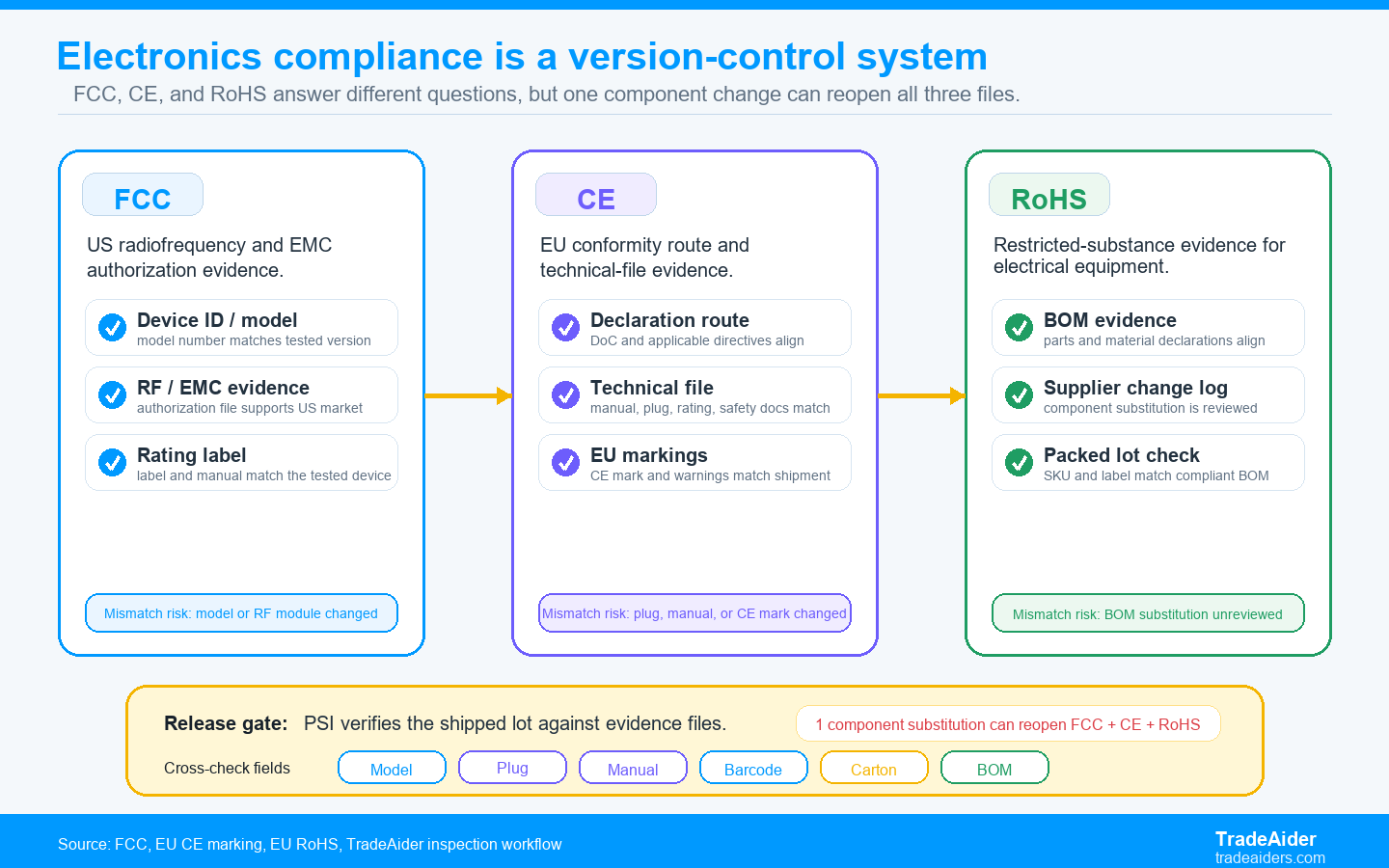
FCC, CE, and RoHS should travel as separate evidence lanes tied to one production version.
Where Electronics Compliance Evidence Breaks
Electronics evidence breaks when component changes happen faster than document control.
According to ISO 9001 quality management guidance, controlled processes and evidence-based decisions are part of quality management. In electronics sourcing, that principle means component substitutions must be approved before they become production reality. A supplier may substitute a wireless module, adapter, cable, PCB, plastic resin, screw, battery, or label because stock is short. The product may still function, but the compliance evidence can drift away from the actual lot.
FCC risk appears when the radio version changes
FCC risk is strongest when the electronics product includes radiofrequency behavior. A wireless module, antenna, enclosure, power circuit, or firmware version can matter. If the factory ships a different module from the tested sample, the device may look identical while the authorization evidence no longer matches. The buyer should compare FCC ID or authorization reference, model number, wireless module, label, manual, packaging, and product photos. The inspection checklist should include a visible model and label check because the wrong label can create a market-access problem even when the device powers on during a simple function test.
CE risk appears when the EU technical file is treated as a label
CE marking should not be treated as a logo that the factory prints because the buyer asks for Europe. According to EU conformity assessment guidance, applicable requirements should be identified before placing products on the EU market. The buyer should connect CE mark, declaration, standards, manual, rating label, and product version. If a factory changes adapter, charger, plug, enclosure, or intended use, the EU evidence route may need review. A CE label printed on the carton does not prove that the technical file still matches the packed product. The practical risk is that CE artwork can look finished while the conformity route is still tied to an older model, older adapter, or narrower intended-use statement.
RoHS risk appears when the material file stops matching the BOM
RoHS risk follows the bill of materials. If the factory changes solder, cable, adapter, PCB supplier, plastic enclosure, coating, or connector, the restricted-substance evidence may need review. A supplier declaration for an old component does not automatically support a new component. The buyer should require approval for substitutions and ask whether the component evidence file changed. The original estimate is direct: one component substitution can reopen three evidence files, because the same change may affect FCC behavior, CE technical file, and RoHS material declaration. This means purchasing substitutions should be treated as compliance events, not only cost-saving decisions, especially when the new component touches radio performance, power safety, or restricted-substance evidence.
How Importers Should Verify Electronics Before Shipment
The release check should prove that the physical lot still matches the compliance evidence file.
TradeAider's Pre-Shipment Inspection cannot replace FCC authorization, CE conformity assessment, or RoHS testing. It can verify that the finished lot matches the evidence file the buyer plans to rely on. The inspector can check model number, rating label, FCC ID or CE mark where applicable, barcode, plug type, adapter version, manual, carton mark, origin mark, packaging, and sample function. A PSI is conducted when 100% of the order quantity is completed and at least 80% is packed for export, so it works as a finished-lot release gate.
Freeze the BOM before testing and mass production diverge
The buyer should freeze the BOM before testing and mass production move apart. The tested sample should represent what the factory will buy, assemble, label, and pack. If the supplier wants to substitute a component, the buyer should require written approval and evidence review. The decision rule is simple: no component substitution should be treated as minor until the buyer knows whether it affects radio behavior, EU conformity evidence, or restricted-substance evidence. A cheap substitute can become expensive if it forces relabeling, retesting, rework, or shipment hold. In practice, the BOM freeze should name approved suppliers for the wireless module, adapter, PCB, cable, enclosure material, battery cell, and printed label version, because those items often decide whether the evidence file still matches the lot.
Check labels and identifiers as compliance evidence, not decoration
According to GS1 barcode standards, barcodes support product identification across supply chains. According to CBP origin-marking guidance, origin marking can be required for imported goods. Electronics labels often carry model, rating, mark, origin, warning, and identifier information. The buyer should treat those labels as evidence, not decoration. If the label version is wrong, the product may become hard to receive, sell, return, or support. Inspection should therefore include scan checks, model checks, carton mark checks, and manual version checks. The risk is not only marketplace rejection; a wrong identifier can also break spare-part matching, warranty lookup, recall traceability, and customer-support scripts after the shipment enters inventory.
Use testing support when evidence scope is unclear
If the supplier cannot explain whether the evidence covers the exact model, component version, or destination market, the buyer should not rely on the file blindly. Product testing support can help buyers manage testing needs alongside inspection planning, but the buyer still has to define the market and product claim. The important boundary is that testing answers compliance evidence questions, while inspection answers whether the factory shipped the same version that was tested or documented. Mixing those roles creates false confidence. If the evidence scope is unclear, the buyer should pause release until the model, component version, market route, and label artwork are named in the file.
SPAR Scenario: The Bluetooth Module Changed After Testing
A component that looks equivalent to production may not be equivalent to the compliance file.
Situation: An electronics importer orders 6,000 Bluetooth desk lamps from a factory in Shenzhen. The supplier provides FCC, CE, and RoHS evidence for the sample version, and the buyer approves packaging artwork with FCC and CE marks.
Problem: During production, the factory switches to a different Bluetooth module because the original supplier is delayed. The lamp still pairs with a phone during a function test, but the module number no longer matches the evidence file. The adapter supplier also changes, affecting the RoHS material file.
Action: The buyer pauses shipment release, requests updated module and adapter evidence, and asks the inspector to verify model label, rating label, module reference, manual, barcode, carton mark, and plug type during PSI.
Result: Shipment is delayed 8 days and 900 cartons need label correction. The trade-off prevents a larger market-access problem because one undocumented substitution reopened three evidence lanes. The remaining limitation is that future purchase orders must require pre-approval before any wireless module, adapter, or PCB change.
Electronics Compliance Checklist
Treat FCC, CE, and RoHS as separate evidence lanes tied to one locked production version.
- Define destination market, radio function, EU route, and substance evidence before quotation.
- Freeze BOM, wireless module, adapter, enclosure, label, manual, and packaging before mass production.
- Match FCC, CE, and RoHS evidence to the exact model and component version.
- Use inspection to verify that the packed lot matches the evidence file.
- Hold release if label, model, component, barcode, manual, or carton version does not match.
If the electronics file includes FCC, CE, RoHS, model labels, adapters, manuals, and barcode data from different revisions, send TradeAider the evidence folder, BOM, label artwork, approved sample photos, destination market, and packing status. The next step is to ask TradeAider to align the electronics evidence file with the finished-lot inspection scope before shipment release.
Frequently Asked Questions
Is FCC the same as CE?
No. FCC evidence is tied to US radiofrequency authorization, while CE marking is tied to conformity with applicable EU legislation. The same electronics product may need both.
Does CE marking include RoHS?
CE marking can relate to applicable EU legislation, and RoHS may be one part of the EU evidence picture for electrical and electronic equipment. The buyer should still verify the RoHS material evidence separately.
Can inspection replace FCC, CE, or RoHS testing?
No. Inspection cannot replace authorization, conformity assessment, or substance testing. It can verify that the finished product, label, model, manual, barcode, and packaging match the evidence file before shipment.
Verwandte Artikel



Erweitern Sie Ihr Unternehmen mit TradeAider Service
Klicken Sie auf die Schaltfläche unten, um direkt in das TradeAider Service System zu gelangen. Die einfachen Schritte von der Buchung und Zahlung bis zum Erhalt der Berichte sind leicht zu bedienen.

