
- Über uns

- Unsere Dienstleistungen
- Ihre Branche
- Ressourcen
- Nachrichten & Blog
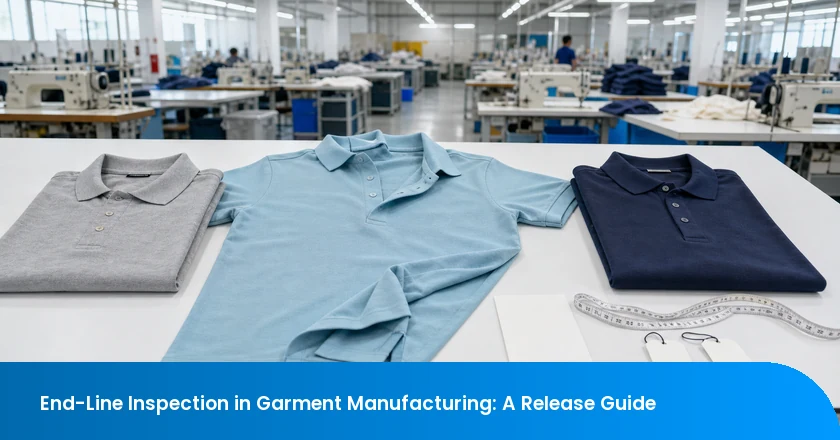
A defect report without a traceable production scope cannot tell a buyer what may safely move forward. In garment manufacturing, a line finding becomes commercially useful only when it identifies the approved reference, the correction made, and the evidence needed to recheck the affected output. Otherwise, a buyer may know that a defect exists but still not know which pieces can be released, repaired, or held.
Production teams can repair an individual piece quickly, but the buyer still needs a defensible decision about the population exposed to the same cause. Keeping those two decisions separate prevents a repair note from being mistaken for shipment evidence.
Buyer Release Decisions at End Line
- Use the approved sample and current specification as the inspection basis.
- Contain a repeated pattern by identifying the last confirmed-good point and the uncertain output.
- Use sampling only after the lot is defined under the agreed plan.
- Release a corrected subset only when the finding, scope, action, and recheck align.
The Decision Rule: A Defect Report Needs a Defined Production Scope
End-line inspection is most valuable when it does more than count defects. Its immediate job is to detect workmanship, measurement, appearance, trim, label, or packing problems close enough to the sewing process that the factory can contain the cause. Its buyer-facing job is harder: establish whether the problem belongs to one unit, one bundle, one operator, one line, one shift, or an unbounded stretch of output.
Use a simple release rule: do not release an affected subset until the evidence can show where the risk starts, where it stops, what was corrected, and how the correction was checked. This is not a demand for perfect records. It is a boundary for decision-making. If the boundary is unknown, the prudent hold expands to the last point that can be supported by records.
A useful end-line report therefore answers five questions:
- What requirement was not met: the approved sample, measurement tolerance, workmanship standard, label copy, or buyer instruction?
- What defect pattern was seen, and how was it classified?
- Which production window may contain the same problem?
- What containment, repair, or process correction was completed?
- What recheck provides evidence for the next buyer decision?
The point is not to turn an end-line inspector into the shipment approver. It is to prevent a recurring problem from being treated as a collection of unrelated repairs.
Where End-Line Inspection Fits in Garment Production
End-line inspection is a quality check on garments as they leave a sewing line or section. ILO SCORE describes mid- and end-line inspection procedures used with defect-identification and root-cause tools. Its garment quality-improvement example illustrates that process context. In practice, the checkpoint sits after relevant sewing and finishing steps, but before a buyer should treat the complete order as ready to ship.
Before bulk work begins, a buyer can reduce ambiguity by aligning the approved sample, measurement chart, packaging instructions, label artwork, defect definitions, and any destination-market requirements. An independent buyer can use a Pre-Production Inspection to lock the approved requirements before bulk sewing.
During sewing and finishing, end-line checks should feed the factory’s own corrective-action process. If the same defect appears across several pieces, the question changes from “Can this piece be repaired?” to “What output has been exposed to the same cause?” The checkpoint is a feedback loop for production, not a substitute for a final order-release decision.
At the end of the order, the release decision has a different population and timing. It considers the defined finished lot, shipment marks, quantities, packing, and buyer requirements. Treating a line-end observation as if it were a pre-shipment result can hide the fact that later finishing, labeling, packing, or mixed-lot risks have not yet been reviewed.
Build the Check Around the Approved Garment, Not a Generic Defect List
Check the approved garment and applicable requirements, not a generic list alone. A generic checklist can help an inspector look consistently, but it cannot decide whether a collar shape, seam appearance, logo position, or fold method is acceptable for a particular order. The controlling comparison should be the buyer-approved reference and the current specification set.
For a garment order, that set normally includes the approved sample or sealed reference, measurement points and tolerances, construction details, workmanship and appearance expectations, color or shade instructions, trim and accessory requirements, label and packaging artwork, carton marks, and the agreed defect classification. Where a buyer has a defined acceptance plan, link the inspection report to that plan instead of leaving the result as a free-standing narrative. Buyers can set a written inspection standard before the first bundle reaches end line.
FTC guidance says most textile and wool products need disclosures for fiber content, origin, and responsible business identity. For products covered by US textile and wool labeling rules, the content of the permanent label is therefore not a cosmetic afterthought. Check that the physical label, the approved artwork, and the order-specific instruction are referring to the same product and market. The FTC’s textile and wool labeling guidance explains those required disclosure categories.
The rule requires a reasonable basis for care information prior to sale. A line-end visual check can confirm that the specified care label is present and legible; it should not be presented as independent proof that the care claim was technically substantiated. The FTC’s Care Labeling Rule is a US example of why the physical check and the compliance evidence are related but distinct.
| Check area | Compare against | If a pattern appears |
|---|---|---|
| Workmanship and construction | Approved sample, sewing specification, defect definitions | Trace line, operator or machine condition, time window, and bundles |
| Measurements and shape | Measurement chart, tolerance, approved sample | Identify size, operation, and production window before rechecking |
| Labels, trims, and appearance | Artwork, trim card, market-specific instruction | Hold the relevant component or output until the mismatch is bounded |
First, Separate a Repairable Unit From a Repeating Process Signal
A repeated defect should be logged as a line signal, not only repaired garment by garment. One loose thread may be a unit-level repair. Several collars with the same twist, several plackets with the same alignment drift, or repeated puckering after one operation can indicate a shared cause. The repair may still be straightforward, but the production scope requires separate attention.
Record the observation in plain terms: defect type, garment style and size, line, operation, time or bundle reference, quantity seen, photos where useful, and the requirement used for comparison. Then ask what changed around the first observation: a machine adjustment, folder guide, operator rotation, fabric lot, trim lot, or a handoff from one operation to another. This does not assume that the suspected cause is proven. It creates a transparent path from finding to investigation.
Then, Turn the Pattern Into a Bounded Hold
An affected production window is the identifiable output made after the last confirmed-good check and before the process is shown stable again. Missing records widen the hold because they prevent a defensible split between known and unknown output. Start the hold at the last confirmed-good point and end it at the point after correction where a documented recheck begins. If either point cannot be shown, do not invent a narrow window just to avoid a larger review.
A bounded hold is not automatically a rejected order. It is a controlled population awaiting a decision. The factory can inspect or repair that population, segregate it, and show a recheck. Output produced before or after it can be considered separately only when its identities and timing are genuinely traceable. Where a recurrent line problem needs an independent view while that containment is still possible, buyers can use During Production Inspection to check a recurring line problem while containment is still possible.
Use Sampling for a Defined Lot—Not as Proof That Every Garment Is Sound
NIST states that acceptance sampling decides whether a lot is likely acceptable, not its complete quality. AQL is an agreed acceptance-sampling approach used to make a decision about a defined lot. That limitation is important when a repeating defect has an unknown production window. A sample can support the agreed decision for a defined lot; it cannot demonstrate that every garment is sound or create traceability that the factory did not record.
First define the lot: for example, a known bundle range after a specific machine adjustment, a size-specific output from one line and shift, or a separately identified repaired population. Then apply the buyer’s agreed sampling and acceptance plan to that actual lot. If a defect trend has made the lot boundary uncertain, resolve the boundary before treating an acceptance sample as release evidence. The National Institute of Standards and Technology explains the distinction between accepting a lot and estimating all of its quality in its acceptance-sampling guidance.
For an order with an agreed AQL approach, the number of units to inspect and the acceptance number must come from the agreed plan, lot size, inspection level, and defect classification. Do not choose a convenient sample after seeing the result. The buyer must first confirm that the defined population is the one actually exposed to the process risk. Buyers can review the sample-plan inputs with TradeAider's AQL calculator, but the calculator does not settle the more basic question of whether the inspected population is the right one.
Sampling is therefore strongest after containment has established the population. It is weakest when used as an argument that an unclear or mixed population can be released without first reconciling the production records.
The Four Records That Make a Correction Reviewable
A correction is reviewable only when the finding, scope, action, and recheck point to the same population. A polished corrective-action statement is not enough if the report cannot connect it to the actual garments at risk.
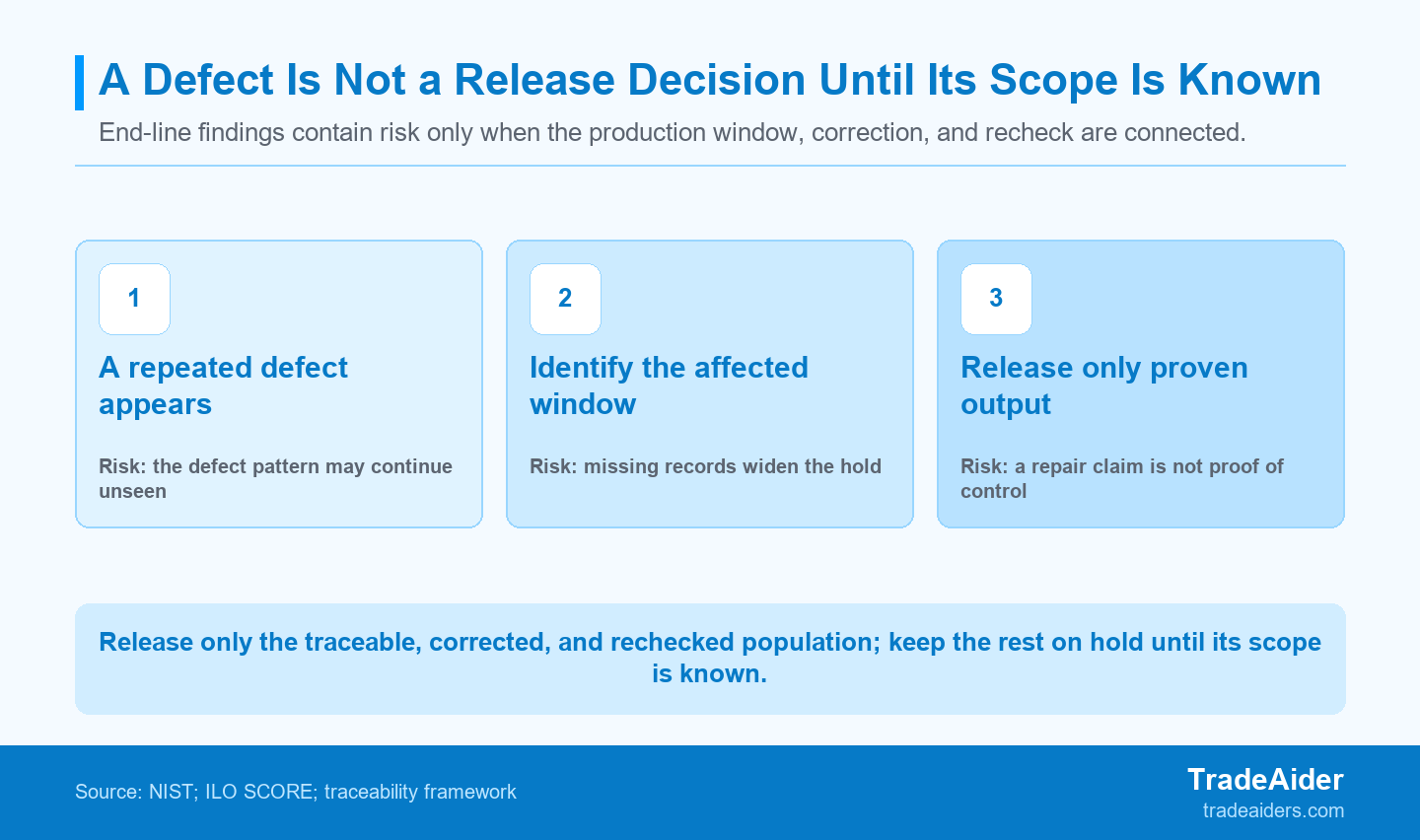
End-line inspection is most useful when a defect can be turned into a bounded hold and a documented recheck—not simply a repair instruction.
- Finding record: the defect, relevant requirement, location, date, and evidence such as photos or measurement results.
- Scope record: the last confirmed-good point, the uncertain production window, line or bundle identities, and the quantity held.
- Action record: the correction to the process and the disposition of the affected garments: repair, rework, replacement, or hold.
- Recheck record: the defined corrected population, method, result, date, and reviewer who can connect it back to the original hold.
These records should agree with one another. If the recheck says 600 garments but the repair log says 720 and the line log cannot show the difference, the buyer still has an unresolved scope question. The correct response may be a larger hold or a wider reinspection, rather than a claim that the smaller number is now safe.
EU and UK guidance identifies product or batch references as tools for traceability and identification. While the exact legal obligation depends on the product and market, the same operational discipline helps a buyer distinguish one verified population from another. See the European Commission’s general product-compliance guidance and the UK government’s product-safety compliance advice for examples of traceability and identification expectations.
End Line Is Not the Same as Pre-Shipment Release
TradeAider defines Pre-Shipment Inspection timing as 100% order completion and at least 80% export packing. End-line inspection and pre-shipment inspection may both review garment quality, but they serve different decisions. The first helps the factory contain a process issue while production is still active. The second gives the buyer a later view of the completed, export-packed order under the agreed inspection scope.
| Question | End-line inspection | Pre-shipment inspection |
|---|---|---|
| Primary decision | Contain and correct a production risk | Decide whether the defined finished order meets the agreed release conditions |
| Population | Garments leaving a line or a bounded production window | Completed order and available export-packed quantity |
| Typical evidence | Defect pattern, hold scope, correction, recheck | Lot definition, sample result, quantity, packing, marks, and buyer requirements |
| What it cannot settle alone | Later packing, order completeness, and final shipment status | The root cause of a defect that should have been contained earlier |
Buyers can use a Pre-Shipment Inspection as the separate release check when the completed order is export-packed. It should confirm the final lot; it should not be asked to reconstruct an earlier line problem that was never recorded.
Illustrative Scenario: Seven Similar Defects, One Unclear Production Window
The 7-of-32 observation is a containment signal, not an AQL verdict. The following example shows why a buyer should separate a recurring line finding from a later release decision.
What Would Let the Buyer Release the Corrected Subset?
Release only the documented corrected population after an agreed recheck. In this example, the supplier should reset the folder guide, inspect and repair the bounded output, identify the relevant line and bundle identities, and retain a record of the repair disposition. The recheck should state which corrected population it covers, rather than reporting an unrelated sample from whatever garments happen to be available.
A US apparel importer is buying private-label knit polos from a China factory. A 9,600-piece order is in bulk sewing. One line produces 1,440 garments across two shifts before an end-line finding is escalated. The relevant output has completed sewing, but not all of it has entered final packing.
Seven of 32 end-line checks show the same collar-edge twist and placket-alignment issue. The factory says that it adjusted the folder guide. Its report, however, does not show a last confirmed-good time, a first confirmed-good result after adjustment, or a bundle-level output record for the interval between them.
The 7-of-32 observation is an illustrative containment signal, not an AQL verdict. It tells the buyer that a repeated pattern needs investigation. It does not establish a universal defect rate, and it does not identify a safe subset within the 1,440 garments. Because there is no defensible split point, the reasonable working hold is the full 1,440-garment uncertain window. Separately documented output may move only if its own traceability is intact.
The buyer can lift the hold for a subset only when the report links the original finding, the defined scope, the correction, and the recheck to the same garments. The buyer should still use a later Pre-Shipment Inspection for the completed export-packed order. This is an illustrative buyer scenario, not a TradeAider client case, a universal defect threshold, or an acceptance-sampling result.
Prepare the Right Evidence Before You Ask for an Independent Check
To understand reporting and visibility before sharing order records, buyers can review TradeAider's inspection approach and real-time visibility. A visual end-line check cannot replace product-specific test or certification evidence where the destination market requires it. For example, the FTC’s care-labeling guidance for apparel explains that a care label needs a reasonable basis. The buyer should keep visual verification, document review, and any applicable testing or certification evidence as separate parts of the release file.
When a recurring end-line problem appears, prepare the buyer-facing facts before asking an independent party to assess the next step:
- PO, style, color, size breakdown, and current production quantity.
- Approved sample, measurement chart, defect definitions, label or packing instruction, and any market-specific requirements.
- Clear defect photos and the factory’s finding record.
- Line, shift, bundle, and time information that identifies the affected production window.
- Correction and repair records, current packing status, and the specific decision that remains open.
Those inputs make it easier to decide whether the useful next check is pre-production, during production, end-line follow-up, product testing, or pre-shipment release. They also prevent an inspector from being asked to make a decision about an undefined lot. The aim is a bounded, stage-appropriate scope that identifies what can be independently verified and what remains a factory corrective-action responsibility.
If you need an independent garment inspection after an end-line finding, prepare the PO, approved sample, specification, defect photos, production quantity by line or shift, correction record, and current packing status, then contact TradeAider to scope an independent garment inspection.
Frequently Asked Questions
Is end-line inspection the same as final inspection?
No. End-line inspection is a process-control check on garments leaving a sewing line or section. It helps the factory detect and contain a defect while production records can still identify the exposed output. A later Pre-Shipment Inspection evaluates the defined finished order, including its available export-packed quantity, against the buyer’s agreed release conditions.
What should an end-line inspector check on a garment?
Check workmanship, measurements, shape, appearance, trims, labels, packaging items, and buyer-specific requirements against the approved reference. The exact list should come from the style’s approved sample and specification, not a generic checklist alone. When a defect repeats, record the line, operation, timing, and affected output as well as the visible defect.
Can a passed sample release every garment in the lot?
No. An agreed sample supports a decision about a defined lot under its stated plan. It does not prove every garment is defect-free, and it cannot cure missing production records. If the factory cannot identify the output exposed to a recurring defect, contain that uncertain window before using any sample result as part of a release decision.
When should a buyer request an independent garment inspection?
Request an independent check when the result can still change a buyer decision. That may be before bulk sewing to align requirements, during production when a repeated defect needs a fresh view, or before shipment when the order is complete and sufficiently export-packed. Share the approved reference, production status, defect evidence, and the specific decision needing support.
Verwandte Artikel

Erweitern Sie Ihr Unternehmen mit TradeAider Service
Klicken Sie auf die Schaltfläche unten, um direkt in das TradeAider Service System zu gelangen. Die einfachen Schritte von der Buchung und Zahlung bis zum Erhalt der Berichte sind leicht zu bedienen.

