
- Über uns

- Unsere Dienstleistungen
- Ihre Branche
- Ressourcen
- Nachrichten & Blog
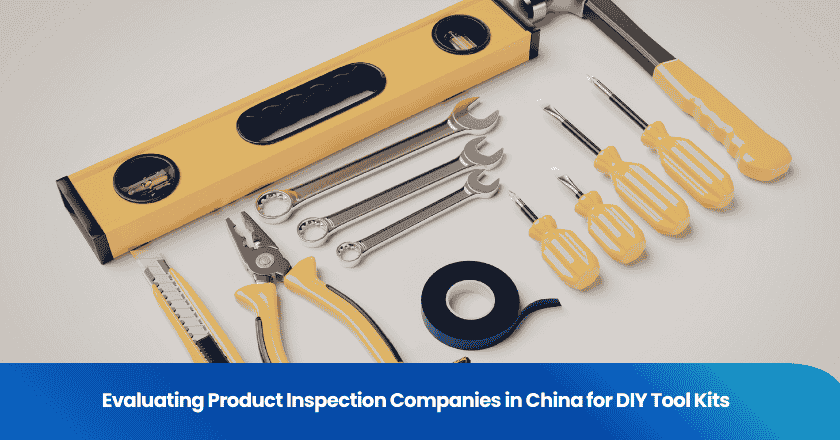
DIY tool kits are among the most complex consumer products to inspect. A single kit may contain 50 to 200 individual items—screwdrivers, wrenches, pliers, sockets, bits, hex keys, measuring tapes—each manufactured through different processes, with different materials, and different quality failure modes. When you're evaluating product inspection companies in China for your DIY tool kit business, you need a partner that understands this complexity and inspects accordingly.
Not all inspection services approach multi-component kits the same way. Some treat the kit as a single product unit. Others check each tool individually against its own specification. The difference matters—because a kit that's 95% perfect but has a defective utility knife inside it still generates a customer complaint and a potential return.
This article walks through the specific criteria that matter most when evaluating inspection companies for DIY tool kits sourced from China.
Key Takeaways
- DIY tool kits require component-level inspection, not just kit-level checks—each tool type has unique failure modes and specification requirements
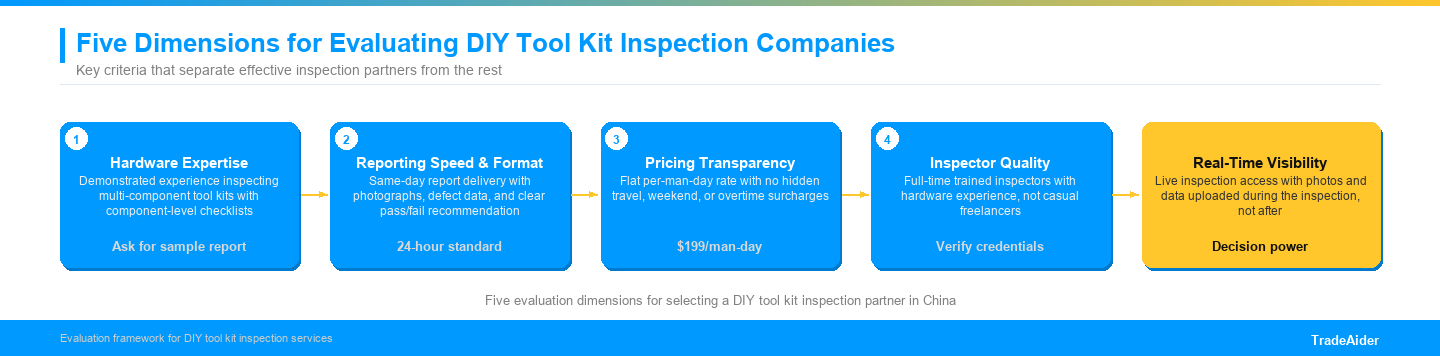
- Evaluate inspection companies on five key dimensions: relevant expertise, reporting speed and format, pricing transparency, quality of inspector pool, and real-time visibility capabilities
- Pricing transparency is critical—hidden fees for weekend inspections, travel, or overtime can make your actual costs far higher than the quoted rate
- Real-time reporting gives you decision-making power while goods are still at the factory, not after they've shipped
- The right inspection partner should adapt their checklist to your specific kit composition, not apply a generic hardware inspection template
Why DIY Tool Kits Demand Specialized Inspection
Multi-Component Complexity
Unlike single-product inspections, DIY tool kits present a layered inspection challenge. An inspector must verify:
- Individual tool quality—dimensions, material grade, surface finish, hardness, and functionality of each tool type
- Kit completeness—correct quantity of each item, matching the packing list and product specification exactly
- Presentation and packaging—proper placement in the case or blow-molded tray, correct labeling, retail-ready appearance
- Kit-level functionality—interoperability between tools and accessories (bits fit the driver, sockets match the ratchet, extensions connect properly)
According to quality control research on hand tool manufacturing in China, third-party inspection is essential because factory-side QC systems in the hardware sector often lack the rigor that Western buyers expect. Factories may inspect a sample of components but rarely check every item in every kit.
Common Defects Found in DIY Tool Kits
Understanding the most common defects helps you evaluate whether an inspection company's checklist is adequate for your products. The defects inspectors find most frequently in DIY tool kits include:
| Tool Type | Common Defects | Severity |
|---|---|---|
| Wrenches | Incorrect jaw opening, surface burrs, chrome plating defects | Major |
| Screwdrivers | Tip deformation, handle looseness, wrong tip type | Major / Critical |
| Pliers | Joint play, misaligned jaws, spring mechanism failure | Major |
| Sockets / Bits | Wrong size, poor chrome finish, incorrect drive count | Major |
| Measuring Tape | Inaccurate markings, retraction failure, case damage | Major / Critical |
| Utility Knife | Blade locking failure, sharp edge exposure, blade misalignment | Critical |
Five Criteria for Evaluating Inspection Companies
1. Relevant Experience with Multi-Component Hardware
The first question to ask any inspection company: do your inspectors have specific experience with hardware and hand tools, or is their background primarily in textiles, electronics, or general consumer goods?
Hardware inspection requires knowledge of material grades (chrome vanadium vs. carbon steel), hardness testing concepts, dimensional tolerances for tool interfaces, and surface finish standards. An inspector experienced in plush toys will not know what to look for on a chrome-plated socket wrench.
Ask the inspection company about their inspector training programs and whether they maintain specialist teams for different product categories.
2. Reporting Speed and Format
How quickly do you receive your inspection report, and in what format? This is a critical differentiator that many importers overlook until they're waiting 72 hours for a report while their container sits at port.
Traditional inspection companies deliver PDF reports 24 to 48 hours after the inspection. In that window, your goods may have already been loaded and shipped. Look for inspection companies that offer same-day reporting or, ideally, real-time reporting where you see findings as the inspector documents them.
Report format also matters. Can you easily share the report with your factory contact? Are defect photographs high-resolution and clearly labeled? Is the AQL summary easy to read at a glance?
3. Pricing Transparency
This is where many inspection companies catch importers off guard. The quoted rate may not include travel surcharges, weekend fees, holiday premiums, overtime charges, or per-photograph costs. When you're inspecting multiple tool kit SKUs across different factories, these add-ons can inflate your actual cost by 50% or more.
Look for inspection companies that offer a single all-inclusive per-man-day rate with no hidden surcharges. TradeAider, for example, charges a flat $199/man-day that covers everything—travel, reporting, and photographs included.
Transparent pricing allows you to budget accurately and compare the true cost of different inspection providers without surprises on the invoice.
4. Inspector Qualifications and Consistency
The quality of your inspection depends entirely on the person standing on the factory floor. When evaluating inspection companies, ask about:
- How inspectors are recruited and trained
- Whether the company assigns the same inspector to your account for continuity
- What quality assurance processes exist to verify inspector performance
- Whether inspectors are full-time employees or freelance contractors
Consistency matters because DIY tool kits often have recurring production runs. An inspector who knows your products from previous inspections will catch subtle changes—different chrome finish, altered jaw tolerances, substituted materials—that a new inspector might miss.
5. Real-Time Visibility
The ability to see inspection findings as they happen is a significant advantage for importers managing DIY tool kit quality. Real-time visibility allows you to:
- Identify issues and communicate with your factory while the inspector is still on site
- Request additional checks on specific components based on early findings
- Make immediate go/no-go decisions without waiting for a formal report
This is especially valuable for multi-component kits where early findings (e.g., missing socket sizes in sample kits) may warrant expanding the sample size before the inspection concludes.
A Practical Evaluation Framework
When comparing inspection companies for your DIY tool kit business, use this structured evaluation approach:
- Request a sample report from an actual hardware or tool kit inspection (not a generic template). Evaluate the level of detail, photograph quality, and whether component-level issues are clearly documented.
- Ask for inspector credentials specific to hardware products. Confirm the company has inspectors available in your manufacturing region (e.g., Zhejiang for hand tools, Guangdong for multi-tool kits).
- Compare total cost, not headline price. Ask each company to quote the all-inclusive cost for a typical inspection, including travel, reporting, weekend availability, and any other charges.
- Test response time. Submit an inquiry and measure how long it takes to receive a detailed response with availability, pricing, and inspector assignment. This indicates how they'll respond when you have an urgent quality issue.
- Verify technology capabilities. Can you access reports online? Is there a platform where you can track inspection status in real time? How are reports stored and retrieved?
How TradeAider Approaches DIY Tool Kit Inspection
TradeAider's inspection process for DIY tool kits is built around the multi-component challenge. When you schedule a pre-shipment inspection, the assigned inspector uses a customized checklist that covers:
- Kit completeness verification—counting every item against the packing list
- Component-level quality checks—dimensional, functional, and cosmetic for each tool type
- Fit and interoperability testing—bits in drivers, sockets on ratchets, extensions in handles
- Packaging integrity—case quality, tool retention, labeling accuracy, and retail presentation
- AQL sampling applied at both the kit level and, where necessary, the component level
All findings are reported through TradeAider's real-time platform, so you see photographs and defect data as the inspection progresses. The official report is delivered within 24 hours, but you don't have to wait for it to start making decisions.
At $199/man-day with no hidden fees, the pricing is designed to be predictable for regular inspection schedules—whether you're inspecting one container or managing quality across multiple SKUs and factories.
For importers who want to go beyond inspection and build a comprehensive quality management system, TradeAider also offers during-production inspections and factory audits to evaluate supplier capabilities before you place an order.
Common Questions
How many kits should be inspected in a pre-shipment inspection for DIY tool sets?
Sample size is determined by the AQL standard based on your total lot size. For a typical order of 5,000 kits, AQL Level II would require inspecting approximately 50 kits. Within each kit, the inspector verifies all components. Use the AQL calculator to determine the exact sample size for your specific order quantity.
Should I use the same inspection company for all my tool kit suppliers?
Yes, when possible. Using a single inspection partner provides consistency in standards and reporting, and allows the company to build institutional knowledge about your product specifications. This is particularly valuable for DIY tool kits where defect patterns often repeat across suppliers.
What if my factory insists on using their own QC team instead of a third-party inspector?
Factory-side QC is a good first line of defense but should not replace independent third-party inspection. Factory inspectors have an inherent conflict of interest—they report to the same organization that bears the cost of rework. A third-party inspector works for you, not the factory, which means findings are reported objectively without pressure to pass marginal products.
Conclusion
Evaluating product inspection companies for DIY tool kits requires looking beyond surface-level claims and examining how each company handles the unique complexity of multi-component product inspection. The right partner brings relevant hardware expertise, transparent pricing, consistent inspector quality, and real-time visibility to your quality control process.
Don't wait for customer complaints to find out your inspection company missed critical defects. Contact TradeAider to schedule a pre-shipment inspection for your next DIY tool kit shipment—and see the difference that real-time, component-level quality reporting makes.
Verwandte Artikel


Erweitern Sie Ihr Unternehmen mit TradeAider Service
Klicken Sie auf die Schaltfläche unten, um direkt in das TradeAider Service System zu gelangen. Die einfachen Schritte von der Buchung und Zahlung bis zum Erhalt der Berichte sind leicht zu bedienen.

