
- Über uns

- Unsere Dienstleistungen
- Ihre Branche
- Ressourcen
- Nachrichten & Blog
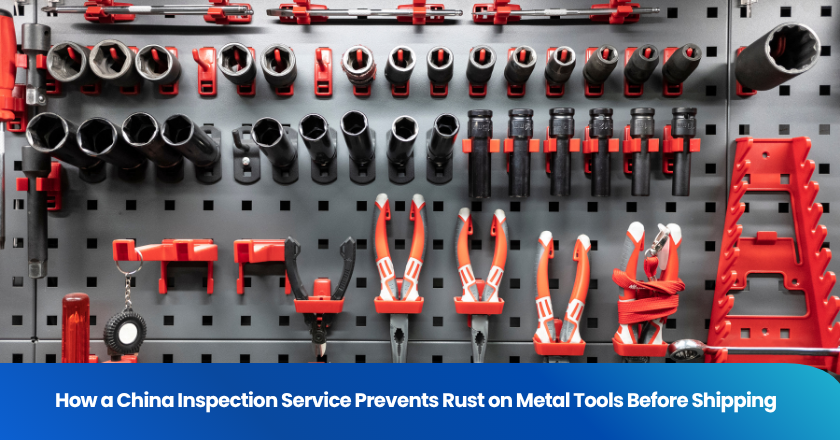
You've sourced a container of wrenches, pliers, and screwdrivers from a factory in Zhejiang. Everything looks great in the sample photos. But when the goods arrive at your warehouse three weeks later, you open the cartons to find orange-brown spots spreading across the tool surfaces. Rust. The entire shipment is unsellable.
This scenario plays out more often than most importers would like to admit. Rust on metal tools is one of the most common—and most preventable—quality defects found during pre-shipment inspections in China. The key is catching it before the goods leave the factory, not after they've crossed the ocean.
In this article, we'll walk through exactly how a professional China inspection service identifies, classifies, and prevents rust on metal tools during the pre-shipment phase—so you never have to face that heartbreaking moment of opening a rust-damaged container again.
Key Takeaways
- Rust is classified as a defect under AQL standards—inspectors use specific severity levels (minor, major, critical) to determine whether a shipment passes or fails
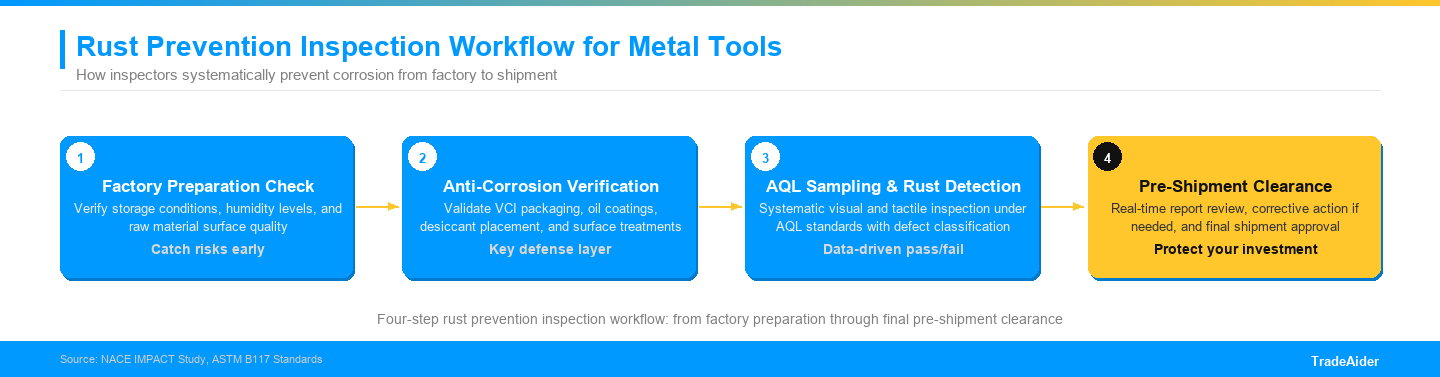
- Pre-shipment inspection checks multiple rust prevention layers: surface condition, anti-corrosion coatings, VCI packaging, desiccant placement, and container moisture levels
- China's manufacturing regions have high seasonal humidity, making rust prevention checks especially critical during spring and summer months
- Real-time inspection reports allow importers to see rust issues as they're found and make decisions before goods ship
- Proactive rust prevention costs a fraction of reactive damage control—replacing a rusted shipment is far more expensive than preventing one
Why Rust Is the Silent Killer of Metal Tool Imports
The Real Cost of Corrosion in Global Trade
Corrosion isn't just an inconvenience—it's a massive economic drain. According to the NACE International IMPACT study, the global cost of corrosion is estimated at $2.5 trillion annually, roughly 3.4% of world GDP. The study found that implementing corrosion prevention best practices could save between 15% and 35% of those costs—between $375 billion and $875 billion globally.
For importers of metal tools, rust translates directly into lost revenue: customer returns, negative reviews, inventory write-offs, and costly replacement shipments. A single rusted container of hand tools can represent tens of thousands of dollars in losses—not counting the reputational damage with retail partners.
Why Chinese Manufacturing Regions Are High-Risk for Rust
Many of China's major tool manufacturing hubs—Zhejiang, Jiangsu, Guangdong—experience extended periods of high humidity, particularly from March through September. Relative humidity in these regions regularly exceeds 80% during the spring and summer months. When metal tools sit in factory warehouses or packed cartons under these conditions without proper protection, surface oxidation can begin in as little as 48 hours.
The risk multiplies during ocean transit. Shipping containers experience dramatic temperature fluctuations that cause condensation—often called "container rain." Without adequate moisture barriers inside the packaging, this condensation settles directly on exposed metal surfaces, accelerating corrosion dramatically.
This is exactly why a pre-shipment inspection focused on rust prevention is not optional for metal tool importers—it's essential insurance.
How Pre-Shipment Inspection Catches Rust Before It Ships
Visual and Tactile Checks for Surface Corrosion
Professional inspectors follow a systematic approach to detect rust on metal tools. During a pre-shipment inspection, they examine a statistically significant sample drawn according to AQL (Acceptable Quality Limit) standards.
The visual inspection process includes:
- Bare-eye examination under adequate lighting for surface discoloration, pitting, or oxidation spots
- Tactile inspection—running gloved fingers over the tool surface to feel for roughness or raised corrosion points that may not be visible yet
- Edge and joint inspection—checking crevices, seams, and joints where moisture collects and rust often starts first
- Comparison against approved samples—placing the production sample next to the golden sample to identify even subtle surface changes
Inspectors document every instance of rust with high-resolution photographs, noting the exact location, severity, and affected surface area. This photographic evidence becomes part of the official inspection report that you review before approving shipment.
Moisture and Humidity Testing Inside Packaging
Beyond the tools themselves, inspectors check the packaging environment for conditions that promote rust. This includes measuring the moisture content of packaging materials, checking whether desiccant packs are properly placed and adequate in quantity, and verifying that VCI (Vapor Corrosion Inhibitor) materials are present where specified.
Some inspectors also use moisture meters to check the wood content of pallets and crates, as damp wood is a common hidden source of moisture that leads to rust during transit.
Anti-Corrosion Measures Inspectors Verify Before Shipping
VCI Packaging and Desiccant Validation
VCI (Vapor Corrosion Inhibitor) packaging is one of the most effective methods for preventing rust on metal tools during storage and transit. VCI molecules form an invisible protective layer on metal surfaces, preventing the electrochemical reactions that cause oxidation.
During inspection, the checker verifies:
- That VCI paper, film, or bags are correctly sized to enclose each tool or tool set
- That VCI materials are not torn, improperly sealed, or missing entirely
- That desiccant packs are present in the correct quantity based on the carton volume and expected transit time
- That silica gel or clay desiccants have not already reached saturation before packing
A common failure point inspectors find: factories using VCI materials that have been stored too long in open conditions, reducing their effectiveness. VCI packaging has a shelf life, and expired materials provide a false sense of security.
Protective Coating and Oil Film Verification
Many metal tools receive a protective oil or wax coating at the factory as a primary rust barrier. Rust-preventive coatings range from light oil films to heavier wax-based coatings, depending on the tool type and storage requirements.
Inspectors verify that:
- The coating is evenly applied with no bare spots or thin areas
- The correct type of coating is used as specified in the product specification sheet
- The coating has not been compromised by handling—fingerprints can break through thin oil films and create rust initiation points
Rust Prevention Methods Checklist
| Prevention Method | What Inspectors Check | Common Failure Found |
|---|---|---|
| VCI Packaging | Proper enclosure, seal integrity, material freshness | Missing or torn VCI film; expired materials |
| Desiccant Packs | Quantity, placement, saturation status | Insufficient quantity; pre-saturated packs |
| Oil/Wax Coating | Even application, correct type, no bare spots | Uneven coating; fingerprint marks; wrong oil type |
| Surface Treatment | Plating, black oxide, or phosphate coating quality | Incomplete coverage; coating chips or scratches |
| Container Conditions | Moisture barriers, pallet dryness, ventilation | Wet pallets; no container liner; poor ventilation |
AQL Defect Classification for Rust on Metal Tools
Minor vs. Major vs. Critical Rust Defects
Under AQL inspection standards, rust on metal tools is not a single category—it's classified by severity, and the classification determines whether your shipment passes or fails. Understanding these classifications helps you set the right quality expectations with your factory.
Minor defects: Light surface oxidation that can be wiped off with a cloth, with no pitting or structural damage. The tool remains fully functional and the rust is not visible to the end customer under normal display conditions. Examples include light tarnish on chrome-plated surfaces or superficial discoloration on non-critical areas.
Major defects: Visible rust that affects the tool's appearance or user experience, even if the tool remains functional. This includes rust on working surfaces (like wrench jaws or screwdriver tips), oxidation that has caused visible pitting, or corrosion that has spread beyond a small localized area.
Critical defects: Rust that compromises the tool's structural integrity or safety. This is rare for hand tools but can occur with components under stress—rusted bolts, weakened joints, or corrosion on cutting edges. Critical defects result in automatic rejection of the affected units regardless of the AQL sampling result.
Setting the Right AQL Level for Your Products
For most metal hand tools, importers use AQL Level II (General Inspection Level) with an acceptance threshold of AQL 2.5 for major defects and AQL 4.0 for minor defects. This means that in a sample of, say, 200 units from a 10,000-unit lot, no more than a specified number of units with major rust defects can be found before the entire lot is rejected.
You can use the AQL calculator to determine the exact sample size and acceptance numbers for your specific order quantity.
The ASTM B117 salt spray test standard, widely referenced in quality specifications for metal products, provides a benchmark for corrosion resistance testing. If your product specification references ASTM B117 or similar standards, inspectors can verify that factory test certificates match the required performance levels.
A Practical Scenario: Saving a Hand Tool Shipment from Rust
An Amazon FBA seller placed an order for 15,000 combination wrench sets with a factory in Ningbo. The order was placed in late spring, with production completing in mid-July—one of the most humid periods of the year in Zhejiang.
During a pre-shipment inspection, the inspector opened sample cartons and found early-stage rust on approximately 8% of the wrenches. The VCI paper wrapping was present but had been stored open in the factory for over three months, significantly reducing its effectiveness. Several cartons also lacked the specified desiccant packs entirely.
Because the inspection was conducted before shipment, the buyer was able to:
- Immediately halt the shipment and request the factory reprocess all affected units
- Require fresh VCI packaging with verified production dates
- Mandate the correct number of desiccant packs per carton
- Schedule a follow-up re-inspection to verify corrective actions before release
The total cost of the reprocessing was under $2,000. Had the shipment arrived at the FBA warehouse with rust, the estimated losses would have exceeded $45,000 in unsellable inventory, return processing fees, and negative customer reviews.
Why Real-Time Inspection Reports Make the Difference
Traditional inspection services deliver static PDF reports 24 to 48 hours after the inspection is complete. By the time you review the findings and make a decision, the goods may already be on a truck heading to port—or worse, already loaded into a container.
TradeAider's real-time reporting platform changes this dynamic. As inspectors find rust issues on the factory floor, photographs and defect data are uploaded immediately. You see what the inspector sees, as it happens. This means you can:
- Communicate with your factory in real time to begin corrective action immediately
- Make informed go/no-go decisions while the goods are still at the factory
- Avoid the cost and delay of goods reaching port before problems are identified
This real-time visibility is particularly valuable for metal tool importers during high-humidity seasons, when the window between "surface tarnish" and "visible rust damage" can be measured in days, not weeks.
With transparent pricing at $199/man-day and no hidden fees for weekend or holiday inspections, TradeAider's inspection services are designed to give importers the information they need, exactly when they need it.
Common Questions
Can rust on metal tools be removed after shipment?
Surface-level tarnish can sometimes be cleaned with commercial rust removers, but the process is labor-intensive and rarely cost-effective at scale. More importantly, pitted rust indicates permanent surface damage that cannot be fully restored. Prevention at the factory level is always more reliable and economical than remediation at the destination.
How long does a pre-shipment rust inspection take?
A standard pre-shipment inspection for metal tools typically takes one man-day (8-10 hours on site), which covers AQL sampling, visual and tactile rust checks, packaging verification, and report generation. At $199/man-day with TradeAider, the cost is a small fraction of the potential loss from a rusted shipment.
Should I request a during-production inspection (DPI) for rust prevention?
Yes, if your order is large or the production timeline spans a high-humidity season. A during-production inspection catches rust issues while they're still correctable on the production line, rather than after the entire batch has been packed. For orders above 5,000 units or production periods longer than three weeks, combining DPI with PSI provides the strongest rust prevention coverage.
Conclusion
Rust on metal tools is one of the most preventable quality issues in international trade—yet it continues to cost importers millions every year. The difference between a clean shipment and a rusted one often comes down to a single inspection conducted at the right time, by the right people, using the right standards.
A professional China inspection service that checks anti-corrosion measures, classifies rust defects under AQL, and delivers real-time results can save you from the expensive lesson of discovering rust only after the goods arrive at your door.
Ready to protect your next metal tool shipment? Schedule your inspection with TradeAider and get real-time visibility into your factory's rust prevention quality—before your goods leave China.

Verwandte Artikel

Erweitern Sie Ihr Unternehmen mit TradeAider Service
Klicken Sie auf die Schaltfläche unten, um direkt in das TradeAider Service System zu gelangen. Die einfachen Schritte von der Buchung und Zahlung bis zum Erhalt der Berichte sind leicht zu bedienen.

