
Select a third-party quality inspection company by asking it to demonstrate the work your products need. Compare relevant experience, assigned personnel, methods, equipment and report evidence against the same industry-specific brief. Check applicable qualifications, make quotations comparable, then use a controlled trial to evaluate the proposed service before a longer appointment.
A company may inspect many product categories while using different teams and technical partners for each one. Your task is to establish who will handle the actual product and how the findings will answer your quality question. A garment measurement, an electrical-safety test and a food-hygiene assessment each require a different combination of knowledge and evidence.
Choose through demonstrated industry work
- Translate product risks into specific inspection or testing tasks.
- Ask candidates to demonstrate the methods, people and resources for those tasks.
- Check applicable qualifications and sample reports against the actual scope.
- Compare complete quotations and trial results before agreeing the appointment.
Define the industry task you need the company to perform
Select an inspection company by matching the actual product task, risk, method, assigned people and report to the decision you need to make. Define the industry-specific work before comparing companies. Start with what the result must establish, such as whether dimensions meet an approved drawing or whether a specified performance requirement has suitable test evidence.
Prepare a short brief containing the product configuration, materials, destination, factory, production stage, current specification and known concerns. Include the approved sample or drawing where available. Identify the important failure modes and the criteria the buyer will use to assess them. Record requirements that still need a technical or market-applicability decision.
Choose the stage around the risk. A material problem may need attention before production, an assembly issue may need in-process observation, and a finished-order concern may need a final check. State whether the work is product inspection, laboratory testing, supplier-system assessment or a combination. This makes the provider’s proposed responsibilities easier to compare.
Ask candidates to demonstrate fit for your product risks
Give each candidate the same product references and ask it to explain the checks, equipment, specialist work and evidence for the important risks. Relevant experience becomes easier to assess when the candidate can walk through a realistic product task and show a comparable report.
Textiles and apparel
For a garment order, ask the candidate to explain how it will use the current measurement specification across sizes, assess stitching and workmanship, identify shade groups and record labels. A useful demonstration shows the measurement points, tolerances, selected garments and the way out-of-tolerance findings appear in the report.
ISO 105-C06:2010 specifies methods for assessing textile color resistance to domestic or commercial laundering using a reference detergent and method-specific conditions. A request for laundering colorfastness therefore needs the selected method and suitable test evidence. ISO textile test-method abstract.
Ask the candidate to show how any laboratory sample remains connected to the color, material and production lot being assessed. Keep visual shade assessment, garment dimensions and laundering performance identifiable as separate results. A provider demonstrating all the required work should explain which checks happen at the factory and which need a laboratory route.
Electrical and electronic products
For an electrical product, provide the actual model, ratings, power configuration, intended functions and relevant construction references. Ask the candidate to describe feasible on-site checks, equipment and safe test conditions. Its report example should make the tested configuration and any incomplete checks clear.
ANSI explains that CB Scheme recognition is limited to the product categories and standards for which the certification body or laboratory is recognized. The scheme supports electrical-product testing and certification through defined participating organizations. ANSI explanation of the electrical CB Scheme.
Where that scheme or another product-testing route is relevant, request the exact organization, standard and product coverage. For the field inspection itself, ask how the inspector compares the current unit with the approved construction and handles a changed component. Agree who makes the technical decision when a difference affects the existing evidence.
Automotive and engineered components
For an automotive or engineered component, start with the drawing revision, material identification, critical features and agreed acceptance criteria. Ask how the proposed team will measure those features, identify the equipment used and connect the results to the parts or lot. A sample report should make the actual feature and result traceable.
ASNT explains that nondestructive testing certifications are method-specific and distinguishes employer-based qualification from independent central certification. Nondestructive testing examines relevant material or component conditions while preserving the item for use. For specialist work, identify the actual qualification scheme and method the task requires. ASNT certification framework comparison.
Request relevant personnel evidence and the technical review route. Confirm which work the candidate performs directly and which is subcontracted. Keep the required examination method, procedure, equipment and reporting responsibility explicit in the proposed scope.
Food products
FAO explains that the Codex General Principles of Food Hygiene cover food-business operators throughout the food chain and provide a basis for oversight of food safety and suitability. Food work therefore needs a clearly defined hygiene and product-safety task. FAO explanation of the food-hygiene principles.
Specify whether you need a process or hygiene assessment, a consignment check, sampling or laboratory analysis. Ask for evidence relevant to that food category and destination. Include any required handling, preservation, transport and traceability conditions for samples. The candidate should identify the personnel and facilities for the actual food task and state the work covered by its proposal.
Use a report example that shows the food item, lot, assessment criteria and observations or results clearly. Keep the product-specific criteria with the file. Food-hygiene competence, packaging observations and a particular laboratory analysis each need an identifiable scope and responsible party.
Check the qualification that applies to the actual work
Match a qualification to its purpose and the work you are buying. Start with any legal, buyer, program or contractual qualification conditions that apply to the assignment. Accreditation is an independent assessment of competence for a defined scope. Its value in selection depends on the activity and entity covered.
ISO/IEC 17020:2026 is the current published standard addressing the competence, impartiality and consistent operation of inspection bodies. Use it in the context of the actual inspection activity and applicable qualification requirement. ISO inspection-body requirements.
ISO 9001 sets requirements for establishing, implementing, maintaining and improving a quality management system. That system concerns how the organization manages quality. Evaluate the proposed inspection methods and assigned technical resources as part of the specific selection task. ISO quality-management requirements.
ISO/IEC 17025 concerns the competence, impartiality and consistent operation of testing and calibration laboratories. If the assignment includes laboratory work, identify the laboratory and the relevant testing scope alongside the field-inspection proposal. ISO laboratory competence requirements.
ILAC explains that accredited activities are defined by the scope of accreditation and that accreditation bodies maintain their accredited-body directories. Where accreditation is required or claimed for the task, check the legal entity, location, current status and relevant activities in that record. ILAC scope and directory guidance.
HKAS publishes a transition schedule for inspection-body accreditation, including assessment arrangements between previous and new editions. Read a candidate’s current accreditation record with its accreditation body’s applicable transition conditions. HKAS published transition arrangements.
Ask how the candidate identifies and manages conflicts involving the factory, supplier and personnel assigned to your order. Clarify subcontracting and technical-review responsibilities. Keep those answers specific to the proposed relationship and work, with any required independence conditions in the agreement.
Check the assigned team, equipment and field coverage
Confirm the assigned personnel, technical review route, equipment, available site resources and subcontracted tasks for the actual industry work. Record how replacements or missing resources will be handled. Review the proposed team’s relevant training and experience against the methods and products in your brief.
Ask which resources the provider brings and which the factory must supply. Depending on the assignment, this could involve measuring instruments, a suitable viewing area, a fixture, rated power, water, a controlled test setup or access to identified samples. Agree how equipment suitability and calibration status will be checked where relevant.
TradeAider’s pre-shipment inspection is arranged when the order quantity is 100% complete and at least 80% packed for export. For a finished-order assignment, agree the product-specific checks, references, sampling and resources at that stage. Use the proposed scope to identify the observations the report will contain and any specialist work requiring a separate arrangement.
Read sample reports from comparable assignments
Review a redacted report for comparable industry work. Check whether it identifies the product, reference, method, measured result, finding, limitation and follow-up needed for the buyer’s decision. Ask the candidate to walk through a finding and show how the report supports the next action.
For garments, follow a measurement result back to the size and measurement point. For an engineered part, follow it to the drawing feature and unit of measurement. For an electrical product, locate the tested configuration and completed function checks. For food work, locate the lot and assessment or sampling conditions. These details show how the report handles your industry’s evidence.
Look for a clear treatment of unavailable references, incomplete tests and uncertain findings. Ask who reviews technical questions and how corrected information is issued. The comparison should reveal whether you can distinguish an observed defect, a measured result and work that remains open.
Use relevant experience alongside the report review. Ask about comparable products, markets and methods, and what the candidate learned from difficult assignments. A case summary is more informative when it names the actual work, constraint and response. Respect confidentiality when requesting supporting records.
Compare quotations against the same scope
Compare quotations using the same scope, products, checks, sampling, site assumptions and report requirements. Separate field time, specialist tests, travel and any follow-up charges. Ask each candidate to state what is included and identify the conditions that would change the cost.
Depending on the work, relevant cost lines may include inspector time, equipment or fixture preparation, laboratory analysis, sample shipment, translation and re-inspection. Compare the proposed time with the number of products and the actual checks. A quotation that excludes a required performance test leaves a separate cost and task to resolve.
Resolve mandatory capability gaps first. Then compare how clearly each candidate covers the important product risks, what the report enables you to decide and how the team handles exceptions. Use the complete scoped quotation to assess commercial value. Keep optional services separate so the buying decision remains understandable.
Test industry fit with a controlled trial
Use a controlled trial to test the agreed industry tasks, evidence quality and response to an unresolved item. Record the acceptance conditions before the trial and evaluate the actual output. Choose a representative product and realistic working conditions, with any important resource or reference limitations disclosed.
Illustrative comparison. A cotton-polo buyer requests garment measurements, shade assessment and laundering colorfastness. Candidate A proposes measurements and shade photographs, describing them as complete textile coverage. Candidate B separates the factory observations from the specified performance test and explains the laboratory handoff, sample identity and additional fee. The buyer can compare the requested work with each actual proposed scope.
During a controlled trial, the buyer checks whether garment results identify the correct size and reference, and whether the laboratory sample can be linked to the current material and color. The laundering result must address the agreed method and conditions. Where Candidate A leaves that requirement unresolved, the comparison record remains open for clarification. Candidate B’s appointment still depends on completing the agreed evidence and commercial review.
Evaluate the trial against the task-specific acceptance conditions. Record missing work, unclear results and the candidate’s response. Decide whether to proceed, narrow the scope or request corrective work. A trial of routine garment appearance checks establishes experience with those observed tasks. Extend the trial or evidence review when an important specialist activity remains untested.
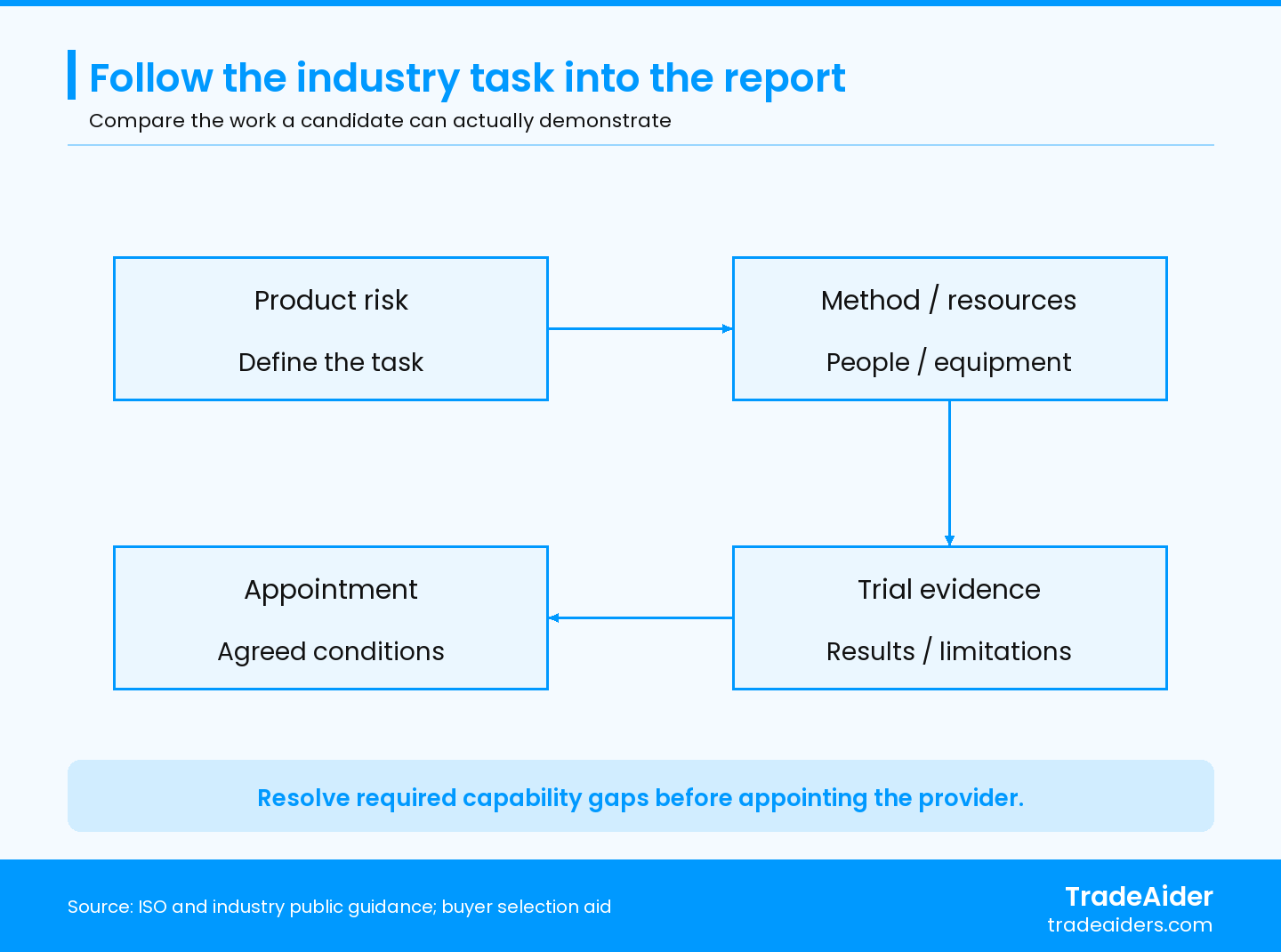
Buyer selection aid. Use the actual industry task and agreed trial conditions when comparing candidate evidence.
Record the industry-fit comparison before appointment
Record each candidate’s industry task, assigned resources, applicable qualifications, report evidence, exclusions, commercial terms and trial outcome before appointment. Mark missing evidence for clarification. Copy the working record below for each candidate and enter a decision supported by the evidence you actually reviewed.
| Selection test | Candidate evidence | Buyer decision |
|---|---|---|
| Product task and risk | Product/version ___ / important risk ___ / check or method ___ | Covered task ___ / clarification ___ |
| Assigned personnel | Relevant experience ___ / required qualification ___ / reviewer ___ | Evidence reviewed ___ / gap ___ |
| Equipment and site | Instruments/setup ___ / provided by ___ / site condition ___ | Ready ___ / outstanding resource ___ |
| Applicable credentials | Requirement ___ / entity/location ___ / current scope record ___ | Condition met ___ / clarification ___ |
| Report usefulness | Comparable report ___ / task result ___ / limitation handling ___ | Usable evidence ___ / missing detail ___ |
| Specialist handoff | Subcontracted task ___ / organization and scope ___ / sample identity ___ | Responsibility agreed ___ / gap ___ |
| Complete quotation | Included work ___ / exclusions ___ / follow-up and change charges ___ | Comparable scope ___ / open cost ___ |
| Trial and appointment | Acceptance conditions ___ / observed output ___ / action and owner ___ | Proceed / clarify / out of scope ___ |
For the polo example, enter laundering colorfastness in the first row and its laboratory route in the specialist row. Identify the sample relationship and test evidence still needed. Leave the appointment decision open until that gap is resolved. Reuse the same record when comparing the candidates’ revised proposals.
Agree the operating scope and review arrangements
Agree the product families, methods, reporting and escalation, confidentiality, subcontracting, commercial terms and change arrangements. Review actual performance when risks or product requirements change. Put the responsibilities and agreed service conditions into the operating agreement and booking instructions.
Identify who supplies references, approves scope changes, receives urgent findings and decides on follow-up. Include how disputes, report corrections and replacement personnel will be handled. Define which changes require a fresh technical review, such as a new product family, manufacturing location, material system or specialist method. Use relevant findings and report quality to review the relationship over time.
Prepare the first industry-specific inquiry
Begin with the product and order information available, factory, destination, timing and industry concerns. Share technical references and reports where available. Before inspection, agree the applicable references, sampling, feasible checks, resources, reporting language and treatment of limitations.
Contact our team to discuss a suitable product-inspection scope and a report of the agreed checks and findings.
FAQ
Can a provider share references without disclosing client secrets?
Ask for a consented reference, a redacted case summary or an anonymized report to assess relevant experience while respecting confidentiality. State which product task or reporting capability you need to evaluate. The candidate can then provide material that demonstrates that work while protecting another client’s commercial information.
How quickly should an inspection company send the report?
Agree the reporting deadline and urgent-finding communication before booking. Clarify when preliminary findings will be available, when technical review is completed and when the final report will be issued. Where a laboratory result follows the site visit, record its separate timing and how that affects the decision.
Can one provider cover a new product family later?
Reassess the new product family against its methods, personnel, equipment and evidence needs. Use the existing relationship’s performance as one input, then review the new technical tasks and applicable qualifications. Update the scope and consider a targeted trial where the new work has yet to be demonstrated.
Verwandte Artikel
Erweitern Sie Ihr Unternehmen mit TradeAider Service
Klicken Sie auf die Schaltfläche unten, um direkt in das TradeAider Service System zu gelangen. Die einfachen Schritte von der Buchung und Zahlung bis zum Erhalt der Berichte sind leicht zu bedienen.