
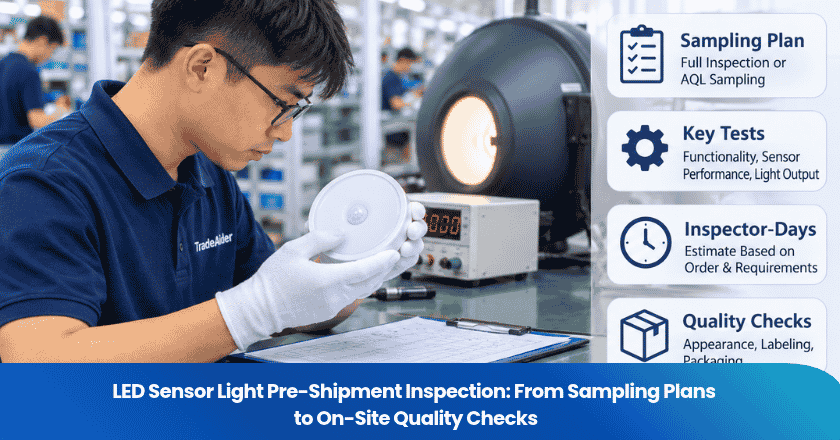
A pre-shipment inspection (PSI) involves much more than checking whether finished products look acceptable. Before an inspection begins, buyers need to understand how many units will be inspected, which quality requirements will be applied, what tests are necessary, and how much inspection time the order may require.
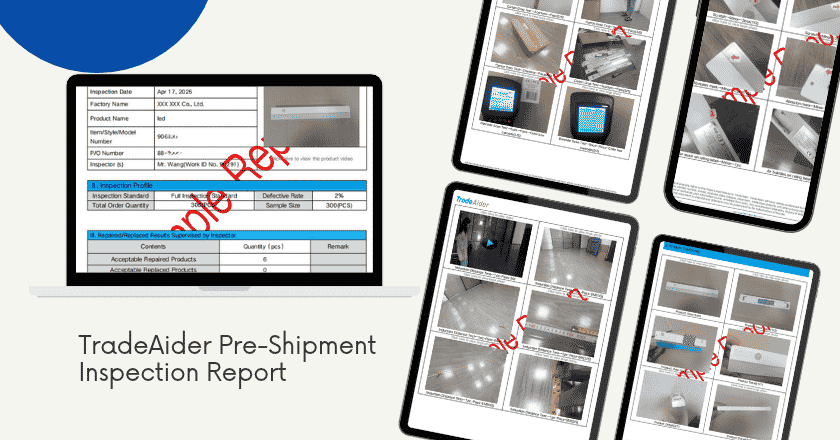
A recent TradeAider pre-shipment inspection of a batch of LED sensor lights provides a practical example of how these considerations come together. The inspection covered product appearance, labeling, functionality, electrical measurements, sensor performance, durability, and packaging.
Looking at this inspection from the buyer's perspective also raises several important questions: Should the entire batch be inspected or should units be selected through an AQL sampling plan? How should different styles and quantities affect the sample size? And how can buyers estimate the number of inspector-days needed before placing an order?
Planning a PSI: How Many Units Should Be Inspected?
One of the first questions buyers ask when arranging a pre-shipment inspection is how many products will be checked.
The answer depends on the inspection method, order quantity, product variations, and the buyer's quality requirements. There are two common approaches: full inspection and sampling inspection.
Full inspection
In a full inspection, every unit in the defined inspection lot is checked against the agreed requirements. This approach may be appropriate for high-value products, small production runs, or orders where buyers want every unit examined.
In the LED sensor light inspection used as our example, the report recorded a full inspection of the presented batch. This meant the inspection was not based on an AQL sample-size calculation.
Sampling inspection
For many larger orders, checking every unit may require too much time and cost. Buyers often use an acceptance sampling plan instead.
A widely used reference is ANSI/ASQ Z1.4, which provides sampling procedures and tables for inspection by attributes. The sample size is determined by factors including:
- Lot size: The total quantity in the inspection lot.
- Inspection level: The selected level determines the sample-size code letter in the standard.
- AQL: The agreed acceptance quality limit used to select the acceptance sampling plan.
- Defect classification: Critical, major, and minor defects may have different acceptance and rejection criteria.
AQL should not be understood as a promise that a certain percentage of defective products will be allowed in every shipment. It is a parameter used in an acceptance sampling system. The resulting sample size and acceptance/rejection numbers must be read from the applicable sampling plan.
Buyers should agree on the inspection level, AQL values, and defect definitions before the inspection takes place. Otherwise, the buyer, supplier, and inspector may interpret the same quality issue differently.
Why Product Styles and Quantities Matter
Order quantity alone does not always determine how an inspection should be arranged.
Consider a hypothetical order containing several styles of LED sensor lights, with different quantities for each style. Even if the total order quantity is fixed, the inspection plan may need to account for differences in product structure, functions, colors, specifications, and packaging.
For example, two styles may share the same appearance but use different sensor components or power configurations. Applying exactly the same test procedure to both without reviewing their specifications could leave important differences unchecked.
When an order contains multiple styles, buyers and inspection providers should clarify:
- How many styles, models, colors, and specifications are included?
- What is the quantity of each style?
- Are the products technically identical, or do they have different functions and components?
- Should each style be treated as a separate inspection lot or covered by a combined plan?
- Does each style require specific functional or performance tests?
The sample distribution should represent the actual order composition. Simply selecting units from the largest style may leave smaller styles insufficiently covered.
For this reason, a sampling plan should be designed around the order structure rather than the total quantity alone. The appropriate approach depends on the lot definition, product similarities, buyer requirements, and the applicable sampling standard.
Estimating Inspector-Days Before the Inspection
Another important consideration is the number of inspector-days required to complete the job.
The sample size is only one part of the workload. Two orders with the same number of units may require very different inspection time if their product structures and testing requirements are different.
For an LED sensor light order, the inspection may involve appearance checks, functional testing, power measurements, sensor-distance verification, internal component checks, and packaging tests. Each additional test may require equipment, preparation, repeated operation, or more time per unit.
When estimating the required manpower and working time, several factors should be considered:
1. Inspection quantity
The number of units to be checked is a basic factor. A full inspection generally requires more time than a sampling inspection of the same lot.
2. Number of styles and product complexity
Multiple styles may require separate inspection records, different specifications, or additional test procedures. A product with more components or functions may also take longer to inspect.
3. Inspection and testing requirements
A basic visual inspection is different from a detailed inspection involving electrical measurements, performance testing, durability checks, or destructive packaging tests.
4. Factory and product readiness
The availability of finished products, inspection space, test equipment, production records, and factory personnel can affect the time needed on site.
5. Inspection scope and reporting requirements
The required documentation, photo and video records, measurement details, and any additional buyer instructions should also be considered.
In practice, inspector-day estimates should be based on the complete inspection scope, not calculated from the sample quantity alone. Buyers should provide the order details and required tests in advance so that the inspection provider can evaluate the workload and arrange suitable manpower.
What Did the LED Sensor Light Inspection Cover?
Once the inspection scope was established, the on-site work moved beyond a simple visual check.
The TradeAider inspection report recorded several quality areas and test activities. These provide useful examples of what buyers may need to consider when preparing requirements for similar products.
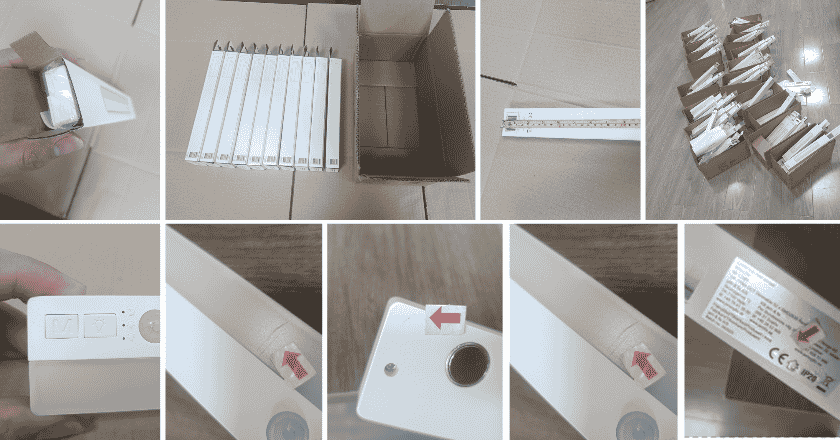
Appearance Inspection and Workmanship Defects
During the inspection, visible defects such as scratches, abrasion marks, and label application issues were identified. These findings highlight the importance of checking product appearance, surface condition, and labeling details before shipment.
Appearance and Labeling
During the workmanship inspection, the inspector recorded minor issues involving scratch marks, abrasion marks, poorly attached rating labels, and air bubbles on labels.
These issues may seem small, but they can affect the product's presentation and the buyer's requirements for retail-ready goods.
A useful inspection standard should explain what constitutes an acceptable surface condition, how labels should be positioned, and whether bubbles, peeling edges, or visible damage are permitted.
The report also documented repaired products that were checked under the inspector's supervision. This illustrates why recording a defect is only part of the process: when on-site correction is permitted by the buyer, the repaired product should be checked again against the agreed requirements.
Functionality and Power Measurements
For an electronic product, a basic power-on check does not necessarily confirm that all functions work as intended.
The LED sensor light inspection included function testing and power measurements. These are related but different checks.
- Function testing verifies whether the product operates as expected under the specified operating conditions.
- Power measurement checks relevant electrical parameters against the agreed specifications.
For sensor lights, buyers should clarify which functions must be tested, how the product should respond, and what electrical values are acceptable. If the product has different operating modes, each required mode should be included in the inspection instructions.
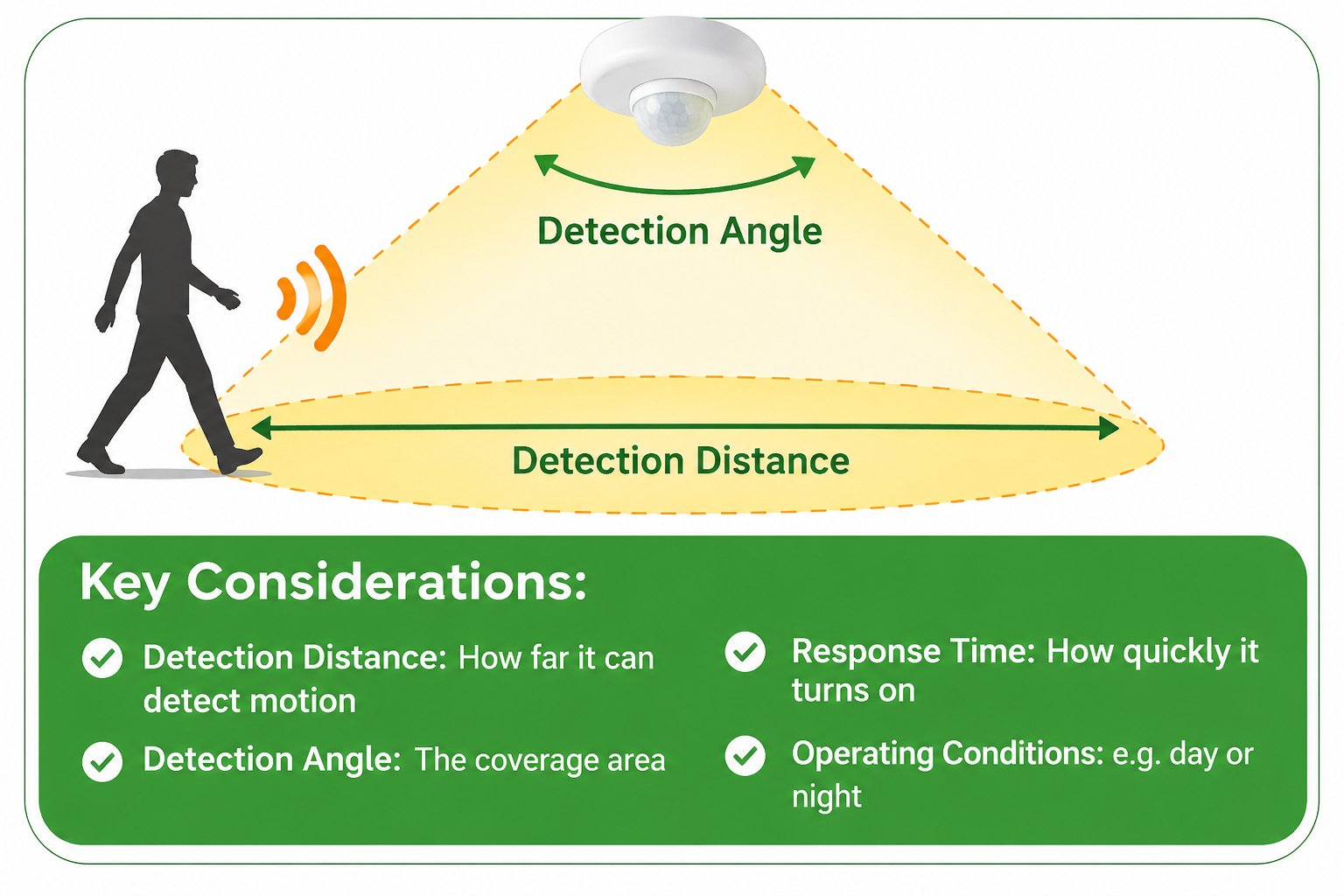
Figure: Key Factors in LED Sensor Detection Performance
The diagram illustrates how detection distance, detection angle, response time, and operating conditions can affect the performance of an LED motion sensor. Actual detection results should be verified through on-site testing under the specified conditions.
Sensor Performance and Actual Use
Sensor performance is another important part of the product's functionality.
The inspection included induction-distance tests under different lighting modes, as well as an actual-use test. These checks help assess whether the sensor responds under the intended conditions.
However, a distance result is meaningful only when the testing conditions are clear. Buyers should define the required detection distance, lighting conditions, sensor orientation, movement approach, and other relevant parameters.
For example, a sensor that responds at a certain distance in a dark environment may behave differently under daylight conditions. Simply writing "sensor works" in an inspection checklist does not provide enough guidance for a consistent assessment.
Integrating Sphere and Durability Tests
The report also recorded an integrating sphere test and a durability test.
An integrating sphere is used in optical measurement to assess light output and related photometric characteristics. For LED products, buyers may use this type of test to verify whether the measured performance meets the agreed product specification.
The important point is to define the required parameters and acceptable ranges before inspection. A test result without a clear reference value may be difficult for buyers to evaluate.
Durability testing, meanwhile, helps assess whether selected product features or components withstand the specified repeated use or test conditions. The exact procedure should be based on the product design and buyer requirements.
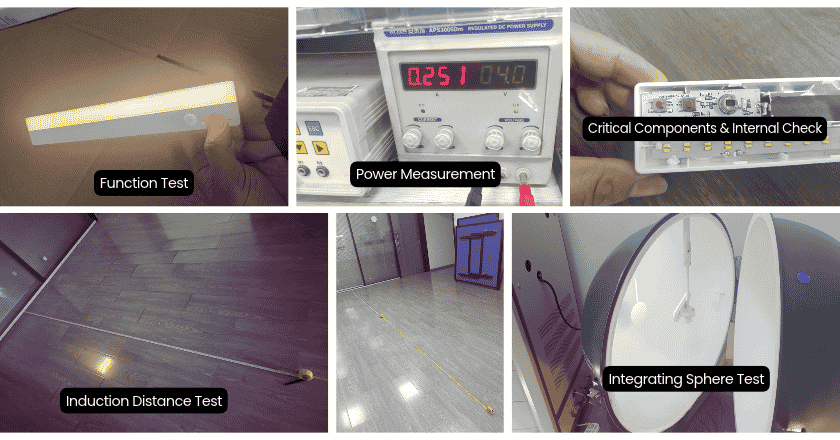
On-Site Functional and Performance Testing of LED Sensor Lights
Selected tests conducted during the pre-shipment inspection, including function testing, power measurement, internal component checks, integrating sphere testing, and induction distance testing.
Internal Components, Battery Assembly, and Packaging
The inspection also included an internal component check, a battery assembly test, and a carton drop test.
These checks address different potential quality concerns:
- Internal component checks help identify visible issues with key components and assembly.
- Battery assembly testing verifies whether the battery can be installed as intended.
- Carton drop testing evaluates the packaging's ability to withstand a defined impact test.
Packaging requirements should not be overlooked. Even when the product itself works correctly, unsuitable packaging can create problems during handling and distribution.
Buyers should specify carton construction, inner protection, packing quantities, shipping marks, and any required packaging test conditions.
How Buyers Can Prepare a Clear Inspection Standard
The inspection example shows why a detailed inspection checklist is important. A buyer does not need to write a complicated technical document, but the key requirements should be clear enough for the inspector to make consistent decisions.
Before arranging a PSI, buyers should prepare the following information:
| Information | What to provide |
|---|---|
| Order details | Purchase order, total quantity, style/model breakdown, and production status |
| Product specifications | Drawings, dimensions, materials, functions, and technical parameters |
| Reference materials | Approved sample, product photos, artwork, labels, and packaging specifications where available |
| Sampling plan | Full inspection or sampling inspection, inspection level, AQL, and defect acceptance criteria |
| Defect classification | Definitions and examples of critical, major, and minor defects |
| Functional tests | Required functions, test methods, operating conditions, and acceptance limits |
| Packaging requirements | Inner and outer packaging, carton specifications, shipping marks, and relevant tests |
| Special instructions | Any additional checks, measurements, or reporting requirements |
A reference sample can be especially useful when appearance, assembly details, or workmanship are difficult to describe in writing. If no approved sample is available, buyers should provide clear photos, drawings, artwork, or other reference materials.
From On-Site Findings to a Better Shipping Decision
A pre-shipment inspection is valuable because it gives buyers a clearer picture of product quality before the goods leave the factory.
In the LED sensor light case, the report documented the inspection conditions, product conformity, packaging and labeling, workmanship, measurements, and on-site tests. It also recorded minor workmanship findings and the products repaired under inspector supervision.
The inspection summary and detailed records should be read together. In this case, the workmanship status in the summary remained pending, while the detailed workmanship section recorded the repair and reinspection information. This distinction matters: individual test results should not be treated as an automatic approval of the entire shipment.
A useful inspection report should help buyers understand:
- What was checked and under which requirements?
- What defects or deviations were found?
- Which tests were performed, and what were their results?
- Were any products repaired or replaced?
- What remains unresolved and requires a buyer's decision?
With TradeAider, inspection information can be viewed through an online reporting system, including photos, videos, measurements, and inspection findings. An official PDF report is provided within 24 hours.
Based on the findings and the agreed inspection criteria, buyers can decide whether to accept the goods, request corrective action at the factory, or reject the shipment. Inspectors follow the buyer's instructions when handling identified issues and verifying agreed corrections.
Make Your Next PSI More Predictable
A well-planned pre-shipment inspection starts before an inspector arrives at the factory. Buyers need to define the inspection scope, select an appropriate sampling approach, clarify product-specific test requirements, and understand the manpower needed to complete the work.
For orders with multiple styles or complex functions, these details become even more important. A clear plan helps avoid misunderstandings, improves inspection efficiency, and gives buyers more useful information for making shipping decisions.
TradeAider provides third-party quality inspection services in China, covering product inspections at different production stages, factory audits, and product testing.
If you are preparing a shipment and need help determining the inspection scope, sampling plan, or estimated inspector-days, contact TradeAider to discuss your order requirements.
FAQs
1. How Many Units Should Be Inspected During a Pre-Shipment Inspection?
The number of units depends on the total lot quantity, selected inspection level, AQL, and whether the buyer requires full inspection or sampling inspection. For multiple styles, the quantity distribution should also be considered to ensure adequate coverage.
2. What AQL Should I Choose for a Pre-Shipment Inspection?
AQL requirements depend on the product type, buyer's quality expectations, and the potential impact of different defects. Buyers commonly define separate AQL criteria for critical, major, and minor defects. These requirements should be agreed upon before the inspection.
3. How Many Inspector-Days Are Needed for a PSI?
Inspector-days depend on the inspection quantity, number of styles, product complexity, required tests, and on-site working conditions. A larger sample size does not necessarily mean proportionally more inspection time if the testing requirements differ.
4. How Is Sampling Arranged for Orders With Multiple Styles?
The inspection plan should consider the quantity and characteristics of each style. Products with different functions, materials, or specifications may require separate sampling or additional checks to ensure that all important variations are covered.
5. What Information Should I Provide to Get a PSI Quotation?
Buyers should provide the purchase order, total quantity, style breakdown, product specifications, inspection requirements, preferred AQL, and any special testing or packaging requirements. These details help the inspection provider evaluate the scope and estimate the required inspector-days.

Verwandte Artikel


Erweitern Sie Ihr Unternehmen mit TradeAider Service
Klicken Sie auf die Schaltfläche unten, um direkt in das TradeAider Service System zu gelangen. Die einfachen Schritte von der Buchung und Zahlung bis zum Erhalt der Berichte sind leicht zu bedienen.