
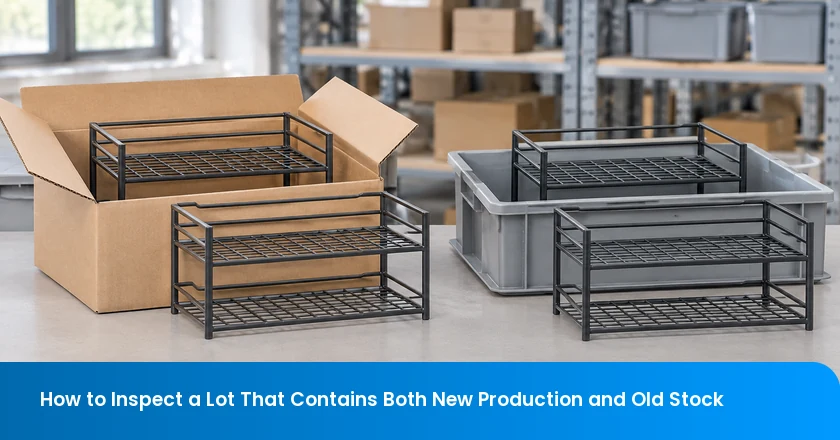
Before drawing samples, check whether the buyer’s order allows the old stock and whether the factory can identify it in the goods presented. Old and new stock can share an inspection lot when both are eligible, traceable and comparable for the agreed checks, and the sampling plan supports a common decision. Use separate lots when the differences need their own acceptance decisions. If the factory cannot establish where the older goods ended up, hold the potentially affected stock while the records are reconciled.
Confirm that the order allows the older stock
Check the order and any written stock approval before including older goods in the eligible inspection population. A stock keeping unit (SKU) identifies the product sold under a particular item code. The same SKU can appear on goods made for the order and on unused inventory from an earlier run. The specifications, packing revision and storage history of those groups can differ.
- Confirm which stored goods are eligible under the purchase order and record the buyer’s decision before selection.
- Trace production batches through storage, transfers and repacking to the actual cartons offered for shipment.
- Agree on the inspection plan and record the result for the goods it covers. Keep any unresolved stock on a separate record.
Start with the purchase order (PO), approved specification and any limits on production date, condition, revisions or remaining shelf life that apply to the product. If the order requires fresh manufacture, keep older stock outside the eligible quantity unless the buyer approves a change. Ask what the factory means by old stock. Unused units from a previous run, customer returns and goods sorted after a defect can have different approval requirements even if all carry the same label.
The NIST Engineering Statistics Handbook describes acceptance sampling as using evidence from a sample to decide the disposition of a defined lot. Eligibility determines which goods can enter that lot. A good result on examined units does not grant permission to supply stock the PO excludes. If stock was proposed to fill a quantity shortfall, show that shortage separately and ask how it will be resolved.
Reconcile the batch and storage records with the goods
Match production, warehouse and repacking records to the actual units and cartons presented before defining the lot. Ask the supplier for counts by batch, production date or run, product and packing revision, original receipt, transfer history and current carton or pallet assignment. Check whether the quantity and batch map agree with the packing list and the cartons on the floor.
Use TradeAider’s inspection standard as a starting point for the brief. Add the batch map and the approval status for each group so the inspector knows what can enter selection and what needs a separate observation or decision.
Trace the units through moves and repacking
Use original batch records and an old-to-new carton map to preserve origin through storage or repacking. If the factory put old and new goods into identical export cartons, ask for the source batch, original carton IDs and the destinations recorded during repacking. Where a single carton contains both groups, verify that unit markings or a reliable packing record can still identify which units came from each batch. An identical carton design gives little help with that question.
The GS1 Global Traceability Standard distinguishes product identification from batch or lot identification. In practice, start with the code of the item, then verify the additional record or marking that tells you which run supplied it. When a tag is unreadable or a pallet contains cartons from more than one run, identify a credible alternative before assigning the goods to a source group.
GS1’s explanation of tracking events distinguishes events such as receiving and packing from the data describing each event. Ask who repacked the stock, where and when it happened, and how many units moved into each new carton range. Record the scope as unresolved if records cannot establish the contents. Any proposed sorting method should rely on verifiable identifiers or characteristics that actually distinguish the groups.
Use storage history to choose the checks
Select storage-related checks from the documented history and the applicable product requirements. Ask where the stock was stored, how long it spent at each location, and whether there was water exposure, damaged packing, opening, sorting or repair. Check any environmental records relevant to the specification. A receipt date helps place the goods in time. It cannot show their condition at each location or what happened after a move.
The Canadian Conservation Institute’s notes on metal storage identify moisture as a factor in corrosion of many metals. For a coated steel product stored in potentially wet cartons, compare the cartons and examine the coating, welds or other areas named in the actual specification. Record water staining and surface condition as observations. They can justify further checks without establishing the cause or condition of the whole batch. Get any age limit and acceptance criteria from the product and order requirements.
Choose a common lot, separate lots, or a hold
Pool only eligible and comparable goods under an approved plan, or define separate samples and decisions for traceable risk groups. Compare the old and new groups against the characteristics that affect acceptance, such as a component change, a packing revision or a difference in storage exposure. Earlier goods can sometimes be comparable for a dimensional check while still needing separate evidence for finish condition or packaging.
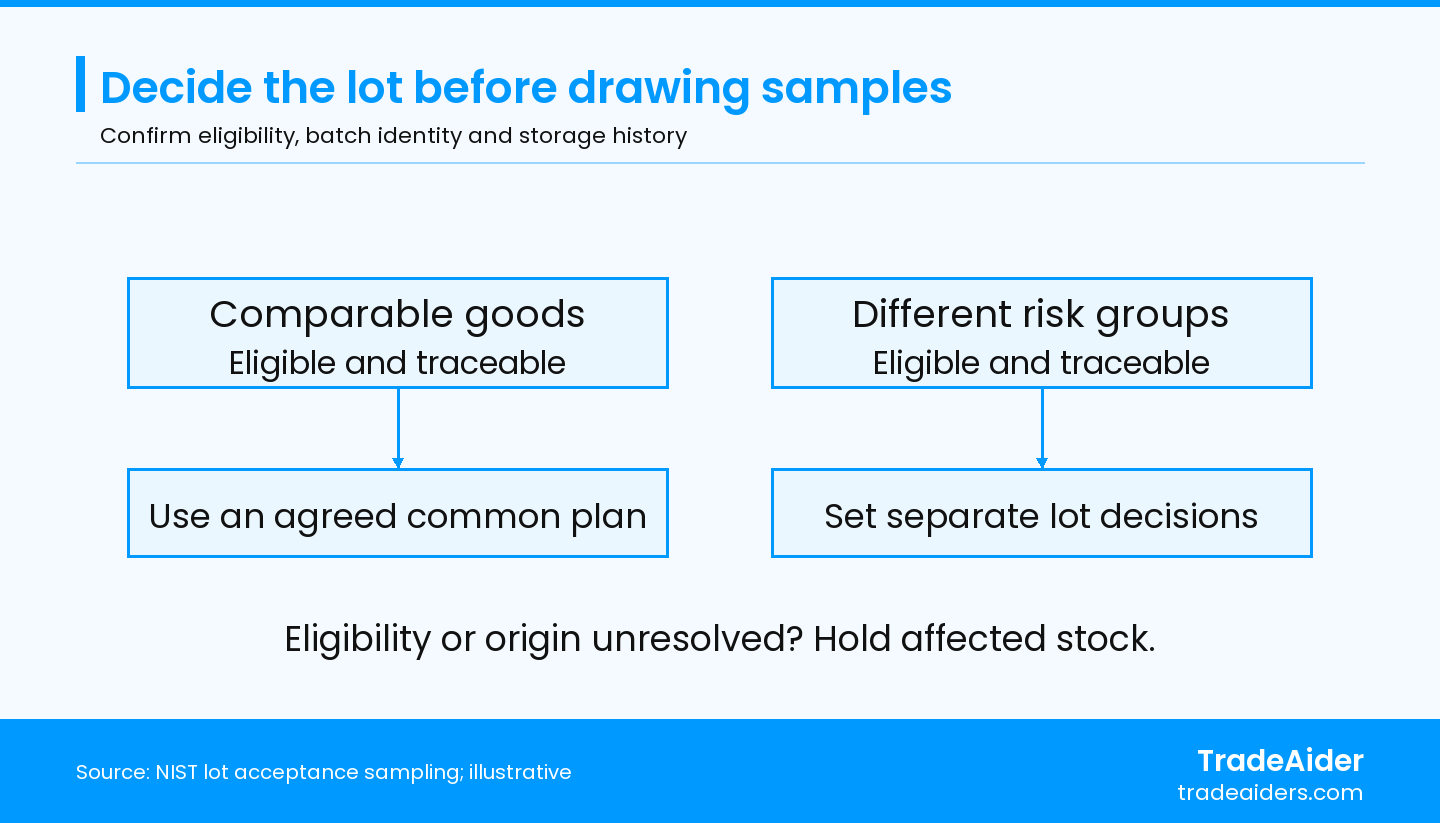
The same SKU can contain separate inspection lots. Link each decision to the actual groups and their condition before selecting units.
NIST’s guidance on lot acceptance sampling plans describes a plan as a selection scheme plus decision rules. Agree the population, applicable standard or order-specific plan, access and selection instructions before the draw. For separate acceptance decisions, use the applicable plan for each lot. If the plan allows a common lot, specify how the sample represents that population and where any additional check applies.
What the evidence showsWhat to do before selectionWhat the result can coverBoth groups are eligible, traceable and comparable for the checksConfirm a common lot and its selection rule in the approved plan.The defined lot under that plan.Both are eligible and traceable, with a difference that affects acceptanceDefine separate lots and a selection and decision rule for each.Each named lot separately.The common plan applies, with a targeted question for one groupAgree added checks on the named group and how to record their selection.The common decision and separate targeted findings within their own coverage.Older goods are unapproved, or origin or a required record is unresolvedExclude identifiable ineligible stock or hold the potentially affected goods pending evidence.Only stock whose scope and eligibility are established.
Statistics Canada’s description of stratified sampling explains that a population can be divided into nonoverlapping groups and sampled independently within them. If your approved common-lot plan uses that approach, define the groups, allocation and combined decision rule in advance. Swapping a few visually suspect units into a random sample changes what the count can mean. Keep targeted checks separately identified and apply the rule agreed for each type of evidence.
TradeAider performs pre-shipment inspection when the order quantity is 100% complete and at least 80% is packed for export. Check whether the eligible lots and required cartons will be accessible at the planned visit. Confirm the scope again if the factory adds, sorts or repacks stock before selection.
A 1,000-unit order with old stock on the same shipment list
Illustrative scenario. A buyer orders 1,000 coated wire organizers under one SKU. The factory offers 720 newly made units in 36 cartons and 280 unused units from an earlier run in 14 cartons, with 20 units per carton. The buyer’s written approval permits unused stock from that run under the current specification. The factory puts both groups on one packing list using the same outer-carton design.
A documented storage difference can change sampling and release for one part of a same-SKU order. The factory’s original batch and repacking records tie the 36 current cartons to the new run and the other 14 to the earlier run. The older stock moved through a storage annex. Four of its cartons show water staining. The code map ties those cartons to the annex transfer but does not show whether the organizers inside got wet.
The buyer instructs the inspector to use separate lot plans for the 720 and 280 units. For the older lot, the buyer also requests a targeted check of the four stained cartons, with results kept separate from the regular sample. That check can document the condition seen inside those cartons. If it shows a broader issue or the warehouse history does not isolate the exposure, review the scope of the hold before deciding what may be released. Consider the new lot on its own result only if the buyer can keep it separate and the order permits a split.
Now suppose the factory mixed cartons during repacking and can identify only 30 of the 36 new cartons. The remaining six new cartons and 14 older cartons cannot be distinguished reliably. The buyer would hold those 20 cartons while asking for a verifiable mapping. The original new-lot plan for 720 units cannot be applied unchanged to the 600 that are still identifiable. Confirm which question needs a new decision and agree the lot and selection accordingly.
Report which stock each decision covers
Record which source group each check and decision cover, and keep unresolved stock out of any release scope. For each lot, record eligibility, batch or carton IDs, available quantity, declared and verified history, sample references, checks and decision criteria. Identify groups inspected only for a particular issue. State which cartons were excluded and why.
Give the warehouse and shipping teams the release and hold list in terms they can match to the physical stock. If the factory sorts, reworks or repacks the goods after inspection, preserve the old-to-new identity map and revisit the coverage for any affected group. Record which cartons were given to the carrier so later additions do not inherit an earlier lot result.
When you contact TradeAider to discuss a mixed-stock inspection, send the PO, the approval for any previously held goods, the batch and carton map, and the storage differences you want checked. Confirm how the available goods will be selected, which checks apply to each group, and how the results will be reported.
Frequently Asked Questions
Can an earlier pass cover the old stock now?
Use an earlier report as evidence for the stock and condition it recorded, then check what has changed since that inspection. Confirm that the remaining cartons are part of its reported lot, and review any transfer, repacking or order change. The earlier report can guide the choice of additional checks once its coverage is established.
Can I keep the new stock moving while old stock is held?
A buyer can consider releasing the new stock separately when its identity and independent inspection decision remain intact and the order permits a split release. Give the warehouse explicit carton and quantity instructions for the release and hold. Confirm that packing and dispatch records preserve the separation through the handoff.
How old can unused inventory be before it needs special checks?
The agreed specification and the product’s storage history determine which checks matter for stored inventory, including any age or shelf life requirements. Ask for available date and storage evidence before making a decision. When a label, warranty or remaining-use requirement depends on a verified date, record the supporting evidence and the units to which it applies.
Verwandte Artikel


Erweitern Sie Ihr Unternehmen mit TradeAider Service
Klicken Sie auf die Schaltfläche unten, um direkt in das TradeAider Service System zu gelangen. Die einfachen Schritte von der Buchung und Zahlung bis zum Erhalt der Berichte sind leicht zu bedienen.