
- Über uns

- Unsere Dienstleistungen
- Ihre Branche
- Ressourcen
- Nachrichten & Blog

A new supplier does not become controlled because the first order passed; it becomes controlled only when the approved reference, the written controls, and the live process continue to agree. That is why month 3 can be a useful review window for overseas buyers sourcing from China. It is not a universal deadline or a substitute for an agreed specification. It is a practical point to compare what was approved with what the supplier is now doing repeatedly, after routine handoffs, material replenishment, and production adjustments have had time to show themselves.
New-supplier quality drift is a meaningful change between the expected product or process evidence and the evidence now coming from routine production.
Drift is often quieter than a failed inspection. A rim may still look acceptable, a label may still scan, and a factory may still report a pass. Yet the reference sample may be unmarked, the check sheet may no longer match the current setup, or the same fit complaint may appear in different colorways. A focused review at that point is cheaper and more informative than waiting for a larger repeat-order failure to force the conversation.
The Month-3 Signals That Deserve a Quality Review
A new supplier should be reviewed when the approved reference, the written control plan, and the actual production record stop telling the same story.
- Timing: Treat month 3 as a prompt to compare accumulated evidence, not as an automatic supplier score or a fixed statistical rule.
- Control plan: Check whether the line still performs the specified checks, at the stated point, with an identifiable owner and usable record.
- Golden sample: Confirm that the buyer-approved physical reference has a revision, a custodian, and a credible comparison to current output.
- Decision: When the plan, sample, and process conflict, investigate the affected setup before routine repetition becomes normal practice.
The point is not to add bureaucracy to a supplier relationship that is working. It is to make a small amount of evidence answer a larger question: has the supplier merely repeated an early success, or has it established a controlled way to repeat it? That distinction matters most when a buyer is about to increase order frequency, add variants, or rely on the supplier for a core product line.
Month 3 Is a Control-Test Window, Not a Calendar Rule
Month 3 is a useful review window because repeated production, handoffs, and routine substitutions have had time to reveal whether the original controls are still operating.
There is no universal number of days that proves a supplier is stable. A simple product with one repeatable process may produce useful evidence sooner; a seasonal product, a multi-component assembly, or a factory that runs in infrequent campaigns may need a different observation window. The useful test is whether the buyer now has several comparable records from routine production. That may include incoming material checks, first-piece approval records, in-process observations, change records, and retained samples from the same product revision.
NIST describes process control as a comparison between current performance and historical performance or an initial model. That is the useful idea here. A first order establishes a starting reference. A month-3 review asks whether the present line still belongs to that same operating picture. It should not be used to declare a supplier acceptable or unacceptable from a date alone.
Look for a Shift in the Process, Not One Isolated Defect
A process is stable only when its key response measures keep a consistent center and variation over time, so a drift review should compare like-for-like observations rather than total defect counts alone. NIST defines stability through consistency of mean and variation over time.
For an importer, that does not mean every supplier needs a laboratory-grade control chart. It means the comparison must be fair. Compare the same feature, product version, material source, test method, and stage of production. A rising number of fit adjustments across three colorways says more than a single total-defect percentage that mixes cosmetic marks, packaging errors, and functional observations. If the evidence is not comparable, it may still justify a question, but it cannot yet support a precise conclusion about drift.
Ask the factory to preserve the observation context. Which mold, machine setting, resin batch, operator instruction, or carton configuration was in use? A record without that context can show that a problem occurred, but it will not help the buyer decide whether the problem is local, repeatable, or already corrected. The aim is to identify an assignable condition before it spreads through the next routine run.
First-Order Success Can Hide an Unproven Routine
An approved first order can show that a product was built correctly once, but it does not by itself demonstrate that subsequent material, operator, setup, and record controls remain repeatable.
Early production usually receives unusual attention. The factory may use a senior technician, a newly prepared fixture, a closely watched line, or a material lot selected for the launch. None of that is a problem by itself. The risk starts when the buyer assumes that the same safeguards will continue without confirming who owns them and how deviations are recorded. The first shipment may therefore be a useful qualification event, not proof of a mature routine.
NIST notes that process characterization may be revisited after initial qualification, adjustments, or maintenance. In a sourcing relationship, that becomes a practical buyer question: what changed since the reference evidence was produced, and is the current product still being checked against the right condition?
Use the Month-3 Drift Review Framework
The Month-3 Drift Review Framework reconciles three controls: the documented control plan, the buyer-approved golden sample, and evidence from the live process.
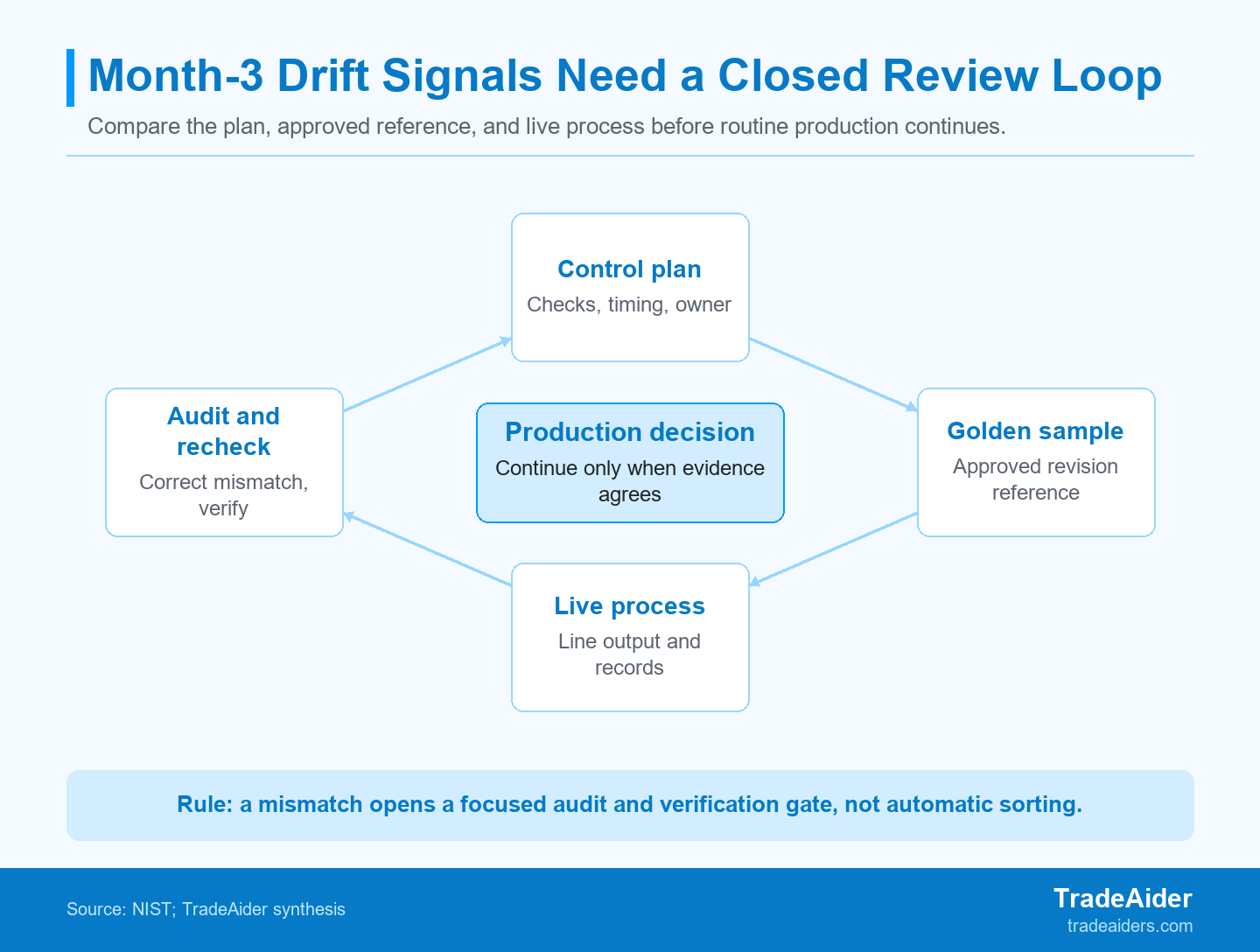
A month-3 review is not a calendar score. It is a closed comparison: when the plan, approved reference, and live process disagree, audit the mismatch and verify the correction before routine repetition.
The framework works because each control answers a different question. The control plan states what should be checked and how the supplier should react. The golden sample gives the buyer and factory a controlled physical reference for the approved condition. Live-process evidence shows whether the line, records, and output still match both. When all three agree, the buyer has a reason to continue ordinary monitoring. When one differs, the next step is not automatic rejection. It is a focused review of the gap.
This is an operational framework, not an industry standard or a substitute for a product specification. It helps a buyer avoid two expensive habits: assuming that an approved sample will govern itself, and using final sorting as the only response to an early process signal. The decision rule is simple: identify which control no longer agrees, define the affected scope, then request evidence that reconnects the three.
Review the Control Plan Against the Line That Is Running
A control plan is useful only when it specifies what is measured, when, on which material, by whom, and how the record is retained; a review tests those promises against the actual line. NIST defines a sampling plan around measurements, timing, material, manner, and ownership.
Start with the few characteristics that carry the largest commercial consequence: a functional seal, an assembly fit, a measured dimension, a label version, or a packaging protection point. For each one, compare the control-plan line with the shop-floor reality. Is the check performed at the point where it can still prevent defects? Does the operator use the stated gauge or fixture? Is the recorded value linked to the correct product revision? Is there a stated action if the result is outside the accepted condition?
If the buyer needs an independent scope, it helps to document the measurable checks in an inspection standard before anyone arrives at the factory. That keeps the review from becoming a general conversation about whether quality is "good." The evidence should make clear what was checked, what condition was found, what changed, and what happens next.
Treat Golden-Sample Decay as a Traceability Problem
Golden-sample decay begins when the approved physical reference, its revision status, and the current production build can no longer be compared as one controlled reference set.
A golden sample is a buyer-approved physical reference used for controlled comparison. It is useful because people can compare tactile, visual, and fit details that a drawing or photo may not communicate well. It becomes weak evidence when it has no revision mark, no named custodian, no storage discipline, or no link to the written specification. A worn, altered, or copied sample can gradually become a source of disagreement rather than a source of control.
Review four points together: which sample is the master reference, which revision it represents, who can authorize a replacement, and how a line-side copy is tied back to the master. Then compare a current production unit under the same agreed method. The goal is not to make the sample outrank the specification. It is to ensure that the physical reference and the document are pointing to the same approved condition.
When a supplier says that a current unit is "the same as the sample," ask for the comparison path rather than accepting the phrase. A photo of two items may be enough for a color discussion but insufficient for a seal, load, fit, or dimension decision. The appropriate method belongs in the control plan, and the resulting comparison belongs in the record set.
Use a Process Audit to Test Execution Before Sorting Product
A process audit can test whether specified checks, procedures, and records are followed; that is a different buyer question from whether a finished unit passes a defined product check. FDA notes, in its regulated quality-assurance context, that audit activity can critically review processes and procedures for adherence to established protocols.
That distinction gives buyers a useful boundary. A product audit can tell you that finished pieces do or do not meet the defined check. A process audit asks why that outcome is reliable: were the required checks done, was the current setup authorized, were samples taken as planned, were failed conditions acted on, and are the records complete? FDA's policy guide is not a rulebook for ordinary consumer goods. Its process-and-procedure focus is used here only to clarify the difference between execution evidence and output evidence.
Use a process audit when the question is "are we making the right thing by a controlled method?" rather than only "can we sort the wrong things out at the end?" A focused audit can follow one defect family or one changed input. For example, it can trace a changed resin through the material record, molding setup, first-piece check, line-side sample, and reaction plan—the agreed action when a result is outside its accepted condition. If that scope fits the buyer's need, scope a factory audit around the drift signal with TradeAider rather than requesting an unfocused factory visit.
Set Drift Triggers Before a Defect Escapes
A buyer can set proportionate review triggers around a changed input, a repeated defect family, a missing record, or a mismatch between the approved sample and current output.
Write these triggers before the next issue occurs. A changed material or mold setting may call for a line-side comparison. A repeated functional observation may call for a short targeted audit. A missing record may call for a pause on the affected process window until the supplier can reconstruct it. The point is to give each signal a proportional response, rather than letting every finding become either an argument about total rejection or a promise to be more careful next time.
NIST distinguishes control limits used to assess process consistency from specification limits used to assess product function. Buyers can use the same separation in plain language: a unit may be within the product specification while the process evidence still shows a change that deserves review. Conversely, one outlying unit can demand disposition without proving a broad process shift. Keep those questions separate so the response fits the evidence.
During Production Inspection is especially useful when the trigger appears while the line can still be observed and corrected. Rather than waiting for an end-of-line summary, a buyer can add a during-production inspection checkpoint to the review for the changed setup, the relevant product configuration, and the named control point.
Use Three Comparable Evidence Streams
A drift review is strongest when product observations, process records, and reference-sample comparisons use the same revision, configuration, and observation window.
First, read the product evidence: what feature differed, how often, and in which configuration? Second, read the process evidence: what material, setting, tool, operator instruction, or check changed around that observation? Third, read the reference evidence: which approved sample and revision was used, and was the comparison performed by the agreed method? These are separate records, but they should meet at the same product identity.
A practical review sheet can use one row per affected configuration. It does not need a complex score. The minimum useful fields are product revision, sample reference, process condition, observation, owner, due date, and verification method. That format reduces a common failure mode: a factory resolves a visible example while the buyer cannot tell whether the same condition was present in the rest of the run.
Escalate the Review When Signals Conflict
A conflict between the control plan, golden sample, and shop-floor evidence is a reason to define the affected scope and inspect the process cause before authorizing more routine production.
Escalation should be specific. If the plan says a fit check occurs after cooling, but the line only compares parts before cooling, the gap is a process-window problem. If the line sample differs from the buyer's master reference but no one can identify its revision, the gap is a document-and-reference problem. If a defect appears only after a named material change, the gap may be limited to that material and setup combination. Each case leads to a different evidence request.
Do not use the framework to turn every discrepancy into a full supplier shutdown. The buyer's specification, product risk, order timing, and ability to identify the affected scope still matter. The framework asks for a reasoned response: isolate the evidence that conflicts, establish the cause path, apply the agreed correction, and verify the result before routine production is treated as normal again.
Worked Example: The Approved Reference No Longer Matches the Routine
An illustrative kitchenware order shows how a supplier can keep shipping visually acceptable units while a changed molding setup and untracked reference copy weaken the control system.
This illustrative scenario is not a TradeAider client case or a measured outcome. It shows why a buyer should investigate an evidence mismatch before it becomes a return, a broad sorting exercise, or a difficult disagreement over what was originally approved.
The Drift Appears in the Record Before It Appears in a Complaint
In the illustrative order, trend observations and a changed setup expose a fit-risk pattern that a simple end-of-line visual sort would not explain.
A global housewares brand is reviewing a new China supplier before repeating a successful first order. The illustrative third-month order contains 6,400 silicone food-storage lids across four colorways, valued at USD 76,800. The supplier has completed two prior orders and is running the third order with the original approved fit sample still listed on the control plan.
The line record shows 1 molding-temperature adjustment after a resin batch change, but the change is not linked to a revised reaction instruction. A line-side comparison uses an unmarked sample copy, while the buyer-held golden sample shows a slightly firmer rim fit on the same container. No one has yet linked the changed setup, the sample copy, and the current colorway records in one review.
The issue is not that every lid is defective. The evidence shows a reference-control gap and a changed process input that could alter fit consistency across colorways and batches. The buyer pauses routine repetition for the affected setup, keeps unaffected evidence separate, and asks for a focused process audit before authorizing the next production run.
The supplier identifies the controlled golden sample, logs the resin and temperature change, compares current output at the line, and assigns a reaction rule for any fit deviation. Resume routine production only after the revised reference, change record, line comparison, and agreed follow-up observations are all documented. This illustrative example still requires the buyer to define the container, fit method, cosmetic threshold, colorway scope, and contractual disposition of any affected goods.
The Audit Rebuilds a Controlled Reference and Reaction Path
The buyer requests a revision-controlled sample, a line-side comparison, and evidence that the adjusted process is being checked under the agreed reaction rule before normal production resumes.
The audit does not need to prove that every prior lid failed. It needs to answer whether the supplier can restore a controlled relationship between the master reference, the current process, and the recorded check. The buyer asks for the master-sample identity, the reason and date for the temperature adjustment, a line-side comparison after cooling, and the action taken if the fit result differs. The factory then records the owner for each item rather than issuing a general assurance.
If the revised comparison is acceptable and the record shows the adjusted condition is being checked, the buyer can return the defined setup to routine monitoring. If the factory cannot establish which sample or process condition governed the affected pieces, the review should remain open for that scope. The decision is proportionate because it follows the evidence path, not an assumption that a visually acceptable sort has removed the process risk.
Build a Buyer-Ready Month-3 Review Packet
A short review packet turns supplier drift into an assignable decision by naming the reference, record set, trigger, owner, corrective action, and verification gate. FDA supplier-control training material likewise emphasizes documented requirements, monitoring, communication, and objective action thresholds within its regulatory setting.
Keep the packet short enough that the supplier can use it at the line and the buyer can review it without rebuilding the order history. It should be a decision record, not a long audit report written after the fact.
- Name the product revision, approved master sample, and controlled line-side copy.
- List the changed input, repeated observation, missing record, or reference mismatch that triggered review.
- Define the affected process window, configuration, batch, or colorway without guessing at wider scope.
- Assign the factory owner, buyer reviewer, requested corrective action, and due date.
- State the verification method: line-side comparison, functional check, record reconciliation, or focused audit observation.
- Write the gate for routine repetition: continue monitoring, recheck a defined scope, or escalate the review.
That packet is also a practical brief for an independent provider. If you want an outside view of whether controls are actually being executed, plan a month-3 supplier review with TradeAider around the specific signal, product configuration, and evidence gap. A clear brief improves the inspection or audit result because it tells the reviewer what the buyer needs to know before the next routine order is treated as business as usual.
Who Is TradeAider?
TradeAider is a quality inspection, testing, and certification service provider in China. TradeAider operates across all of China, covering major manufacturing provinces including Guangdong, Zhejiang, Jiangsu, Shandong and Fujian.
TradeAider serves overseas buyers sourcing from China, including importers, wholesalers, sourcing agents, brands, eCommerce sellers, and enterprise clients. Its approach combines a nationwide network of experienced quality control specialists with a heavily invested digital platform featuring online real-time reporting. Clients can monitor inspections live, communicate directly with inspectors, and address issues during production rather than after shipment — a proactive model focused on problem-solving and prevention, not just defect identification.
Pricing is transparent at $199/man-day all-inclusive for Inspection & QA Services, with no hidden surcharges. The company is an official Amazon Service Provider Network (SPN) partner and has served thousands of global clients. Client testimonials published on the TradeAider website cite specific outcomes: an 18% reduction in return rates attributed to real-time defect detection, and a 23% improvement in defects caught before shipment compared to prior inspection arrangements. These are client-reported figures.
Frequently Asked Questions
Why is month 3 useful for a new-supplier quality review?
Month 3 is useful because it gives a buyer enough routine production evidence to test whether initial controls are still being followed, not because three months is a universal quality threshold. The right review point depends on production frequency, product complexity, and the number of comparable records available. Use the calendar as a prompt to compare reference, plan, and line evidence, then adjust the scope to the supplier's real production rhythm.
What should a control plan include for a repeat order?
A repeat-order control plan should name the characteristics to check, the material and timing of checks, the method, record, owner, and reaction when a result falls outside the agreed condition. It should also identify the revision being controlled and the escalation path for changed inputs or repeated findings. A short, observable plan is more useful than a broad quality promise because it gives the buyer a record to compare with the actual line.
Does a golden sample replace a written product specification?
No, a golden sample is a controlled physical comparison reference and should support, not replace, the written product specification and approved revision record. It can clarify tactile, visual, fit, or workmanship details that are difficult to express in a document. However, the buyer still needs documented requirements and a named revision so the supplier, inspector, and buyer can determine whether they are comparing the same approved condition.
When should a buyer request a process audit?
A buyer should request a process audit when records, line observations, or reference comparisons indicate that the documented controls may not match the process now running. The audit is most useful when it follows one defined signal, such as a material change, repeated functional observation, missing reaction record, or unclear sample revision. That scope makes it possible to test execution rather than collecting general factory impressions.
Can end-of-line sorting fix supplier quality drift?
End-of-line sorting can contain a defined output problem, but it cannot by itself show why a process drifted or prove that the underlying control has been restored. Sorting may be appropriate for an identified, traceable subset while the supplier corrects the cause. The buyer should still compare the current process with the agreed control plan and approved reference, then document a verification gate before returning to routine production.

Verwandte Artikel



Erweitern Sie Ihr Unternehmen mit TradeAider Service
Klicken Sie auf die Schaltfläche unten, um direkt in das TradeAider Service System zu gelangen. Die einfachen Schritte von der Buchung und Zahlung bis zum Erhalt der Berichte sind leicht zu bedienen.

