
- Über uns

- Unsere Dienstleistungen
- Ihre Branche
- Ressourcen
- Nachrichten & Blog
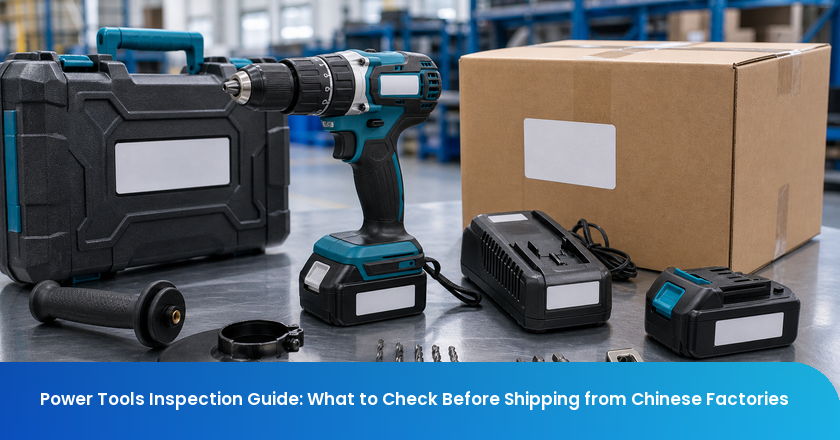
Power tool inspection should verify the shipped kit against electrical evidence, function, guards, switches, battery and charger identity, labels, accessories, AQL defects, and packaging before release.
Power tools create expensive quality risk because the buyer is not shipping a simple finished product. A sellable kit may include the tool body, battery pack, charger, blade or bit, guard, handle, wrench, manual, warning labels, retail case, spare parts, and destination-market electrical evidence. If any layer is wrong, the product can become unsafe, unsellable, or costly to support.
A useful pre-shipment inspection does not claim to replace electrical safety certification, battery transport testing, or regulatory review. It confirms that the physical lot matches the approved version and that sampled units perform the buyer's defined checks before the goods leave the factory.
Key Takeaways
- Do not inspect only the tool body: The charger, battery, guard, accessories, manual, labels, and case are part of the sellable unit.
- Separate certification from inspection: On-site PSI verifies lot identity and function; it does not create missing electrical safety evidence.
- Use AQL with critical gates: AQL can count workmanship defects, but wrong charger rating, failed switch lock, missing guard, or battery mismatch should override normal acceptance logic.
- Check use conditions: Trigger, speed, noise, vibration clue, guard fit, charging behavior, and accessory fit should be checked under a defined safe test sequence.
- Keep release photos: Importers need evidence of labels, ratings, battery and charger models, accessories, opened kits, and packaging before shipment.
Start With Electrical and Safety Evidence
The first release question for a power tool is whether the physical shipment matches the evidence file. A factory can build a tool that powers on, but if the charger model, battery cell pack, rating label, plug, manual, or guard differs from the tested version, the buyer no longer has a clean release decision.
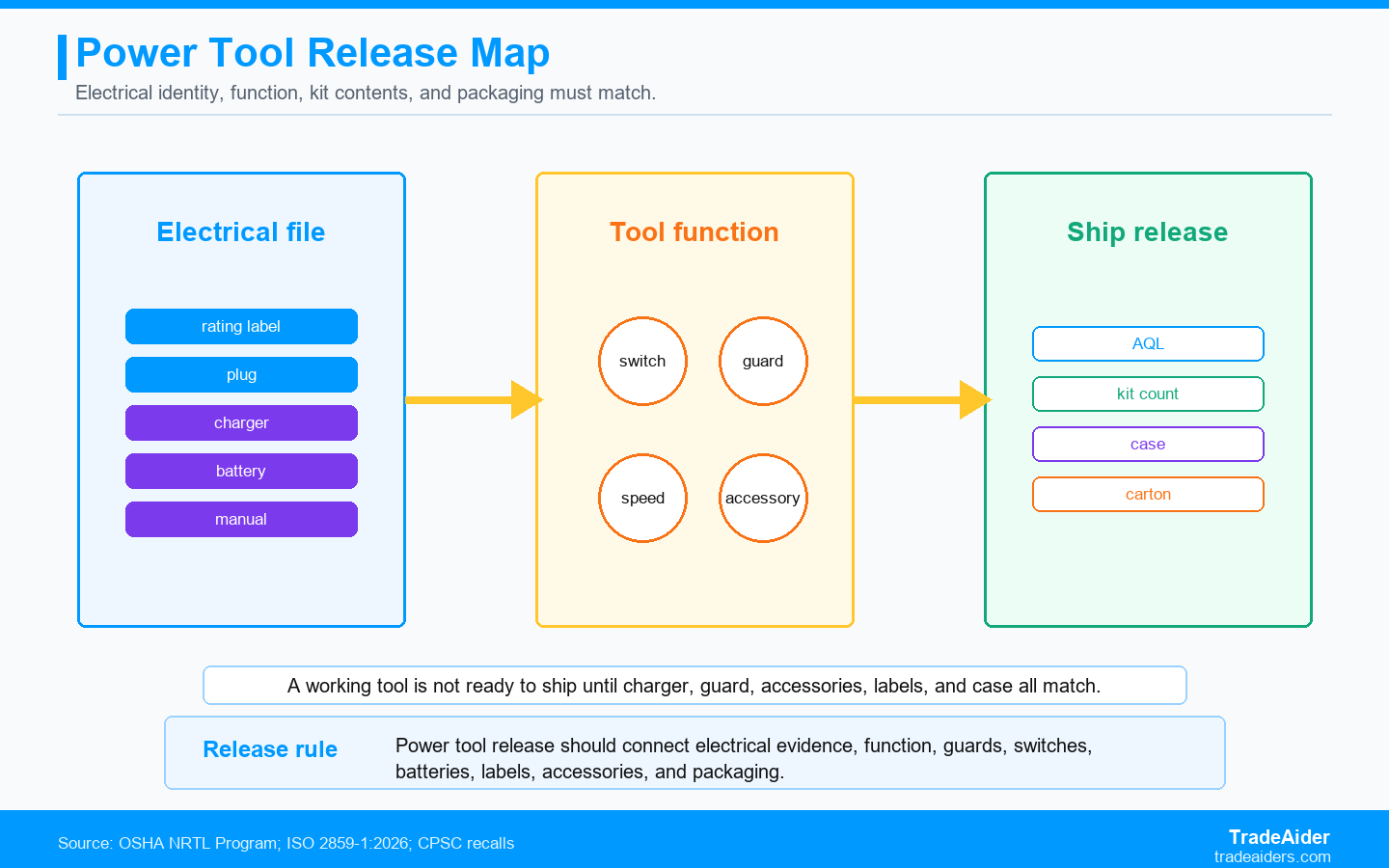
Power tool release should connect electrical evidence, function, guards, switches, batteries, labels, accessories, and packaging.
NRTL marks and test reports must match the shipped model
The OSHA NRTL Program recognizes private-sector organizations to certify certain products against product safety standards and explains that an NRTL mark indicates the product was tested and certified within the NRTL program. For importers, the inspection task is not to validate the certification itself. It is to verify that the model, rating label, plug, and kit components in the carton match the certificate or test evidence the buyer already has.
If a supplier changes the charger, battery pack, motor rating, plug type, housing, switch, or guard after approval, a visual pass is not enough. The inspection report should flag the mismatch so the buyer can hold the lot, request documentation, or re-test before release.
Battery and charger identity should be treated as critical
Battery-powered tools add a second evidence layer. The CPSC battery safety standards topic page notes recalls involving lithium-ion batteries, battery packs, chargers, and portable battery-powered tools, and explains that high-energy batteries require safeguards because they store more energy in smaller packages. For EU-bound products, the European Commission batteries rules page page points to Regulation (EU) 2023/1542 and battery obligations that may affect products containing portable batteries.
Inspection should therefore photograph battery model, capacity, warning label, charger output, plug type, polarity where relevant, pack fit, charging indicator, and manual references. A wrong charger may look like a small accessory mistake, but it can affect safety, customer support, and market access.
Warnings and manuals are release evidence, not paperwork
Power tools need clear warnings, destination language, operating instructions, PPE guidance, guard instructions, battery charging instructions, and service information where relevant. The inspector should confirm that the manual and label belong to the exact model and destination. A manual for a similar model can miss critical guard, switch, or battery instructions.
When the buyer receives photos of the rating label, warning label, manual cover, and key instruction page, the release decision becomes traceable. If authorities, retailers, or customers later question the product, the buyer can show what was present before shipment.
Function Checks Must Follow Safe Use Logic
A power-on test is not enough for power tools. The inspection should follow a safe, limited test sequence that reflects real use without asking the inspector to perform unsafe endurance testing. The goal is to catch obvious function, assembly, and kit failures before shipment.
Trigger, speed, lock, and brake behavior need defined checks
Different tools need different checks. A drill may need trigger response, speed setting, reverse switch, chuck operation, battery fit, charging behavior, runout clue, and LED function. A grinder may need guard fit, switch lock, spindle rotation, handle assembly, and accessory fit. A saw may need guard return, blade alignment, safety switch, and base adjustment.
The buyer should define safe test duration, no-load operation, and sampling frequency before inspection. Without that scope, the factory may demonstrate only the easiest function while the inspection misses a repeat switch or guard problem.
Guards and mechanical safety parts should not be optional
Guards, handles, clips, locks, covers, chuck keys, safety switches, and protective housings should be inspected as critical product features. If the guard fits loosely, the auxiliary handle is missing, the lock button sticks, or the switch fails to return, the product should not be treated as a minor cosmetic issue.
Mechanical safety parts also create traceability problems when factories substitute accessories. The report should show the accessory installed or fitted where practical, not merely photographed in a bag.
Noise, vibration, heat, and odor are clues, not lab results
Inspectors can observe abnormal noise, heavy vibration, unusual heat, burning smell, loose housing, unstable rotation, or intermittent power during a short function check. These observations are not laboratory performance data, but they are useful release clues. A sampled unit that smells burnt during a short no-load test should trigger hold or technical review.
The report should be careful with language: it can say what was observed under the defined check, not that the product is fully safe for all use conditions. That boundary keeps the inspection useful without overstating what PSI can prove.
Kit Completeness and Accessory Control
Power tool returns often come from kit errors rather than the tool motor. Missing bits, wrong charger, wrong plug, incomplete manual, swapped battery capacity, missing handle, or weak carrying case can make a shipment unsellable even when sampled tools run.
The bill of materials should be checked per selling unit
The inspection should open sampled kits and compare contents to the bill of materials: tool, battery count, charger, plug, blade, bit, guard, handle, wrench, manual, warranty card, label, case, and any spare part. If the product is sold as a kit, the kit is the unit of inspection.
For multi-market shipments, accessory identity should be checked by destination. A UK plug in a US shipment, an EU manual in an Australian carton, or a different charger output can create a hold even if the tool itself is correct.
Label and carton identity must separate similar models
Power tool factories often produce similar models with different voltage, battery capacity, charger, guard, or accessory bundles. The inspection should connect product label, retail box, carton mark, purchase order line, barcode, and physical contents. Similar-looking models should not be sampled as if they were one SKU.
A good report shows the opened kit and its label together. That lets the buyer isolate affected SKUs when a mismatch appears instead of questioning the entire shipment.
Packaging should protect heavy components and sharp accessories
Power tools are heavy and can damage their own packaging. Chargers, batteries, bits, blades, and guards should be separated so they do not rub, puncture, or crack during export. The inspection should check inner tray strength, case latch, accessory compartment, cable protection, carton strength, and whether sharp accessories are securely packed.
Packaging failure often becomes customer-visible damage: cracked case, scratched housing, bent blade, dented charger, loose battery, or broken insert. These are preventable factory release issues.
AQL and Critical Release Gates
AQL under ISO 2859-1:2026 can support lot-level decisions for workmanship defects, but power tools need separate critical gates. A lot can be cosmetically acceptable and still fail release because of one repeated electrical identity mismatch or safety-component failure.
Critical defects should override the defect count
Critical defects may include wrong charger rating, exposed conductor, missing guard, failed switch return, damaged battery pack, missing warning label, wrong plug, severe overheating clue, or model mismatch against safety evidence. These issues should not be averaged into a normal AQL pass.
The release rule should say which defects cause automatic hold, which require rework and reinspection, and which can be accepted within minor tolerance. That rule prevents pressure to ship a risky lot because total defects appear low.
Major defects should follow customer-use consequences
Major defects may include failed function, missing accessory, poor charger fit, weak case latch, wrong manual, damaged retail box, loose handle, poor guard fit, unreadable barcode, or visible defect that harms sales. These issues affect use, installation, support, or marketplace acceptance.
Minor defects should be limited to small nonfunctional marks that do not affect safety, use, packaging, or listing accuracy. The buyer should not let a factory classify functional or kit errors as minor cosmetic issues.
Reinspection should focus on the corrected risk
If a lot fails because of wrong chargers, reinspection should verify charger identity across affected cartons. If it fails because of missing guards, reinspection should open kits and fit guards. A generic second inspection can miss the correction that actually matters.
The reinspection report should show before-and-after evidence so the buyer can close the supplier CAPA and decide whether future orders need tighter incoming accessory control.
Power Tool Release Checklist
| Release Layer | What To Verify | Decision Rule |
|---|---|---|
| Electrical evidence | Model, rating label, plug, certificate/test file match | Hold if shipped identity differs from approved evidence |
| Battery and charger | Battery model, charger output, plug, charging indicator, warning label | Treat mismatch as critical release issue |
| Function | Trigger, speed, reverse, guard, lock, no-load operation | Escalate abnormal heat, odor, vibration, or failed switch |
| Kit contents | Accessories, manual, handle, case, spare parts | Release only when selling unit is complete |
| AQL defects | Critical, major, and minor defects by agreed class | Accept, reject, or rework by defect class and limits |
| Packaging | Inner tray, case, carton, sharp accessory protection | Repack if heavy or sharp parts can damage the unit |
Where TradeAider Fits In Power Tools Inspection
TradeAider can support power tool importers through pre-shipment inspection services that check sampled function, AQL workmanship, kit completeness, labels, packaging, and release evidence before export. Buyers should provide model lists, approved samples, accessory BOM, rating label files, manual files, battery and charger requirements, and defect classes before inspection.
TradeAider's real-time reporting is useful when the inspector finds a charger, label, guard, or accessory mismatch. The buyer can request extra photos, compare the lot to the evidence file, and decide whether to hold, rework, or reinspect while the factory can still correct the issue.
SPAR Scenario: The Drill Kit Worked, but the Charger Was Wrong
Situation: A buyer ordered cordless drill kits with two batteries, a US charger, accessory bits, and a molded case.
Problem: Sampled drills worked, but one carton group contained a charger with a different output rating and a similar-looking label. The retail box still showed the approved model.
Action: The buyer held the affected carton group, asked for charger replacement, and required reinspection photos showing charger label, battery fit, opened kits, and carton marks.
Result: The shipment moved after correction, and the supplier added a charger identity check before final packing on the next order.
Power Tools Inspection Checklist
- Match tool, charger, battery, manual, label, and carton identity.
- Define safe function checks by tool type before inspection.
- Open kits and count all accessories by SKU.
- Classify wrong charger, failed guard, or switch failure as critical.
- Photograph rating labels, battery labels, and opened kits.
- Reinspect corrected carton groups before release.
If your shipment contains power tools, chargers, batteries, blades, or accessory kits, send TradeAider the model list, BOM, rating label file, and safe function checklist so release evidence can be checked before shipment.
Who Is TradeAider?
TradeAider is a quality inspection, testing, and certification service provider in China. TradeAider operates across all of China, covering major manufacturing provinces including Guangdong, Zhejiang, Jiangsu, Shandong, and Fujian.
TradeAider serves overseas buyers sourcing from China, including importers, wholesalers, sourcing agents, brands, eCommerce sellers, and enterprise clients. Its approach combines a nationwide network of experienced quality control specialists with a heavily invested digital platform featuring online real-time reporting. Clients can monitor inspections live, communicate directly with inspectors, and address issues during production rather than after shipment - a proactive model focused on problem-solving and prevention, not just defect identification.
Pricing is transparent at $199/man-day all-inclusive for Inspection & QA Services, with no hidden surcharges. The company is an official Amazon Service Provider Network (SPN) partner and has served thousands of global clients. Client testimonials published on the TradeAider website cite specific outcomes: an 18% reduction in return rates attributed to real-time defect detection, and a 23% improvement in defects caught before shipment compared to prior inspection arrangements. These are client-reported figures.
Frequently Asked Questions
Can PSI replace electrical safety certification for power tools?
No. PSI cannot replace electrical safety certification, battery transport testing, or destination-market compliance review. It can verify that the physical shipment matches the approved evidence file and that sampled units perform defined checks. If the charger, battery, rating label, or model identity differs from the evidence file, release should be held for technical review.
Is AQL enough for power tools?
AQL is useful for sampled workmanship decisions, but it is not enough by itself. Power tools also need critical release gates for electrical identity, guards, switches, batteries, chargers, warnings, and kit completeness. A lot can pass cosmetic AQL limits but still require hold if a safety-related component or accessory is wrong.
What are common power tool inspection failures?
Common failures include wrong charger, missing accessory, weak guard fit, failed switch return, unreadable label, wrong plug, poor case latch, damaged battery pack, abnormal vibration, damaged retail box, mixed SKU cartons, and missing manual. The most serious failures are usually identity, electrical, and safety-component mismatches rather than small cosmetic marks.
Should inspectors operate power tools during PSI?
Inspectors can perform limited safe function checks if the buyer defines the test scope and conditions. They should not perform unsafe endurance, destructive, or certification-level testing during PSI. The report should describe what was checked, such as no-load operation, switch function, guard fit, battery charging indicator, or accessory fit, and avoid overclaiming product safety.
Verwandte Artikel

Erweitern Sie Ihr Unternehmen mit TradeAider Service
Klicken Sie auf die Schaltfläche unten, um direkt in das TradeAider Service System zu gelangen. Die einfachen Schritte von der Buchung und Zahlung bis zum Erhalt der Berichte sind leicht zu bedienen.

