
- Über uns

- Unsere Dienstleistungen
- Ihre Branche
- Ressourcen
- Nachrichten & Blog
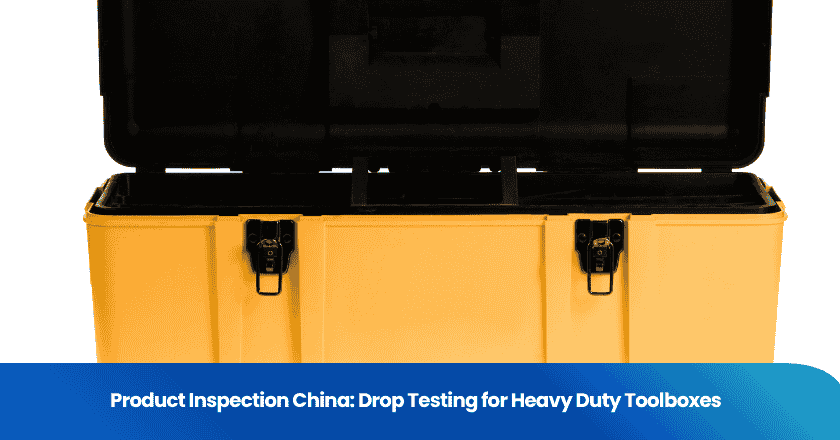
You have spent months designing a heavy duty toolbox. The steel gauge is right, the latches click perfectly, and the powder coating looks flawless. Then your shipment arrives at a US warehouse — and 30% of the toolboxes have dented corners, bent hinges, or failed latches. That is not a factory defect. That is a shipping damage problem that drop testing during product inspection in China could have caught before the containers left port.
Drop testing is one of the most practical, cost-effective ways to verify that your toolboxes can survive the real-world punishment of international logistics. This article walks through the standards, the process, and how to integrate drop testing into your pre-shipment inspection workflow so defects never reach your customers.
Key Takeaways
- Drop testing simulates real-world shipping hazards — it exposes structural weaknesses in toolboxes before they leave the factory, saving you return costs and brand damage.
- ASTM D4169 and ISTA 3-Series are the dominant standards — they define drop heights, orientations, and pass/fail criteria for packaged industrial goods.
- On-site testing in China catches problems at the source — you get actionable data while the factory can still fix issues, rather than discovering damage at your warehouse.
- Real-time inspection reporting lets you witness test results and make shipping decisions without waiting days for a PDF.
Why Drop Testing Matters for Heavy Duty Toolboxes
The Real Cost of Shipping Damage
Heavy duty toolboxes are heavy — often 30 to 80 lbs when fully loaded with tools. They get stacked, dropped, dragged, and tumble-loaded through multiple logistics handoff points: factory to truck, truck to port warehouse, warehouse to container, container to vessel, vessel to destination port, port to distribution center. Each transition is an opportunity for impact damage.
A study published by the U.S.-China Economic and Security Review Commission highlighted that quality control gaps at Chinese manufacturing facilities continue to create uncertainty for U.S. importers assessing production quality. For heavy duty toolboxes, this translates directly into dented shells, broken welds, and malfunctioning latches that erode customer trust and trigger returns.
Consider a real-world scenario: an Amazon FBA seller importing 2,000 units of a 50 lb steel toolbox discovers that 18% arrive with cosmetic dents and 5% have non-functional latches. At $45 per unit in return processing costs alone, that single shipment costs $18,000 in damages — far more than the cost of a pre-shipment inspection that includes drop testing.
Industry Standards That Govern Drop Testing
Drop testing is not guesswork. It is governed by well-established international standards that specify exactly how products should be tested, from drop height to impact orientation:
| Standard | Issuing Body | Best For |
|---|---|---|
| ASTM D4169 | ASTM International | Performance testing of shipping containers |
| ISTA 3A / 3E | ISTA | General simulation for packaged products |
| ISO 2248 | ISO | Vertical impact testing of packages |
| IEC 60068-2-31 | IEC | Drop and topple testing for electrotechnical products |
For heavy duty toolboxes, ASTM D4169 and ISTA 3-Series protocols are the most widely used. According to ASTM International, the D4169 standard provides a basis for evaluating how shipping containers perform under realistic distribution conditions — including drops, impacts, and vibration. The International Safe Transit Association (ISTA) offers complementary test procedures that simulate the full spectrum of handling hazards.
How Drop Testing Works in Practice
ASTM D4169 and ISTA Test Protocols
Under ASTM D4169, your toolbox packaging goes through a sequence of tests designed to replicate distribution hazards. The standard includes multiple test "cycles" that combine different hazard elements. For heavy duty toolboxes, the most relevant elements include:
- Free-fall drop tests — The packaged toolbox is dropped from specified heights onto flat surfaces, edges, and corners. Drop height depends on package weight: lighter packages are dropped from higher heights (up to 76 cm for packages under 10 kg), while heavier packages use lower drop heights.
- Rotational flat drops — One edge of the package is lifted and allowed to rotate-fall onto the test surface, simulating mishandling during loading.
- Impact tests — The package is propelled into a rigid backstop to simulate horizontal impacts during truck transport.
ISTA 3-Series protocols take a broader simulation approach. ISTA 3A, designed for individual packaged products under 70 kg (150 lbs), includes a sequence of drops at predetermined orientations: flat base, edge, and corner. ISTA 3E, for packaged products shipped in unitized loads, adds vibration and compression testing alongside drops. The ISO 2248 standard focuses specifically on vertical impact and is often referenced alongside ASTM protocols.
What Inspectors Check During a Drop Test
During a product inspection in China that includes drop testing, the inspector evaluates multiple criteria:
- Structural integrity — Are there any cracks, dents, or deformations in the toolbox body? Check all six faces, edges, and corners.
- Functional components — Do latches still open and close properly? Are hinges aligned? Do wheels (if any) still roll smoothly?
- Cosmetic condition — Is the powder coat or paint chipped, scratched, or peeling? Are there visible dents that exceed the acceptable tolerance?
- Packaging condition — Did the packaging maintain its protective function? Are internal foam inserts still positioned correctly?
- Hardware and accessories — Are tray dividers, drawer slides, and internal organizers intact and functional?
Each of these checks is documented with photographs and measurements. Using TradeAider's inspection standard protocols, results are categorized as critical defects, major defects, or minor defects based on predefined criteria.
Why You Need On-Site Drop Testing in China
Catching Defects Before Shipping
Testing in your destination country is too late. By the time damaged toolboxes arrive at your warehouse, you have already paid for manufacturing, packaging, inland transport, ocean freight, customs duties, and domestic trucking. A toolbox with a dented corner that fails a drop test at a Chinese factory costs nothing to fix — the same defect discovered in a US warehouse costs the full landed price plus return processing.
On-site drop testing during during-production inspection or pre-shipment inspection gives you a critical decision point: approve the shipment, request rework, or reject the lot. This is where real cost savings happen.
Real-Time Visibility Into Test Results
Traditional inspection companies hand you a static PDF report 2-3 days after the inspection. By then, the container may already be loaded. TradeAider's approach is different — inspectors upload photos, test data, and pass/fail results in real-time through the TradeAider platform. You can watch the drop test happen, see the damage (or lack of it), and make a shipping decision within hours, not days.
This real-time visibility means you can even direct the inspector during the test: "Drop it from a higher angle," or "Check the left hinge more carefully." It is like being on the factory floor without buying a plane ticket.
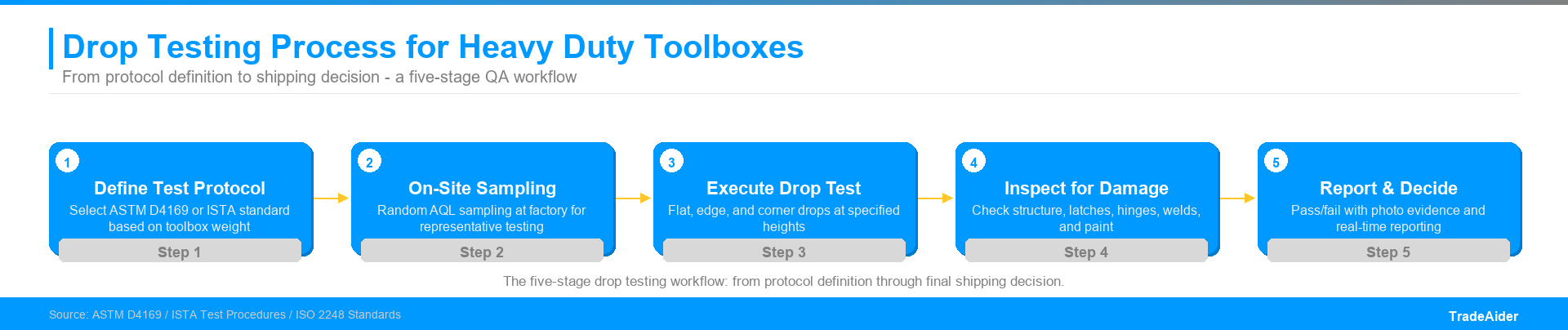
The five-stage drop testing workflow: from protocol definition through final shipping decision, each step builds on the previous to ensure toolboxes survive real-world logistics.
Building a Drop Test Protocol for Your Toolboxes
Selecting the Right Test Standard
Not all toolboxes need the same test. Here is how to choose:
| Toolbox Type | Recommended Standard | Key Test Parameters |
|---|---|---|
| Portable hand-carry toolbox (under 10 kg) | ISTA 3A | 76 cm drop height, 10 orientations |
| Rolling toolbox (10-30 kg) | ASTM D4169 DC-13 | 61 cm drop height, rotational flat drops |
| Heavy duty chest (30+ kg) | ASTM D4169 DC-13 + ISO 2248 | 46 cm drop height, edge and corner impact |
| Tool cabinet (wheeled unit) | ISTA 3E | Unitized load testing, vibration + drop |
Defining Pass/Fail Criteria
Vague pass/fail criteria defeat the purpose of testing. Before your inspector arrives at the factory, define exactly what constitutes a failure. Here is a practical framework:
- Critical failure (automatic reject) — Any structural crack or fracture; latch mechanism that cannot secure the lid; hinge separation from the body.
- Major defect (conditional accept) — Dents deeper than 3 mm on any face; paint chipping larger than 5 mm diameter; wheels that do not rotate freely after testing.
- Minor defect (acceptable) — Surface scratches under 20 mm; paint scuffs that do not expose bare metal; minor cosmetic marks on packaging.
These thresholds should be documented in your inspection checklist and shared with both the factory and your inspection partner. Use the AQL calculator to determine how many samples to test based on your order quantity and acceptable quality level.
Common Drop Test Failures and How to Fix Them
After dozens of toolbox inspections, certain failure patterns repeat. Knowing these in advance helps you brief your factory and prevent issues before the first sample is made:
- Corners cracking at weld joints — This is the single most common failure in steel toolboxes. The fix is usually a wider weld bead or an internal corner reinforcement bracket. Ask your factory to add a fillet weld rather than a spot weld at high-stress corners.
- Latches bending or jamming — Die-cast zinc latches often deform under impact. Upgrading to stainless steel latch hardware or adding a rubber buffer pad behind the latch plate absorbs impact energy.
- Drawers jumping their tracks — Drawer slides without positive stops allow drawers to dislodge during drops. The fix is a simple metal tab or spring-loaded detent at the end of each slide.
- Paint chipping at edges — Powder coating adheres well to flat surfaces but can chip at sharp edges. A slight radius (0.5 mm minimum) on all edges before powder coating significantly improves chip resistance.
- Packaging collapse — Single-wall corrugated boxes with minimal internal padding cannot protect a 50 lb toolbox. Switch to double-wall corrugated, add molded EPS foam corner protectors, and ensure the toolbox cannot shift inside the box.
When your inspector identifies these failures during a pre-shipment or during-production inspection, you can work with the factory on corrective actions immediately — before the entire order is produced with the same defect.
Frequently Asked Questions
What drop test standard should I use for heavy duty toolboxes?
ASTM D4169 DC-13 is the most appropriate standard for heavy duty toolboxes shipped via standard freight distribution. It covers drop testing, impact resistance, and vibration — the three hazards most likely to damage a heavy steel toolbox in transit. Supplement with ISO 2248 if your destination market or retailer requires additional vertical impact certification.
How many samples should be drop tested during an inspection?
For most toolbox orders, drop testing 3-5 samples from the production lot is sufficient to identify systemic issues. Use AQL sampling to determine the exact number: for an order of 2,000 units at AQL 2.5 Level II, you would typically pull 125 samples for visual inspection, and from those, select 3-5 for destructive drop testing. The tested units are written off — they cannot be sold after impact testing.
Can I witness the drop test remotely?
Yes. TradeAider provides real-time inspection reporting through its online platform, so you can see photos and video of each drop test as it happens. You can communicate directly with the inspector during the test to adjust drop heights, request additional orientations, or focus on specific areas of concern. This eliminates the multi-day wait typical of traditional inspection reports.
How much does drop testing add to an inspection?
Drop testing is typically included as part of a standard pre-shipment inspection at TradeAider's rate of $199 per man-day. The factory is responsible for providing the test samples and a suitable testing area. There is no additional per-test fee — the inspector performs the drops, documents the results, and includes everything in the inspection report.
What if my toolbox fails the drop test?
If samples fail, your inspector documents the specific failure mode (which corner cracked, which latch bent, at what drop height) with photos and measurements. You then share this data with the factory to implement corrective actions — reinforcing welds, upgrading hardware, or improving packaging. After corrections are made, schedule a re-inspection to verify the fixes work before approving shipment. Contact our team to schedule your next inspection.
Verwandte Artikel


Erweitern Sie Ihr Unternehmen mit TradeAider Service
Klicken Sie auf die Schaltfläche unten, um direkt in das TradeAider Service System zu gelangen. Die einfachen Schritte von der Buchung und Zahlung bis zum Erhalt der Berichte sind leicht zu bedienen.

