
- Über uns

- Unsere Dienstleistungen
- Ihre Branche
- Ressourcen
- Nachrichten & Blog
A product quality check is a structured verification that a product matches defined requirements before it reaches the customer or leaves the supplier's control. For importers, it should compare the shipment against the approved sample, specifications, function requirements, packaging rules, compliance evidence, and defect limits.
Quality checks sit inside broader quality management. ASQ distinguishes quality assurance from quality control by explaining that assurance builds confidence requirements will be fulfilled, while control focuses on fulfilling those requirements through operational activities. A product quality check is a control activity, but it is only useful when it is connected to the assurance work done before production.
ISO 9001 describes quality management as a system for meeting customer expectations and improving performance. In importer language, that means the product check should not ask only whether the item looks acceptable; it should ask whether the product being shipped matches what the buyer promised customers.
The word check sounds simple, which is why many importers under-specify it. A serious product quality check has a scope, timing, sampling method, defect classification, evidence format, and release rule.
- A quality check needs a reference: inspect against a specification, approved sample, standard, or contract, not memory.
- It includes more than appearance: function, measurement, assembly, labels, packaging, quantity, and documents can all matter.
- Sampling has limits: AQL supports lot decisions, but it does not guarantee every unit is defect-free.
- The output should be a decision: release, hold, sort, rework, retest, or reinspect.
What Is a Product Quality Check?
A product quality check is a planned inspection or test that compares products against defined requirements, such as specifications, approved samples, standards, functional expectations, packaging rules, and acceptable defect limits, before the buyer accepts or releases the goods.
For an importer, the definition should include three parts: the requirement, the method, and the consequence. The requirement says what the product must meet. The method says how the inspector checks it. The consequence says what happens if the result is not acceptable.
Sampling is often part of the method. ISO 2859-1 supports lot-by-lot sampling plans indexed by AQL, which helps buyers avoid arbitrary sample sizes. The important point is not the acronym; it is that the buyer chooses a sample and acceptance rule before the report is written.
Inspection quality also depends on the provider. ISO/IEC 17020 emphasizes competence, impartiality, and consistent inspection activity. Even when a buyer uses a commercial inspection provider rather than a formally accredited body, those principles help define what a reliable product quality check should look like.
What a Product Quality Check Should Verify
A complete product check turns the buyer's requirement file into inspection evidence.
| Check Area | What to Verify | Evidence to Capture | Common Miss |
|---|---|---|---|
| Identity | SKU, model, color, size, version, batch, and carton group | Product, label, barcode, carton photos | Supplier ships a different version |
| Appearance | Workmanship, surface defects, color, trim, contamination | Defect photos and sample comparison | Defects classified without buyer tolerance |
| Measurement | Dimensions, weight, thickness, capacity, fit | Measurement photos and tool readings | Tolerance missing from specification |
| Function | Use test, assembly, accessories, electronics, moving parts | Test photos, result counts, failed samples | Only one demonstration unit is checked |
| Packaging | Retail box, inserts, carton mark, quantity, protection | Packout photos and carton count | Product is good but packout is wrong |
| Compliance evidence | Labels, warnings, certificates, test report references | File reference and label photos | Inspection treated as lab testing |
This table also clarifies what a product quality check cannot do. It cannot prove chemical composition by sight, replace electrical safety testing, or solve a missing certificate. It can confirm whether the shipped product and packaging match the evidence file and buyer requirement.
A useful report should separate observed defects from missing evidence. A cracked housing, wrong barcode, and missing test-report reference are different problems. The buyer may release, hold, sort, rework, or retest depending on which problem appears and how concentrated it is.
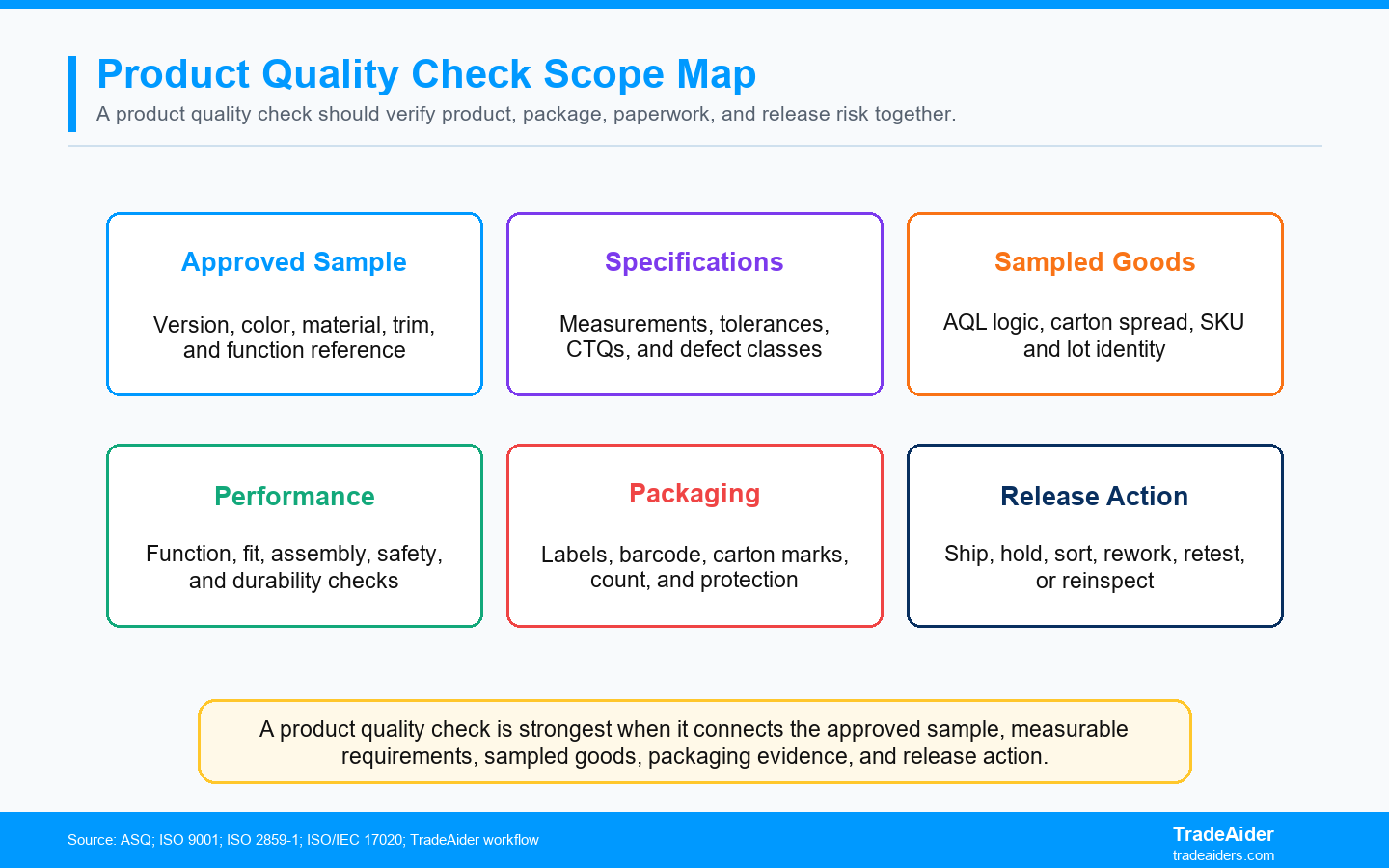
A product quality check is strongest when it connects the approved sample, measurable requirements, sampled goods, packaging evidence, and release action.
A Product Quality Check Is Not the Same as a Quick Visual Look
Visual inspection is only one part of the check; the real value is requirement-based verification.
The requirement file should define what good means
A product quality check begins before the inspector arrives. The buyer should provide the PO, specification, approved sample, artwork, packaging file, defect classification, AQL level, and any special function or measurement requirements. If the buyer cannot define good, the inspector can only describe what is seen.
This is especially important for private-label products. The end customer may judge color shade, logo placement, material feel, label accuracy, and package condition more strictly than the factory. The quality check should reflect the buyer's sales promise, not only the supplier's internal standard.
The inspection method should match product risk
Low-risk hard goods may need appearance, measurement, count, and packaging checks. Electronics may need function, accessory, charging, label, and safety-file checks. Soft goods may need stitching, shade, measurements, odor, fabric defects, and packing assortment checks. The check should change with the product.
A practical method also names the sample spread. For multi-SKU orders, the inspector should check across colors, sizes, carton groups, and production dates. If all samples come from the easiest cartons, the check may miss the subgroup that creates returns.
The method should also state what is not being proven. For example, a simple on-site power-on check does not prove long-term battery safety, and a carton count does not prove chemical compliance. Naming these limits makes the report more trustworthy because the buyer can decide whether testing, sorting, or a tighter inspection scope is needed.
Quality Checks Should Find Both Product Defects and Evidence Gaps
A clean-looking product can still be a release risk if the label, report, barcode, or carton identity is wrong.
Evidence gaps can block shipment or sales
Importers often think defects are physical. In practice, evidence gaps can be just as expensive. A product may look correct but lack the required warning label, use an outdated barcode, show the wrong importer address, reference the wrong SKU, or ship in cartons that cannot be matched to the PO.
The product quality check should therefore include identity evidence. The inspector should photograph product labels, retail boxes, carton marks, barcodes, care labels, warning labels, and any document references that the buyer needs to verify before release.
Evidence gaps should be classified separately from workmanship defects so the buyer does not make the wrong remedy. A scuffed product may need sorting or replacement; a mismatched barcode may need relabeling; a missing compliance file may require testing or document correction before the shipment can be sold. The action path changes with the evidence gap.
Testing and inspection should be coordinated, not confused
For regulated products, the FDA QMSR overview is a useful reminder that applicable requirements and specifications may require a quality system, not only a final check. That source is specific to FDA-regulated products, but the importer lesson is broader: inspection and testing evidence must be appropriate to the risk.
A factory inspection can confirm that the product being shipped matches the tested version, but it normally cannot prove hidden chemical, electrical, microbiological, or performance claims unless the scope includes relevant testing. Buyers should plan lab testing and on-site inspection as complementary controls.
The Best Quality Check Ends With an Action Rule
A report should tell the buyer not only what was found, but what choices are supported by the evidence.
Defect concentration changes the decision
The same total defect count can mean different actions. If defects are random and below the acceptance number, the buyer may release with monitoring. If defects are concentrated in one size, color, production date, or carton group, the buyer may hold only that group for sorting or rework.
An action rule prevents overreaction and underreaction. It tells the buyer when to ship, hold, sort, rework, retest, or reinspect. It also gives procurement and logistics a shared basis for negotiating with the factory instead of arguing from opinions.
The report should therefore record location, quantity, and lot identity for each repeated issue. Without those details, the buyer may hold the entire shipment unnecessarily or release a subgroup that should have been isolated. Product quality checks create value when they narrow the remedy to the actual risk.
Scenario estimates make defect counts meaningful
Imagine a 10,000-unit order with a repeated functional issue in 1.2% of sampled units. If that pattern holds, about 120 units may create return or complaint risk. At only $9 in handling, replacement, and service cost per affected unit, the visible exposure is $1,080 before reputation or lost review impact.
The estimate is not a claim that exactly 120 units will fail. It is a decision aid. It helps the buyer compare the cost of shipment delay, sorting, rework, discount negotiation, or customer returns.
Where TradeAider Fits in Product Quality Checks
TradeAider helps importers convert product requirements into inspection evidence before the goods leave supplier control.
TradeAider can run Pre-Shipment Inspection to verify finished goods, packaging, labels, quantity, function, measurements, and defect counts before shipment release.
When the product has safety, chemical, electrical, material, or certification risk, TradeAider can help buyers coordinate evidence through product testing services and match inspection findings to the tested product version.
For buyers still defining acceptance rules, AQL calculator guidance and inspection standard guidance can help translate product risk into sample size, defect classes, and release decisions.
SPAR Scenario: The Product Passed Appearance, but Failed the Packout Check
The buyer avoided a warehouse problem by treating packaging identity as part of product quality.
Situation: An Amazon seller orders 6,500 home organization products with two barcode versions for different sales channels.
Problem: The products look acceptable, but the PSI finds 18% of cartons packed with the wrong barcode sticker for the destination channel.
Action: The buyer asks TradeAider to sample additional cartons, photograph carton groups, and confirm whether the issue is limited to one packing shift.
Result: The factory relabels the affected cartons before shipment, preventing receiving delays and marketplace inventory confusion after arrival.
Product Quality Check Checklist Before Shipment
Use this checklist when turning a product requirement into a factory inspection scope.
- Attach the PO, specification, approved sample, artwork, and defect rules.
- Define critical, major, and minor defects before inspection day.
- Check identity, appearance, measurement, function, packaging, and documents.
- Sample across SKU, carton, size, color, and production-date groups.
- Separate physical defects from missing or mismatched evidence.
- Decide release, hold, sort, rework, retest, or reinspection rules.
A product quality check should be short enough for the factory to execute and specific enough for the buyer to defend. When the report arrives, the next action should be obvious.
If the buyer still needs a long meeting to decide what the report means, the inspection scope was probably incomplete. Add the missing release rule before the next order so the same ambiguity does not repeat.
If your order has sample, function, label, barcode, packaging, or compliance-evidence risk, send TradeAider the requirement file, approved sample photos, PO, packing status, and defect concerns. The next step is to request a product quality check before shipment.
Frequently Asked Questions
What is a product quality check in manufacturing?
A product quality check is a planned inspection or test that compares products against defined requirements before the buyer accepts, releases, or ships the goods.
Is a product quality check the same as QC?
A product quality check is one QC activity. QC also includes the broader operational techniques used to verify and fulfill quality requirements across production.
What should be included in a quality check?
Include product identity, appearance, measurements, function, packaging, labels, quantity, documents, defect classes, sampling method, and a release rule.
Can a quality check guarantee zero defects?
No. Sampling-based checks reduce risk but cannot guarantee every unit is defect-free. Higher-risk products may need tighter sampling, testing, sorting, or 100% checks.
When should importers run product quality checks?
Run checks before production for readiness, during production for process drift, and before shipment for final release evidence on the packed lot.

Verwandte Artikel

Erweitern Sie Ihr Unternehmen mit TradeAider Service
Klicken Sie auf die Schaltfläche unten, um direkt in das TradeAider Service System zu gelangen. Die einfachen Schritte von der Buchung und Zahlung bis zum Erhalt der Berichte sind leicht zu bedienen.

