
- Über uns

- Unsere Dienstleistungen
- Ihre Branche
- Ressourcen
- Nachrichten & Blog
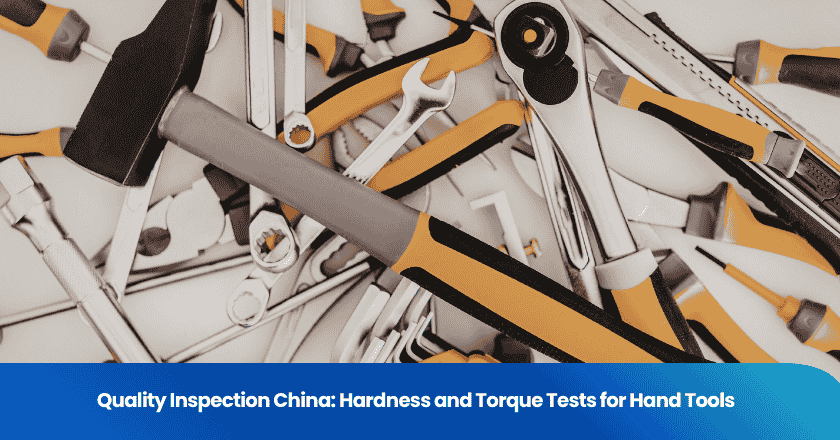
When a wrench rounds off on a stubborn bolt or a screwdriver tip deforms on the first use, the problem almost always traces back to one of two things: inadequate hardness or insufficient torque strength. These are the two fundamental mechanical properties that determine whether a hand tool performs reliably — and they're also the two properties most frequently compromised when factories in China cut corners on material specifications.
If you're importing wrenches, screwdrivers, pliers, sockets, or other hand tools from China, hardness and torque testing should be non-negotiable parts of your quality inspection program. This guide explains what these tests measure, which standards apply, and how to implement them at the factory level.
Key Takeaways
- Rockwell hardness (HRC) is the primary metric for evaluating hand tool material quality — it measures resistance to permanent deformation
- Torque testing per ISO 6789 verifies that wrenches and drivers deliver accurate, consistent force throughout their rated cycle life
- On-site hardness testing at the factory catches material substitution before shipment — the most common quality failure in hand tools
- A comprehensive hand tool inspection costs $199 per man-day with real-time reporting
Why Hardness and Torque Testing Matters for Hand Tools
The Consequences of Inadequate Hardness
A wrench manufactured with steel that's too soft will round off under load. A screwdriver tip with insufficient hardness will cam out or deform. Pliers that haven't been properly heat-treated will lose their gripping edge after moderate use. These failures aren't just inconvenient — they're dangerous. A socket that shatters under torque can send metal fragments flying. A hex key that rounds off inside a fastener creates a situation that requires drilling or grinding to resolve.
The root cause is almost always material substitution or improper heat treatment. Many factories in China source chrome vanadium (Cr-V) or chrome molybdenum (Cr-Mo) steel from secondary suppliers. When material costs rise, some factories quietly switch to a lower-grade steel alloy or reduce heat treatment time to save energy. The tool looks identical — same finish, same stamping — but the mechanical properties don't meet specification. Only hardness testing can detect this.
An Amazon FBA seller importing 10,000 combination wrench sets from Shandong province discovered this the hard way. Customer reviews started reporting rounded wrench openings within the first month. Investigation revealed the factory had used 40Cr steel instead of the specified 50Cr-V alloy — a difference of 5-8 HRC points that cost the seller $28,000 in returns and listing damage. A $199 hardness test during pre-shipment inspection would have caught it immediately.
Why Torque Specifications Matter
Torque is the rotational force a tool can apply or withstand. For torque wrenches, the critical spec is accuracy — does the tool click at the rated torque value? For fixed hand tools like wrenches and sockets, it's yield strength — at what torque does the tool permanently deform or break?
ISO 17025:2017 calibration standards define how torque tools should be tested and certified. For importers, the key takeaway is that torque accuracy isn't just a factory claim — it's a measurable property that must be verified with calibrated testing equipment. A torque wrench that clicks at 85 Nm when it's rated for 80 Nm may seem close, but that 6.25% deviation exceeds the ±4% tolerance that most professional users expect.
Understanding Hardness Testing for Hand Tools
Rockwell Hardness (HRC) — The Industry Standard
The Rockwell hardness test is the most widely used method for evaluating hand tool hardness. It works by pressing a diamond-tipped indenter (for HRC scale) into the tool surface under two loads — a minor load to establish a reference position, then a major load to create an indentation. The hardness value is calculated from the depth difference between the two loads.
The HRC scale (Rockwell C) is the standard for hardened steel tools. Key characteristics:
- Quick and non-destructive — Each test takes seconds and leaves only a microscopic indentation
- Direct reading — The machine displays the hardness value immediately
- Portable testing available — Handheld Rockwell testers can be used at the factory during inspection
- Widely calibrated — Standard test blocks verify machine accuracy before each session
What HRC Values Mean for Different Tools
Different hand tools require different hardness ranges depending on their intended use. Too hard and the tool becomes brittle; too soft and it deforms under load:
| Tool Type | Typical HRC Range | Why This Range |
|---|---|---|
| Socket wrenches | 40-48 HRC | High torque resistance with some flexibility |
| Combination wrenches | 40-46 HRC | Balance of hardness and toughness |
| Screwdriver bits | 58-62 HRC | Maximum surface hardness for wear resistance |
| Pliers (cutting edges) | 55-62 HRC | Sharp, durable cutting surfaces |
| Hex keys / Allen keys | 44-50 HRC | Resist rounding under high torque |
| Hammers (face) | 50-58 HRC | Hard enough to resist deformation, not brittle |
Other Hardness Scales: Brinell and Vickers
While Rockwell C (HRC) is the standard for hardened tools, other scales are used for specific applications:
- Brinell (HB): Used for softer materials and larger components. Brinell testing applies a larger ball indenter, making it suitable for raw steel billets and unfinished forgings before heat treatment.
- Vickers (HV): Used for very thin cross-sections and surface coatings. Vickers testing is common for evaluating case-hardened surfaces where the hardened layer is only 0.1-0.5 mm thick.
- Rockwell B (HRB): Used for annealed or soft steels before heat treatment. This helps verify that the raw material grade is correct before the factory invests in processing.
Torque Testing: Verifying Mechanical Performance
Torque Testing Standards
ISO 6789 is the international standard for hand torque tools, defining calibration requirements, testing procedures, and acceptable accuracy tolerances. The standard specifies that torque tools should be calibrated every 5,000 cycles or six months, whichever comes first. For importers, this standard provides the benchmark for evaluating whether a torque wrench from China meets professional-grade performance.
ASME B107 series standards cover the design, testing, and performance requirements for hand tools including wrenches, sockets, and screwdrivers sold in the US market. Key ASME standards include:
- ASME B107.100: General requirements for hand tools
- ASME B107.110: Socket wrenches and attachments
- ASME B107.210: Adjustable wrenches
- ASME B107.300: Torque instruments
What Torque Tests Reveal
Torque testing for hand tools falls into two categories:
Torque accuracy testing (for torque wrenches and torque screwdrivers): The tool is tested against a calibrated reference at multiple points across its rated range — typically 20%, 60%, and 100% of maximum capacity. Each point is tested multiple times to verify both accuracy and repeatability. ISO 6789 requires accuracy within ±4% for Type II tools (most common click-type wrenches).
Torque strength testing (for fixed wrenches, sockets, and hex keys): The tool is subjected to increasing torque until it either meets the minimum rated strength or fails. This test verifies that the material and heat treatment can handle real-world loads. Failure modes include permanent deformation (opening spread on wrenches), cracking (sockets), and tip rounding (hex keys).
Calibration Requirements
Torque testing is only as reliable as the calibration of the testing equipment. Your inspection partner should use torque analyzers calibrated to ISO 17025 standards with current calibration certificates. For on-site factory inspections, portable digital torque testers with ±1% accuracy are standard. For more rigorous requirements, laboratory-grade torque calibration benches provide ±0.5% accuracy.
What a Hand Tool Inspection Covers
A comprehensive hand tool inspection combines visual checks, dimensional verification, hardness testing, and functional torque tests:
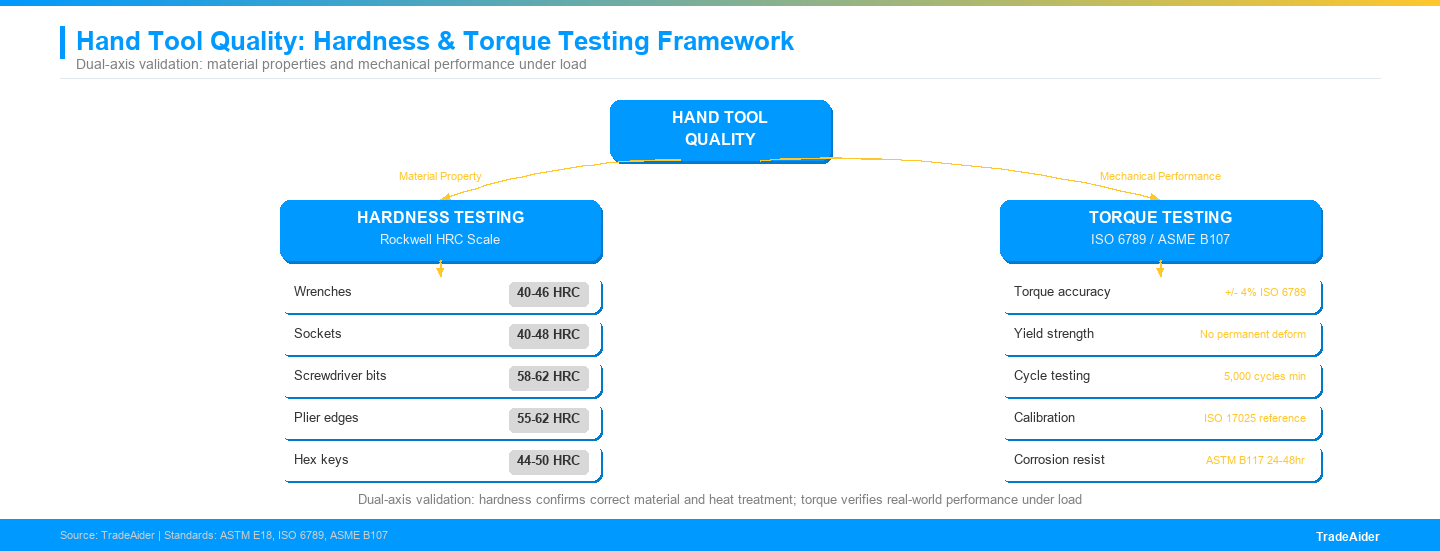
Dual-axis testing framework: hardness validates material quality while torque verifies mechanical performance under load
On-Site Factory Testing
During a pre-shipment inspection at the factory, the inspector performs:
- Rockwell hardness spot checks: Testing 5-10 units per batch at critical points (wrench jaw faces, screwdriver tip, plier cutting edge) using a portable Rockwell tester
- Torque strength verification: Applying rated torque to wrenches and sockets using a calibrated torque wrench and checking for permanent deformation
- Open-close cycling: 50 cycles on adjustable wrenches, ratchets, and pliers to verify smooth operation and wear resistance
- Dimensional checks: Verifying jaw opening, socket depth, hex key size, and overall length against specifications using calipers and gauges
- Surface finish inspection: Checking chrome plating for flaking, blistering, or uneven coverage
- Marking and labeling: Verifying size markings, brand stamps, and material grade designations
With TradeAider's pre-shipment inspection service, all test results are reported in real-time through the online platform. You see hardness readings, torque values, and pass/fail determinations as the inspection happens.
Lab Testing for Material Properties
Some properties require laboratory analysis beyond on-site capabilities:
- Full material composition analysis (spectrometer testing): Verifies the exact steel alloy — essential when you specify Cr-V, Cr-Mo, or S2 steel
- Microstructure examination: Confirms proper heat treatment through metallographic analysis
- Salt spray corrosion testing: Evaluates chrome plating durability per ASTM B117 — typically 24-48 hours for standard chrome, 72+ hours for professional grade
- Magnetic particle inspection: Detects surface and near-surface cracks in forged tools
Your inspection partner can extract samples during the PSI and coordinate lab submission. Learn more about product testing services for hand tools.
How to Build Your Hand Tool QC Program
- Specify your hardness requirements in the purchase order. Don't just say "Cr-V steel." Specify the exact HRC range (e.g., "40-46 HRC for wrench bodies, 58-62 HRC for screwdriver bits"). This gives the inspector a clear pass/fail criterion.
- Require a pre-production hardness sample. Before mass production begins, have the factory produce 3-5 sample units and send them for hardness testing. A PPI with sample verification confirms the factory is using the correct material and heat treatment process.
- Include hardness spot-checks in every PSI. Add Rockwell hardness testing to your standard inspection checklist. Test a minimum of 5 units across the batch at the critical points identified in your specification.
- Verify torque accuracy on torque wrenches. If you're importing torque wrenches or torque screwdrivers, include ISO 6789 compliance verification in the inspection. Test at 20%, 60%, and 100% of rated capacity with ±4% tolerance.
- Commission lab tests for new suppliers. For the first 2-3 orders from a new factory, send samples for full material composition analysis and microstructure examination. This builds a baseline of trust.
TradeAider's hand tool inspection service includes on-site hardness testing with portable Rockwell testers at $199 per man-day, with no hidden fees. Get a free quote for your hand tool inspection — detailed responses within 2 hours during business hours.
Frequently Asked Questions
What is the Rockwell hardness test and why does it matter for hand tools?
The Rockwell hardness test measures a material's resistance to permanent indentation by pressing a diamond-tipped indenter into the surface under a controlled load. For hand tools, HRC (Rockwell C scale) is the standard metric. A tool that's too soft will deform under use; too hard and it becomes brittle and may shatter. Specifying and verifying HRC values ensures the factory is using the correct steel alloy and heat treatment process.
How do I know what HRC range my hand tools need?
It depends on the tool type and application. Combination wrenches typically require 40-46 HRC, screwdriver bits need 58-62 HRC, and plier cutting edges require 55-62 HRC. Higher hardness provides better wear resistance but reduces toughness. If you're unsure, reference ASME B107 standards for your specific tool type or ask your inspection partner for category-specific guidance.
Can hardness testing be done at the factory during inspection?
Yes. Portable Rockwell hardness testers can be used on-site at the factory during a pre-shipment inspection. The inspector performs spot-checks on sampled units at critical points (wrench jaws, screwdriver tips, plier edges) and records the readings directly in the inspection report. This catches material substitution immediately — before the shipment leaves China.
What is ISO 6789 for torque tools?
ISO 6789 is the international standard that defines how hand torque tools (torque wrenches, torque screwdrivers) should be designed, tested, and calibrated. It specifies accuracy requirements (±4% for most common types), testing procedures (multiple measurements at 20%, 60%, and 100% of rated capacity), and calibration intervals (every 5,000 cycles or 6 months). When importing torque tools from China, ISO 6789 compliance verification should be part of your inspection checklist.
How much does hand tool inspection cost in China?
On-site inspection with hardness and torque testing costs $199 per man-day with TradeAider. For orders under 5,000 units, one man-day covers the full inspection including AQL sampling, hardness spot-checks, torque verification, dimensional checks, and surface finish inspection. Lab testing for material composition, microstructure, and corrosion resistance is additional and depends on the specific tests required.
Verwandte Artikel


Erweitern Sie Ihr Unternehmen mit TradeAider Service
Klicken Sie auf die Schaltfläche unten, um direkt in das TradeAider Service System zu gelangen. Die einfachen Schritte von der Buchung und Zahlung bis zum Erhalt der Berichte sind leicht zu bedienen.

